


 PLATFORM UPDATE:


Structural, electronic, and gas adsorption properties of Nin (n = 1–20) atomic clusters

Abstract
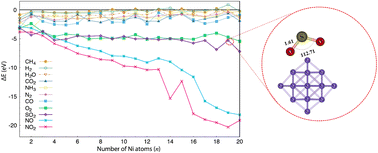
Nickel clusters have drawn considerable interest because of their distinctive structural and electronic characteristics, which differ significantly from those of their bulk-material counterparts. In this work, we investigate the structures of Ni metal atomic clusters (Nin, n = 1–20) in neutral charge state. We also explore how these clusters interact with a range of gases such as CO, CO2, CH4, NO, NO2, NH3, H2, H2O, N2, O2, and SO2, and compute the adsorption energies, in an effort to assess their potential exploitation in sensing materials. The geometries of the clusters are optimized, and the adsorption energies are calculated using the Density Functional Theory (DFT) method at the B3LYP-GD3BJ/LANl2DZ level of theory. Indicators, including cohesive energy, HOMO–LUMO energy gap, dissociation energy, and conceptual DFT analysis descriptors, show that the stability of these clusters increases with increasing size. Ni19 was found to be the most stable cluster among those that we studied, having the highest binding energy and a compact icosahedral geometry. As the size of the clusters increased, the cohesive energy increased, while the HOMO–LUMO gap decreased, indicating a transition from molecular to metallic behavior. The calculated adsorption energies revealed weak physisorption (0 to −1 eV) for CH4, H2, H2O, and N2, and strong chemisorption (−4 to −20 eV) for O2, NO, NO2, and SO2, with NO and NO2 binding most strongly on Nin, for n = 16–19. Charge analysis indicates greater electron transfer and partial covalent bonding for the strongly adsorbed gases.
 Please wait while we load your content...


