


 PLATFORM UPDATE:


Research on the regulation of osteogenic differentiation and mechanotransduction by porous bionic coatings on titanium alloy implant surfaces
 *d
and
*d
and
Abstract
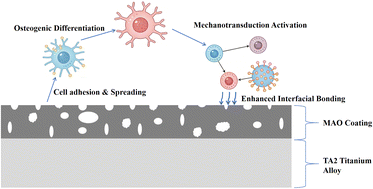
To elucidate the mechanism underlying micro-arc oxidation (MAO) coatings in bone regeneration, biomimetic coatings with different surface roughness were fabricated on titanium alloy substrates via MAO, and their effects on osteogenic differentiation and mechanotransductive signaling were investigated. The prepared hydroxyapatite (HA)-containing MAO coating exhibited a porous micro-nano structure, with porosity and micro-roughness ranging from 28.1% to 38.6% and 9.3 to 15.8 µm, respectively. Cell experiments demonstrated that the coating with a porosity of 35.6% and a roughness of 15.8 µm significantly promoted cell adhesion, proliferation, and osteogenic differentiation (with a 76.0% increase in alkaline phosphatase activity relative to the NC group), while upregulating the expression of downstream target genes YAP1, Runx2 and OCN. Micro-CT results revealed that the 500 V coating group exhibited a 30.9% increase in bone volume fraction and an 81.3% elevation in trabecular thickness relative to the NC group, with the bone-implant contact ratio showing a corresponding 44.6% enhancement. Histological analysis further confirmed that the elevated porosity and surface roughness facilitated the tight encapsulation of the porous coating structure by newly formed bone tissue. Bond strength testing revealed that the 500 V coating group achieved an interfacial bond strength of 33.2 N after 42 days in vivo, representing a 55.87% increase compared with the NC group. This study elucidated the influence of surface roughness on osseointegration, providing a theoretical basis for optimising the surface microstructure of implant materials.
 Please wait while we load your content...


