


 PLATFORM UPDATE:


A new hybrid bismuth chloride semiconductor (C5H7BrN3)6(BiCl5)3: powder XRD, optical properties, and DFT investigation

Abstract
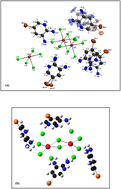
In this work, we report the synthesis and characterization of the new hybrid inorganic–organic compound (C5H7BrN3)6(BiCl5)3, which crystallizes in the triclinic space group P![[> with combining macron]](https://www.rsc.org/images/entities/char_003e_0304.gif) 1. The crystal structure, determined from X-ray powder diffraction, reveals an asymmetric unit built from one [Bi2Cl10]4− dimer, one independent [BiCl5]2− anion, and six neutral 2,3-diamino-5-bromopyridinium molecules. This arrangement highlights the coexistence of distinct bismuth chloride units stabilized by an extensive network of hydrogen bonding and electrostatic interactions with the organic moieties. Density Functional Theory (DFT) calculations performed at the B3LYP/LANL2DZ level provide optimized structural parameters and vibrational assignments consistent with the experimental IR spectrum recorded in the 400–4000 cm−1 range. The optical properties investigated via solid-state UV-vis diffuse reflectance reveal an indirect bandgap of 2.6 eV, confirming the semiconducting behavior of the material. The combination of structural features, optical response, and theoretical insights underscores the potential of (C5H7BrN3)6(BiCl5)3 as a promising hybrid material for semiconductor and optoelectronic applications.
1. The crystal structure, determined from X-ray powder diffraction, reveals an asymmetric unit built from one [Bi2Cl10]4− dimer, one independent [BiCl5]2− anion, and six neutral 2,3-diamino-5-bromopyridinium molecules. This arrangement highlights the coexistence of distinct bismuth chloride units stabilized by an extensive network of hydrogen bonding and electrostatic interactions with the organic moieties. Density Functional Theory (DFT) calculations performed at the B3LYP/LANL2DZ level provide optimized structural parameters and vibrational assignments consistent with the experimental IR spectrum recorded in the 400–4000 cm−1 range. The optical properties investigated via solid-state UV-vis diffuse reflectance reveal an indirect bandgap of 2.6 eV, confirming the semiconducting behavior of the material. The combination of structural features, optical response, and theoretical insights underscores the potential of (C5H7BrN3)6(BiCl5)3 as a promising hybrid material for semiconductor and optoelectronic applications.
 Please wait while we load your content...


