


 PLATFORM UPDATE:


Excited-state intramolecular charge transfer dynamics in 4-methoxy-4′-nitrostilbene: excitation wavelength and solvent dependence

Abstract
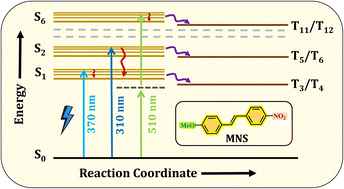
We present a detailed study of the excited-state dynamics of 4-methoxy-4′-nitrostilbene (MNS), a donor–acceptor chromophore, focusing on the effects of solvent polarity, viscosity, and excitation energy. Steady-state spectroscopy reveals strong intramolecular charge transfer (ICT) behavior, with solvatochromic shifts and large Stokes shifts in polar solvents. Time-resolved fluorescence measurements show that both polarity and viscosity enhance ICT state stabilization by extending emissive state lifetimes. Femtosecond transient absorption measurements in toluene and acetonitrile reveal distinct spectral features and relaxation dynamics upon excitation at different wavelengths. In the case of toluene, 370 and 310 nm excitations lead to efficient intersystem crossing (ISC) as depicted by a strong and persistent excited state absorption (ESA) band at ∼600 nm. In case of acetonitrile, ISC is slower, and very weak ESA associated with a triplet state is observed under the same excitations. While in the case of 510 nm excitation, ESA band at 540 nm is stable, and does not exhibit any spectral shift in both the solvents, a clear indication of inefficient ISC and relaxation essentially occurs through a different pathway. The experimental observations are well corroborated with computational analysis carried out using time-dependent density functional theory. These findings highlight tunable excited-state behavior in donor–acceptor systems for photonic applications.
 Please wait while we load your content...


