Ofei D. Mante
*,
David C. Dayton and
Mustapha Soukri
RTI International, Energy Technology Division, 3040 East Cornwallis Road, Research Triangle Park, NC 27709, USA. E-mail: omante@rti.org; Tel: +1-919-541-6202
First published on 27th September 2016
Value-added chemicals present in liquid products from direct liquefaction of biomass can be recovered as bioproducts in an integrated biorefinery to enhance the economic viability of biomass-to-liquid fuel technologies and afford a higher return on investment. In recent efforts, RTI International is exploring and developing processes that could be used to produce bioproducts in addition to liquid fuel from biocrude intermediates. The present study focused on the production and recovery of high-value lignin-derived compounds from biocrude. Catalytic pyrolysis with a nonzeolite, alumina-based catalyst was used to produce the biocrude from loblolly pine in RTI's 1-tonne per day pilot-scale plant. Distillation was evaluated as a potential separation method given that the biocrude is relatively thermally stable and distillable compared to raw pyrolysis oils. The distillation studies were performed with a laboratory distillation unit (PETRODIST 300 CC) and the biocrude was fractionated into four distillate cuts: cut 1 (IBP-110 °C), cut 2 (110–200 °C), cut 3 (200–300 °C), and cut 4 (300–400 °C). In a case study, cut 3 was distilled further to concentrate the lignin-derived chemicals boiling between 200 and 270 °C. The results showed that a biocrude containing about 10 wt% guaiacols could be concentrated to about 35 wt% of guaiacols (representing 75% recovery) in the first distillation step. The second distillation step increased the concentration of guaiacols to about 53 wt% (representing 80% recovery). These findings suggest that it is possible to isolate and concentrate the lignin-derived products using a distillation column with a number of plates/trays. The yields, physicochemical properties, and chemical composition of the fractions, as well as the overall distillation separation efficiency, are reported.
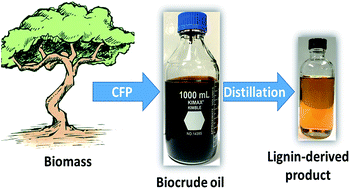
Biomass pyrolysis is one of the promising technology options available for producing biobased fuels and chemicals. Uniquely, the liquid product (bio-oil) from biomass fast pyrolysis contains numerous oxygenated compounds3,4 that are not easily synthesized from petroleum feedstocks, such as, aldehydes, ketones, alcohols, esters, anhydrosugars, furans, phenols, guaiacols, syringols, and large molecular weight oligomers.5,6 Importantly, some of these compounds could be recovered as specialty chemicals or as building blocks for synthesis of other bio-based products. A number of the chemicals have ready markets and could be used to improve the environmental performance of similar products obtained from petroleum-based sources. Strategically, these chemicals could be produced alongside biofuels to enhance the economic viability of biomass-to-liquid fuel technologies and afford a higher return on investment7 as it is being practiced in the petroleum industry. Therefore, it is vital to develop efficient separation technologies for recovery of high-value chemicals from the liquid products of direct biomass liquefaction processes.
The recovery of chemicals from bio-oils has been extensively studied over the past several years. Many previous studies have explored options of extracting high-value chemicals from bio-oils.8,9 For example, the British Columbia Research Corporation developed a method for extraction and recovery of levoglucosan at high purity.10 The recovery of acetol, phenols, hydroxyacetaldehyde, and glyoxal have also been studied by other research groups.8,9 In fact, several attempts have been made to recover phenolic compounds from bio-oil.11–19 Fractionation of bio-oil into different streams of similar functionalities has indeed enhanced chemical recovery.12,20–23 Nevertheless, many of these efforts have not yet resulted in the production of a marketable chemical product. The technical challenge is fundamentally due to the chemical complexity of the mixture, and because the concentration of any single compound is too low to warrant efficient recovery.
Selective processes other than conventional pyrolysis have the potential of converting biomass into a liquid with a narrower chemical composition, thereby enhancing the ability to effectively recover chemical components of interest by simple separation methods. It is well known that catalytic biomass pyrolysis is relatively more selective than conventional pyrolysis, because the product slate can be controlled by applying catalysts and optimizing operating conditions. In many instances, the product slate is narrower and the chemicals of interest are in relatively high yields, making it much more feasible for their recovery. For example, the use of zeolite catalysts such as ZSM-5 results in the production of aromatic hydrocarbons including benzene, toluene, xylenes (BTX), and naphthalenes.24 Likewise, the use of metal oxides like CeO2 and TiO2 lead to the formation of ketones, furans, and phenols.25 Other catalysts have also been used to increase production of levoglucosan, levoglucosenone, furfural, hydroxyacetaldehyde, acetic acid, gluconic acid,20 and phenolic compounds.6,26 Additionally, selective processes using bimetallic catalysts and hydrogen donor solvents have been explored for lignin conversion to phenolics and other aromatic chemicals.27–30
In this work, catalytic pyrolysis with a nonzeolitic, alumina-based catalyst was used to produce a phenolic rich biocrude from loblolly pine, which was then distilled to recover valuable lignin-derived chemicals. The partially deoxygenated biocrude (oxygen contents between 20–25 wt%) is thermally stable, distillable, and can be upgraded further into biofuels using conventional technologies such as hydrotreating. Unlike the biocrude from zeolitic catalytic pyrolysis, which consists mainly of aromatic hydrocarbons, the partially deoxygenated biocrude obtained by the reported process contains useful phenolic chemicals that are difficult to make from petroleum feedstocks. Therefore, in this work, distillation was evaluated as a potential separation method to recover guaiacols from loblolly pine biocrude as chemical intermediates; the findings from this investigation are reported herein.
For each experiment, 200 mL of biocrude was charged into a 500 mL round-bottom flask and the distillation was performed under vacuum (20 kPa) according to ASTM D-1160 method. The boiling point ranges for the distillation cuts were: cut 1 (IBP-110 °C), cut 2 (110–200 °C), cut 3 (200–300 °C), and cut 4 (300–400 °C). The four cuts were continuously collected using automatic fraction receivers. A laser level follower system measured the volume of each distillate cut during the distillation. In some cases, the distillation automatically stopped if vapor cracking was detected or if the maximum flask temperature value was reached. After each run, the weight distributions of the cut fractions were determined gravimetrically.
The chemical composition of the biocrude and the distillate fractions were determined using gas chromatography (GC) with mass spectrometric detection (Agilent 6890GC and 5975C MS). An HP-5MS column (30 m × 0.25 mm, 0.25 μm film thickness with 5% phenyl-methyl-polysiloxane as the stationary phase) was used for the separation of the components. The GC column followed a temperature program of 35 °C for 2 min, 5 °C min−1 to 145 °C, 15 °C min−1 to 290 °C held for 15 min. The helium carrier gas flow rate was controlled to maintain a constant linear velocity of 1 mL min−1. The ion source and the interface of the mass spectrometer (MS) detector were held at 230 °C and 250 °C, respectively. The National Institute of Standards and Technology (NIST) mass spectral library was used for the initial identification of the most abundant compounds. The GC-MS was then calibrated with eugenol, isoeugenol, guaiacol, 4-methylguaiacol, 4-ethylguaiacol, and 4-propylguaiacol to specifically quantify their concentration in the distillate fractions. These pure compounds were purchased from Sigma-Aldrich. The analytical standards for calibration were prepared in accordance with ASTM method D4307. For each compound, a linear calibration curve was established for concentrations of 1000, 2000, and 3000 μg mL−1. The calibration curves had R2 value greater than 0.97.
| Property | Analysis method | Biocrude-A (425 °C) | Biocrude-B (465 °C) |
|---|---|---|---|
| a By difference. | |||
| Moisture content (wt%) | Karl-Fischer titration | 20.20 | 8.66 |
| Density@23 °C, g m−3 | ASTM D4052 | 1.116 | 1.218 |
| Kinematic viscosity, at 40 °C (cSt) | Cannon-Fenske routine viscometer (ASTM D445) | 132 | 169 |
| Elemental composition, wt% (dry basis) | ASTM D3176 | ||
| C | 63.15 | 70.15 | |
| H | 6.28 | 7.21 | |
| N | 0.48 | 0.32 | |
| Oa | 30.10 | 22.37 | |
Based on the chemical composition analysis by GC-MS in Table 2, lignin-derived products accounted for about 50% of the total ion chromatogram. The main phenolics were isoeugenol, eugenol, guaiacol, 4-methylguaiacol, 4-ethylguaiacol, and 4-propylguaiacol. Other multifunctional phenolics included 4-hydroxy-3-methoxybenzaldehyde, 2-(4-hydroxy-3-methoxy-phenyl) acetic acid, 4-hydroxy-3-methoxybenzoic acid methyl ester, 4-hydroxy-2-methoxycinnamaldehyde, and 1-(4-hydroxy-3-methoxyphenyl) ethanone. Anhydrosugars such as levoglucosan constituted about 11–16% of the total ion chromatogram. Other chemical species identified in the biocrudes include polyaromatic hydrocarbons, acetic acid, hydroxyacetone, furfural, furans, and other hydroxyl-carbonyls. Monoaromatic hydrocarbons, a characteristic of catalytic pyrolysis of biomass with zeolite, were not obvious in these biocrudes produced with the nonzeolite alumina-based catalyst at the report conditions.
| List of major compounds in biocrude | GC-MS analysis (relative area%) | |
|---|---|---|
| Biocrude-A | Biocrude-B | |
| Lignin-derived products | ||
| 2-Methoxy-4-(1-propenyl)-(E)phenol (isoeugenol) | 14.64 | 14.60 |
| 3-Allyl-6-methoxyphenol (eugenol) | 5.24 | 4.83 |
| 2-Methoxy-4-methylphenol (4-methylguaiacol) | 1.97 | 6.50 |
| 4-Ethyl-2-methoxyphenol (4-ethylguaiacol) | 3.96 | 3.62 |
| 2-Methoxy-4-propylphenol (4-propylguaiacol) | 8.38 | 1.84 |
| 2-Methoxyphenol (guaiacol) | 1.97 | 2.34 |
| 4-Hydroxy-3-methoxybenzaldehyde | 2.40 | 2.66 |
| 1,2-Benzendiol (catechol) | 2.16 | 3.21 |
| Alkylphenols | 2.30 | 3.86 |
| 4-Hydroxy-3-methoxy-benzeneacetic acid (vanillin) | 3.53 | 2.97 |
| 4-Hydroxy-3-methoxy-methyl ester-benzoic acid (methyl vanillate) | 0.69 | 2.13 |
| 1-(3-Hydroxy-4-methoxyphenyl)-ethanone (apocynin) | 1.01 | 2.95 |
| 4-Hydroxy-2-methoxycinnamaldehyde | 0.99 | 2.19 |
| Other chemicals | 49.23 | 53.70 |
| 1-Methyl-7-(1-methylethyl)-phenanthrene | 3.14 | 3.42 |
| 5-Methyl-2-furancarboxaldehyde | 2.60 | 1.91 |
| Acetic acid | 4.07 | 1.16 |
| 1-Hydroxy-2-propanone | 2.67 | 1.87 |
| Furfural | 1.70 | 1.61 |
| 2(5H)-Furanone | 1.13 | 0.66 |
| 2-Hydroxy-3-methyl-2-cyclopenten-1-one | 2.18 | 1.63 |
| 1,6-Anhydro-beta-D-glucopyranose (levoglucosan) | 11.56 | 15.80 |
Table 3 shows the yields of each cut fraction for 12 distillation experiments; the first 6 experiments were with biocrude-A and the last 6 were conducted with biocrude-B. The weight distribution of each distillate fraction and the residue formed were determined gravimetrically. The volumetric yields were automatically measured with the aid of a laser level follower system. The distillation curves for liquids collected from all the experiments are also shown in Fig. 2; the dashed lines are for biocrude-A and the solid lines are for biocrude-B. Clearly, the distillation characteristics of the two biocrudes were different. The total yield of the distillates collected from biocrude-A varied between 60 wt% and 80 wt%, and the amount of residue formed ranged from 14 wt% to 29 wt%. In the case of biocrude-B, the total yield of the distillates was between 65 wt% and 75 wt%; the residue was between 16 wt% and 23 wt%. Also, about 4 wt% to 9 wt% of distillate escaped condensation and was collected in the cold trap. The mass closures were between 93% and 101%. It is worth pointing out that the variation in the overall distillation yields is partly due to differences in the distillation end points. In a number of the experiments, the distillation was terminated prematurely due to automatic detection of cracking during distillation; hence, high amounts of bottoms/residue were recorded. The final boiling point (FBP) set-point (400 °C) was only reached in a few of the experiments.
| Experiment # | Cut 1 | Cut 2 | Cut 3 | Cut 4 | Cold trap | Residue | Mass balance |
|---|---|---|---|---|---|---|---|
| A1 | 12.9 | 5.9 | 21.4 | 25.4 | 7.5 | 22.3 | 95.4 |
| A2 | 17.8 | 8.1 | 28.8 | 19.6 | 7.2 | 16.7 | 98.3 |
| A3 | 12.8 | 6.5 | 21.8 | 27.3 | 8.5 | 22.3 | 99.1 |
| A4 | 11.9 | 7.1 | 24.0 | 26.3 | 6.9 | 20.1 | 96.2 |
| A5 | 12.5 | 7.8 | 22.4 | 27.3 | 7.7 | 21.7 | 99.4 |
| A6 | 13.0 | 7.5 | 20.7 | 28.2 | 4.6 | 19.4 | 93.3 |
| B1 | 7.7 | 4.5 | 18.9 | 35.1 | 6.3 | 28.4 | 101.0 |
| B2 | 7.8 | 1.5 | 13.3 | 47.8 | 5.8 | 22.5 | 98.7 |
| B3 | 6.0 | 4.5 | 18.2 | 44.7 | 6.8 | 20.2 | 100.5 |
| B4 | 8.9 | 4.3 | 19.1 | 28.3 | 6.3 | 28.0 | 94.9 |
| B5 | 4.1 | 3.2 | 17.3 | 55.1 | 4.1 | 14.9 | 98.6 |
| B6 | 5.6 | 3.5 | 17.3 | 47.0 | 6.0 | 19.9 | 99.1 |
The highest distillate fraction collected from the biocrudes was cut 4 in most cases; the yields were between 19 wt% and 55 wt%, depending on the run and the biocrude used. As shown by the distillation curves, a large fraction of the biocrude boiled above 300 °C. Specifically, about 35% and 50% of the volume of biocrude-A and biocrude-B, respectively, distilled below 300 °C. The cut 3 fraction had the second highest yield; the yields varied between 13 wt% and 29 wt%. The cut 2 fraction had the lowest yield, suggesting that chemical components like acetic acid, furfural, hydroxyacetone, and other cyclic ketones with boiling points between 110 °C and 200 °C were of lower concentration in the biocrudes. As expected, the cut 1 yields (components boiling below 110 °C) were more reflective of the initial moisture contents of the biocrudes. For instance, biocrude-A had a moisture content of 20.20 wt% and its cut 1 yield ranged from 12 wt% to 18 wt%. Similarly, biocrude-B had a moisture content of 8.66 and the cut 1 distillate yield averaged about 6.7 wt%.
Overall, the distillation yields reported herein for the biocrudes produced by catalytic biomass pyrolysis are higher than the usual yields observed from the distillation of raw bio-oils. This is simply because of the improved stability of the biocrudes used. Typically, distillation of fast pyrolysis oils results in excessive formation of solid residue (over 50 wt%) even at lower temperatures (<200 °C);32 this observation is attributed to the thermochemical instability of raw bio-oils. For instance, a study by Zhang et al.13 on mass production of chemicals from bio-oil reported a distillation yield of about 51.86 wt%. Zheng and Wei33 also reported 61 wt% yield for distillation of bio-oil at reduced pressure (2.0 kPa). Nevertheless, it has been shown by other studies that the use of approaches such as molecular distillation at very low pressures (<0.1 kPa) improves the distillation of bio-oils23,34,35 and prevents excessive formation of residue due to polymerization reactions.
| Sample | Moisture (wt%) | Density (g cm−3) | Carbon (wt%) | Hydrogen (wt%) | Oxygen (wt%) |
|---|---|---|---|---|---|
| Cut 1 (IBP-110 °C) | |||||
| Experiment B3 | 81.20 | 1.013 | 13.31 | 10.01 | 76.67 |
| Experiment B4 | 88.70 | 1.015 | 5.64 | 10.32 | 84.04 |
| Experiment B5 | 76.70 | 0.998 | 17.93 | 10.30 | 71.76 |
| 12.30 | 10.21 | 77.49 | |||
![]() |
|||||
| Cut 2 (110–200 °C) | |||||
| Experiment B3 | 27.65 | 1.079 | 52.16 | 8.17 | 39.67 |
| Experiment B4 | 45.30 | 1.081 | 35.35 | 8.72 | 55.93 |
| Experiment B5 | 23.05 | 1.055 | 49.24 | 8.57 | 42.18 |
| 1.072 | 45.584 | 8.487 | 45.930 | ||
![]() |
|||||
| Cut 3 (200–300 °C) | |||||
| Experiment B3 | 8.85 | 1.085 | 67.20 | 8.10 | 24.70 |
| Experiment B4 | 7.05 | 1.140 | 65.18 | 8.23 | 26.59 |
| Experiment B5 | 6.69 | 1.068 | 69.18 | 8.06 | 22.75 |
| 67.19 | 8.13 | 24.68 | |||
![]() |
|||||
| Cut 4 (300–450 °C) | |||||
| Experiment B3 | 0.90 | 1.093 | 73.15 | 8.70 | 18.15 |
| Experiment B4 | 1.10 | 1.208 | 67.13 | 7.97 | 24.90 |
| Experiment B5 | 1.13 | 1.210 | 78.13 | 9.26 | 12.60 |
O band around 1705 cm−1 indicates ketones and aldehydes as well as acids. Also, the O–H stretching vibration around 3350 cm−1 and the broad band between 1300 cm−1 and 1000 cm−1 as well as the aromatic C–H stretch at 1600 cm−1 are probably due to heavy phenolic compounds. Typically, phenolic C–O–H deformation stretches are seen around 1268 cm−1 and aromatic ethers of C–O–C stretches between 1200 and 1240 cm−1. Also, the absorption bands between 1030 and 1150 cm−1 due to C–O stretching vibrations may be originating from alicyclic ring alcoholic compounds such as sugars. Furthermore, a thermogravimetric analysis (Fig. 4) showed that about 40 wt% of the residue degraded when it was heated at a rate of 10 °C min−1 to 600 °C under helium. Most of the decomposition occurred between 300 °C and 500 °C. The remaining fraction at 600 °C degraded completely when the atmosphere was changed from helium to zero air. In general, the analyses suggest that the residue contain nonvolatiles like lignin oligomers and other higher molecular weight compounds.
![]() | ||
| Fig. 5 Concentration of eugenols and guaiacols in cut 2, cut 3, and cut 4 fractions from seven selected distillation experiments (A1, A2, and B2–B6). | ||
In the previous work reported above, most of the fractionation studies to isolate phenolic compounds from bio-oil have used liquid–liquid extraction separation techniques. Distillation, on the other hand, is not as common, even though it is a well-known separation technique. Distillation has long been the dominant separation process in industrial applications with respect to the overall number of units implemented and in terms of total capital investment. Additionally, the relative simplicity, efficiency, and maturity of distillation make it the obvious first choice in the chemical processing industry. Nevertheless, its application for bio-oil separation has been hindered by excessive formation of solid residue (over 50 wt%) even at lower temperatures (<200 °C).32 This is attributed to the thermochemical instability of bio-oils produced by conventional fast pyrolysis. The work by Murwanashyaka et al.18 and Amen-Chen et al.19 are among the few studies that have employed distillation as a separation technique to recover phenolics. Specifically, Murwanashyaka et al.18 utilized steam distillation to concentrate phenolic compounds, which were further purified by solvent extraction to yield syringol with a purity of 92.3%. Amen-Chen et al.19 used distillation in combination with a five cross-current stage liquid–liquid extraction to recover valuable phenolics such as cresols, guaiacols, catechols, and syringol from wood tar.
The results from this study suggest that distillation could be used exclusively to recover a phenolic fraction from bio-oil, given that it is relatively stable and has narrow chemical distribution. As shown in the GC-MS data, the amount of undesirable oxygenates like hydroxy-carbonyls, acids, and anhydrosugars which are predominant in non-catalytic bio-oils were rather lower in the biocrude used. Also, the biocrude contained largely aromatic and phenolic compounds. The difference in the chemical composition of the biocrude used and what is typically expected from non-catalytic pyrolysis oils can be attributed to the catalytic effect of the alumina-based catalyst. The alumina catalyst is a solid acid catalyst, and as such, it is able to promote cracking reactions to break down higher molecular weight compounds like oligomers and also facilitate dehydration and decarbonylation reactions of many of the hydroxy-carbonyls and anhydrosugars. Consequently, the biocrude from catalytic pyrolysis tend to be relatively thermally stable, less acidic, and less oxygenated; and as such can be distilled without the usual excessive formation of residue. As shown in the present work, the loblolly pine bio crude produced from RTI's 1 TPD catalytic biomass pyrolysis unit was up to 80% distillable for temperatures up to 400 °C. Moreover, the study showed that phenolics such as eugenols and guaiacols in biocrude were concentrated from 10 wt% to 35 wt% in the first stage of distillation and to 53 wt% in a second stage of distillation. The data also showed that the recovery of the eugenols and guaiacols was about 75% in the first stage and 80% in the second stage. The findings suggest that a number of stages would be required to obtain higher purities.
Clearly, catalytic pyrolysis plays a critical role in the production of chemical products of interest by producing a bio-oil or biocrude with desirable thermochemical characteristics that enable traditional separation techniques to be employed. For instance, the eugenols and guaiacols targeted in this study are not selectively produced during conventional biomass pyrolysis; as such, their concentration in raw bio-oils is low (up to 4 wt%)14 compared to the biocrude from catalytic pyrolysis, which has high concentration of eugenols (up to 10 wt%) and guaiacols (up to 6.5 wt%).31 The reason for the difference in concentration is that, in conventional pyrolysis, most of the lignin biopolymer breaks down mainly into polyphenols, also called pyrolytic lignin/insoluble lignin. However, in catalytic pyrolysis, the pyrolytic lignin is further cracked/depolymerized, which consequentially enhances the formation of monomeric phenolics. As a result, the selection of a particular type of separation technique will depend on the thermochemical characteristics and thermodynamic properties of the chemical product of interest.36
| This journal is © The Royal Society of Chemistry 2016 |