Shiman Shia,
Qiufeng Shi*ab,
Cai'e Cuia,
Lei Wanga,
Yue Tiana and
Ping Huang*a
aCollege of Physics and Optoelectronics, Taiyuan University of Technology, Taiyuan 030024, China. E-mail: shiqiufeng@tyut.edu.cn; huangpinghuangka@163.com
bDepartment of Experimental Physics, Ural Federal University, Ekaterinburg, 620002, Russia
First published on 14th September 2016
Nd3+ and Yb3+ singly and codoped samples of LaOF were prepared by a hydrothermal synthesis method and the phase purity of samples was examined by X-ray powder diffraction. The Yb3+ concentration dependence of luminescence and decay times of LaOF:Nd3+, Yb3+ were investigated. Cross-relaxation energy transfer from Nd3+ (4D3/2 → 4G5/2) to Yb3+ (2F7/2 → 2F5/2) was confirmed not only based on the excitation spectra, but also by the decay properties of the Nd3+ 4D3/2 state. However, the dominant process was multi-phonon relaxation from Nd3+ higher levels to 4F3/2, followed by energy transfer to Yb3+ 2F5/2. In addition, host energy transfer to Yb3+ and back energy transfer from Yb3+ (2F5/2 → 2F7/2) to Nd3+ (4I9/2 → 4F3/2) were also revealed. The present study could be rewarding in the design of efficient spectral converters applied in silicon-based solar cells.
Some of the lanthanide ions are very suitable to be used in DC materials because of their rich energy level structures that allow for efficient spectral conversion.3 Trivalent ytterbium has only two simple energy levels of 4f13 configuration with excited state at around 10
000 cm−1 (1.24 eV), matching with the band-gap energy of silicon (1.12 eV). Therefore, Yb3+ is a very favourable activator, of which emission can be efficiently absorbed by silicon solar cells with very little thermalization losses. Some lanthanide ions with excited state twice the energy of Yb3+ 2F5/2 state can be the sensitizers of Yb3+. Such as Ce3+,4,5 Pr3+,6–8 Nd3+,9,10 Tb3+,11 and so on, codoped with Yb3+ in some hosts, have been investigated on the energy transfer processes and luminescence properties.
For the sensitizer of Nd3+, the DC from the Nd3+ 4G9/2 level via the cross-relaxation process from Nd3+ (4G9/2 → 4F3/2) to Yb3+ (2F7/2 → 2F5/2), followed by a second energy transfer step from the 4F3/2 level of Nd3+ to Yb3+, are preferable processes for quantum cutting materials. It is reported that in YF3:Nd3+, Yb3+ the first step energy transfer process is very inefficient due to the fast multi-phonon relaxation from 4G9/2 state to lower states. But efficient cross-relaxation energy transfer from higher level 4D3/2 to Yb3+ was observed.9 In LaOBr with lower phonon energy, more efficient first step energy transfer was observed.12 The second step energy transfer process was almost confirmed in all reported materials.9,12,13 In some hosts, back energy transfer from Yb3+ to Nd3+ was proposed.13,14 Because of the low absorption coefficient of parity forbidden 4fn–4fn transitions, some research is focusing on finding sensitizers with large absorption coefficient to enhance the absorptivity in the blue-near UV range, such as by host sensitization.10,15,16 As discussed in literature,9 the cross-relaxation energy transfer from higher level 4D3/2 to Yb3+ was verified only by excitation spectra, decay curves are needed to validate this process. In addition, the research on sensitization of Nd3+ doped in host lattices with low phonon energy is crucial in the view point of developing efficient spectral converter for practical application in solar cells.
In this paper, we choose lanthanum oxyfluoride (LaOF) as the host, which has high thermal and chemical stability and superior luminescence quantum efficiency associated with low maximum phonon energy of hosts.17 The research focuses on the study of energy transfer processes between Nd3+ and Yb3+ and the host sensitization process, not only from the view point of steady state spectra, but also the decay curves of Nd3+ and Yb3+ emissions. The Yb3+ concentration dependence of decay of Nd3+ 4D3/2 and 4F3/2 and Yb3+ 2F5/2 states will also be investigated.
m (no. 166) and Z = 6. La3+ ions occupy sites with C3v symmetry.19 The SEM image of micro particle LaOF:0.5% Nd3+, 1.0% Yb3+ is shown in Fig. S1,† the average size of the sample is 160 nm. EDS spectrum of it in Fig. S2† confirms the presence of all expected elements in LaOF.
![]() | ||
| Fig. 1 XRD patterns of prepared samples LaOF:10.0% Nd3+, LaOF:1.0% Nd3+, 5.0% Yb3+ and standard PDF card of LaOF. | ||
![]() | ||
| Fig. 2 Emission spectra of LaOF:1.0% Nd3+ upon 4D1/2 state excitation at 352.5 nm. Inset shows the variation of Nd3+ 4F3/2 state integrated emission intensity with the concentration of Nd3+. | ||
The excitation spectrum of LaOF:1.0% Nd3+ monitoring Nd3+ 4F3/2 → 4I11/2 transition at 1059.5 nm is presented in Fig. 3. All the excitation peaks originating from Nd3+ 4f3 to 4f3 transitions were assigned in the figure.20 The presence of excitation peaks from Nd3+ higher energy levels monitoring Nd3+ 4F3/2 state emission reveals that the feeding of 4F3/2 state from these excited states through multi-phonon relaxation or cross-relaxation processes. From the established energy level diagram of Nd3+, the energy gaps of the neighboring higher levels are very small, therefore, multi-phonon relaxation to 4F3/2 state should be the dominate process.9
![]() | ||
| Fig. 4 Emission spectrum of LaOF:1.0% Nd3+, x% Yb3+ (x = 0, 1.0, 2.0 and 5.0) upon excitation of Nd3+ 4D1/2 state at 352.5 nm. | ||
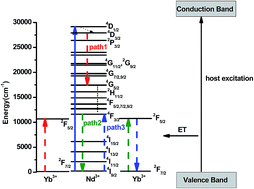
The presence of the Yb3+ emission upon Nd3+ excitation indicates the occurrence of energy transfer from Nd3+ to Yb3+. From the comparison of relative emission intensity of Nd3+ and Yb3+ with the concentration of Yb3+ in Fig. 4, the emission intensity from Nd3+ decreases all along, whereas the emission intensity of Yb3+ increases first and reaches maximum at concentration of 2.0%, and then decreases. The decrease of Nd3+ emission intensity and increase of Yb3+ emission intensity with Yb3+ concentration are due to the increasing energy transfer efficiency from Nd3+ to Yb3+. However, concentration quenching occurs with further increase the content of Yb3+. As discussed in Section 3.2, electron on the Nd3+ higher excited state is dominated by non-radiative relaxation to the lower 4F3/2 state. Based on this, the energy transfer route from Nd3+ (4F3/2 → 4I9/2) to Yb3+ (2F7/2 → 2F5/2) is proposed, the occurrence of which will further be confirmed according to the decay properties of related states. From the energy level structures of Nd3+ and Yb3+, the route of cross-relaxation energy transfer from the higher energy levels of Nd3+ to Yb3+ is also possible, which will be discussed in the following section.
Fig. 5 shows the excitation spectra of LaOF:1.0% Nd3+, x% Yb3+ (x = 0, 2.0 and 5.0) monitoring the emission of Nd3+ at 1059.5 nm and Yb3+ at 976 nm, respectively, and of LaOF:1.0% Yb3+ monitoring the emission of Yb3+ at 976 nm. The spectra in Fig. 5(b) and (c) were normalized at 748 nm of Nd3+ 4F7/2 excitation peak. In the excitation spectra of LaOF:1.0% Nd3+ monitoring the emission of Nd3+ at 1059.5 nm in Fig. 5(a), the characterized excitation peaks of Nd3+ are present and the corresponding transitions were indicated in the spectra. For the sample of LaOF singly doped with Yb3+, monitoring the emission of Yb3+ at 976 nm, a broad excitation band situating at around 256 nm emerges, which is originated from host lattice excitation of LaOF.18,21 The appearance of host excitation band monitoring the emission of Yb3+ reveals the energy transfer from host to Yb3+. In the excitation spectra of Nd3+ doped LaOF, the host excitation band is not present, showing the absence of energy transfer from host to Nd3+.
From the excitation spectra of LaOF:Nd3+, Yb3+ monitoring the emission of Yb3+ in Fig. 5(b) and (c), the characterized excitation peaks of Nd3+ and the excitation band related to host lattice are present, demonstrating the energy transfer from Nd3+ and host to Yb3+. The host lattice excitation band also appears in addition to the characterized excitation peaks of Nd3+ in the excitation spectra monitoring the emission of Nd3+. As shown in Fig. 5(a), there is no direct energy transfer from host to Nd3+, but when Yb3+ was codoped, energy transfer from host to Nd3+ occurs, indicating that the host excitation energy is firstly transferred to Yb3+, and then Yb3+ transfers the energy to Nd3+. The back energy transfer from Yb3+ to Nd3+ was also proposed in 0.8CaSiO3–0.2Ca3(PO4)2 eutectic glass.14
From the comparison of normalized excitation spectra in Fig. 5(b) and (c), the excitation intensity of energy levels Nd3+ 2G7/2 and higher ones is enhanced monitoring the emission of Yb3+. This illustrates that cross-relaxation energy transfer from higher Nd3+ states to Yb3+ occurs, otherwise, no enhancement will appear in the excitation spectra with Yb3+ emission. Based on the energy level diagrams of Nd3+ and Yb3+, the potential cross-relaxation energy transfer processes will be proposed.
![]() | ||
| Fig. 6 Decay curves of Nd3+ 4D3/2 state emission in LaOF:1.0% Nd3+, x% Yb3+ (x = 2.0, 3.0 and 5.0) upon Nd3+ 4D1/2 state excitation at 355 nm. | ||
The decay curves of Nd3+ 4F3/2 state emission (885 nm) in LaOF:1.0% Nd3+, x% Yb3+ (x = 0, 2.0, 3.0 and 5.0) upon excitation into the 4D1/2 state at 355 nm were shown in Fig. 7. The luminescence decay curves of the Nd3+ 4F3/2 emission (885 nm) in the sample without doping of Yb3+ can be described by a single exponential with a lifetime of about 668 μs. With the doping of Yb3+ and concentration increasing, the lifetime of Nd3+ 4F3/2 state gradually decreases with average time from 522 μs to 168 μs and become non exponential. This demonstrates that energy transfer from 4F3/2 energy level of Nd3+ to Yb3+ occurs and the transfer efficiency increases with the increase of Yb3+ concentration. The non-exponential character of the decay of Nd3+ 4F3/2 emission is originated from the random distribution of Yb3+ around Nd3+.
![]() | ||
| Fig. 7 Decay curves of Nd3+ 4F3/2 state emission in LaOF:1.0% Nd3+, x% Yb3+ (x = 0, 2.0, 3.0 and 5.0) upon Nd3+ 4D1/2 state excitation at 355 nm. | ||
If energy transfer from Nd3+ 4F3/2 state to Yb3+ 2F5/2 state occurs, there should be a rising process for the emission of Yb3+ 2F5/2. Hence, the decay curves of Yb3+ 2F5/2 state are presented in Fig. 8. The rising process of Yb3+ 2F5/2 state emission becomes faster with the increase of Yb3+ concentration, which is consistent with the decay trends of Nd3+ 4F3/2 state. In addition, the decay time of Yb3+ 2F5/2 state decreases with the increase of Yb3+ content, indicating the occurrence of concentration quenching.
![]() | ||
| Fig. 8 Decay curves of Yb3+ 2F5/2 state emission in LaOF:1.0% Nd3+, x% Yb3+ (x = 2.0, 3.0 and 5.0) upon Nd3+ 4D1/2 state excitation at 355 nm. | ||
![]() | ||
| Fig. 9 Energy level diagram of Nd3+ and Yb3+ ions and the potential energy transfer processes proposed. | ||
From the excitation spectrum in Fig. 5(a), energy transfer from host to Yb3+ is present and there is no direct energy transfer from host to Nd3+. The mechanism responsible for the energy transfer is not clear. The excitation spectra of Nd3+ and Yb3+ codoped LaOF indirectly reveal that the transfer of energy from Yb3+ to Nd3+indicated by path 3. the back energy transfer is unfavorable to the efficiency of spectral converters. The host lattice has strong absorption with efficient energy transfer to Yb3+, but absorption lies in the range with weak sun light intensity. Adjusting the host absorption to longer wavelength (300–500 nm) or searching for appropriate hosts for sensitization is necessary in the future research.
Although cross-relaxation energy transfer from Nd3+ to Yb3+ occurs, the efficiency is very low due to the fast non-radiative relaxation to Nd3+ 4F3/2 state. The back energy transfer from Yb3+ to Nd3+ could also decrease the efficiency of infrared emissions. The host sensitization of Yb3+ is very interesting and greatly enhances the absorptivity, but the host absorption should be adjusted to blue-near UV range to match well with the solar spectrum. The knowledges on the energy transfer processes (host, Nd3+ and Yb3+) in LaOF:Nd3+, Yb3+ would be great beneficial to the development of efficient spectral converters for silicon-based solar cells.
Footnote |
| † Electronic supplementary information (ESI) available. See DOI: 10.1039/c6ra19953d |
| This journal is © The Royal Society of Chemistry 2016 |