
DOI:
10.1039/C6RA17990H
(Paper)
RSC Adv., 2016,
6, 91133-91140
Eu2O3 modified CeO2 nanoparticles as a heterogeneous catalyst for an efficient green multicomponent synthesis of novel phenyldiazenyl-acridinedione-carboxylic acid derivatives in aqueous medium†
Received
14th July 2016
, Accepted 13th September 2016
First published on 14th September 2016
Abstract
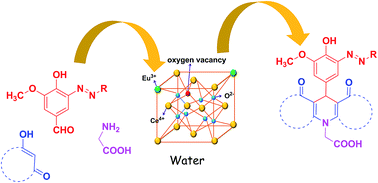
A green and highly efficient protocol has been developed for the synthesis of phenyldiazenyl-acridinedione-carboxylic acids by a one-pot multicomponent coupling of 1,3-dicarbonyl compounds, 4-hydroxy-3-methoxy-5-(substituted-phenyl-diazenyl)-benzaldehydes and glycine using europium modified ceria nanoparticles as the catalyst in aqueous medium. An environmentally benign reaction procedure, a wide diversity of products, excellent yields and reusability of the catalyst make the present method extremely advantageous for the synthesis of phenyldiazenyl-acridinedione-carboxylic acids. The formation, size and oxidation state of the metal ions present in the nano-europium modified ceria is confirmed by powdered-XRD, TEM and XPS techniques.
Introduction
Multicomponent reactions (MCRs) have been typically employed to quickly launch structurally varied and/or complex compounds from a number of simple starting materials in a one-pot approach.1 These reactions are useful for a broad range of functional groups and provide an opportunity for performing a diversity of post-multicomponent reaction transformations, such as re-functionalization and cyclization.2 MCRs in aqueous media are highly advantageous since water is environmental friendly and it has exceptional physical and chemical properties which may lead to certain reactivities and selectivities usually unachievable by organic solvents.3
Nano metal oxide catalysis is a green chemistry approach to chemical conversions because of its mild reaction conditions, high selectivity, formation of few by-products and low energy requirements. Therefore, the search for promising new nano metal oxides to reach eco-friendly reactions continue to avoid the use of hazardous Lewis acids, bases and other harsh reaction conditions and produce the diverse nature of chemical substances with higher yields.4
Acridines represent a significant class of biologically active compounds, which have important attention from many medicinal and pharmaceutical chemists, because of their antibacterial,5 myorelaxant,6 antimalarial7 and anticancer activities.8 In recent years, diazo compounds have become significant due to their activities such as tyrosinase inhibition,9 anticancer,10 antifungal11 and vesicular glutamate transporter inhibition.12 Hence, synthesis of diazo group containing acridine derivatives using green protocols has become a significant consideration for us.
In continuation of our efforts towards the development of green synthetic methods to novel heterocyclic molecules13 herein, we report a facile synthesis of 4-hydroxy-3-methoxy-5-(substituted-phenyldiazenyl)-dihydropyridine-acetic acid derivatives. To the best of our knowledge, for the first time, an ecofriendly process was developed for the synthesis of novel 4-hydroxy-3-methoxy-5-(substituted-phenyldiazenyl)-dihydropyridine-acetic acid scaffold from 1,3-dicarbonyl compounds, 4-hydroxy-3-methoxy-5-(substituted-phenyldiazenyl)benzaldehydes and glycine using europium modified ceria nanoparticles (CeO2–Eu2O3) as catalyst in aqueous medium. The catalyst was prepared by coprecipitation method and characterized using powdered-XRD, TEM and XPS techniques.
Results and discussions
Nanosized Ce0.8Eu0.2O2−δ (CE 8
:
2 mole ratio based on oxides) solid solutions were prepared by a modified co-precipitation method using appropriate amounts of the corresponding cerium(III) nitrate hexahydrate [Ce(NO3)3·6H2O, 99.99%, Aldrich] and europium(III) nitrate pentahydrate [Eu(NO3)3·5H2O, 99.9%, Aldrich] precursors respectively. The desired amounts of precursors were dissolved separately in double-distilled water under mild stirring conditions and mixed together. Dilute aqueous ammonia solution was added drop-wise over a period until the pH of the solution reached ∼8.5 and CE hydroxide formed. The obtained light yellow colored precipitate was decanted, filtered, and washed with distilled water multiple times followed by oven drying at 393 K for 12 h. The oven dried samples were crushed using an agate mortar and calcined in air at 773 K for 5 h at a heating rate of 5 K min−1. Finally, the CE material was obtained, which was thoroughly investigated by XRD, TEM and XPS techniques. For comparative purpose, pure cerium oxide (CeO2, labelled as C) was also prepared in a similar way.
Fig. 1 Shows the XRD patterns of CE and C material. The planes are observed at 2θ = 28.4°, 32.8°, 47.3°, 55.7°. From the analysis of XRD, it is understood that only one type of crystalline phases is present in the prepared sample. Absence of any peaks corresponding to dopant oxide (Eu2O3) confirms the formation of solid solutions. The average crystallite size was calculated by the Debye–Scherrer equation using most intense peaks (111), (200), (220), and (311), which is 8.4 nm and the surface area of the material was measured using nitrogen adsorption–desorption method at 90 m2 gm−1. These values for pure ceria are 8.9 nm and 40 m2 gm−1. From this, it is clear that the crystallite size of ceria material decreases and surface area increases upon introduction of europium oxide into the ceria lattice. This is one of the significant factors to determine the activity of the catalysts.
 |
| | Fig. 1 Powder X-ray diffraction patterns of europium modified ceria (CE) and pure ceria (C) nanoparticles. | |
Fig. 2 shows the TEM images of the CE and pure C material. From the figure, it is clear that, the average particle size was in the range of 8–10 nm, which is well in agreement with XRD data.
 |
| | Fig. 2 Transmission electron microscopy image of pure ceria (a) and europium modified ceria (b) nanoparticles. | |
XP spectra are used to know the oxidation states of the metal ions present on the surface of the solid solution. Fig. 3(a) and (b) represent the Ce 3d and O 1s spectra of CE and C material. Ce 3d spectra were deconvoluted into eight peaks corresponding to four pairs of spin–orbit doublets and the peaks were labeled as u and v referred to the 3d3/2 and 3d5/2 spin–orbit components, respectively. The peaks designated as u, u′′, u′′′ and v, v′′, v′′′ can be assigned to Ce4+ while the peaks u′ and v′ belong to Ce3+ suggesting the coexistence of Ce3+ and Ce4+ in the CE material. From the figure, it is clear that the position of the Ce 3d peaks of CE material shifted to lower binding energy compared to pure ceria indicates the formation of vacancy defects in the doped sample contrast to pure ceria.14
 |
| | Fig. 3 (a) Ce 3d XP spectra of CE and C, (b) O 1s XP spectra of CE and C and (c) Eu 3d XP spectrum of europium modified ceria nanoparticles. | |
O 1s spectra of CE and C material calcined at 773 K are presented in Fig. 3(b). From the figure two peaks were observed, one is at 529.3 eV and other one is at 531.7 eV. The former can be related to lattice oxygen (OI) and the latter to the adsorbed oxygen (OII). It indicates that two types of oxygens are present in the CE material. The binding energy of the above two peaks (OI and OII) of CE is lower than pure ceria. It signifies that the environment present around the oxygen atoms is different i.e., Ce–O–Ce versus Ce–O–Eu, which influence the catalytic properties of ceria significantly.
Eu 3d XP spectrum of prepared material is shown in Fig. 3(c). The peak observed at 1134 eV corresponds to Eu3+ and shows that the dopant is present in the trivalent state only.15
From the characterization studies (XRD, TEM and XPS), it is apparent that the properties of CE material like surface area and oxygen defects are significantly improved with respect to pure ceria.
A green multicomponent synthesis of 4-hydroxy-3-methoxy-5-(substituted-phenyldiazenyl)-dihydropyridine-acetic acid derivatives was achieved by a reaction among 1,3-dicarbonyl compounds (1a–b, 2 mmol), 4-hydroxy-3-methoxy-5-(substituted-phenyl-diazenyl)-benzaldehydes (2a–f, 1 mmol) and glycine (3, 1 mmol) in the presence of CeO2–Eu2O3 nanoparticles (NPs) acting as catalyst in aqueous medium at 80 °C. A model reaction was conducted using 5,5-dimethylcyclohexane-1,3-dione 1a and 4-hydroxy-3-methoxy-5-((4-nitrophenyl)-diazenyl)-benzaldehyde 2c along with glycine 3 employing different solvents, catalysts at different temperatures for optimizing the reaction conditions.
Initially the reaction was performed with a variety of solvents like methanol, ethanol, water, acetonitrile (Table 1, entries 1–4) and it was observed that aqueous medium afforded better yields than other solvents. Further, we focused on the evaluation of different catalysts for the model reaction in water at 80 °C. A wide range of catalysts like sodium hydroxide, piperidine, triethylamine, acetic acid, ferric chloride (Table 1, entries 5–9) including nano catalysts like Fe3O4, TiO2, CeO2 (C), CeO2–Eu2O3 (CE) (Table 1, entries 10–13) were employed to test their efficacy for the specific synthesis of compound 4c. Amongst, CeO2 and CeO2–Eu2O3 exhibiting better results. In these, CeO2–Eu2O3, showing improved performance than pure ceria, which can be supported from the characterization studies. The results showed that in the presence of CeO2–Eu2O3 (europium modified ceria nanoparticles), the desired product 4c was obtained in 90% yield and the yield of the desired product was tested using different mol ratios (10, 20, 30 mol%). The maximum yield was found with the 20 mol% catalyst (Table 1, entry 14). Lower than this, catalyst did not yield any promising result and when the reaction was tried using 30 mol% (Table 1, entry 15), no improvement was observed in the yields of 4c. The results were similar with the reaction when 20 mol% catalyst was used. As an extension of the above, we also studied the effect of temperature on the above reaction at different temperatures like room temperature, 40 °C, 60 °C and reflux temperature (Table 1, entries 16–19). Among these results, we found that 80 °C temperature enhanced the reaction yields.
Table 1 Effect of solvent and catalysts in the synthesis of 4c

|
| Entrya |
Catalyst (mol%) |
Solvent |
Temperature (°C) |
Time (h) |
Yieldb (%) |
| Reaction conditions: 5,5-dimethylcyclohexane-1,3-dione (2 mmol), 4-hydroxy-3-methoxy-5-((4-nitrophenyl)-diazenyl)-benzaldehyde (1 mmol) and glycine (1 mmol), solvent (1 mL) and catalyst. Yields of isolated products. |
| 1 |
— |
Methanol |
80 |
24 |
5 |
| 2 |
— |
Ethanol |
80 |
24 |
12 |
| 3 |
— |
Water |
80 |
24 |
27 |
| 4 |
— |
Acetonitrile |
80 |
24 |
15 |
| 5 |
NaOH (10%) |
Water |
80 |
15 |
36 |
| 6 |
Piperidine (10%) |
Water |
80 |
8 |
31 |
| 7 |
Triethylamine (10%) |
Water |
80 |
8 |
29 |
| 8 |
Acetic acid (10%) |
Water |
80 |
8 |
63 |
| 9 |
FeCl3(10%) |
Water |
80 |
8 |
51 |
| 10 |
Fe3O4 (10%) |
Water |
80 |
8 |
57 |
| 11 |
TiO2 (10%) |
Water |
80 |
8 |
44 |
| 12 |
CeO2 (10%) |
Water |
80 |
8 |
75 |
| 13 |
CeO2–Eu2O3 (10%) |
Water |
80 |
4 |
82 |
| 14 |
CeO2–Eu2O3 (20%) |
Water |
80 |
2 |
90 |
| 15 |
CeO2–Eu2O3 (30%) |
Water |
80 |
2 |
90 |
| 16 |
CeO2–Eu2O3 (20%) |
Water |
rt |
2 |
55 |
| 17 |
CeO2–Eu2O3 (20%) |
Water |
40 |
2 |
71 |
| 18 |
CeO2–Eu2O3 (20%) |
Water |
60 |
2 |
79 |
| 19 |
CeO2–Eu2O3 (20%) |
Water |
Reflux |
2 |
83 |
The well optimized one-step reaction protocol was adopted to create a diverse series of (4-hydroxy-3-methoxy-5-(substituted-phenyldiazenyl)-dihydropyridine-acetic acids 4a–l in good to excellent yields (69–91%) with 1,3-dicarbonyl compounds 1a–b, 4-hydroxy-3-methoxy-5-(substituted-phenyl-diazenyl)-benzaldehydes 2a–f and glycine 3 in the presence of CeO2–Eu2O3 nanoparticles (NPs) as a catalyst in aqueous medium at 80 °C. To estimate the scope and generality of the procedure, 4-hydroxy-3-methoxy-5-(substituted-phenyl)diazenyl)-benzaldehydes like 4-hydroxy-3-methoxy-5-(phenyldiazenyl)-benzaldehyde (2a), 4-hydroxy-3-methoxy-5-(p-tolyldiazenyl)-benzaldehyde (2b), 4-hydroxy-3-methoxy-5-((4-nitrophenyl)diazenyl)-benzaldehyde (2c), 4-hydroxy-3-methoxy-5-((3-nitrophenyl)diazenyl)-benzaldehyde (2d), 4-hydroxy-3-methoxy-5-((2-nitrophenyl)diazenyl)-benzaldehyde (2e) and 3-((3-fluoro-4-morpholinophenyl)diazenyl)-4-hydroxy-5-methoxybenzaldehyde (2f) having both electron-donating and electron-withdrawing groups were reacted with 1,3-dicarbonyl compounds like 5,5-dimethyl-1,3-cyclohexanedione (1a) and 1,3-cyclohexanedione (1b); along with glycine (3) under optimized conditions, and results are summarized in Table 2.
Table 2 Synthesis of 4-hydroxy-3-methoxy-5-(substituted-phenyldiazenyl)-dihydropyridine-acetic acids 4a–la

|
| Reaction conditions: 1,3-dicarbonyl compounds (2 mmol), 4-hydroxy-3-methoxy-5-((4-substituted-phenyl)-diazenyl)-benzaldehyde (1 mmol) and glycine (1 mmol), water (1 mL) and nano-CeO2–Eu2O3. Yields of isolated products. |
 |
The recyclability is of excessive significance of applying a catalytic system in industrial processes. Therefore, the recyclability of the catalyst was investigated in the synthesis of compound 4c with 5,5-dimethylcyclohexane-1,3-dione 1a, 4-hydroxy-3-methoxy-5-((4-nitrophenyl)-diazenyl)-benzaldehyde 2c and glycine 3. After completion of the reaction, the reaction mixture was cooled to room temperature and the product was extracted with ethyl acetate. The catalyst was separated by filtration, washed with acetone, dried and used for the next run. The catalytic activity of the CeO2–Eu2O3 was restored within the limits of the experimental errors for the four successive recycled runs (Fig. 4). A plausible reaction mechanism for the formation of acridines involves the activation of aldehyde 2 by CeO2–Eu2O3 nanoparticles followed the attack of enol form of 1,3-dicarbonyl compound 1 to give the intermediate A. The formation of intermediate (B) takes place by a condensation between 1,3-dicarbonyl compound 1 and glycine 3. Subsequently a Michael type addition occurs between intermediate A and B producing intermediate (C). Intermediate C undergoes intermolecular cyclization to afford the final product 5 as depicted in the Scheme 1. The structures of the synthesized compounds were well characterized by IR, 1H-NMR, 13C-NMR spectroscopy, mass spectrometry and elemental analysis.
 |
| | Fig. 4 Reusability studies of the nano-sized CeO2–Eu2O3 catalyst for the synthesis of compound. | |
 |
| | Scheme 1 : Proposed mechanism for the formation of phenyldiazenyl-acridinedione-carboxylic acid derivatives (4). | |
Experimental results
Materials and method
All reagents were procured from commercial sources and used without further purification. A Bruker WM-4 (X) spectrophotometer (577 model) was used for recording IR spectra (KBr). NMR spectra were recorded on a Bruker WM-500 spectrophotometer at 400 MHz (1H), Bruker WM-400 spectrophotometer at 400 MHz (1H) and 100 MHz (13C) respectively, in DMSO-d6 with TMS as an internal standard. Elemental analysis was performed on a Carlo Erba EA 1108 automatic elemental analyzer. Mass spectra (ESI) were recorded on a jeo1 JMSD-300 spectrometer. XRD data was acquired in the 2θ range of 12–80° on a Rigaku Multiflex instrument using Cu Kα (λ = 1.5418 Å) radiation and a scintillation counter detector. XRD phases present in the samples were identified with the help of the Powder Diffraction File-International Centre for Diffraction Data (PDF-ICDD). The average size of the crystalline domain (D) of CE was estimated with the help of the Scherrer eqn (1) using the XRD data of all prominent lines.| |
D = Kλ/β cos θ
| (1) |
where D denotes the crystallite size, λ the X-ray wavelength (1.541 Å), K the particle shape factor taken as 1, β the peak width (FWHM, full width at half maximum) in radians, and θ the Bragg diffraction angle. The BET surface areas were measured by nitrogen adsorption–desorption isotherms at liquid nitrogen temperature using a Micromeritics ASAP 2020 instrument.
HRTEM studies were made on a JEM-2010 (JEOL) instrument equipped with a slow-scan CCD camera at an accelerating voltage of 200 kV.
The XPS measurements were performed on a Shimadzu (ESCA 3400) spectrometer by using Al Kα (1486.7 eV) radiation as the excitation source. Charging effects of catalyst samples were corrected by using the binding energy of the adventitious carbon (C 1s) at 284.6 eV as internal reference. The XPS analysis was done at ambient temperature and pressures usually in the order of less than 10−8 Pa.
Synthesis of 2-(9-(4-hydroxy-3-methoxy-5-(substituted-phenyldiazenyl)phenyl)-1,8-dioxo-octahydroacridin-10(9H)-yl)acetic acid derivatives (4a–l)
A mixture of 1,3-dicarbonyl compound (2 mmol), 4-hydroxy-3-methoxy-5-(substituted-phenyl diazenyl)-benzaldehyde (1 mmol) and glycine (1 mmol) in water (1 mL) was taken in a 50 mL round bottom flask and the catalyst of europium modified ceria nanoparticles (20 mol%, 104.8 mg) was added. The resulting mixture was kept at 80 °C for 2–2.5 hours until the full conversion was achieved (monitored by TLC). After completion of the reaction the product was separated from the catalyst by extraction with ethyl acetate, which was evaporated under vacuum. The product was purified by column chromatography using silica gel [3.9
:
6.0
:
0.1 hexane
:
ethyl acetate
:
methanol] to afford the pure compounds (4a–l).
2-(9-(4-Hydroxy-3-methoxy-5-(phenyldiazenyl)phenyl)-3,3,6,6-tetramethyl-1,8-dioxo-1,2,3,4,5,6,7,8-octahydroacridin-10(9H)-yl)acetic acid (4a). Dark red solid; mp 251–253 °C; IR (KBr, cm−1) νmax: 3426, 2950, 1728, 1669; 1H NMR (400 MHz, DMSO-d6): δ 1.02 (s, 6H, –CH3), 1.06 (s, 6H, –CH3), 2.32–2.44 (m, 10H), 3.86 (s, 3H, –OCH3), 4.18 (s, 1H), 6.97 (s, 1H, ArH), 7.17 (s, 1H, ArH), 7.45–7.52 (m, 3H, ArH), 7.93 (d, 2H, J = 8.0 Hz, ArH), 12.12 (s, 1H, –OH), 13.08 (s, 1H, –COOH); 13C NMR (100 MHz, DMSO-d6): δ 198.17, 195.57, 162.73, 159.55, 151.45, 148.63, 143.62, 137.44, 135.19, 132.70, 128.97, 124.17, 121.12, 115.77, 113.65, 55.78, 52.34, 49.46, 36.38, 32.99, 28.31, 25.73; ESI-MS (m/z): 558 (M + 1); anal. calcd for C32H35N3O6: C, 68.92; H, 6.33; N, 7.54; found: C, 68.72; H, 6.44; N, 7.38.
2-(9-(4-Hydroxy-3-methoxy-5-(p-tolyldiazenyl)phenyl)-3,3,6,6-tetramethyl-1,8-dioxo-1,2,3,4,5,6,7,8-octahydroacridin-10(9H)-yl)acetic acid (4b). Dark red solid; mp 247–248 °C; IR (KBr, cm−1) νmax: 3425, 2949, 1732, 1667; 1H NMR (400 MHz, CDCl3): δ 1.16 (s, 6H, –CH3), 1.31 (s, 6H, –CH3), 2.26–2.54 (m, 13H), 3.86 (s, 3H, –OCH3), 5.59 (s, 1H), 6.75 (s, 1H, ArH), 7.30 (s, 1H, ArH), 7.33 (d, 2H, J = 8.0 Hz, ArH), 7.75 (d, 2H, J = 8.0 Hz, ArH), 12.09 (s, 1H, –OH), 13.19 (s, 1H, –COOH); 13C NMR (100 MHz, DMSO-d6): δ 198.32, 195.74, 162.36, 157.71, 148.05, 144.91, 140.78, 137.43, 135.60, 134.87, 122.00, 119.90, 114.14, 112.56, 112.01, 55.62, 50.86, 50.13, 34.55, 31.25, 29.55, 27.13, 21.62; ESI-MS (m/z): 572 (M + 1); anal. calcd for C33H37N3O6: C, 69.33; H, 6.52; N, 7.35; found: C, 69.42; H, 6.39; N, 7.21.
2-(9-(4-Hydroxy-3-methoxy-5-((4-nitrophenyl)diazenyl)phenyl)-3,3,6,6-tetramethyl-1,8-dioxo-1,2,3,4,5,6,7,8-octahydroacridin-10(9H)-yl)acetic acid (4c). Dark red solid; mp 262–263 °C; IR (KBr, cm−1) νmax: 3426, 2948, 1729, 1670; 1H NMR (400 MHz, CDCl3-d6): δ 1.14 (s, 6H, –CH3), 1.29 (s, 6H, –CH3), 2.35–2.52 (m, 10H), 3.85 (s, 3H, –OCH3), 5.55 (s, 1H), 6.78 (s, 1H, ArH), 7.28 (s, 1H, ArH), 7.94 (d, 2H, J = 8.0 Hz, ArH), 8.38 (d, 2H, J = 8.0 Hz, ArH), 12.04 (s, 1H, –OH), 12.87 (s, 1H, –COOH); 13C NMR (100 MHz, CDCl3): δ 190.86, 189.56, 153.51, 148.84, 148.40, 143.31, 137.34, 129.59, 125.02, 122.73, 122.52, 115.31, 115.23, 56.32, 47.10, 46.43, 32.33, 31.40, 29.78, 27.19; ESI-MS (m/z): 603 (M + 1); anal. calcd for C32H34N4O8: C, 63.78; H, 5.69; N, 9.30; found: C, 63.91; H, 5.89; N, 9.18.
2-(9-(4-Hydroxy-3-methoxy-5-((3-nitrophenyl)diazenyl)phenyl)-3,3,6,6-tetramethyl-1,8-dioxo-1,2,3,4,5,6,7,8-octahydroacridin-10(9H)-yl)acetic acid (4d). Dark red solid; mp 269–270 °C; IR (KBr, cm−1) νmax: 3425, 2949, 1730, 1670; 1H NMR (400 MHz, CDCl3): δ 1.14 (s, 6H, –CH3), 1.30 (s, 6H, –CH3), 2.35–2.54 (m, 10H), 3.85 (s, 3H, –OCH3), 5.56 (s, 1H), 6.80 (s, 1H, ArH), 7.32 (s, 1H, ArH), 7.71 (t, 1H, J = 8.0 Hz, ArH), 8.15 (d, 1H, J = 8.0 Hz, ArH), 8.32 (d, 1H, J = 8.0 Hz, ArH), 8.66 (s, 1H, ArH), 12.04 (s, 1H, –OH), 12.47 (s, 1H, –COOH); 13C NMR (100 MHz, CDCl3): δ 190.86, 189.59, 151.08, 149.17, 148.63, 141.68, 136.99, 130.27, 129.47, 128.96, 124.88, 122.71, 115.91, 115.27, 115.14, 56.35, 47.12, 46.45, 32.31, 31.49, 29.68, 27.26; ESI-MS (m/z): 603 (M + 1); anal. calcd for C32H34N4O8: C, 63.78; H, 5.69; N, 9.30; found: C, 63.99; H, 5.49; N, 9.55.
2-(9-(4-Hydroxy-3-methoxy-5-((2-nitrophenyl)diazenyl)phenyl)-3,3,6,6-tetramethyl-1,8-dioxo-1,2,3,4,5,6,7,8-octahydroacridin-10(9H)-yl)acetic acid (4e). Dark red solid; mp 255–256 °C; IR (KBr, cm−1) νmax: 3426, 2947, 1725, 1669; 1H NMR (400 MHz, CDCl3): δ 1.13 (s, 6H, –CH3), 1.28 (s, 6H, –CH3), 2.34–2.52 (m, 10H), 3.83 (s, 3H, –OCH3), 5.51 (s, 1H), 6.68 (s, 1H, ArH), 7.13 (s, 1H, ArH), 7.53 (t, 1H, J = 8.0 Hz, ArH), 7.72 (t, 1H, J = 8.0 Hz, ArH), 7.97 (d, 1H, J = 8.0 Hz, ArH), 8.11 (d, 1H, J = 8.0 Hz, ArH), 12.05 (s, 1H, –OH), 13.18 (s, 1H, –COOH); 13C NMR (100 MHz, CDCl3): δ 190.77, 189.54, 149.61, 148.04, 143.81, 142.32, 137.73, 134.03, 129.47, 125.37, 122.14, 118.17, 115.17, 114.85, 56.25, 47.07, 46.43, 31.39, 30.97, 29.76, 27.21; ESI-MS (m/z): 603 (M + 1); anal. calcd for C32H34N4O8: C, 63.78; H, 5.69; N, 9.30; found: C, 63.90; H, 5.42; N, 9.51.
2-(9-(3-((3-Fluoro-4-morpholinophenyl)diazenyl)-4-hydroxy-5-methoxyphenyl)-3,3,6,6-tetramethyl-1,8-dioxo-1,2,3,4,5,6,7,8-octahydroacridin-10(9H)-yl)acetic acid (4f). Dark red solid; mp 244–245 °C; IR (KBr, cm−1) νmax: 3425, 2953, 1750, 1670; 1H NMR (400 MHz, CDCl3): δ 1.14 (s, 6H, –CH3), 1.30 (s, 6H, –CH3), 2.35–2.54 (m, 10H), 3.20–3.24 (m, 4H), 3.83 (s, 3H, –OCH3), 3.88–3.91 (m, 4H), 5.55 (s, 1H), 6.72 (s, 1H, ArH), 6.99 (d, 1H, J = 8.0 Hz, ArH), 7.24 (s, 1H, ArH), 7.74 (d, 1H, J = 8.0 Hz, ArH), 8.17 (s, 1H, ArH), 12.04 (s, 1H, –OH), 12.81 (s, 1H, –COOH); 13C NMR (100 MHz, CDCl3): δ 190.67, 189.51, 156.79, 154.32, 148.44, 146.24, 145.19, 142.48, 140.96, 136.83, 128.77, 123.32, 122.36, 122.24, 122.05, 117.93, 113.64, 107.61, 107.38, 66.81, 56.28, 50.38, 47.11, 46.44, 32.28, 31.42, 30.97, 29.75, 27.24; ESI-MS (m/z): 661 (M + 1); anal. calcd for C36H41FN4O7: C, 65.44; H, 6.25; N, 8.48; found: C, 65.31; H, 6.33; N, 8.62.
2-(9-(4-Hydroxy-3-methoxy-5-(phenyldiazenyl)phenyl)-1,8-dioxo-1,2,3,4,5,6,7,8-octahydroacridin-10(9H)-yl)acetic acid (4g). Dark red solid; mp 254–255 °C; IR (KBr, cm−1) νmax: 3425, 2949, 1749, 1669; 1H NMR (400 MHz, CDCl3): δ 2.01–2.08 (m, 4H), 2.34–2.43 (m, 6H), 2.64–2.73 (m, 4H), 3.99 (s, 3H, –OCH3), 4.82 (s, 1H), 7.24 (s, 1H, ArH), 7.25 (s, 1H, ArH), 7.46–7.53 (m, 3H, ArH), 7.83 (d, 2H, ArH), 11.64 (s, 1H, –OH), 13.22 (s, 1H, –COOH); 13C NMR (100 MHz, DMSO-d6): δ 198.74, 195.83, 164.81, 162.49, 158.77, 151.52, 148.98, 144.08, 138.13, 135.70, 131.47, 129.66, 123.22, 122.32, 119.98, 114.78, 113.83, 112.79, 55.81, 47.06, 36.71, 34.87, 26.16, 23.48; ESI-MS (m/z): 502 (M + 1); anal. calcd for C28H27N3O6: C, 67.05; H, 5.43; N, 8.38; found: C, 67.22; H, 5.21; N, 8.59.
2-(9-(4-Hydroxy-3-methoxy-5-(p-tolyldiazenyl)phenyl)-1,8-dioxo-1,2,3,4,5,6,7,8-octahydroacridin-10(9H)-yl)acetic acid (4h). Dark red solid; mp 232–233 °C; IR (KBr, cm−1) νmax: 3426, 2948, 1748, 1670; 1H NMR (400 MHz, DMSO-d6): δ 1.90–2.00 (m, 4H), 2.29–2.33 (m, 6H), 2.41 (s, 3H, –CH3), 2.60–2.69 (m, 4H), 3.83 (s, 3H, –OCH3), 4.23 (s, 1H), 6.90 (s, 1H, ArH), 7.13 (s, 1H, ArH), 7.39 (d, 2H, J = 8.0 Hz, ArH), 7.90 (d, 2H, ArH), 10.98 (s, 1H, –OH), 12.88 (s, 1H, –COOH); 13C NMR (100 MHz, DMSO-d6): δ 198.41, 196.23, 164.75, 158.38, 149.54, 148.33, 143.38, 141.37, 137.62, 135.29, 129.59, 122.15, 119.33, 114.59, 113.87, 112.71, 55.47, 49.80, 36.71, 34.43, 26.10, 21.43, 19.31; ESI-MS (m/z): 516 (M + 1); anal. calcd for C29H29N3O6: C, 67.56; H, 5.67; N, 8.15; found: C, 67.39; H, 5.43; N, 8.33.
2-(9-(4-Hydroxy-3-methoxy-5-((4-nitrophenyl)diazenyl)phenyl)-1,8-dioxo-1,2,3,4,5,6,7,8-octahydroacridin-10(9H)-yl)acetic acid (4i). Dark red solid; mp 245–246 °C; IR (KBr, cm−1) νmax: 3426, 2950, 1749, 1671; 1H NMR (400 MHz, CDCl3): δ 2.04–2.11 (m, 4H), 2.37–2.44 (m, 6H), 2.67–2.73 (m, 4H), 3.99 (s, 3H, –OCH3), 4.81 (s, 1H), 7.24 (s, 1H, ArH), 7.29 (s, 1H, ArH), 7.96 (d, 2H, J = 8.0 Hz, ArH), 8.37 (d, 2H, ArH), 12.51 (s, 1H, –OH), 13.04 (s, 1H, –COOH); 13C NMR (100 MHz, CDCl3): δ 191.05, 189.86, 152.88, 150.27, 149.04, 145.34, 140.38, 138.20, 136.52, 135.36, 133.00, 130.79, 129.07, 126.75, 125.21, 122.92, 111.68, 56.65, 49.34, 37.01, 35.97, 27.32, 21.23; ESI-MS (m/z): 547 (M + 1); anal. calcd for C28H26N4O8: C, 61.53; H, 4.80; N, 10.25; found: C, 61.72; H, 4.93; N, 10.50.
2-(9-(4-Hydroxy-3-methoxy-5-((3-nitrophenyl)diazenyl)phenyl)-1,8-dioxo-1,2,3,4,5,6,7,8-octahydroacridin-10(9H)-yl)acetic acid (4j). Dark red solid; mp 229–230 °C; IR (KBr, cm−1) νmax: 3427, 2951, 1743, 1669; 1H NMR (400 MHz, DMSO-d6): δ 1.94–2.02 (m, 4H), 2.27–2.34 (m, 6H), 2.64–2.74 (m, 4H), 3.83 (s, 3H, –OCH3), 4.59 (s, 1H), 6.98 (s, 1H, ArH), 7.16 (s, 1H, ArH), 7.83 (t, 1H, J = 8.0 Hz, ArH), 8.22 (d, 1H, J = 8.0 Hz, ArH), 8.42 (d, 1H, J = 8.0 Hz, ArH), 8.74 (s, 1H, ArH), 11.72 (s, 1H, –OH), 12.44 (s, 1H, –COOH); 13C NMR (100 MHz, DMSO-d6): δ 197.02, 195.80, 155.43, 154.50, 149.43, 148.56, 145.31, 141.98, 138.60, 135.55, 132.25, 130.28, 125.40, 124.19, 56.48, 48.72, 36.91, 30.87, 26.96, 20.40; ESI-MS (m/z): 547 (M + 1); anal. calcd for C28H26N4O8: C, 61.53; H, 4.80; N, 10.25; found: C, 61.38; H, 4.62; N, 10.49.
2-(9-(4-Hydroxy-3-methoxy-5-((2-nitrophenyl)diazenyl)phenyl)-1,8-dioxo-1,2,3,4,5,6,7,8-octahydroacridin-10(9H)-yl)acetic acid (4k). Dark red solid; mp 276–277 °C; IR (KBr, cm−1) νmax: 3425, 2950, 1750, 1634; 1H NMR (400 MHz, CDCl3): δ 2.03–2.11 (m, 4H), 2.36–2.46 (m, 6H), 2.56–2.69 (m, 4H), 3.99 (s, 3H, –OCH3), 4.82 (s, 1H), 7.21 (s, 1H, ArH), 7.24 (s, 1H, ArH), 7.51 (t, 2H, J = 8.0 Hz, ArH), 7.83 (d, 2H, J = 8.0 Hz, ArH), 11.61 (s, 1H, –OH), 13.22 (s, 1H, –COOH); 13C NMR (100 MHz, DMSO-d6): δ 198.45, 196.28, 164.57, 158.45, 152.30, 150.34, 148.71, 145.72, 139.65, 136.68, 132.24, 129.85, 124.95, 119.48, 117.25, 115.03, 113.25, 108.87, 56.09, 49.63, 37.36, 34.87, 26.36, 19.57; ESI-MS (m/z): 547 (M + 1); anal. calcd for C28H26N4O8: C, 61.53; H, 4.80; N, 10.25; found: C, 61.76; H, 4.94; N, 10.41.
2-(9-(3-((3-Fluoro-4-morpholinophenyl)diazenyl)-4-hydroxy-5-methoxyphenyl)-1,8-dioxo-1,2,3,4,5,6,7,8-octahydroacridin-10(9H)-yl)acetic acid (4l). Dark red solid; mp 233–234 °C; IR (KBr, cm−1) νmax: 3425, 2950, 1748, 1670; 1H NMR (400 MHz, CDCl3): δ 2.02–2.08 (m, 4H), 2.36–2.41 (m, 6H), 2.68–2.74 (m, 4H), 3.20–3.25 (m, 4H), 3.88–3.91 (m, 4H), 3.98 (s, 3H, –OCH3), 4.81 (s, 1H), 6.98 (d, 2H, J = 8.0 Hz, ArH), 7.18 (s, 1H, ArH), 7.22 (s, 1H, ArH), 7.62 (s, 1H, ArH), 11.78 (s, 1H, –OH), 12.98 (s, 1H, –COOH); 13C NMR (100 MHz, CDCl3): δ 198.50, 196.97, 164.19, 148.06, 145.24, 141.54, 138.04, 136.91, 135.83, 134.96, 132.13, 122.66, 122.17, 117.95, 116.68, 116.14, 66.81, 56.54, 50.39, 48.03, 36.96, 27.20, 21.27, 20.32; ESI-MS (m/z): 605 (M + 1); anal. calcd for C32H33FN4O7: C, 63.57; H, 5.50; N, 9.27; found: C, 63.78; H, 5.38; N, 9.10.
Conclusion
In summary, we have developed an efficient and eco-friendly procedure for the one-pot synthesis of phenyldiazenyl-acridinedione-carboxylic acids by a multicomponent reaction of 1,3-dicarbonyl compounds, 4-hydroxy-3-methoxy-5-(substituted-phenyl-diazenyl)-benzaldehydes and glycine using europium modified ceria nanoparticles as a powerful catalyst under aqueous medium. This protocol has the advantages of a wide scope of operational simplicity, short reaction times, high yields, avoiding the use of toxic solvents and reusability of catalyst.
Acknowledgements
The authors are thankful to the Director, National Institute of Technology, Warangal, for providing facilities. One of the authors PSVK also grateful to council of scientific & industrial research (CSIR), New Delhi [File no. 09/922 (0005)2012/EMR-I], India, for the award of senior research fellowship.
References
-
(a) M. M. Khan, R. Yousuf, S. Khan and Shafiullah, RSC Adv., 2015, 5, 57883–57905 RSC
;
(b) M. N. Elinson, E. O. Dorofeeva, A. N. Vereshchagin, R. F. Nasybullin and M. P. Egorov, Catal.: Sci. Technol., 2015, 5, 2384–2387 RSC
;
(c) M. J. Climent, A. Corma and S. Iborra, RSC Adv., 2012, 2, 16–58 RSC
;
(d) P. S. V. Kumar, L. Suresh, G. Bhargavi, S. Basavoju and G. V. P. Chandramouli, ACS Sustainable Chem. Eng., 2015, 3, 2944–2950 CrossRef CAS
. -
(a) S. Pal, M. N. Khan, S. Karamthulla and L. H. Choudhury, RSC Adv., 2013, 3, 15705–15711 RSC
;
(b) Z. Chen and J. Wu, Org. Lett., 2010, 12, 4856–4859 CrossRef CAS PubMed
;
(c) P. Slobbe, E. Ruijter and R. V. A. Orru, Med. Chem. Commun., 2012, 3, 1189–1218 RSC
;
(d) L. Levi and T. J. J. Muller, Chem. Soc. Rev., 2016, 45, 2825–2846 RSC
;
(e) R. C. Cioc, E. Ruijter and R. V. A. Orru, Green Chem., 2014, 16, 2958–2975 RSC
;
(f) H. G. O. Alvim, E. N. da Silva Juniorb and B. A. D. Neto, RSC Adv., 2014, 4, 54282–54299 RSC
. -
(a) S. R. Kale, S. S. Kahandal, A. S. Burange, M. B. Gawande and R. V. Jayaram, Catal.: Sci. Technol., 2013, 3, 2050–2056 RSC
;
(b) S. Takale, S. Parab, K. Phatangare, R. Pisal and A. Chaskar, Catal.: Sci. Technol., 2011, 1, 1128–1132 RSC
. -
(a) U. C. Rajesh, Divya and D. S. Rawat, RSC Adv., 2014, 4, 41323–41330 CAS
;
(b) X. Marset, J. M. Pérez and D. J. Ramon, Green Chem., 2016, 18, 826–833 RSC
;
(c) S. Lingala, P. S. V. Kumar, T. Vinodkumar and C. Garimella, RSC Adv., 2016, 6, 68788–68797 RSC
. - N. K. Ladani, D. C. Mungra, M. P. Patel and R. G. Patel, Chin. Chem. Lett., 2011, 22, 1407–1410 CrossRef CAS
. - M. G. Gunduz, F. Isli, A. El-Khouly, S. Yıldırım, G. S. O. Fincan, R. Şimşek, C. Şafak, Y. Sarıoglu, S. O. Yıldırım and R. J. Butcher, Eur. J. Med. Chem., 2014, 75, 258–266 CrossRef CAS PubMed
. - C. W. Muth, H. L. Minigh, S. Chookruvong, L. A. Hall and H. Chao, J. Med. Chem., 1981, 24, 1016–1018 CrossRef CAS PubMed
. - K. B. Ramesh and M. A. Pasha, Bioorg. Med. Chem. Lett., 2014, 24, 3907–3913 CrossRef CAS PubMed
. - H. Xu and X. Zeng, Bioorg. Med. Chem. Lett., 2010, 20, 4193–4195 CrossRef CAS PubMed
. - M. Tonelli, I. Vazzana, B. Tasso, V. Boido, F. Sparatore, M. Fermeglia, M. S. Paneni, P. Posocco, S. Pricl, P. L. Colla, C. Ibba, G. Collu and R. Loddo, Bioorg. Med. Chem., 2009, 17, 4425–4440 CrossRef CAS PubMed
. - H. Hamidiana, R. Tagizadeha, S. Fozoonib, V. Abbasalipoura, A. Taheric and M. Namjoud, Bioorg. Med. Chem., 2013, 21, 2088–2092 CrossRef PubMed
. - F. Favre-Besse, O. Poirel, T. Bersot, E. Kim-Grellier, S. Daumas, S. E. Mestikawy, F. C. Acher and N. Pietrancosta, Eur. J. Med. Chem., 2014, 78, 236–247 CrossRef CAS PubMed
. -
(a) P. Sagar Vijay Kumar, L. Suresh, T. Vinodkumar, B. M. Reddy and G. V. P. Chandramouli, ACS Sustainable Chem. Eng., 2016, 4, 2376–2386 CrossRef CAS
;
(b) L. Suresh, Y. Poornachandra, S. Kanakaraju, C. Ganesh Kumar and G. V. P. Chandramouli, Org. Biomol. Chem., 2015, 13, 7294–7306 RSC
. - Z. Wang, Q. Wang, Y. Liao, G. Shen, X. Gong, N. Han, H. Liu and Y. Chen, ChemPhysChem, 2011, 12, 2763–2770 CrossRef CAS PubMed
. - T. Vinodkumar, D. Naga Durgasri, B. M. Reddy and I. Alxneit, Catal. Lett., 2014, 144, 2033–2042 CrossRef CAS
.
Footnote |
| † Electronic supplementary information (ESI) available. See DOI: 10.1039/c6ra17990h |
|
| This journal is © The Royal Society of Chemistry 2016 |
Click here to see how this site uses Cookies. View our privacy policy here.