S. Y. Park,
Y. J. Kim and
S.-Y. Kwak*
Department of Materials Science and Engineering, Seoul National University, 599 Gwanak-ro, Gwanak-gu, Seoul 151-744, Korea. E-mail: sykwak@snu.ac.kr
First published on 12th September 2016
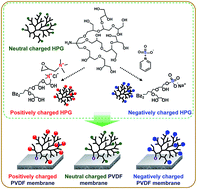
We develop a charge-modified PVDF UF/MF membrane that restricts membrane fouling derived from charged water contaminants. The charge-modified membranes are fabricated through surface assembly of various charged hyperbranched polyglycerols (HPGs), which act as anti-fouling agents. The native HPGs are neutrally charged polymers with a lot of hydroxyl end groups that can be modified with specific charges. We prepare three types of charged HPGs, i.e., neutrally charged HPGs without end group modifications, positively charged HPG with quaternary ammonium groups, and negatively charged HPG with sulfonate groups. The combined results for 1H NMR, FT-IR, and XPS results show that the charged HPGs are successfully synthesized and bound to the surfaces of the PVDF membrane. The surface hydrophilicity improves upon assembly of the hydrophilic charged HPGs. As expected, zeta potential results disclose that the differently charged HPGs provide the desired electrical properties to the membrane surface. In addition, the surface-assembled charged HPGs effectively suppress the attachment and accumulation of foulants having the same charge due to electrostatic repulsion and improved surface hydrophilicity.
Approaches to suppressing hydrophobic contaminant membrane fouling have focused on introducing hydrophilic materials, such as hydrophilic polymers or inorganic nanoparticles, through coatings,7–9 grafting,10–13 or blending5,14–17 methods. The hydrophilic surface layer hinders the adsorption of hydrophobic foulants on the membrane surface and helps remove accumulated fouling layers from the membrane surface using a simple cleaning process. Hydrophilic modifications provide effective anti-fouling layers against hydrophobic water contaminants.5,18,19 Nonetheless, some water contaminants include fully or localized specific charges that promote membrane fouling via electrostatic attractions to the membrane surface.20,21 Thus, it is necessary to introduce hydrophilic charged surface groups to block the charged matter involved in membrane fouling.
Modifying membranes with charged materials provides hydrophilic surfaces and electrostatic repulsive forces that act against foulants with the same charge. Several researchers have attempted to create charged layers on membrane surfaces by blending, grafting polymerization and surface assembly of charged materials.22–28 The specifically charge-modified membranes display a low propensity toward fouling by foulants having the same charge due to the introduction of electrostatic repulsive forces; however, most of these attempts have introduced only one type of charged group onto the membrane surface. Feed solutions that include oppositely charged contaminants or mixed charged contaminants may undergo rapid membrane fouling as a result of attractive electrostatic forces. The simultaneous introduction of neutral, positive, and negative charges could potentially yield anti-fouling membranes with the selective suppression of fouling by different charged contaminants. If various charges i.e., neutral, positive and negative charges, are selectively deposited onto membrane surface, it can be developed that the anti-fouling membranes have selective fouling suppression for various kinds of charged contaminants. Hyperbranched polyglycerol (HPG) as an anti-fouling modifier, which is composed of a variety branched structures bearing hydrophilic ethylene glycol chains and numerous hydroxyl end functional groups.29–34 HPG is a hydrophilic polymer with a neutral charge. The hyperbranched structure of HPG can hinder the attachment of foulants more effectively than single chain hydrophilic polymers such as polyethylene glycol (PEG). Specific charges may be selectively introduced into the HPG by modifying the hydroxyl end groups.
Here, we present an anti-fouling UF/MF membrane fabricated through the surface assembly of various charged HPGs onto a polyvinylidene fluoride (PVDF) membrane surface. The charged HPGs, i.e., anti-fouling surface modifying agents, were prepared through the anionic ring opening polymerization of a glycidol monomer with a three-armed core that included an amine functional group. The hydroxyl end groups were then converted into cationic quaternary ammonium groups or sulfonic anion groups. The various charged HPGs were covalently assembled onto the PVDF membrane surface via a cross-linking agent. The charged surfaces of the membranes effectively suppressed membrane fouling against identical charged water contaminants via the electrostatic repulsive forces. Selective charge modification of our membranes makes them attractive in a variety of wastewater purification processes for wastewater including specific charged contaminants.
The benzyl protecting groups were eliminated from Bz2HPG by treating Bz2HPG with hydrogen gas in the presence of a palladium catalyst.36 A 5 g sample of Bz2HPG was dissolved in 130 mL ethanol, and a mixture of 1.3 mL acetic acid and 0.8 g Pd/C was added to the Bz2HPG/ethanol solution. The reaction vessel was flushed with hydrogen gas (1 atm) and stirred for 14 h at 60 °C. The insoluble solid was removed by filtration using a celite pad, and the filtrate was evaporated under reduced pressure. The final product (neutral charged amino-functionalized HPG) was dried under vacuum at 80 °C overnight.
Positively charged end-modified HPG was synthesized by dissolving Bz2HPG (11.03 g, 1 equiv.) and NaOH (13.69 g, 2.4 equiv.; OH in Bz2HPG) in 60 mL DI water. The aqueous solution was cooled to 0 °C and reacted with GTAC (25.94 g, 1.2 equiv.; OH of Bz2HPG) via dropwise addition. The mixture was allowed to react over 16 hours and was subsequently neutralized with 5 N HCl (68.42 mL). The solvent was removed by evaporation at 60 °C, and the residual product was dissolved in methanol for precipitation with NaCl. The product was removed by filtration. The final product (positively charged Bz2HPG) was obtained by evaporating the methanol solvent.
The negatively charged end-modified amine-functionalized HPG was synthesized by the dropwise addition of a solution of STPC (11.44 g, 71.2 mM) in 80 mL DMF to a solution containing Bz2HPG (5.508 g, 71.2 mM OH-groups)/50 mL DMF over 6 h at 60 °C (dropwise rate: 0.11 mL min−1). The solution was stirred continually at 60 °C for 4 hours and was then cooled to room temperature.
The pyridine groups were decoupled from the sulfonated Bz2HPG by adding DI water (13 mL) to the above solution. A 1 M NaOH solution was then injected until the solution reached a pH 11. The solvent was removed by evaporation, and the residual solution was precipitated in cold acetone. The final product (negatively charged Bz2HPG) was dried at 60 °C overnight.
The positively charged Bz2HPG was debenzylated according to the protocol for debenzylating Bz2HPG. The negatively charged Bz2HPG was synthesized by slightly altering the debenzylation protocol for Bz2HPG due to the poor solubility of the negatively charged Bz2HPG in ethanol. A 4.67 g sample of the negatively charged Bz2HPG was dissolved in 100 mL DI water and 100 mL ethanol at 60 °C, and the solution was cooled to room temperature. Next, 4 mL acetic acid and 1.5 g Pd/C were added the above solution. The reaction vessel was flushed with hydrogen gas (1 atm), and the reaction was allowed to agitate for 4 days at 60 °C. The insoluble solid was removed by filtration using a celite pad, and the filtrate was evaporated under reduced pressure. The final product was dried at 80 °C overnight.
The synthesis of the charge-modified HPG was monitored by Fourier transform infrared spectroscopy (FT-IR; Thermo Scientific Nicolet 6700 FT-IR spectrometer) at a spectral resolution of 4 cm−1 over the range 4000–400 cm−1, and by 1H nuclear magnetic resonance (1H NMR, Bruker Avance 600) spectroscopy using DMSO-d6 as a solvent.
![]() | ||
| Fig. 1 Schematic illustration for the overall preparation procedure of charged PVDF membrane by assembly of charged modified HPG onto the plasma treated PVDF membrane surface. | ||
σ = (8kTC0ε)1/2 sinh(zeξ/2kT)
| (1) |
The water flux was measured using an Amicon® 8010 dead-end stirred cell (Millipore Corp.) connected to a pressure vessel filled with DI water at 0.17 bar. The flux data were collected by measuring the permeate weight using an electronic balance CUW420H (CAS corporation) linked to a computer to automate the data gathering process at specific time intervals. The flux Jw was calculated according to eqn (2),
| Jw = Q/(At) | (2) |
The membrane performance was evaluated using the normalized flux (eqn (3)) and flux recovery ratio (eqn (4)),
| Normalized flux = Jw/Jw0, | (3) |
| FRR = Jw1/Jw0, | (4) |
| Rt (%) = [1 − Jw/Jw1] × 100, | (5) |
| Rr (%) = [Jw1/Jw0 − Jw/Jw1] × 100, | (6) |
| Rir (%) = [1 − Jw1/Jw0] × 100, | (7) |
The HPG was polymerized using a tris(hydroxymethyl)aminomethane (THAM) derivate as the initiator core, which was prepared by directly binding two benzyl groups to the amino group of the THAM to suppress the reactivity of the amine groups during anionic polymerization.27 The main chains of the HPGs were synthesized via anionic ring-opening polymerization of glycidol using the benzyl-protected THAM initiator. The charge end-modified HPGs were prepared through a reaction between the hydroxyl end groups, glycidyl trimethylammonium chloride (GTAC), and the sulfur trioxide pyridine complex (STPC), respectively. Finally, the benzyl protective groups of the amino functional group were removed by hydrogenolysis using a palladium/charcoal catalyst under a H2 atmosphere.
Fig. 2 shows the 1H NMR spectra of the benzyl protected initiator and the charged HPGs. As the HPGs were polymerized from the Bz2THAM initiator, new 1H NMR peaks corresponding to the ethylene oxide backbone developed around 3–4 ppm. The degree of polymerization (DPn) and the absolute number-average molecular weight (Mn) were calculated to be 21 and 1864.5 g mol−1, respectively, in good agreement with the reaction ratio obtained from the glycidol monomer and the Bz2THAM initiator. After removing the benzyl protective groups from the Bz2HPG, the 1H NMR peaks corresponding to the benzene ring around 7.0 ppm disappeared completely. In addition, new 1H NMR peak was appeared at 1.9 ppm assigned as NH2 group. These results indicated that the single amino functional group in HPG was successfully recovered by removing the two benzyl protective groups. A positive charge was introduced onto the HPGs by reacting the hydroxyl end groups with GTAC under a basic environment. As shown in Fig. 2d, new 1H NMR peaks were observed at 4.35 ppm and 3.16 ppm, which corresponded to –CH2–N(CH3)3+ and N(CH3)3+, respectively.
The FT-IR spectra (see Fig. S3†) displayed new IR bands corresponding to a CH3 bending mode at 1480 cm−1 in the quaternary ammonium group of the GTAC. The degree of substitution (DS) was determined by calculating the integration ratio of the benzyl peaks 4–6 and the ether peak e, and was calculated to be 99% (see Fig. S3†). The terminal hydroxyl groups were converted to quaternary ammonium groups through an epoxy ring-opening reaction of the GTAC. A negative charge was introduced into the HPG via sulfonation using STPC. The 1H NMR spectra collected after carrying out the reaction between the end groups of the HPG and the sulfur trioxide of STPC compound displayed ether bond signals g and f (4.24–4.75 ppm). The FT-IR spectra (see Fig. S2†) featured sulfone-related IR bands, including the S
O stretch 1259 cm−1 and the C–O–S stretch 805 cm−1 due to the end group sulfonation process. The degree of substitution (DS) of the end hydroxyl groups was calculated to be 67%, based on a comparison of the 1H NMR integral ratio (see Fig. S4†).
The combined results of 1H NMR and FT-IR analysis results revealed that the HPGs were successfully prepared with the desired number of branches and molecular weights, and the desired charge was introduced at the ends of the HPGs in a high density.
Fig. 3 shows the ATR FT-IR spectra collected from the neat PVDF membrane, PDC-linked PVDF membrane, and charged HPG-assembled PVDF membranes, i.e., PVDF-HPG, PVDF-PHPG, and PVDF-NHPG. New IR bands corresponding to OH and NH stretches at 3600–3200 cm−1, a C–N stretch and an aroma.
C–H stretch at 1637 cm−1, 1510 cm−1 appeared in the PDC-linked PVDF membrane. As the charged HPGs assembled onto the plasma-treated PVDF membrane surface, a OH stretch IR band at 3300 cm−1 developed, and a C
O stretch developed at 1748 cm−1 corresponding to urethane. These spectral changes provided evidence for the assembly of charged HPGs onto the membrane via the PDC linker. XPS analysis provided more detailed surface chemical information about the assembly of the charged HPGs onto the membrane surfaces. Fig. 4 shows the XPS spectra collected from the surface of the neat PVDF membrane, the neutral HPG-assembled PVDF membrane, the positively charged HPG-assembled PVDF membrane, and the negatively charged HPG-assembled PVDF membrane, respectively.
The C 1s XPS spectrum of the neat PVDF membrane could be fit to two main peaks at 284.5 eV and 289.03 eV, corresponding to CH2 and CF2, respectively. As the charged HPGs assembled, peaks corresponding to the C–O binding energy at 285 eV and the C
O binding energy at 288 eV developed, derived from the ethylene oxide backbone in the HPG and urethane bonds as a result of the PDC linker-assisted assembly. An N–H species appeared at 399 eV in the XPS spectra of the PVDF-HPG and PVDF-PHPG samples. By contrast, no nitrogen species were detected in the neat PVDF membrane. The N–H species were derived from the amino group in the core of the HPGs and the PDC linker. A new binding energy peak at 402 eV developed in the N 1s XPS spectra of the PVDF-PHPG, corresponding to an N+–C species derived from the quaternary ammonium group of the positively charged HPG. The XPS spectra of the PVDF-NHPG and sulfone group revealed peaks at 168.8 eV. These new XPS peaks corresponded to the quaternary ammonium and sulfone groups. As assembly of neutral and charge-modified HPGs onto the surface of PVDF membranes, XPS atomic concentrations of carbon and oxygen were also increased (see Table S1†). In particular, the oxygen atomic concentrations which is derived from neutral and charge-modified HPGs were increased by 14.39 at% (for HPG-PVDF), 13.22 at% (for PHPG-PVDF) and 12.24 at% (for NHPG-PVDF), respectively. The results of XPS analysis indicated the direct assembly of neutral and charged HPGs on the membrane surfaces with similar introduced quantity.
The morphological changes in the membrane surface after the assembly of charged HPGs were characterized using FE-SEM measurement. Fig. 5 shows the FE-SEM images collected from the top surfaces of the neat PVDF, PVDF-HPG, PVDF-PHPG, and PVDF-NHPG membranes. All membranes showed similar surface morphologies of typical stretched membranes, indicating that the plasma-treatment and assembly of the charged HPGs did not significantly affect the surface pore structures of the PVDF membrane. The pure water contact angles (see the inset images of Fig. 5) decreased with the assembly of the charged HPGs. The neat PVDF membranes provided a high contact angle of 136.2 ± 5.2° due to the hydrophobicity of the surface groups. The charged HPG-assembled membranes provided smaller contact angles, 80–110°, compared to the neat PVDF membrane. These results indicated that the assembled HPGs endowed the membrane surfaces with hydrophilic properties due to the ethylene oxide backbone and the charged end groups.
![]() | ||
| Fig. 5 FE-SEM images of the top surface morphologies and (inset images) pure water contact angles of neat PVDF, PVDF-HPG, PVDF-PHPG and PVDF-NHPG membranes. | ||
The membrane surface charges substantially influenced the fouling properties during the filtration process.19 The adhesive force between the foulants and the partially or fully charged surfaces could be controlled by tuning the electrostatic properties of the membrane surface. The charges on the membrane surfaces suppressed adhesion among identical charged contaminants due to the electrostatic repulsive forces. The membrane surface charge strength was determined by the zeta potential measurements. The zeta potential originates from an ion stream on a shear plane bordering the electric double layers formed by the immobilized and diffused layers. The zeta potentials of the charge-modified membranes were measured at pH 3–10. As shown in Fig. 6, the neat PVDF membrane displayed a negative zeta potential, except at pH 3, under which conditions the C–F moiety in the neat PVDF membrane was negatively charged. The zeta potential values decreased monotonically as the pH increased. The isoelectric point (IEP) was 3.7. The PVDF-HPG membrane showed a nearly neutral zeta potential across the entire pH range due to the presence of neutral HPG. By contrast, the zeta potentials of the PVDF-PHPG and PVDF-NHPG membranes were positive and negative, respectively, across the entire pH range. These results indicated that the charges of the HPGs (neutral, positive, or negative) provided the desired chemical and electrical properties to the membrane surface and affected the fouling performance during filtration of charged solutes.
![]() | ||
| Fig. 6 Zeta potential results for neat PVDF, PVDF-HPG, PVDF-PHPG and PVDF-NHPG membranes over the pH range 3–10. | ||
The surface analysis data indicated that the charged HPGs successfully bound to the membrane surface via the PDC cross-linker. The surface charges on the membrane could be controlled through the assembly of specific charged HPGs on the membrane surfaces.
These proteins assumed different charges at neutral pH. The zeta potential values for LYZ and BSA are +3.5 mV and −22.3 mV at pH 7.4, respectively.20
The neat PVDF and charged PVDF membranes were fouled by filtering a 500 ppm protein solution over 60 minutes. After filtering the protein solution, the membranes were backwashed to remove loosely attached foulants. Then, the pure water flux through the membrane was measured. These filtration processes were repeated three times. The results obtained from the filtration test are plotted in Fig. 7. Before filtration of protein feed solution, the all membranes had similar level of pure water permeability (neat-PVDF: 2635 ± 188 LMH bar−1, PVDF-PHPG: 2883 ± 240 LMH bar−1, PVDF-HPG 2629 ± 206 LMH bar−1, PVDF-NHPG: 2534 ± 155 LMH bar−1). The positively charged protein, LYZ, was filtered across the membrane (see Fig. 7a and S5 in the ESI†), and the normalized water flux decreased due to the accumulation of the foulant on the membrane surface. As the pure water passed through the membranes, the normalized flux was recovered due to the elimination of loosely bound foulants from the membrane surface.
![]() | ||
| Fig. 7 Filtration tests of neat PVDF, PVDF-HPG, PVDF-PHPG and PVDF-NHPG membranes using (a) 500 ppm lysozyme (LYZ) (b) bovine serum albumin (BSA) suspended neutral aqueous solutions. | ||
In particular, the PVDF-PHPG membrane showed the highest resistance to fouling among the membranes tested. The total fouling of the PVDF-PHPG membrane, meaning the summation of the reversible and irreversible fouling measurements, was 16–33% less than the total fouling measured from the neat PVDF membrane. The PVDF-PHPG membrane provided half of its initial water flux, even after three filtration cycles applied to a highly concentrated contaminant solution. These results indicated that the positive surface charges and the hydrophilicity of the PVDF-PHPG membrane suppressed the accumulation of the positively charged LYZ. Thus, these groups reduced the adsorption of LYZ and improved detachment of the surface-bound LYZ during the membrane backwashing step. By contrast, the neat PVDF membrane lost about 70% of its original permeability after the filtration test because the neat PVDF membrane presented a hydrophobic surface with a negative surface charge. The neutral PVDF-HPG membrane displayed an intermediate level of fouling resistance due to a neutral surface and good hydrophilicity. The negatively charged PVDF-NHPG membrane surface displayed a resistance to fouling against the LYZ foulant comparable to that obtained from the neat PVDF membrane because the PVDF-NHPG membrane was more hydrophilic than the neat PVDF membrane.
The negative charged BSA filtration test results are presented in Fig. 7b and reveal that the negatively charged PVDF-NHPG membrane showed the highest fouling resistance because the membrane presented a negative surface charge and was hydrophilic. About 85% of the permeation performance of the PVDF-NHPG membrane was recovered after three BSA filtration cycles. By contrast, the positively charged PVDF-PHPG membrane displayed a low fouling resistance against the negatively charged BSA foulant. The filtration tests resulted in an irreversible fouling that was 16% higher than the irreversible fouling obtained in the PVDF-NHPG membranes because the surface was positively charged. The neutral PVDF-HPG membrane showed an intermediated level of BSA fouling resistance.
Overall, the fouling resistance of the membranes in the presence of charged contaminants clearly revealed that the surface charge and hydrophilic properties could be tuned to reduce membrane fouling by suppressing the accumulation of identically charged foulants on the membrane surface. These results showed similar level anti-fouling performance compared with previous reported surface modified UF/MF membranes, which is summarized in Table S2.† Membrane surface grafting modifications using a variety of charged HPG groups provide an eco-friendly approach to synthesizing wastewater filtration membranes that resist fouling by charged contaminants.
Footnote |
| † Electronic supplementary information (ESI) available. See DOI: 10.1039/c6ra19020k |
| This journal is © The Royal Society of Chemistry 2016 |