Fluorescence visualization of interactions between surfactants and polymers

Lulu Jiao, Lijuan Zhang, Weijiang Guan and Chao Lu*
State Key Laboratory of Chemical Resource Engineering, Beijing University of Chemical Technology, Beijing 100029, China. E-mail: luchao@mail.buct.edu.cn; Fax: +86 010 64411957; Tel: +86 010 64411957

Received 2nd August 2016 , Accepted 8th September 2016

First published on 9th September 2016


Abstract

An aggregation-induced emission (AIE) anionic surfactant, tetraphenylethene–sodium dodecyl sulfonate, is used to image the process of surfactants binding to polymers through the confocal fluorescence microscopy technique. Two inflection points of the interactions between polymers and surfactants are obtained by the change in the fluorescence intensity of the fabricated AIE-active probe. The proposed fluorescence imaging method supports the development of visualization strategies for studying the interactions between surfactants and other polymers.

Surfactant–polymer complexes have superior performances to the individual components. Investigations of the interactions between surfactants and polymers are a topic of continued intense interest in the fundamental understanding of the structure of surfactant–polymer complexes and the practical applications in diverse fields such as pharmaceuticals, food products, and cosmetics.1 The interactions between surfactants and polymers2 depend on two inflection points, called critical aggregation concentration (CAC) and polymer saturation point (PSP).3

Nowadays, surface tension, viscosity and electroconductivity are routinely used to measure the two inflection points and deduce the binding patterns of the interactions between surfactants and polymers in aqueous solutions.4 However, there is still a crucial need for development of a direct picture to examine the interaction patterns between surfactants and polymers obtained by physicochemical techniques. Development of a fluorescence imaging technology could endow new opportunities in elucidating the structure/composition of surfactant–polymer complexes and the mechanisms of the association phenomena.5 The surfactant-induced conformational changes of DNA were visualized by fluorescence microscopy with binding 4′,6-diamidino-2-phenylindole (DAPI) to DNA.6 Moreover, Swanson's group did much research on fluorophore-labelled polymer and the applications for the study of surfactant–polymer interactions, polymer-complexation, and the restriction of intramolecular motion on polymer complex formation.7 These works inspire us to expect that the visualization of the interactions between surfactants and polymers could be achieved if there is a luminescent surfactant.

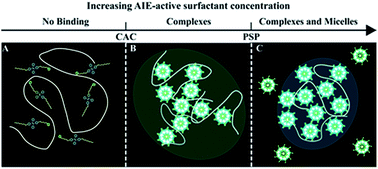
Recently, cooperated with Tang's group, we synthesized a tetraphenylethene–sodium dodecyl sulfonate anionic surfactant (TPE–SDS) with aggregation-induced emission (AIE) characteristics.8 It is reasonable to anticipate that such a TPE–SDS surfactant may be appropriate for the direct visualization of the interactions between surfactants and polymers. Herein, we studied the interactions of TPE–SDS surfactants with positively charged chitosan. Three stages in the process of TPE–SDS surfactant binding to chitosan were observed by confocal fluorescence microscopy (CFM) technique (Fig. 1). In addition, the obtained CAC and PSP inflection points during the interactions by the proposed fluorescence method were in accordance with those by traditional viscosity method. The generality of the present strategy was also verified by direct visualization of the interactions of TPE–SDS surfactants with neutral poly(ethylene oxide) (PEO).


image file: c6ra19517b-f1.tif
Fig. 1 Schematic description for the process of surfactants binding to polymers: (A) polymers decorated with surfactants; (B) surfactant–polymer complexes; (C) surfactant–polymer complexes and free micelles.

The chemical structures of chitosan and TPE–SDS are shown in Fig. 2A, respectively. The prime functional groups present in the chitosan are hydroxyl, amino, and acetamido groups. It has been reported that chitosan has a pKa value of 6.5 because of its amino groups.9 When the pH value of solution is below 6.5, chitosan could be positively charged with easy solubility in water. The well-designed TPE–SDS is an anionic surfactant with AIE characteristic. Its optical properties were studied by UV-visible absorption and fluorescence spectra (Fig. S1). A strong electrostatic attraction interaction could occur upon mixing the two oppositely charged species in solution, leading to the formation of surfactant–polymer complexes. Traditionally, the interactions between surfactants and polymers are investigated by viscosity method, which can reflect the behaviors of polyelectrolyte chains in the presence of oppositely charged surfactant.10 The effect of TPE–SDS on the viscosity of the chitosan solution (pH 4.0, 100 mM acetate buffer), is depicted in Fig. 2B. The viscosity curve shows three different regions: the inflection points between every two regions adjacent are corresponding to CAC (around 20 μM) and PSP (around 60 μM), respectively. Below the CAC, the viscosity of chitosan had few changes upon the addition of TPE–SDS. With a further addition of TPE–SDS, the chitosan chains could shrink due to the neutralization of their positive charges by the binding TPE–SDS micelle-like aggregates, leading to the sharply reduced viscosity. When the TPE–SDS concentration reached the PSP, the viscosity decreased to the minimum because all the chitosan chains were saturated with TPE–SDS micelle-like aggregates. Above the PSP, the viscosity value remained almost constant, because an increasing surfactant concentration only caused changes in the micellar pseudophase11 other than the TPE–SDS–chitosan complexes pseudophase. The viscosity result of TPE–SDS and chitosan system is in agreement with the previous description of polyelectrolyte behaviors in the presence of oppositely charged surfactant.12


image file: c6ra19517b-f2.tif
Fig. 2 (A) Chemical structures of chitosan and TPE–SDS. (B) Viscosity of chitosan solution (pH 4.0, 100 mM acetate buffer) as a function of TPE–SDS concentration. Viscosity experiments were performed at 25.0 ± 0.1 °C and repeated three times. The concentrations of TPE–SDS were 5–80 μM and the concentration of chitosan was 0.1% (w/v).

On the other hand, TPE–SDS could serve as an AIE-active probe to investigate its interactions with chitosan. As shown in Fig. 3A, the fluorescence intensity curve of TPE–SDS at different concentrations in buffer solution (pH 4.0, 100 mM acetate buffer) had only one inflection point at around 25 μM. This inflection point between the two different slopes indicates the formation of TPE–SDS micelles.13 Moreover, the fluorescence intensity curve of different concentrations of TPE–SDS in the presence of chitosan solution (pH 4.0, 100 mM acetate buffer) was recorded. Two inflection points were observed: the first inflection point was around 20 μM while the second inflection point was around 60 μM. Interestingly, the two inflection points were in accordance with those determined by viscosity method. Below the CAC, the anionic TPE–SDS unimers just adsorbed on the positive sites of the chitosan chains, leading to no obvious variations of fluorescence intensity in comparison to the same concentration of TPE–SDS in buffer solution. Between the CAC and PSP, the chitosan induced micellization of electrostatic-bound TPE–SDS unimers, the fluorescence intensity had a steep increase as a result of the restriction of intramolecular motions.14 In comparison with TPE–SDS in buffer solution, the fluorescence intensity was significantly enhanced due to the fact that the chitosan chains wrapped around the exterior of TPE–SDS micelle-like aggregates to further restrict the intramolecular motions of TPE–SDS. Above the PSP, the chitosan chains had been saturated with TPE–SDS, and the additional TPE–SDS could form the free TPE–SDS micelles in solution, resulting in a similar enhancement extent of fluorescence intensity as the TPE–SDS in buffer solution. In addition, the absorption peaks of TPE–SDS–chitosan complexes (Fig. S2) remained constant with those of pure TPE–SDS in water (Fig. S1), indicating that the conformation of TPE–SDS molecules was independent on the presence of chitosan. Given the above results, the fluorescence measurement of surfactant with AIE characteristic is able to investigate the interactions between surfactants and charged polymers.


image file: c6ra19517b-f3.tif
Fig. 3 (A) Plots of fluorescence intensity at 490 nm versus TPE–SDS concentration in the absence (blue symbols) and in the presence of chitosan (red symbols). (B) Fluorescence spectra of 40 μM TPE–SDS and chitosan under different pH conditions. All experiments were repeated three times and the concentration of chitosan was 0.1% (w/v).

Theoretically, the interactions between TPE–SDS and cationic chitosan were primarily driven by electrostatic attraction, then the spontaneous micellization of TPE–SDS was occurred with the increase of adsorbed TPE–SDS unimers. Therefore, greater charge density of chitosan could adsorb more TPE–SDS unimers, resulting in more micelle-like aggregates wrapped by chitosan chains to obtain stronger fluorescence intensity. Experimentally, the positive charge density of chitosan was adjusted by altering pH value of solution: higher pH leads to lower density of positive charge. As shown in Fig. 3B, the fluorescence intensity of TPE–SDS decreased with an increase in the pH value of solution. Note that the higher pH values (>6.5) could lead to occurrence of insoluble chitosan agglomerates. This result demonstrates that the higher pH values lead to the decreasing fluorescence intensity because of the weaker electrostatic attraction interaction.

In our AIE-active surfactant system, the luminescent micellar dots could be directly observed by CFM.8 Therefore, it is reasonable to anticipate that the visualization of binding patterns in different stages could also be achieved as a solid visual evidence for the interactions between TPE–SDS and chitosan. Fig. 4 showed the fluorescence microscopy images of different concentrations of TPE–SDS in the presence of (0.1% w/v) chitosan. At low concentration of TPE–SDS (5.0 μM, below the CAC), no obvious luminescent dots could be observed because the amount of TPE–SDS is insufficient to form micelle-like aggregates in the chitosan chains (Fig. 4A). As the TPE–SDS concentrations increased up to CAC, the TPE–SDS micelle-like aggregates began to form and were wrapped by the chitosan chains. The neutralization of positive charge of chitosan leads to the transformation of chitosan chains from expanding coils to contracting coils, resulting in the appearance of luminescent dots in the fluorescence microscopy image (Fig. 4B). Moreover, as shown in Fig. 4C, free luminescent TPE–SDS micellar dots with smaller size could be observed when the TPE–SDS concentration was above PSP (i.e., 80 μM). Further detail could be illustrated in Fig. 4D (magnification of the indicated region in Fig. 4C). The small and large luminescent dots in Fig. 4C represented the free TPE–SDS micelles and the TPE–SDS–chitosan complexes, respectively. The CFM and transmission electron microscopy (TEM) images of TPE–SDS in the absence of chitosan had been shown in Fig. 5. In addition, the aggregate behaviors of three stages in binding process of TPE–SDS and chitosan were confirmed by TEM (Fig. S3): below CAC, no TPE–SDS micelles could be observed; above CAC, TPE–SDS micelles were dotted inside the chitosan; above PSP, TPE–SDS micelles were appeared both inside and outside the chitosan. The XY resolution of CFM images in our experiment is approximately 150 × 150 nm with 405 nm diode laser. Thus, the micelle size (luminescent dots) in CFM image is at least 150 nm.15 Given the resolution differences between CFM and TEM, there would be size inconsistencies of micelles observed by CFM and TEM. In conclusion, direct visualization by CFM clearly disclosed the different stages of the process of TPE–SDS binding to chitosan.


image file: c6ra19517b-f4.tif
Fig. 4 CFM images of different stages of different concentrations of TPE–SDS in the presence of chitosan. (A) At low concentration of TPE–SDS (5.0 μM). (B) At moderate concentration of TPE–SDS (40 μM). (C) At high concentration of TPE–SDS (80 μM). (D) Magnification of the indicated region in (C). Scale bars: 10 μm. The concentration of chitosan was 0.1% (w/v). All images were taken with a 405 nm laser.

image file: c6ra19517b-f5.tif
Fig. 5 (A) CFM image of the TPE–SDS micelles. Scale bar: 5 μm. (B) TEM image of the TPE–SDS micelles. Scale bar: 50 nm.

In addition, the interactions between TPE–SDS and neutral PEO were also investigated to verify the generality of the developed visualization strategy. Fig. S4 shows the chemical structure of PEO: the ether oxygen has large polarity, which can electrostatically bind to the exterior of TPE–SDS micelle-like aggregates through ion–dipole interaction.16 As shown in Fig. 6A, there were three stages in the fluorescence intensity curve of TPE–SDS in the presence of PEO (0.1% w/v). The three stages of TPE–SDS and PEO are similar to those of the interactions between TPE–SDS and chitosan. Moreover, the conventional electroconductivity methods were carried out to verify the inflection points obtained from the proposed fluorescence method (Fig. 6B). The electroconductivity initially increased linearly as the addition of TPE–SDS in the presence of (0.1% w/v) PEO. When the TPE–SDS concentration increased to around 18 μM, the increment of electroconductivity became smaller. This point was considered as CAC because the bound TPE–SDS molecules in the PEO chains have a lower molecular mobility in comparison to pure TPE–SDS in water. As the concentration of TPE–SDS was above 60 μM (PSP), the electroconductivity curve was overlapped with that of pure TPE–SDS in water, indicating that the free TPE–SDS micelles were formed after the PSP. The viscosity measurement of TPE–SDS–PEO solutions was depicted in Fig. S5. The viscosity increases between CAC and PSP because electrostatic repulsion between TPE–SDS–PEO complexes resulted in the expansion of PEO coils. More importantly, the three stages mentioned above (TPE–SDS binding to PEO) were also directly visualized by CFM technique (Fig. S6). During the binding process, the absorption peaks of TPE–SDS–PEO complexes were still located in 250 nm and 318 nm (Fig. S7). This result demonstrated that the proposed AIE-based fluorescence strategy was applicable for the visualization investigation of binding behaviors between surfactants and neutral polymers.


image file: c6ra19517b-f6.tif
Fig. 6 (A) Plots of fluorescence intensity at 490 nm versus TPE–SDS concentration in the absence (blue symbols) and in the presence of PEO (red symbols). (B) Plots of electroconductivity of TPE–SDS solution in the absence (blue symbols) and in the presence of PEO (red symbols). All experiments were repeated three times and the concentration of PEO is 0.1% (w/v).

In addition, the present system of TPE–SDS and neutral PEO can be used to study the effect of polymer molecular weight on the binding interactions. Fig. S8–S10 showed the fluorescence intensity measurements of the systems consisting of TPE–SDS and PEO with different molecular weights. In the low molecular weight region, the CAC value is around the CMC value of pure TPE–SDS in water (32 μM), indicating that TPE–SDS had few interactions with PEO. This is because the PEO chains were too short to form the optimal TPE–SDS–PEO complexes (Fig. S8). In the moderate molecular weight region, as shown in Fig. S9, the CAC decreased gradually with increasing molecular weight of PEO. In general, the CAC is affected by the hydrophobicity of polymer at constant temperature and ionic strength.17 The increased hydrophobicity of PEO could facilitate the binding of PEO segments to TPE–SDS micelle-like aggregates. As the molecular weight of PEO continued to increase, the CAC was nearly constant (Fig. S10). Fig. S11 summarized the correlation between CAC and PEO with different molecular weights. The extent of the restriction of intramolecular motions differs as the molecular weight of PEO gets larger. Therefore, we can obtain the CAC of the interactions between TPE–SDS and PEO with different molecular weights in virtue of the proposed fluorescence method.

In summary, the changes of fluorescence intensity of AIE-active surfactant could directly demonstrate the binding patterns of surfactants and polymers. The binding patterns were further confirmed by viscosity and electroconductivity measurement methods. Moreover, the binding patterns of three stages were visualized by CFM: below CAC, no TPE–SDS micelles could be observed; above CAC, TPE–SDS micelles were dotted inside the chitosan; above PSP, TPE–SDS micelles were appeared both inside and outside the chitosan. This work provides not only a solid visual evidence for the interactions between surfactants and polymers, but also a fundamental understanding of the structure of surfactant–polymer complexes and their practical applications in diverse fields.

Acknowledgements

This work was supported by National Basic Research Program of China (973 Program, 2014CB932103), the National Natural Science Foundation of China (21575010 and 21375006), Innovation and Promotion Project of Beijing University of Chemical Technology.

Notes and references

  1. (a) E. D. Goddard and K. P. Ananthapadmanabhan, Interactions of surfactants with polymers and proteins, CRC Press, Boca Raton, FL, 1993 Search PubMed; (b) E. D. Goddard and J. V. Gruber, Principles of polymer science and technology in cosmetics and personal care, Marcel Dekker, New York, 1999 Search PubMed; (c) D. C. Li and N. J. Wagner, J. Am. Chem. Soc., 2013, 135, 17547 CrossRef CAS PubMed.
  2. E. D. Goddard, J. Am. Oil Chem. Soc., 1994, 71, 1 CrossRef CAS.
  3. (a) S. M. C. Silva, F. E. Antunes, J. J. S. Sousa, A. J. M. Valente and A. A. C. C. Pais, Carbohydr. Polym., 2011, 86, 35 CrossRef CAS; (b) J. Han, F. Cheng, X. G. Wang and Y. P. Wei, Carbohydr. Polym., 2012, 88, 139 CrossRef CAS.
  4. (a) M. N. Jones, J. Colloid Interface Sci., 1967, 23, 36 CrossRef CAS; (b) M. J. Schwuger, J. Colloid Interface Sci., 1973, 43, 491 CrossRef CAS; (c) S. M. Bystryak, M. A. Winnik and J. Siddiqui, Langmuir, 1999, 15, 3748 CrossRef CAS; (d) E. Minatti and D. Zanette, Colloids Surf., A, 1996, 113, 237 CrossRef CAS.
  5. J. Grant, H. Lee, R. C. W. Liu and C. Allen, Biomacromolecules, 2008, 9, 2146 CrossRef CAS PubMed.
  6. (a) M. D. Miguel, Adv. Colloid Interface Sci., 2001, 89, 1 CrossRef PubMed; (b) S. M. Mel'nikov, V. G. Sergeyev and K. Yoshikawa, J. Am. Chem. Soc., 1995, 117, 9951 CrossRef; (c) S. M. Mel'nikov, V. G. Sergeyev and K. Yoshikawa, J. Am. Chem. Soc., 1995, 117, 2401 CrossRef.
  7. (a) L. Ruiz-Pérez, A. Pryke, M. Sommer, G. Battaglia, I. Soutar, L. Swanson and M. Geoghegan, Macromolecules, 2008, 41, 2203 CrossRef; (b) C. K. Chee, S. Rimmer, I. Soutar and L. Swanson, Polymer, 2001, 42, 5079 CrossRef CAS; (c) C. K. Chee, K. P. Ghiggino, T. A. Smithb, S. Rimmera, I. Soutar and L. Swanson, Polymer, 2001, 42, 2235 CrossRef CAS.
  8. (a) W. J. Guan, W. J. Zhou, C. Lu and B. Z. Tang, Angew. Chem., Int. Ed., 2015, 54, 15160 CrossRef CAS PubMed; (b) W. J. Guan, S. Wang, C. Lu and B. Z. Tang, Nat. Commun., 2016, 7, 11811 CrossRef CAS PubMed.
  9. (a) V. K. Thakur and M. K. Thakur, ACS Sustainable Chem. Eng., 2014, 2, 2637 CrossRef CAS; (b) B. H. Morrow, G. F. Payne and J. Shen, J. Am. Chem. Soc., 2015, 137, 13024 CrossRef CAS PubMed; (c) D. G. Khandare, H. Joshi, M. Banerjee, M. S. Majik and A. Chatterjee, Anal. Chem., 2015, 87, 10871 CrossRef CAS PubMed; (d) E. K. Lim, W. Sajomsang, Y. Choi, E. Jang, H. Lee, B. Kang, E. Kim, S. Haam, J. S. Suh, S. J. Chung and Y. M. Huh, Nanoscale Res. Lett., 2013, 8, 467 CrossRef PubMed; (e) M. N. V. Ravi Kumar, R. A. A. Muzzarelli, C. Muzzarelli, H. Sashiwa and A. J. Domb, Chem. Rev., 2004, 104, 6017 CrossRef PubMed.
  10. (a) N. Plucktaveesak, A. J. Konop and R. H. Colby, J. Phys. Chem. B, 2003, 107, 8166 CrossRef CAS; (b) D. F. Anghel, S. Saito, A. Baran and A. Iovescu, Langmuir, 1998, 14, 5342 CrossRef CAS; (c) E. Hoff, B. Nystrom and B. Lindman, Langmuir, 2001, 17, 28 CrossRef CAS; (d) J. Grant, J. Cho and C. Allen, Langmuir, 2006, 22, 4327 CrossRef CAS PubMed; (e) K. Chari, J. Kowalczyk and J. Lal, J. Phys. Chem. B, 2004, 108, 2857 CrossRef CAS; (f) A. Herslof, L. Sundelof and K. Edsman, J. Phys. Chem., 1992, 96, 2345 CrossRef.
  11. D. Zanette, A. A. Ruzza, S. J. Froehner and E. Minatti, Colloids Surf., A, 1996, 108, 91 CrossRef CAS.
  12. (a) P. Hansson, Langmuir, 2001, 17, 4167 CrossRef CAS; (b) A. J. Konop and R. H. Colby, Langmuir, 1999, 15, 58 CrossRef CAS; (c) I. Satake and J. T. Yang, Biopolymers, 1976, 15, 2263 CrossRef CAS PubMed.
  13. M. J. Rosen and J. T. Kunjappu, Surfactants and Interfacial Phenomena, Wiley, Hoboken, NJ, 2012 Search PubMed.
  14. (a) J. Mei, N. L. C. Leung, R. T. K. Kwok, J. W. Y. Lam and B. Z. Tang, Chem. Rev., 2015, 115, 11718 CrossRef CAS PubMed; (b) Y. Y. Yuan, R. T. K. Kwok, B. Z. Tang and B. Liu, J. Am. Chem. Soc., 2014, 136, 2546 CrossRef CAS PubMed.
  15. M. H. N. Yio, M. J. Mac, H. S. Wong and N. R. Buenfeld, J. Microsc., 2015, 258, 151 CrossRef CAS PubMed.
  16. (a) K. J. Liu, Macromolecules, 1968, 1, 213 CrossRef CAS; (b) J. L. Xia, P. L. Dubin and Y. Kim, J. Phys. Chem., 1992, 96, 6805 CrossRef CAS; (c) B. Cabane and R. Duplessix, J. Phys., 1982, 43, 1529 CrossRef CAS; (d) P. L. Dubin, J. H. Gruber, J. L. Xia and H. W. Zhang, J. Colloid Interface Sci., 1992, 148, 35 CrossRef CAS; (e) M. Yoshizawa and H. Ohno, Electrochim. Acta, 2001, 46, 1723 CrossRef CAS.
  17. (a) R. Meszaros, I. Varga and T. Gilanyi, J. Phys. Chem. B, 2005, 109, 13538 CrossRef CAS PubMed; (b) S. Dai and K. C. Tam, J. Phys. Chem. B, 2001, 105, 10759 CrossRef CAS.

Footnote

Electronic supplementary information (ESI) available. See DOI: 10.1039/c6ra19517b

This journal is © The Royal Society of Chemistry 2016
Click here to see how this site uses Cookies. View our privacy policy here.