Tailoring the magnetic and magnetoelectric properties of rare earth orthoferrites for room temperature applications

N. Ramua, R. Muralidharanbd, K. Meera*cd and Y. H. Jeongd
aResearch Centre, Bharathiyar University, Coimbatore, India
bDepartment of Science and Humanities, Vel Tech High Tech Dr Rangarajan Dr Sakunthala Engineering College, Avadi, Chennai, India
cP.G Department of Physics, Womens Christian College, Chennai, India. E-mail: meecgc@gmail.com
dDepartment of Physics, Pohang University of Science and Technology, Pohang, Korea

Received 18th June 2016 , Accepted 21st July 2016

First published on 22nd July 2016


Abstract

Polycrystalline samples of SmFeO3, ErFeO3 and Sm0.5Er0.5FeO3 were prepared by a standard solid state reaction. An X-ray diffraction study shows that all the samples to be single phase. Reversal of the magnetic moment at low temperatures in the case of ErFeO3 and Sm0.5Er0.5FeO3 was observed which may be attributed to freezing of magnetic domains at these temperatures and the interaction between antiparallel alignments of two magnetic sublattices. The spin reorientation (SR) temperature can effectively be tuned close to room temperature in Sm0.5Er0.5FeO3 solid solution. Also we observed a magneto dielectric effect around room temperature which may shed light on a new series of magneto dielectric materials.

Complex oxides of perovskites with general formula ABO3, are an important class of materials which find applications in insulators, conductors, semiconductors, superconductors, magnetic and magnetoelectrics.1–3 Multiferroics are materials which have two or more ferroic properties in the same material and have been envisaged for a plethora of applications. Multiferroic materials are very rare in nature because of the mutual exclusive nature of ferromagnetism and ferroelectricity, the details of which can be found in many recent reviews,4–8 and the references there in. In the last few years rare earth orthoferrites have been explored for multiferroic applications after improper ferroelectricity has been reported in some rare earth orthoferrites.9,10

Rare earth orthoferrites crystallizes in perovskite, orthorhombic structure with general formula RFeO3, where R is a rare earth metal ion. In the last decade a resurgence of research interest has started in this class of materials because these are magnetic insulator and can be used in smart devices like gas sensors, photo catalytic systems and magnetic systems.11,12 Marezio et al.13 have reported in detail about the crystal chemistry of almost all rare earth orthoferrites and found that the distortion in the iron oxygen octahedral is very small or constant when moving from LuFeO3 to SmFeO3 and started to decrease from NdFeO3. The rare earth metal ion in these compound may be magnetic or non magnetic and as there are two metal ions (R, Fe), three interactions are possible (Fe–Fe, Fe–R and R–R) of which the iron–iron interaction is very strong and responsible for antiferromagnetic transition around 650 K. The iron ions orders with a slight canting so there will be an effective weak ferromagnetic component in one direction below the Neel temperature (for ErFeO3 along crystallographic c-axis and for SmFeO3 along a-axis). The Fe–R interaction is responsible for the spin reorientation transition (SR) and occurs usually below 100 K for undoped orthoferrites except SmFeO3 (450 K). If R is a magnetic ion, they polarize either parallel or antiparallel with the Fe ion then a compensation point between these two magnetic sublattices will occur and at very low temperature R–R ordering will take place. So this group of materials has many phase transitions and a rich phase diagram. Moreover ErFeO3 is peculiar candidate where an anomalous change in sound velocity around the magnetic transition temperature bas been observed14 and a negative magnetic moment opposing to the applied magnetic field has been reported which has not been understood clearly so far.15 The symmetry condition predicts RFeO3 can show ferroelastic behavior.16 In these kind of materials magneto dielectric coupling can occur through coupling between electric, elastic and magnetic dipoles. Artyukin et al. suggests that in orthoferrites and orthochromites the domain wall array may be present which may induce the electrical polarization and a long range order of this may induce switching of electrical polarization with magnetic field and vice versa.17 Tokunaga et al. reports that in DyFeO3 single crystal on applying a magnetic field along the c-axis induces a small electrical polarization of around 0.2 μC cm−2 along the c-axis and suggests the reason for this induced polarization is due to the exchange striction between the two magnetic ions present in the rare earth orthoferrite single crystals and a new ground state have been reported at ultra low temperatures in the case of DyFeO3.18,19 The domain wall control of the multiferroic domains will pave way for new generation spintronic devices with low power consumption.20

The aim of the present paper is of three fold (i) to tailor the spin reorientation temperature towards room temperature by forming a solid solution of SmFeO3 with ErFeO3 (ii) to scrutinize the negative magnetization observed in some rare earth orthoferrites (iii) to explore the magneto dielectric effect in Sm0.5Er0.5FeO3 solid solutions.

Experiment

All the polycrystalline samples were prepared by the conventional solid state reaction taking stoichiometric composition of Er2O3, Fe2O3 and Sm2O3 with appropriate ratio. The powders of these compounds were grounded, sintered at 800 °C initially and finally sintered in air at 1200 °C for 24 h with intermediate grinding and sintering. The crystalline nature and purity of the sintered powders were confirmed by X-ray powder diffraction measurements (Bruker) at room temperature using CuKα radiation. The magnetization with temperature (MT) curves were measured using Physical Property Measurement System (PPMS, Quantum Design) between a temperature range of 5 to 300 K and field range up to 8 T. Both field cooled (FC) and zero field cooled (ZFC) measurements were done with a small external magnetic field of 100 Oe. For dielectric measurements silver paste was applied on both sides of thin pellet of 0.5 mm thickness which acts like a parallel plate capacitor. Physical Property Measurement System (PPMS, Quantum Design) was used for low temperature control and magnetic field and the capacitance was measured using Hioki LCR meter for an applied frequency of 1 KHz.

Results and discussion

The powder XRD patterns of final sintered at 1200 °C sample are shown in Fig. 1. The XRD patterns can be indexed with an orthorhombic perovskite structure (space group Pbnm) with four formula units per unit cell using the Joint committee on Powder Diffraction Standards (JCPDS) card number 74-1474 for SmFeO3 and 74-1480 for ErFeO3. It is clear from the figure that there is no other impurity phase apart from the perovskite phase. The sharp and intense peaks confirm the good crystalline quality of the sintered samples.
image file: c6ra15850a-f1.tif
Fig. 1 Powder XRD pattern of (a) SmFeO3 (b) ErFeO3 (c) Sm0.5Er0.5FeO3.

The magnetic properties of the rare earth orthoferrites (RFeO3) originates from the Fe ion and R, if it is magnetic and the interaction between them as mentioned before in the introduction section. The Fe–Fe interaction is very strong and is responsible for the antiferromagnetic to paramagnetic transition. So the Neel temperature of all the orthoferrites will lie around 670 K (not shown in Fig. 2). In the present study, as we are concentrating on the spin reorientation temperature, which is due to the interaction between R–Fe ions, we show here (Fig. 2a) the magnetization versus temperature (MT) curve below 300 K only for ErFeO3. Fig. 2a shows the field cooled (FC) and zero field cooled (ZFC) magnetization curve with temperature of pure ErFeO3 with a very small applied field (500 Oe). The temperature at which the FC and ZFC splits is the onset of spin reorientation temperature, for ErFeO3 it is around 94 K and agrees well with the earlier reports.15,21 The temperature at which the FC and ZFC curves crosses again corresponds to the spin compensation temperature but the more striking point in Fig. 2a is, below 31 K the FC magnetization goes to the negative value which is peculiar. This negative magnetization with temperature does nowhere relate to the diamagnetic property but it is due to the exchange coupling between different magnetic sublattices present and their interaction between them. This implies the complicated spin structure of ErFeO3. Only scanty number of materials shows negative magnetization like Ni(HCOO)2·2H2O and some rare earth orthovanadates and a detailed review on the negative magnetization and its implications has been reported more recently.22 Among the rare earth orthoferrites only ErFeO3 show negative magnetization so it might be presumed that the Er sublattice play a major role. If the negative magnetization occurs during ZFC, then it might be due to a very small trapped field in the measuring instrument (SQUID). In our case the negative magnetization occurs during the FC cycle which undeniably should be an intrinsic property. The possible reason may be due to the competition between different interactions of contrasting magnetic sublattices existing in the compound. To study the effect of external applied magnetic field on the negative magnetization, we measured magnetization with temperature for an applied magnetic field of 5000 Oe (Fig. 2b), from Fig. 2b we could observe almost ten times increase in the magnitude of the magnetization value of the ZFC curve apart from the change in the shape of the FC curve, i.e. The FC curve no more shows negative value but follows the ZFC curve. This implies that there should be a critical magnetic field to overcome the exchange interaction between the sublattices. Fig. 2b also shows that the magnetic field (5000 Oe) is not sufficient to change the spin reorientation temperature and spin compensation temperature which remains almost the same as Fig. 2a (500 Oe).


image file: c6ra15850a-f2.tif
Fig. 2 Field cooled (FC) and zero field cooled (ZFC) MT curves of ErFeO3 for an applied magnetic field (a) 500 Oe (b) 5000 Oe.

Fig. 3a shows the magnetization versus temperature for a pure SmFeO3 polycrystalline sample. It is clear from the figure that the spin reorientation temperature of SmFeO3 is around 450 K (splitting of ZFC and FC) also the ZFC and FC curves remains parallel (no cross over) even at very low temperatures (figure not shown here) as contrary to ErFeO3 implying that the magnetic moments of Sm and Fe ions are parallel to each other. Fig. 3b shows the magnetism versus temperature of Sm0.5Er0.5FeO3 sample prepared simultaneously with the pure ErFeO3 and SmFeO3. Two interesting points should be noted from this curve primarily the spin reorientation temperature of the solid solution is around 240 K which hints that the SR can be tuned linearly between 95 K and 450 K by changing the Sm concentration. The compensation temperature and also the starting of negative magnetization decreases to lower value which shows that Er ions play a major role for the negative magnetization. This kind of magnetic reversal can be attributed to the exchange interaction between Er and Fe magnetic sublattices and their magnetic moments are ordered in a antiparallel manner.


image file: c6ra15850a-f3.tif
Fig. 3 FC and ZFC, MT curves with an applied field of 500 Oe for (a) SmFeO3 (b) Sm0.5Er0.5FeO3.

Fig. 4 shows the magnetization versus magnetic field curves of (a) ErFeO3, (b) SmFeO3 (c) Sm0.5Er0.5FeO3 measured at 300 K and 5 K. The MH curve of ErFeO3 (Fig. 4a) at 300 K shows overall paramagnetic behavior more than the ferromagnetic behavior. The inset is the enlarged image of the curve which shows a symmetric hysteresis with a very small coercive field implying a soft magnet. The loop is not saturated with the maximum applied field. The MH curve at 5 K displays that the coercive field has decreased further and also the loop is shifted (not symmetric) implying that there is some internal field which might be the reason for negative magnetization during the magnetization versus temperature measurements (Fig. 2a). The MH curve for SmFeO3 at 300 K exhibit a very small coercive field and it increases at 5 K. It is to be noted that for SmFeO3 the magnetization can be saturated unlike the other two cases. The magnetic characterization and low temperature specific heat capacities of four different rare earth orthoferrites RFeO3 where R = Gd, Dy, Ho and Y have been studied and shown that the different rare earth ions have different interaction with the Fe ion.23 Sm0.5Er0.5FeO3 at 300 K displays a twin loop signifying a complicated interaction between different magnetic sublattices and also at 5 K the loop is slightly shifted suggesting the presence of internal field due the presence of Er ions, note that for pure SmFeO3 the MH loop is symmetric at 5 K.


image file: c6ra15850a-f4.tif
Fig. 4 The magnetization versus magnetic field curves of (a) ErFeO3, (b) SmFeO3 (c) Sm0.5Er0.5FeO3.

Fig. 5a shows the dielectric constant with temperature for ErFeO3, SmFeO3 and Sm0.5Er0.5FeO3 and it remains constant and low value until 200 K and increases with temperature thereafter up to the room temperature. It should be noted that the dielectric constant did not show any anomaly around the magnetic transition temperatures like the spin reorientation temperature, spin compensation temperature or the negative magnetization region. This shows that the electrical properties in all these samples are unaffected by the magnetic properties. On increasing the temperature the ionic charges which are sensitive to temperature will tend to move towards the electrodes increasing the space charge polarization and dielectric constant respectively and it is widely known as Maxwell Wagner mechanism. Fig. 5b shows the change in dielectric loss with temperature and it is clear from the figure that the loss remains very small suggesting that the samples prepared are good electrical insulators. It is interesting to note that the loss value shows some anomaly around 175 K for pure ErFeO3 and 225 K for SmFeO3 and Sm0.5Er0.5FeO3 samples and the dielectric constant starts to increase around these temperatures as seen in Fig. 4a.


image file: c6ra15850a-f5.tif
Fig. 5 (a) Dielectric constant with temperature for ErFeO3, SmFeO3 and Sm0.5Er0.5FeO3 and (b) variation of tan[thin space (1/6-em)]d with temperature for ErFeO3, SmFeO3 and Sm0.5Er0.5FeO3.

In general the magneto dielectric or magneto capacitance is considered as a proof of multiferroic or magnetoelectric coupling. To further study the effect of applied magnetic field on the dielectric properties of the synthesized samples, the dielectric constant for applied magnetic field is measured for different temperatures and the magneto dielectric effect was calculated using the formula

image file: c6ra15850a-t1.tif

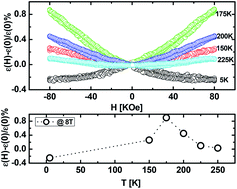
The MDE for pure ErFeO3 for various temperatures are shown in Fig. 6a and it is observed that the MDE increases with the magnetic field with a maximum of 0.8% for 175 K at 8 T. It should be noted here that for this sample an anomaly is observed in dielectric loss on the same temperature. In Fig. 5b the maximum MDE at 8 T for various temperatures is plotted and clearly follows the dielectric loss curve. Similarly Fig. 7a and b shows MDE effect of Sm0.5Er0.5FeO3 and it is observed that the maximum MDE effect has reduced slightly. Interestingly pure SmFeO3 sample does not show any pronounced MDE effect (figure not shown here) for which the existence of ferroelectricity due to inverse Dyzolonski–Morya interaction has been reported and remains a controversy.24,25 While measuring the dielectric constant a small ac field will be applied and the response to this field will come from a capacitive term for pure insulators and a resistive term for the practical samples. For most of the magnetic insulators the electrical leakage will be high as many of them will contain metal as one of their constituents. So the contribution from the resistive part will be more, while measuring the magneto dielectric measurements. What we observed in Fig. 6 and 7 as MDE may not be pure capacitive effect but due to the magneto resistive effect. Further studies on single crystalline samples on different orientation can shed light on this.


image file: c6ra15850a-f6.tif
Fig. 6 (a) Magneto dielectric effect (MDE) at different temperatures for ErFeO3 and (b) variation of maximum MDE with temperature obtained at 8 T for ErFeO3.

image file: c6ra15850a-f7.tif
Fig. 7 (a) Magneto dielectric effect (MDE) at different temperatures for Sm0.5Er0.5FeO3 and (b) variation of maximum MDE with temperature obtained at 8 T for Sm0.5Er0.5FeO3.

Conclusion

Polycrystalline samples of ErFeO3, Sm0.5Er0.5FeO3 and SmFeO3 were synthesized successfully by conventional solid state reactions. XRD measurements reveal that the synthesized samples were single phase without any impurity or secondary phase. The magnetization with temperature curve shows negative magnetization value for the samples containing Er ions alone confirming that the Er and Fe ions are arranged in anti-parallel manner and grows in a different manner with temperature. The dielectric constant value does not show any anomaly around the magnetic transition temperature hinting the coupling between electrical and magnetic dipoles. The temperature at which maximum MDE effect observed corresponds to dielectric loss maxima it might be due to magneto resistance rather than magneto capacitance. This study proves that the magneto dielectric effect alone is not sufficient to show magnetoelectric coupling in a material but may be advantageous other practical applications.

Acknowledgements

The authors, KM and YHJ were supported by BK21 plus and Center for Topological Matter at POSTECH. YHJ was also supported by NRF (2015R1D1A1A02062239).

References

  1. J. Zhu, H. Li, L. Zhong, P. Xiao, X. Xu, X. Yang, Z. Zhao and J. Li, ACS Catal., 2014, 4(9), 2917–2940 CrossRef CAS.
  2. K. Uchino, Sci. Technol. Adv. Mater., 2015, 16, 046001 CrossRef.
  3. Y. Suzuki, K. Uchino, H. Gouda, M. Sumita, R. E. Newnham and A. R. Ramachandran, J. Ceram. Soc. Jpn., 1991, 99, 1096 Search PubMed.
  4. Magnetoelectric Interaction Phenomena in Crystals, ed. M. Fiebig, V. V. Eremenko and I. E. Chupis Kluwer, Dordrecht, 2004, Proceedings of the MEIPIC-5, Sudak, Ukraine, 21–24 September 2003 Search PubMed.
  5. R. Ramesh and N. A. Spaldin, Nat. Mater., 2007, 6, 21–29 CrossRef CAS PubMed.
  6. Ce-W. Nan, M. I. Bichurin, S. Dong, D. Viehland and G. Srinivasan, J. Appl. Phys., 2008, 103, 031101 CrossRef.
  7. N. A. Hill, J. Phys. Chem. B, 2000, 104, 6694–6709 CrossRef CAS.
  8. X. Yang, Z. Zhou, T. Nan, Y. Gao, G. M. Yang, M. Liu and N. X. Sun, J. Mater. Chem. C, 2016, 4, 234–243 RSC.
  9. H. J. Zhao, Y. Yang, W. Ren, Ai-J. Mao, X. M. Chen and L. Bellaiche, J. Phys.: Condens. Matter, 2014, 26, 472201 CrossRef PubMed.
  10. A. Stroppa, M. Marsman, G. Kresse and S. Picozy, New J. Phys., 2010, 12, 093026 CrossRef.
  11. M. A. Ahmed and S. I. El-Dek, Mater. Lett., 2006, 60, 1437–1446 CrossRef CAS.
  12. L. Li, X. Wang, Y. Lan, W. Gu and S. Zhang, Ind. Eng. Chem. Res., 2013, 52(26), 9130–9136 CrossRef CAS.
  13. M. Marezio, J. P. Remeika and P. D. Dernier, Acta Crystallogr., Sect. B: Struct. Crystallogr. Cryst. Chem., 1970, 26, 2008 CrossRef CAS.
  14. V. D. Buchelnikov, I. V. Bychkov and V. G. Shavrov, JETP Lett., 1991, 54, 470 Search PubMed.
  15. Z. Zhou, L. Guo, H. Yang, Q. Liu and F. Ye, J. Alloys Compd., 2014, 583, 21–31 CrossRef CAS.
  16. H. Rabe, D. N. Rakov, J. P. Rivera, V. A. Murashov and H. Schmid, Ferroelectrics, 1994, 162, 307–315 CrossRef.
  17. S. Artyukhin, M. Mostovoy, N. P. Jensen, D. Le, K. Prokes, V. G. de Paula, H. N. Bordallo, A. Maljuk, S. Landsgesell, H. Ryll, B. Klemke, S. Paeckel, K. Kiefer, K. Lefmann, L. Theil Kuhn and D. N. Argyriou, Nat. Mater., 2012, 11, 694 CrossRef CAS PubMed.
  18. Y. Tokunaga, S. Iguchi, T. Arima and Y. Tokura, Phys. Rev. Lett., 2008, 101, 097205 CrossRef CAS PubMed.
  19. Z. Y. Zhao, X. Zhao, H. D. Zhou, F. B. Zhang, Q. J. Li, C. Fan, X. F. Sun and X. G. Li, Phys. Rev. B: Condens. Matter Mater. Phys., 2004, 89, 224405 CrossRef.
  20. Y. Tokunaga, N. Furukawa, H. Sakai, Y. Taguchi, T.-hisa Arima and Y. Tokura, Nat. Mater., 2009, 8, 558 CrossRef CAS PubMed.
  21. R. L. White, J. Appl. Phys., 1969, 40, 1061 CrossRef CAS.
  22. A. Kumar and S. M. Yusuf, Phys. Rep., 2015, 556, 1–34 CrossRef CAS.
  23. F. Zhang, S. Li, J. Song, J. Shi and X. Sun, IEEE Trans. Magn., 2015, 51, 1000904 Search PubMed.
  24. J.-H. Lee, Y. K. Jeong, J. H. Park, M.-A. Oak, J. Yeog Son, H. Myung Jang and J. F. Scott, Phys. Rev. Lett., 2011, 107, 117201 CrossRef PubMed.
  25. C.-Y. Kuo, Y. Drees, M. T. Fernández-Díaz, L. Zhao, L. Vasylechko, D. Sheptyakov, A. M. T. Bell, T. W. Pi, H.-J. Lin, M.-K. Wu, E. Pellegrin, S. M. Valvidares, Z. W. Li, P. Adler, A. Todorova, R. Küchler, A. Steppke, L. H. Tjeng, Z. Hu and A. C. Komarek, Phys. Rev. Lett., 2014, 113, 217203 CrossRef PubMed.

This journal is © The Royal Society of Chemistry 2016
Click here to see how this site uses Cookies. View our privacy policy here.