Shakeel Ahmad Khandy* and
Dinesh C. Gupta*
Condensed Matter Theory Group, School of Studies in Physics, Jiwaji University, Gwalior – 474 011, MP, India. E-mail: sosfizix@gmail.com
First published on 26th April 2016
Self-consistent ab initio calculations with highly precise spin-polarised, density functional theory (DFT) have been performed for the first time, to study the structural stability, mechanical and magneto-electronic properties of cubic perovskite PbTaO3. The DFT as well as the analytically calculated values of tolerance factor, in addition to stable-phase optimization, mechanical and elastic properties show stability of the present material in the cubic phase with a reasonably stiff nature and ductile properties. The symmetric spin-polarised band structure of both the spin (up and down) channels reveals zero spin polarisation at the Fermi level. Moreover, the insignificant total and individual spin magnetic moments of adjacent atoms and magnetic susceptibility calculations via the post-DFT treatment predict the paramagnetic nature of the material. Based on results of the present study, the paramagnetic metal PbTaO3 material is considered a promising candidate in designing new electrode materials.
Cubic oxides of tantallum are interesting members of the titanic perovskite family. Ta-Based perovskites are generally paramagnetic metal oxides that could shape future-generation electrode material design technology. Reliable mechanical strength vis-à-vis applied strain, structural stability and chemical environment make these materials feasible as high-quality functional oxides to furnish electrode materials with efficient electrical conductivity.5 The compounds CaTaO3 and SrTaO3 have been observed experimentally to crystallize in a cubic structure with the space group of Pm
m.6,7 Ali et al.8 reported the theoretical paramagnetic and metallic properties of cubic MTaO3 (M = Ca, Sr, Ba) perovskites. Moreover, SnTaO3 oxide has been reported to be a paramagnetic metal9 with cubic structure.10 No theoretical or experimental data on PbTaO3 compound are available in the literature. Thus, we hereby investigate for the first time the structural, mechanical electronic and magnetic properties of this compound theoretically.
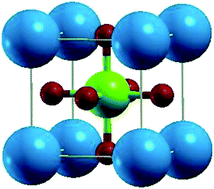
m, where atoms are sited as Pb (0, 0, 0), Ta (0.5, 0.5, 0.5) and O (0, 0.5, 0.5), (0.5, 0, 0.5), (0.5, 0.5, 0) positions. To achieve the optimization of structure and geometry of the crystal, Birch Murnagan's equation of state is used to fit the total energy per unit cell versus volume. The stable ground state for PbTaO3 is clarified by optimizing the 1 × 2 × 1 supercell for all three magnetic configurations (paramagnetic-PM, ferromagnetic-FM and antiferromagnetic-AFM) considered for this compound. For the AFM phase, the spin of Ta atom is reserved up (↑) in one cell and down (↓) in the second cell. From the self-consistent pressure–volume optimization plot, as shown in Fig. 2, it is clear that the paramagnetic phase has lower ground-state energy, and hence, a thermodynamically stable configuration for PbTaO3 is determined. Subsequently, the various optimised structural parameters including lattice constant, bulks modulus, derivative of bulk modulus and total energy presented in Table 1 are calculated. Moreover, an empirical (ionic radii) method is also employed to calculate the lattice constant using the following relation:18| a0 = α + β(rM + rO) + γ(rTa + rO) | (1) |
![]() | ||
Fig. 1 The cubic (Pm m) crystal structure of PbTaO3. The blue, green and red spheres denote Pb, Ta and O atoms, respectively. | ||
![]() | ||
Fig. 2 Calculated double cell optimization curves of PbTaO3 for paramagnetic, ferromagnetic and anti-ferromagnetic phases in Pm m configuration. | ||
| Parameter | GGA | Analytical |
|---|---|---|
| Lattice constant (Å) | 4.09 | 4.08 |
| Bulk modulus (GPa) | 190.74 | |
| B′ | 4.65 | |
| Volume (a.u.)3 | 925.48 | |
| Tolerance factor (t) | 0.99 | 0.99 |
![]() |
||
| Bond lengths (Å) | ||
| Pb–O | 2.89 | |
| Pb–Ta | 3.54 | |
| Ta–O | 2.05 | |
| ΔE = EPM − EAFM (Ry) | −0.006 | |
The knowledge of bond lengths enables us to predict the tolerance factor (t) of a perovskite structure and thus reliability of the crystal structure for a particular compound. The calculation of t can be obtained via two possible methods: ionic radii method18 and bond length (Goldschmidt)20 method with the formulae in eqn (2) and (3), respectively.
![]() | (2) |
![]() | (3) |
Analytically calculated as well as DFT computed values for the present material's tolerance factor (t = 0.99 as shown in Table 1) determines the distortion of a perovskite from the ideal cubic structure because the t in the range 0.93–1.04 is closer to unity, meaning minimum distortion and thus closer to cubic structure stability.21–23 Hence our results match theoretically calculated tolerance factors of SnTaO3, CaTaO3 and SrTaO3,6–10,24 with almost the same electronic configuration. These materials experimentally crystallize in a simple cubic structure. This theoretically justifies the cubic structure of PbTaO3 perovskite.
![]() | (4) |
The calculated cubic constants for PbTaO3 given in Table 2 are all positive and satisfy the cubic stability condition: C12 < B < C11 and the generalized Born (mechanical stability) criteria: (C11 − C12) > 0, (C11 + 2C12) > 0 and C44 > 0.28 Thus, we can say the material is elastically stable. The large obtained value of the bulk modulus, which is related to the hardness of a material, suggests the incompressible nature of PbTaO3. Covalently bonded materials are characterized by the higher value of the shear modulus. Similarly, Young's modulus is directly linked with stiffness of a material because maximizing the Y, the harder the material and hard materials have covalent bonds between constituent atoms.29 Henceforth, the calculated values of the bulk modulus and Young's modulus evidently indicate the stiff and covalent nature of the present material, which therefore may be a candidate for fabrication of superhard materials.
| Parameter | C11 | C12 | C44 | C′′ | Y | G | υ | B/G | A |
|---|---|---|---|---|---|---|---|---|---|
| PbTaO3 | 348.03 | 111.92 | 1.57 | 110.35 | 133.2 | 24.29 | 0.384 | 7.85 | 0.013 |
Microcracks in the material are associated with Zener's anisotropic factor A = 2C44/(C11 − C12) of a crystal. The calculated anisotropy factor (A = 0.013) is less than 1, which suggests that PbTaO3 is elastically anisotropic. Materials with A > 1 are said to be isotropic in nature.30 The calculated value of Cauchy's pressure, C′′ = (C12 − C44) presented in Table 2 implies the presence of metallic bonds; a positive Cauchy pressure value for a material represents a metallic bond and a negative value is a characteristic of angular bonds.30 Also, the compound's ductility is defined by a relatively high value of the Pugh ratio (B/G > 1.75), while brittleness is characterized by lower values of B/G. Therefore, the Cauchy pressure and Pugh ratio values indicate that the present compound is a ductile material.
Another property called Poisson's ratio υ can be calculated using υ = (3B − Y)/6B, which is directly related to the extent of bonding in the material. For covalent solids, it is less than 0.1, while for ionic solids this value is 0.25. However, for metallic materials, the range is 0.25–0.5.31 The present value of υ = 0.38 for PbTaO3 specifies that the material is metallic. This can also be accentuated by the positive value of Cauchy's pressure, which indicates the presence of non-central interatomic forces, rather than central forces attributed to the zero value of Cauchy's pressure. Hereafter, the overall DFT computed elastic and mechanical properties of PbTaO3 are considered to be metallic, stiff and ductile.
![]() | ||
| Fig. 5 Spin-polarized partial density of states (PDOS) of the PbTaO3 at equilibrium lattice constant by, GGA, GGA+U and GGA+U (SOC). | ||
Likewise, it is clear from the partial PDOS that the metallic nature of the compound is the result of p–d hybridization of t2g-states of Ta and p-states of Pb atom, inclusive of a small contribution from O-2p states. According to an earlier report, the d-band splitting (i.e., t2g and eg) in 5d transition metal (TM) oxides makes them metallic32 and the same occurs in the midst of symmetric densities for 5dt2g and deg in both spin phases. Thus, the metallicity property of PbTaO3 as elucidated by inclusive spin-dependent partial density of states is justified. The on-site parameter for the Ta-d states is applied and variation of Ueff up to 7 eV produces little difference in the band structure and overall DOS. Therefore, similar arguments are also put forward for results given in Fig. 5 obtained via GGA+U and GGA+U (SOC) with very little difference in calculated densities due to localization of d-states in the transition metal atom.
Moreover, first-principle calculations are actively used to evaluate electronic charge density, leading to determining the charge distribution in an atom, which in turn also establish the bond character between compound atoms. Thus, in a given system charge density acts as an indicator for chemical bonding; however, it includes contributions from non-bonding electrons and hence provides an overall charge density. The spin-polarized electronic charge densities of PbTaO3 are shown in Fig. 6. They clearly portray the existence of a covalent bond between Ta and O, while the Pb–Ta and Ta–Ta–O bonds are ionic in nature. Both types of bonds, covalent as well as ionic, are present in this material.
In addition, the BoltzTraP code33 was employed to evaluate electrical conductivity, which is a measure of free charge-carrier flow of the material. For metals, electrical conductivity increases with declining temperature due to maximum density of free electrons in the conduction band. At 50 K, maximum conductivity of 3.96 × 10²⁰ (ohm m)−1 s−1, as seen in the plot between electrical conductivity by time factor (s/t) versus temperature (Fig. 7). An exponential decrease in electrical conductivity is observed with the increase in temperature, and from 200 K onward the linear trend continues. SrTaO3 has been reported to have a sub-layer with high formation energy for oxygen vacancy, and thus oxygen migration toward the electrodes can be blocked by this material.34 Paramagnetic cubic oxides like BaMoO3, SrMoO3 and SrRuO3 show identical results, such as metallicity and reasonable electrical conductivity, and are being used as electrode materials.35–38 PbTaO3, then, is expected to serve as an efficient electrode material.
The negative spin magnetic moment of O shows opposite alignment with respect to other atomic moments. This opposition causes a nearly total decrease in the net spin magnetic moment of the cell. The magnetic response of the material is very feeble as observed from the insignificant total magnetic moment equal to 0.00058 μB. The negligible magnetic moment in such compounds leading to their paramagnetic performance is due to unpaired electrons present in atomic orbitals. Paramagnetic materials attain magnetism only when kept in externally applied magnetic fields; otherwise they have no magnetic moment, which is also confirmed by negligible spin polarization as well as symmetric band structures.39 A similar trend was found for total and individual magnetic moments, that is, negligible amounts when GGA and GGA+U (SOC) are employed. Two of the three constituent atoms Pb and Ta for the crystal structure are paramagnetic, while the third atom, oxygen, is non-magnetic. Therefore, application of interaction parameters yields an insignificant variation in the magnetic character and overall DOS of the material.
For paramagnetic materials, the magnetic susceptibility χ and temperature are inversely proportional, and follow the Curie–Weiss law:40
![]() | (5) |
![]() | ||
| Fig. 8 Magnetic susceptibility (χ) and inverse of magnetic susceptibility (χ−1) plots versus temperature of PbTaO3. | ||
Specific heat capacity for the material is an intensive property independent of system size, which yields a degree of temperature change per unit of the substance by absorbing heat, is also calculated. Excellent cooling agents used in diverse industries generally have a high value of specific heat capacity. The plot between molar-specific heat at constant pressure CP (J mol−1 K−1) and temperature T (K) in Fig. 9 shows that CP remains constant from 0 K to 450 K and then increases exponentially up to 800 K, reaching the limit of phase transition. Thus, it is well established from the overall DOS, ground-state energy, feeble magnetism and magnetic susceptibility that PbTaO3 is a metallic paramagnetic material.
m configuration. Cohesive energies in different phases show stability of the paramagnetic phase and chemical bonding, which is explained by the electronic charge densities in this compound. The bond between Pb–Ta and Ta–Ta–O is nearly ionic with strong covalency between Ta and O. Also, metallicity is confirmed by similar types of spin-polarized band structures. The optimized magnetic phase, calculated total (DOS) with an insignificant total magnetic moment and BoltzTraP calculations, reveal the paramagnetic nature of this compound. These properties suggest that the material is a promising candidate in the design of hard materials and in electrode fabrication.
| This journal is © The Royal Society of Chemistry 2016 |