Tailoring length and viscosity of dynamic metallo-supramolecular polymers in solution

Stefanie Martina Munzert, Guntram Schwarz and Dirk G. Kurth*
Julius Maximilians University of Würzburg, Chemical Technology of Advanced Materials, Röntgenring 11, D-97070 Würzburg, Germany. E-mail: dirk.kurth@matsyn.uni-wuerzburg.de

Received 16th December 2015 , Accepted 25th January 2016

First published on 27th January 2016


Abstract

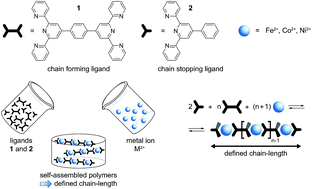
Transition metal ions, like Fe2+, Co2+ and Ni2+ coordinate to ditopic ligands such as 1,4-bis(2,2′:6′,2′′-terpyridin-4′-yl)benzene (1) forming sufficiently strong yet dynamic bonds in aqueous solutions, leading to extended, rigid-rod like metallo-supramolecular coordination polyelectrolytes (MEPEs). Here, we present a way to adjust the average molar mass, chain-length and viscosity of MEPEs using the monotopic chain stopper 4′-(phenyl)-2,2′:6′,2′′-terpyridine (2). The systems are analyzed by light scattering and viscometry. The experiments indicate that chain-length and viscosity of the MEPEs are modifiable in predictable ways by adding the monotopic chain stopper, 2. Light scattering is a suitable method for studying the molar mass and also the shape of the MEPEs.

Introduction

In most polymers the monomer units are linked by covalent bonds. The final structural properties, the polydispersity and the molecular weight distribution or the degree of polymerization, respectively, are controlled by the monomer structure and the conditions in the polymerization process. For example, silicones display a wide range of properties. Using chain stoppers and/or crosslinkers silicones vary in consistency from liquid to gel to rubber to hard plastic. Thus, silicones are used e.g. in sealants, adhesives, medicine, and insulation.1

Supramolecular polymers on the other hand are held together by noncovalent bonds, like coordinative bonds, π–π interactions, or hydrogen bonding. A large area of research is concerned with the design of such systems capable to spontaneously generating a well-defined supramolecular architecture by self-assembling from their components under a given set of conditions.2–9 In analogy to covalent polymers, the chain-length of supramolecular polymers can be tuned by using chain stoppers. For supramolecular polymers this so-called “stopper experiment” was first reported by Meijer et al.10,11 The group designed supramolecular polymers based on quadruple hydrogen bonding and decreased the degree of polymerization and therefore the polymer's chain-length by usage of end-caps that can be formed by a photochemical process. Thus, they are able to trigger the viscosity of the solution by light.10,11 Chain stopper molecular systems were later applied to different hydrogen bond based supramolecular polymers by Meijer,12,13 Lehn,14 Cohen Stuart,15–18 Bouteiller,19 and Yagai,20 to organometallic wires in organic solutions by Terech21,22 and to porphyrin based polymers by Kobuke23 and Hunter.24

A specific class of supramolecular polymers are metallo-supramolecular systems based on coordinative bonds. Metal ion coordination of organic ligands and metal ions results in a plethora of structures ranging from mononuclear compounds, to discrete nanosized assemblies, soluble coordination polymers, gels and solid state networks.25–30 The metal ions bring structural and functional properties to these systems that are relevant for functional materials. The interplay of coordination geometry, thermodynamic and kinetic properties of the metal ions and the structural features of the ligands results in one or a set of well-defined metallo-supramolecular architectures. If under the particular conditions the metal ion ligand interaction is reversible, the resulting macromolecular assemblies are equilibrium structures that can respond to external stimuli. Reversible metal ion coordination offers an attractive alternative to reversible covalent bonds as pH, counter ion and solvent are additional variables in the equilibrium. Such systems can exhibit useful functions e.g. gas storage,25,26 catalysis,31 magnetic,32,33 self-healing,34,35 electrochemical,36,37 electrochromic,38,39 and electro-rheological40 properties.

Metallo-supramolecular polymers, based on different pyridines including polytopic ligands and their interactions with metal salts have been presented by Constable,36,41 Kurth,38,42 Newkome,43 Stuart,29 Rowan,35,44 and Schubert.34,45 Back-to-back connected terpyridine receptors have been proven ideal for self-organizing linear assemblies.46 Due to the chelating effect of the ligand the binding strength to 3d transition metal ions, e.g. Fe2+, Co2+ and Ni2+ is sufficient to support macromolecular assemblies even in aqueous solutions. These metal ions typical coordinate in a pseudooctahedral geometry.

In the case of rigid bis-terpyridines, such as 1, rigid-rod like metallo-supramolecular coordination polyelectrolytes (MEPEs) form in solution (Scheme 1).


image file: c5ra26907e-s1.tif
Scheme 1 Metal ion induced self-assembly of the metal ions Fe2+, Co2+, and Ni2+ with 1,4-bis(2,2′:6′,2′′-terpyridine-4′-yl)benzene (1) results in metallo-supramolecular coordination polyelectrolytes (MEPEs). K1 and K2 are the binding constants for the stepwise complexation of 1 to the metal ion. 4′-(Phenyl)-2,2′:6′,2′′-terpyridine (2) acts as a stopping unit. n1 is the number of monomers, [M(1)]2+, and n2 the number of the chain terminating complexes, [M(2)2]2+, in the solution. The acetate counterions are omitted for clarity.

MEPEs can be incorporated in various architectures, including thin films,47 liquid crystals48 or nanostructures.49 Polyelectrolyte amphiphile complexes based on Fe-MEPE embedded in alkyl phosphate layers exhibit a structure induced and partially reversible spin-crossover between diamagnetic low-spin and paramagnetic high-spin state. The change in the spin state modifies not only the magnetic state but the optical properties of the complex as well.50 Finally, MEPEs exhibit excellent electrochromic properties,38,51 e.g. the electroactive Fe-MEPE based on ligand 1 can be dip-coated on transparent electrodes forming homogeneous films of blue color, several hundred nanometers thick. According to Landau and Levich,52 the film-thickness and thus the optical contrast can be controlled by the pulling speed and the viscosity of the solution. While the maximum pulling speed is limited by the specifications of the used technology the viscosity depends on the concentration of the coating solution and on the chain-length or the molecular weight, respectively. One could assume that concentration and pulling speed can be used as parameters for adjusting the thickness and the optical quality of the electrochromic film. Due to the non-linear dependence of chain-length on the metal ion to ligand ratio, y, in particular in the vicinity of 1, small changes in y result in high viscosity changes of the final Fe-MEPE solutions from different synthesis approaches.46 According to Carothers' equation, which relates degree of polymerization and stoichiometric ratio of reactants in covalent addition polymerization, the impact of an imbalance in y can be illustrated by calculating the number average degree of polymerization, DPn, if y < 1:53,54

 
image file: c5ra26907e-t1.tif(1)
or if y > 1:
 
image file: c5ra26907e-t2.tif(2)
with the assumption, that conversion approaches 100%. This means, that for example an imbalance of y = 0.99 ± 0.005 results in DPn = 266 ± 134, which is an inacceptable error in adjusting a desired chain-length. In contrast to the polymerization reaction based on covalent bonding, metal ion induced self-assembly depends not only on the ratio of metal ion to ligand, y, but also on the overall binding constant.

The assembly of MEPEs is assumed to proceed in two steps. Each step is associated with a binding constant, K1 and K2, respectively (Scheme 1).55 Generally, K2K1 for the coordination of terpyridines with the metal ions Fe2+, Co2+, and Ni2+. Hence, MEPEs are the preferred species even if y > 1, that is an excess of metal ions is present in the solution.56–58

In order to control the viscosity, the molecular weight and therefore the length of the MEPE chains in solution based on Fe2+, Co2+, Ni2+, and ligand 1, the addition of the monotopic chain stopper 4′-(phenyl)-2,2′:6′,2′′-terpyridine (2) is employed (Scheme 1). Here, we present a comprehensive analysis of these chain stopper experiments using light scattering and viscometry in solution.

Results and discussion

Metal ion induced self-assembly of the ditopic ligand 1 and the monotopic ligand 2 is used in the following as model system to study the assembly of MEPEs. Under the assumption that the chain forming ligand 1 and the chain stopping ligand 2 show the same binding properties and that all species are involved in the chain formation, the number of repeating units in MEPEs and, therefore, the average molar mass of the polymer chains can be described as follows. We define the chain termination ratio, z, as:
 
image file: c5ra26907e-t3.tif(3)
where n1 is the number of monomers, [M(1)]2+, and n2 the number of the chain terminating complexes, [M(2)2]2+, in the solution. Chain termination occurs when the number of capping units exceeds the number of chains ends. According to the principle of “maximum site occupancy” the chain ends will then be terminated by monotopic ligand 2, (see Scheme 1).59 A stoichiometric ratio is chosen according to n(M2+) = (n1 + n2). If the number of complexes, n2, is lower than (or equal to) the number of the monomers, n1, that is z ≥ 1/3, the number of MEPE chains in solution is equal to the number of chain terminating complexes [M(2)2]2+. If z < 1/3, the solution consists of [(2)M(1)M(2)]2+-species and an excess of [M(2)2]2+. At z = 1 the chain stopping complex is absent. In this case, the length of the polymer chain depends on the concentration of monomers, [M(1)]2+, and the metal ion to ligand ratio, y. Under the conditions, that 1/3 ≤ z < 1, and that the concentration is low enough to enable the self-assembly of monomers with chain stopping complexes, the length of MEPE chains is independent of the binding constant and total concentration but is terminated solely by the number of complexes present in solution. Of course, the overall binding constant and the total concentration must exceed the threshold of self-assembly. Thus, the molar mass of a single MEPE chain is equal to the sum of the molar mass of monomers, [M(1)]2+, plus the molar mass of the chain terminating complex, [M(2)2]2+. Therefore, the number average molar mass, [M with combining macron]n, equals to the sum of the molar mass of all monomers present in solution divided by n2 and the molar mass of one [M(2)2]2+-complex, that is Mc:
 
image file: c5ra26907e-t4.tif(4)
for 1/3 ≤ z < 1 and with n1 being the number of monomers, [M(1)]2+, and Mm and Mc the molar masses of monomer, [M(1)]2+, and chain terminating complex [M(2)2]2+, respectively. With eqn (3) and (4) the number average molar mass of the MEPE polymer chains can be described as a function of z:
 
image file: c5ra26907e-t5.tif(5)
for 1/3 ≤ z < 1.

With acetate as counter ion, the MEPEs are soluble in water, aqueous acetic acid and polar solvents like EtOH or MeOH. On the other hand, ligand 1 is soluble in aqueous acetic acid, but less soluble in polar solvents such as water, EtOH or MeOH. For this reason, preparation and analysis of the MEPEs are performed in acetic acid solution (75 vol%). For the MEPE synthesis the metal salt is added to a mixture of ligand 1 and 2 (see procedure I in the Experimental section) or the MEPEs are prepared by adding solid MEPE and solid complex, [M(2)2]2+ in pre-defined ratios, z, to acetic acid solution (75 vol%) (see procedure II in the Experimental section); also KOAc is added to the solution. The resulting weight average molar masses, [M with combining macron]w, of the MEPEs are examined by static light scattering and the resulting viscosities by viscometry, respectively.

Light scattering is performed at a temperature of 23 °C and the data is evaluated according to the Guinier–Zimm plot:60,61

 
image file: c5ra26907e-t6.tif(6)
with K being an optical constant, c the concentration of MEPE polymers in solution, Rθ the Rayleigh ratio, rg, the radius of gyration, q the scattering vector, and NA the Avogadro number (for details concerning the data analysis, see Chapter 1 in the ESI). As shown in Fig. 1, the molar mass of the MEPEs is increasing with increasing chain termination ratio z, that is with decreasing amount of chain terminating complex. The weight average molar masses, [M with combining macron]w, measured by static light scattering are consistent with the number average molar masses, [M with combining macron]n, calculated by eqn (5) (black solid line in Fig. 1) within an error of ±7 × 10³ g mol−1, if z < 1. These results show that it is possible to adjust the chain-length of MEPEs by using a pre-defined amount of chain terminating complex.


image file: c5ra26907e-f1.tif
Fig. 1 Weight average molar mass, [M with combining macron]w, of (a) Fe-MEPE, (b) Co-MEPE, and (c) Ni-MEPE for different chain termination ratios, z, in 0.1 M KOAc acetic acid solution (75 vol%) at a temperature of 23 °C with a concentration of 4 g L−1. The samples are prepared by procedure I and II, respectively (see Experimental section). Each data point is obtained by using static light scattering leading to a Guinier–Zimm plot based on eqn (6). The black solid lines show the corresponding number average molar masses, [M with combining macron]n, calculated by eqn (5). DPw is the corresponding weight average degree of polymerization, DPw = [M with combining macron]w/Mm. For details concerning the data analysis, see Chapter 1 in the ESI.

Within the experimental error the average number of monomeric units per polymer chain is similar to the weight average degree of polymerization, DPw = [M with combining macron]w/Mm, (z < 1). As shown in Fig. 1, we determine [M with combining macron]w up to 2.8 × 10⁵ g mol−1, which corresponds to a weight average degree of polymerization, DPw = 385.

In the following set of experiments solid MEPE and solid complex, [M(2)2]2+ are mixed in pre-defined ratios, z, in acetic acid solution (75 vol%) including 0.1 M KOAc (procedure II). The weight average molar masses, [M with combining macron]w, obtained by this procedure are also included in Fig. 1. The results are identical. This experiment proves the dynamic nature of the MEPE chains. The mixture of neat MEPE and chain stopper complex [M(2)2]2+ exchange and equilibrate resulting in chain-lengths determined by the ratio z independently of the preparation procedure. Also, these results confirm the hypothesis that the MEPE length depends only on the ratio of the components under these experimental conditions. The size of the MEPEs remain unchanged within the studied concentration range of 1 g L−1 to 4 g L−1 (see Chapter 4 in the ESI). However, as z approaches unity [M with combining macron]w exhibits larger error bars due to the strong depends of the chain-length on the metal ion to ligand ratio, y, and concentration, as described in the introduction.46,62,63

In the following section we present viscosity data of the MEPE solutions for 0.5 ≤ z ≤ 1. The viscosity and SLS measurements are performed on the same samples.

First, the specific viscosities, ηsp, are presented:

 
image file: c5ra26907e-t7.tif(7)
with η being the measured dynamic viscosity of the solution, and η0 the dynamic viscosity of the solvent, that is in our case the dynamic viscosity of acetic acid solution (75 vol%) mixed with 0.1 M KOAc. η0 is determined to be 2.91 mPa s at a temperature of 23.0 °C. Fig. 2 shows the specific viscosities, ηsp, of Fe-, Co-, and Ni-MEPE for different chain termination ratios, z, at a concentration of 3.0 g L−1.


image file: c5ra26907e-f2.tif
Fig. 2 Specific viscosities of (a) Fe-MEPE, (b) Co-MEPE, and (c) Ni-MEPE for different chain termination ratios, z, at a temperature of 23.0 °C and a concentration of 3.0 g L−1 in 0.1 M KOAc acetic acid (75 vol%). The samples are prepared by procedures I and II, respectively (for details concerning the sample preparation see the Experimental section). The black solid lines show the corresponding curve fits according to eqn (8), with ηsp,m = (7.4 ± 0.3) × 10−3 and ηsp,c = (9.1 ± 0.4) × 10−2.

The specific viscosities of MEPEs, ηsp, increase with increasing chain termination ratio, z, from 0.02 up to 2.81. Thus, the trend is the same as shown for the determined weight average molar masses, [M with combining macron]w (Fig. 1), indicating that the chain-length increases with a decreasing amount of chain terminating complex, 2. ηsp is growing analogous to eqn (5) (see black solid lines in Fig. 2):

 
image file: c5ra26907e-t8.tif(8)

In comparison to eqn (5), ηsp,m corresponds to the specific viscosity of the monomers, [M(1)]2+, and ηsp,c corresponds to the specific viscosity of the [M(2)2]2+-complexes in the solution. If the corresponding solid compounds are dissolved in the solvent, we obtain the same specific viscosity data, ηsp (Fig. 2). By curve fitting according to eqn (8), ηsp,m results to (7.4 ± 0.3) × 10−3, and ηsp,c results to (9.1 ± 0.4) × 10−2, for Fe-, Co-, and Ni-MEPE.

This corresponds to dynamic viscosities ηm = 2.93 mPa s and ηc = 3.17 ± 0.1 mPa s. As expected, these values are slightly higher than the dynamic viscosity of the solvent (2.91 mPa s) and are in good agreement with viscosity measurements of [Fe(2)2]2+, [Co(2)2]2+, and [Ni(2)2]2+ in 0.1 M KOAc acetic acid solution (75 vol%). The viscosity data are in full agreement with the light-scattering data supporting the hypothesis that MEPEs are dynamic structures and that chain terminating complexes can be used to tailor the chain-length and viscosity.

Fig. 3 shows the specific viscosity, ηsp, of Fe-, Co-, and Ni-MEPE as a function of concentration (1.0 to 4.0 g L−1) and chain termination ratios, z. As shown in Fig. 3, the specific viscosity increases with an increasing concentration as well as an increasing chain termination ratio, z. As shown in Fig. 3 and also previously shown in Fig. 2, ηsp is increasing according to eqn (8). In the present set of experiments the specific viscosity, ηsp, is changed from 0.01 to 5.06 simply by adjusting the concentration, c, and/or chain termination ratio, z. The dependence of the specific viscosity, ηsp, on the concentration, c, can be examined by Cate's model:64

 
ηsp = cα (9)
with α being an exponent, relating ηsp to c. Regarding MEPEs, α is found to be 1.40 ± 0.04, 1.15 ± 0.05, and 1.04 ± 0.04, for Fe-, Co-, and Ni-MEPE, respectively. For noninteracting species of constant size Cates' model predicts a linear increase of ηsp with c, i.e. α = 1. The length of the MEPE chains should be independent on concentration in the presence of chain terminating complexes. We, therefore, expect α to be close to 1, which is indeed the case for Ni-MEPE; for Co- and Fe-MEPE α increases to 1.15 and 1.40, respectively. Values of α > 1 indicate that size increases with concentration as a result of a supramolecular polymerization or aggregation process.64–66 The presence of chain terminating complex should prevent chain growth through metal ion coordination. The increase in α may, therefore, be associated with other yet unknown aggregation processes. The exponents, α, are in the same range, than reported by Rowan et al.65 for metallo-supramolecular polymers, made from ditopic bis(benzimidazolyl)pyridine ligands and Fe2+ or Co2+. Somewhat larger values are reported for DNA- and hydrogen-bonding based supramolecular solutions, where α = 1.3–1.8.67–69 Finally, the examined concentration range is well below the overlap concentration, where Cate's model predicts a value of α = 3.5.64


image file: c5ra26907e-f3.tif
Fig. 3 Specific viscosities, ηsp, of (a) Fe-MEPE, (b) Co-MEPE, and (c) Ni-MEPE as a function of the MEPE concentration, c, and at different chain termination ratios, z, measured at a temperature of 23 °C.

In the case of samples with the same polydispersity index, the dependence of viscosity on molar mass can be described by the Kuhn–Mark–Houwink (KMH) constants, relating the intrinsic viscosity, [η], to the weight average molar mass, [M with combining macron]w:70–72

 
[η] = Kη[M with combining macron]waη (10)
with Kη and aη being empirical constants, which are characteristic for a polymer–solvent system at a defined temperature. A KMH exponent of aη = 0.5 is indicative of a coil, dissolved in a theta solvent, and aη = 0.8 is typical for coils in a good solvent. Larger exponents, aη > 1, are frequently found for rigid macromolecules. For rigid-rod type polymers, such as tobacco mosaic virus, aη is found to be 2.70 In order to calculate both KMH constants, we first determine the intrinsic viscosity, [η], defined as:
 
image file: c5ra26907e-t9.tif(11)

The intrinsic viscosity, [η], is the contribution of a single particle to the solution's viscosity and is also known as Staudinger index.70 The specific viscosity of MEPE solutions is measured as a function of concentration, the extrapolation to c = 0 gives the intrinsic viscosity, [η] (see Chapter 2 in the ESI). As shown in Fig. 4, the resulting values for [η] are increasing up to 650 mL g−1 with increasing chain termination ratio, z. Thus, the trend is the same as shown for the determined weight average molar masses, [M with combining macron]w, indicating that the intrinsic viscosity grows with a decreasing amount of chain terminating complex. Analogous to eqn (5) and (8), the data follow

 
image file: c5ra26907e-t10.tif(12)
with [η]m = 1.0 mL g−1 and [η]c = 1.4 mL g−1, which is relatively low, as expected. With the intrinsic viscosities, [η], at hand, we can determine the values Kη and aη of eqn (10). A KMH plot is performed as shown in Fig. 5 using the linearized eqn (13):
 
log[η] = log[thin space (1/6-em)]Kη + aη[thin space (1/6-em)]log[thin space (1/6-em)][M with combining macron]w (13)
where log[η] is obtained versus log[thin space (1/6-em)][M with combining macron]w, determined by static light scattering. [η] is the intrinsic viscosity, [M with combining macron]w the weight average molar mass, and Kη and aη are empirical constants, which are characteristic for a polymer–solvent system at a defined temperature.


image file: c5ra26907e-f4.tif
Fig. 4 Intrinsic viscosities, [η], of Fe-, Co-, and Ni-MEPE with different chain termination ratios, z, at a temperature of 23.0 °C. Each value is carried out by a linear plot of ηspc−1 to c → 0 according to eqn (11). The black solid line shows the corresponding curve fitting by eqn (12) with [η]m = 1.0 mL g−1 and [η]c = 1.4 mL g−1.

image file: c5ra26907e-f5.tif
Fig. 5 Kuhn–Mark–Houwink (KMH) fit of Fe-, Co-, and Ni-MEPE at a temperature of 23 °C according to eqn (13).

The KMH exponent, aη, amounts to 0.94 ± 0.07, 0.97 ± 0.03 and 1.09 ± 0.04 and the constant, Kη, to (6.3 ± 0.5) × 10−3 mL g−1, (7.2 ± 0.2) × 10−3 mL g−1, and (1.7 ± 0.1) × 10−3 mL g−1 for Fe-, Co-, and Ni-MEPE, respectively, which is indicative of a semi-rigid (or stiff) polymer.70 Again, there is an influence of the metal ion on the structures, as the stiffness increases in the order Fe-MEPE < Co-MEPE < Ni-MEPE.

The second virial coefficients, A2, obtained from the light scattering data reveals information about the interactions of MEPEs in solution (for details concerning the theory of static light scattering, see Chapter 1 in the ESI). The second virial coefficients, A2, are shown in Fig. 6 for different chain termination ratios, z. As shown in Fig. 6, the second virial coefficients, A2, are positive and decrease with increasing chain termination ratio, z. In general, if A2 = 0, polymers act like ideal chains, assuming exactly their random walk coil dimensions. In this so-called “theta condition” the solvent neither expands nor contracts the macromolecule, which is said to be in its “unperturbed” state. A negative A2 indicates the presence of an attractive interaction between the chains leading to macrophase separation (“salting-out effect”), whereas a positive A2 value indicates repulsive forces between the polymers so that polymer–solvent interactions are favoured over those between the polymers, and the solvent in this case is referred to as a “good solvent” in a thermodynamic sense.73,74 As can be seen in Fig. 6, A2 > 0, indicating that the interactions between the MEPEs and the solvent molecules are favored over those between the MEPEs and, therefore, acetic acid solution (75 vol%) can be referred as a “good solvent”.


image file: c5ra26907e-f6.tif
Fig. 6 Second virial coefficients, A2, of Fe-, Co-, and Ni-MEPE for different chain termination ratios, z, in 0.1 M KOAc acetic acid solution (75 vol%) at a temperature of 23 °C. Each value is determined by an own Guinier–Zimm plot, resulting from static light scattering measurements by dilution of a stock solution (c = 4 g L−1).

Furthermore, an increasing [M with combining macron]w leads to a decreasing A2, that is a decrease of repulsion forces between the MEPEs, which is a well known phenomenon in polymer chemistry, due to the decrease of stiffness and increase of a worm-like structure of the polymers with increasing [M with combining macron]w.70 This tendency is more significant for Co-MEPE, than for Fe-, and Ni-MEPE.

Next, we focus on the hydrodynamic radii, rh, of Fe-, Co-, and Ni-MEPE which are shown in Fig. 7 for different chain termination ratios, z. rh is calculated by the Stokes–Einstein equation:

 
image file: c5ra26907e-t11.tif(14)
with kB being the Boltzmann constant, T the temperature, η0 the viscosity of the solvent, and D0 the diffusion coefficient (for details concerning the application of a dynamic Zimm plot, see Chapter 3 in the ESI).


image file: c5ra26907e-f7.tif
Fig. 7 Hydrodynamic radii, rh, of Fe-, Co-, and Ni-MEPE for different chain termination ratios, z, in 0.1 M KOAc acetic acid solution (75 vol%) at a temperature of 23 °C. Each value is determined by an own dynamic Zimm plot (see Chapter 3 in the ESI), resulting from dynamic light scattering measurements by dilution of a stock solution (c = 4 g L−1).

As expected and shown in Fig. 7, the hydrodynamic radii, rh, increase with increasing chain termination ratios, z, that is, with increasing weight average molar mass, [M with combining macron]w. The trends are the same as shown for [M with combining macron]w in Fig. 1.

With the hydrodynamic radii, rh, at hand, we use the equation

 
rh[M with combining macron]wν (15)
for determination of the dependence of radii to molar masses. A plot is performed as shown in Fig. 8, using the linearized eqn (16):
 
log(rh) ∼ ν[thin space (1/6-em)]log[thin space (1/6-em)][M with combining macron]w (16)
where log(rh) is plotted against log[thin space (1/6-em)][M with combining macron]w, determined by static light scattering. The exponents, ν, result in 0.6 ± 0.2, 0.65 ± 0.04, and 0.72 ± 0.02 for Fe-, Co-, and Ni-MEPE, respectively, which is indicative of worm-like chains with an increased stiffness, comparable to covalent polymers.75,76 The stiffness of the polymers increases in the order Fe-MEPE < Co-MEPE < Ni-MEPE, as already noticed above.


image file: c5ra26907e-f8.tif
Fig. 8 log[thin space (1/6-em)]rh versus log[thin space (1/6-em)][M with combining macron]w of Fe-, Co-, and Ni-MEPE for different chain termination ratios, z, in 0.1 M KOAc acetic acid solution (75 vol%) at a temperature of 23 °C according to eqn (16).

Further information about the shape and structure of the MEPEs is possible by a comparison of rh with the radius of gyration, rg, which can be achieved by the Guinier–Zimm plot, described above, according to eqn (6) and as described in Chapter 1 of the ESI. Calculation of the radius of gyration is possible, if rg > λ0/20, with λ0 being the wavelength of the incident laser light in vacuum. In this case, interference of the scattered light emitted from an individual particle leads to a nonisotropic angular dependence of the scattered light intensity. If rg < λ0/20, only a negligible phase difference exists between light emitted from the various scattering centers within the given particle. In this case, the detected scattered intensity is independent of the scattering angle and only depends on the molar mass of the particle, which is proportional to the total number of scattering centers one particle contains.77 That means, that for light scattering on Co-, and Ni-MEPE, rg has to be >32 nm, since the wavelength of the incident laser, λ0 = 632.8 nm. Light scattering on Fe-MEPE, requires a laser wavelength of λ0 = 784.0, due to absorption effects. Therefore rg of Fe-MEPE has to be >40 nm. Thus, determination of weight average molar mass, [M with combining macron]w, second virial coefficient, A2, and hydrodynamic radius, rh, is possible by light scattering measurements, but rg of Co-, and Ni-MEPE can only be regarded as a trend (see Table S1 in the ESI). The determination of rg of Fe-MEPE is not possible.77 Nevertheless, a comparison of rg to rh is done, since the ratio, ρ, of radii of gyration and hydrodynamic radii

 
image file: c5ra26907e-t12.tif(17)
is a characteristic parameter of the particle architecture.78 We are aware, that the results for ρ can only be regarded as a trend. As shown in Table S2 in the ESI, ρ is decreasing with increasing chain termination ratio, z, which is indicative of a decreasing rigid-rod like structure and an increasing worm-like structure, due to increasing weight average molar masses, [M with combining macron]w.78 The trend of the ratios, ρ, regarding the architecture of the MEPEs is in agreement with the trend, shown in Fig. 6, where the second virial coefficient, A2, is examined and indicates, that the stiffness of the MEPEs is decreasing with increasing [M with combining macron]w.

Conclusions

In this work on metal ion induced self-assembly of metallo-supramolecular coordination polyelectrolytes (MEPEs) chain stopping experiments are carried out in order to adjust the chain-length of Co-, Ni-, and Fe-MEPEs. We established a theoretical model, which can easily be used to receive a polymer of desired average molecular weight and thus, the viscosity, which is an important parameter in technological applications of MEPEs. This model should be applicable to (linear) supramolecular polymerization that form through reversible interactions of ditopic species in solution under equilibrium conditions. The validity of the theoretical model is confirmed by static light scattering and viscometry and we have shown that tailoring of the chain-length is reproducible, due to the dynamic nature of the MEPE polymers. We determined the Kuhn–Mark–Houwink constants aη, to 0.94 ± 0.07, 0.97 ± 0.03 and 1.09 ± 0.04 and the constants, Kη, to (6.3 ± 0.5) × 10−3 mL g−1, (7.2 ± 0.2) × 10−3 mL g−1, and (1.7 ± 0.1) × 10−3 mL g−1 for Fe-, Co-, and Ni-MEPE, respectively, by which it is possible to convert average molar masses to viscosities of the polyelectrolytes. The polymers exhibit a rigid-rod like structure in solution and the stiffness of the polymers seems to increase in the order Fe-MEPE < Co-MEPE < Ni-MEPE.

Experimental section

Synthesis and sample preparation

The ligands 1,4-bis(2,2′:6′,2′′-terpyridine-4′-yl)benzene (1)79 and 4′-(phenyl)-2,2′:6′,2′′-terpyridine (2)80 were synthesized and characterized according to literature procedures. All other chemicals were purchased from Aldrich and used without further purification. All used metal acetates were synthesized from the corresponding neat metals under reflux in acetic acid according to the literature.81 For measuring light scattering and viscometry, the MEPE samples were prepared according to two procedures. In procedure I, the ligands 1, 2, and the respective metal ion (Fe2+, Co2+, or Ni2+) were solved in acetic acid solution (75 vol%) including 0.1 M KOAc and the ligand solution was mixed with the solution of the respective metal ion in pre-defined ratios, z. In procedure II, the MEPEs were prepared by adding solid MEPE and solid complexes, [M(2)2]2+ in pre-defined ratios, z, to acetic acid solution (75 vol%) including 0.1 M KOAc. In both procedures, the resulting MEPE solutions were allowed to equilibrate for at least 20 days.

Static light scattering (SLS)

Dynamic and static light scattering measurements were performed with an ALV CGS-3 Multi Detection Goniometry System (ALV, Langen, Germany), equipped with a He–Ne laser (22 mW at λ = 632.8 nm) for investigation of Co-, and Ni-MEPEs, and an infrared laser (70 mW at λ = 785 nm) for investigation of Fe-MEPE, and 8 fiber optical detection units including 8 simultaneously working APD avalanche diodes. The measurements were conducted at scattering angles from 20° to 144° in steps of 4°. The samples were thermostated in a cell with temperature stability of ±0.1 °C. All solutions were filtered separately before measuring light scattering using 0.2 μm syringe filters in order to remove dust particles. The specific refractive index increment (dn/dc) of every polymer sample was measured at 23.0 °C using a differential refractive index detector BI-DNDC WGE DR Bures from Wyatt Technologies. For details concerning the theory of dynamic and static light scattering, see Chapters 1, 3 and 4 in the ESI.

Viscosity

Viscosity measurements were conducted using a capillary viscometer (Lovis 2000M, Anton-Paar, Ostfildern, Germany) under precise temperature control (23.00 ± 0.01 °C) based on the rolling ball viscosity method employing a steel ball moving in a 1.5 mm diameter glass capillary. The density of the solutions analyte was determined with a density sensor (DMA 4100M, Anton-Paar, Ostfildern, Germany) to obtain both, dynamic and kinematic viscosity.

Conflict of interest

The authors declare no competing financial interest.

Acknowledgements

The authors thank Andreas Stephan for his help preparing the solutions and performing the light scattering and viscosity experiments. This work was supported by the Free State of Bavaria. Light-scattering experiments were possible through support of the Deutsche Forschungsgemeinschaft (INST 93/774–1 FUGG).

Notes and references

  1. W. Noll, Chemistry and technology of silicones, Elsevier, 1968 Search PubMed .
  2. T. F. De Greef, M. M. Smulders, M. Wolffs, A. P. Schenning, R. P. Sijbesma and E. Meijer, Chem. Rev., 2009, 109, 5687–5754 CrossRef CAS PubMed .
  3. E. Krieg, M. M. Bastings, P. Besenius and B. Rybtchinski, Chem. Rev., 2016 DOI:10.1021/acs.chemrev.1025b00369 .
  4. C. Kulkarni, S. Balasubramanian and S. J. George, ChemPhysChem, 2013, 14, 661–673 CrossRef CAS PubMed .
  5. J. M. Lehn, Angew. Chem., Int. Ed., 1990, 29, 1304–1319 CrossRef .
  6. M. R. Molla and S. Ghosh, Phys. Chem. Chem. Phys., 2014, 16, 26672–26683 RSC .
  7. C. Rest, R. Kandanelli and G. Fernández, Chem. Soc. Rev., 2015, 44, 2543–2572 RSC .
  8. S. Yagai, Bull. Chem. Soc. Jpn., 2015, 88, 28–58 CrossRef .
  9. L. Yang, X. Tan, Z. Wang and X. Zhang, Chem. Rev., 2015, 7196–7239 CrossRef CAS PubMed .
  10. B. J. B. Folmer, E. Cavini, R. P. Sijbesma and E. W. Meijer, Chem. Commun., 1998, 1847–1848 RSC .
  11. R. P. Sijbesma, F. H. Beijer, L. Brunsveld, B. J. Folmer, J. K. Hirschberg, R. F. Lange, J. K. Lowe and E. Meijer, Science, 1997, 278, 1601–1604 CrossRef CAS PubMed .
  12. S. P. Dudek, M. Pouderoijen, R. Abbel, A. P. Schenning and E. Meijer, J. Am. Chem. Soc., 2005, 127, 11763–11768 CrossRef CAS PubMed .
  13. J. K. Hirschberg, A. Ramzi, R. P. Sijbesma and E. Meijer, Macromolecules, 2003, 36, 1429–1432 CrossRef CAS .
  14. V. Berl, M. Schmutz, M. J. Krische, R. G. Khoury and J.-M. Lehn, Chem.–Eur. J., 2002, 8, 1227–1244 CrossRef CAS .
  15. W. Knoben, N. Besseling, L. Bouteiller and M. A. C. Stuart, Phys. Chem. Chem. Phys., 2005, 7, 2390–2398 RSC .
  16. W. Knoben, N. Besseling and M. A. C. Stuart, Phys. Rev. Lett., 2006, 97, 068301 CrossRef PubMed .
  17. W. Knoben, N. Besseling and M. A. C. Stuart, J. Chem. Phys., 2007, 126, 024907 CrossRef CAS PubMed .
  18. W. Knoben, N. A. Besseling and M. A. Cohen Stuart, Macromolecules, 2006, 39, 2643–2653 CrossRef CAS .
  19. F. Lortie, S. Boileau, L. Bouteiller, C. Chassenieux and F. Lauprêtre, Macromolecules, 2005, 38, 5283–5287 CrossRef CAS .
  20. S. Yagai, T. Iwashima, T. Karatsu and A. Kitamura, Chem. Commun., 2004, 1114–1115 RSC .
  21. P. Terech and A. Coutin, Langmuir, 1999, 15, 5513–5525 CrossRef CAS .
  22. P. Terech and A. Coutin, J. Phys. Chem. B, 2001, 105, 5670–5676 CrossRef CAS .
  23. K. Ogawa and Y. Kobuke, Angew. Chem., Int. Ed., 2000, 39, 4070–4073 CrossRef CAS .
  24. U. Michelsen and C. A. Hunter, Angew. Chem., Int. Ed., 2000, 39, 764–767 CrossRef CAS .
  25. M. B. Duriska, S. M. Neville, J. Lu, S. S. Iremonger, J. F. Boas, C. J. Kepert and S. R. Batten, Angew. Chem., Int. Ed., 2009, 48, 8919–8922 CrossRef CAS PubMed .
  26. F. Gándara, H. Furukawa, S. Lee and O. M. Yaghi, J. Am. Chem. Soc., 2014, 136, 5271–5274 CrossRef PubMed .
  27. J. M. Lehn, Polym. Int., 2002, 51, 825–839 CrossRef CAS .
  28. A. Y.-Y. Tam and V. W.-W. Yam, Chem. Soc. Rev., 2013, 42, 1540–1567 RSC .
  29. T. Vermonden, J. van der Gucht, P. de Waard, A. T. Marcelis, N. A. Besseling, E. J. Sudhölter, G. J. Fleer and M. A. Cohen Stuart, Macromolecules, 2003, 36, 7035–7044 CrossRef CAS .
  30. V. W.-W. Yam, V. K.-M. Au and S. Y.-L. Leung, Chem. Rev., 2015, 115, 7589–7728 CrossRef CAS PubMed .
  31. J. Lee, O. K. Farha, J. Roberts, K. A. Scheidt, S. T. Nguyen and J. T. Hupp, Chem. Soc. Rev., 2009, 38, 1450–1459 RSC .
  32. M. B. Duriska, S. M. Neville, B. Moubaraki, J. D. Cashion, G. J. Halder, K. W. Chapman, C. Balde, J.-F. Létard, K. S. Murray, C. J. Kepert and S. R. Batten, Angew. Chem., Int. Ed., 2009, 48, 2549 CrossRef CAS PubMed .
  33. O. Sato, Acc. Chem. Res., 2003, 36, 692–700 CrossRef CAS PubMed .
  34. S. Bode, L. Zedler, F. H. Schacher, B. Dietzek, M. Schmitt, J. Popp, M. D. Hager and U. S. Schubert, Adv. Mater., 2013, 25, 1634–1638 CrossRef CAS PubMed .
  35. M. Burnworth, L. Tang, J. R. Kumpfer, A. J. Duncan, F. L. Beyer, G. L. Fiore, S. J. Rowan and C. Weder, Nature, 2011, 472, 334–337 CrossRef CAS PubMed .
  36. S. Graber, K. Doyle, M. Neuburger, C. E. Housecroft, E. C. Constable, R. D. Costa, E. Ortí, D. Repetto and H. J. Bolink, J. Am. Chem. Soc., 2008, 130, 14944–14945 CrossRef CAS PubMed .
  37. K. M. C. Wong, M. M. Y. Chan and V. W. W. Yam, Adv. Mater., 2014, 26, 5558–5568 CrossRef CAS PubMed .
  38. F. Han, M. Higuchi and D. G. Kurth, Adv. Mater., 2007, 19, 3928–3931 CrossRef CAS .
  39. F. S. Han, M. Higuchi and D. G. Kurth, J. Am. Chem. Soc., 2008, 130, 2073–2081 CrossRef CAS PubMed .
  40. G. Schwarz, S. Maisch, S. Ullrich, J. Wagenhöfer and D. G. Kurth, ACS Appl. Mater. Interfaces, 2013, 4031–4034 CAS .
  41. E. C. Constable and A. Thompson, J. Chem. Soc., Dalton Trans., 1992, 1992, 3467–3475 RSC .
  42. D. G. Kurth, Ann. N. Y. Acad. Sci., 2002, 960, 29–38 CrossRef CAS PubMed .
  43. X. Lu, X. Li, Y. Cao, A. Schultz, J. L. Wang, C. N. Moorefield, C. Wesdemiotis, S. Z. Cheng and G. R. Newkome, Angew. Chem., Int. Ed., 2013, 52, 7728–7731 CrossRef CAS PubMed .
  44. J. B. Beck and S. J. Rowan, J. Am. Chem. Soc., 2003, 125, 13922–13923 CrossRef CAS PubMed .
  45. A. Winter, C. Friebe, M. Chiper, U. S. Schubert, M. Presselt, B. Dietzek, M. Schmitt and J. Popp, ChemPhysChem, 2009, 10, 787–798 CrossRef CAS PubMed .
  46. G. Schwarz, T. Sievers, Y. Bodenthin, I. Hasslauer, T. Geue, J. Koetz and D. G. Kurth, J. Mater. Chem., 2010, 20, 4142–4148 RSC .
  47. M. Schütte, D. G. Kurth, M. Linford, H. Cölfen and H. Möhwald, Angew. Chem., Int. Ed., 1998, 37, 2891 CrossRef .
  48. D. G. Kurth, A. Meister, A. F. Thünemann and G. Förster, Langmuir, 2003, 19, 4055–4057 CrossRef CAS .
  49. D. Akcakayiran, D. Mauder, C. Hess, T. K. Sievers, D. G. Kurth, I. Shenderovich, H.-H. Limbach and G. H. Findenegg, J. Phys. Chem. B, 2008, 112, 14637–14647 CrossRef CAS PubMed .
  50. G. Schwarz, Y. Bodenthin, Z. Tomkowicz, W. Haase, T. Geue, J. Kohlbrecher, U. Pietsch and D. G. Kurth, J. Am. Chem. Soc., 2011, 133, 547–558 CrossRef CAS PubMed .
  51. J. England, C. C. Scarborough, T. Weyhermüller, S. Sproules and K. Wieghardt, Eur. J. Inorg. Chem., 2012, 4605–4621 CrossRef CAS .
  52. L. Landau and B. Levich, Acta Physicochim. URSS, 1942, 17, 42–54 Search PubMed .
  53. W. H. Carothers, Trans. Faraday Soc., 1936, 32, 39–49 RSC .
  54. G. Odian, Principles of polymerization, Wiley-Interscience, New York, 2004 Search PubMed .
  55. R. Holyer, C. Hubbard, S. Kettle and R. Wilkins, Inorg. Chem., 1966, 5, 622–625 CrossRef CAS .
  56. V. A. Friese and D. G. Kurth, Coord. Chem. Rev., 2008, 252, 199–211 CrossRef CAS .
  57. U. Kolb, K. Büscher, C. A. Helm, A. Lindner, A. F. Thünemann, M. Menzel, M. Higuchi and D. G. Kurth, Proc. Natl. Acad. Sci. U. S. A., 2006, 103, 10202 CrossRef CAS PubMed .
  58. J. Wang, A. de Keizer, R. Fokkink, Y. Yan, M. A. Cohen Stuart and J. van der Gucht, J. Phys. Chem. B, 2010, 114, 8313–8319 CrossRef CAS PubMed .
  59. M. Ruben, J. Rojo, F. J. Romero-Salguero, L. H. Uppadine and J.-M. Lehn, Angew. Chem., Int. Ed., 2004, 43, 3644–3662 CrossRef CAS PubMed .
  60. T. Röder and B. Morgenstern, Polymer, 1999, 40, 4143–4147 CrossRef .
  61. V. H. Wesslau, Makromol. Chem., 1963, 69, 213–219 CrossRef .
  62. C.-C. Chen and E. E. Dormidontova, J. Am. Chem. Soc., 2004, 126(45), 14972–14978 CrossRef CAS PubMed .
  63. S. Schmatloch, A. M. van den Berg, A. S. Alexeev, H. Hofmeier and U. S. Schubert, Macromolecules, 2003, 36, 9943–9949 CrossRef CAS .
  64. A. Tessa ten Cate and R. P. Sijbesma, Macromol. Rapid Commun., 2002, 23, 1094–1112 CrossRef .
  65. J. B. Beck, J. M. Ineman and S. J. Rowan, Macromolecules, 2005, 38, 5060–5068 CrossRef CAS .
  66. M. Cates, Macromolecules, 1987, 20, 2289–2296 CrossRef CAS .
  67. B. Lahn and M. Rehahn, e-Polym., 2002, 2, 1–33 CrossRef .
  68. T. Shikata, D. Ogata and K. Hanabusa, J. Phys. Chem. B, 2004, 108, 508–514 CrossRef CAS .
  69. J. Xu, E. A. Fogleman and S. L. Craig, Macromolecules, 2004, 37, 1863–1870 CrossRef CAS .
  70. K.-F. Arndt and G. Müller, Polymercharakterisierung, Hanser, 1996 Search PubMed .
  71. M. H. Ottøy, K. M. Vårum, B. E. Christensen, M. W. Anthonsen and O. Smidsrød, Carbohydr. Polym., 1996, 31, 253–261 CrossRef .
  72. C. Tanford, Physical chemistry of macromolecules, Wiley, New York, 1961 Search PubMed .
  73. A. George and W. W. Wilson, Acta Crystallogr., Sect. D: Biol. Crystallogr., 1994, 50, 361–365 CrossRef CAS PubMed .
  74. T. Radeva, Physical Chemistry of Polyelectrolytes, Marcel Dekker, New York, 2001 Search PubMed .
  75. L. Fetters, N. Hadjichristidis, J. Lindner and J. Mays, J. Phys. Chem. Ref. Data, 1994, 23, 619–640 CrossRef CAS .
  76. H. Lee, R. M. Venable, A. D. MacKerell and R. W. Pastor, Biophys. J., 2008, 95, 1590–1599 CrossRef CAS PubMed .
  77. W. Schärtl, Light Scattering from Polymer Solutions and Nanoparticle Dispersions, Springer, 2007 Search PubMed .
  78. W. Burchard, Adv. Polym. Sci., 1983, 48, 1 CrossRef CAS .
  79. A. Winter, A. M. J. V. D. Berg, R. Hoogenboom, G. Kickelbick and U. S. Schubert, Synthesis, 2006, 17, 2873–2878 Search PubMed .
  80. J. Wang and G. Hanan, Synlett, 2005, 8, 1251–1254 Search PubMed .
  81. H. D. Hardt and W. Möller, Z. Anorg. Allg. Chem., 1961, 313, 57–69 CrossRef CAS .

Footnote

Electronic supplementary information (ESI) available. See DOI: 10.1039/c5ra26907e

This journal is © The Royal Society of Chemistry 2016
Click here to see how this site uses Cookies. View our privacy policy here.