Haitao Li†
a,
Yu Pan†b,
Zhizhi Wangb,
Shan Chenb,
Ruixin Guo*b and
Jianqiu Chen*b
aResearch Institute of Nanjing Chemical Industry Group, 210048, Nanjing, China
bDepartment of Environmental Science, China Pharmaceutical University, 210009, Nanjing, China. E-mail: grxcpu@163.com; cjqalga@163.com; Fax: +86 25 86185190; Tel: +86 25 86185190
First published on 18th November 2015
The goal of the current study was to create a combined technique for the removal of two common antibiotics (amoxicillin and cefradine) using Fenton and an algal action process. The removal capacity of the individual algal treatment and the combined system was evaluated. The green algae Chlorella pyrenoidosa had compound-dependent removal efficiency. Due to the high tolerance of the algae to the impact of the antibiotics, most of the target compound amoxicillin (approximately 90%) were treated after a 48 h algal treatment at a relevant lower concentration (100, 200 and 300 mg L−1). However, when the concentration of the treated antibiotic increased to 400 and 500 mg L−1, the final removal rate decreased to less than 90%. For cefradine, the removal efficiency was always unsatisfactory at any of the given five concentrations. Additionally, compared with the removal capacity of the individual algal treatment, a higher removal rate and a shorter treatment time were achieved using the combined Fenton-algal treatment, even when the relevant concentrations were increased to 1 g L−1 for the two target concentrations. Our results also indicated that a reduced amount of the Fenton reagent could not decrease the efficiency of the Fenton treatment process, and the removal contribution using the subsequent algal action was improved.
Considering the excellent capacity for oxidizing and decomposing most organic contaminants. The Advanced Oxidation Processes (AOPs) have been increasingly applied as a pretreatment step to enhance the biodegradability of wastewater containing recalcitrant or inhibitory compounds, which can be justified if the resulting intermediates are easily degradable in a further biological treatment. Among the different types of AOPs, the Fenton process is widely applied to combine the subsequent biological processes.8–10 Considering the unique characteristics of the antibiotic wastewater, the aforementioned conventional approaches have their own obstacles. Consequently, the combination of Fenton as a preliminary treatment followed by a biological treatment was demonstrated to be a feasible process for the removal of antibiotics.11
Excluding the preliminary treatment step, how to explore possible alternative organism in the subsequent biological treatment excites our interest. Microalgae have a widespread ecological distribution, with an autotrophic growth that only simple nutritional requirements can maintain in strict inorganic medium with a continuous rapid growth speed. There were good applications of the green algae to treat antibiotic such as tetracycline,12 norfloxacin13 and spiramycin.14 The primary concern for the release of antibiotics into the environment is related to the development of antibiotic resistant bacteria. The green algae was not the target organism of the antibiotic. Considering the abilities of the algae to treat the above antibiotics, we want to evaluate the possibility that the activated sludge is replaced by the green algae in a Fenton-biological integrated process for the removal of antibiotics. The goal of the current study is to investigate the potential of the algae in the Fenton-algae integrated process as a novel treatment to remove the two widely used antibiotics. Amoxicillin and cefradine, which are widely used in human and veterinary medicine, were selected as the target antibiotics. We aimed to test the hypothesis that the algal treatment could be combined with the Fenton reaction in an integrated treatment process. In addition, we also verified the feasibility that Fenton regent could be further reduced in the combined system.
:
90). The flow rate was 1.0 mL min−1 at 30 °C. The mobile phase of cefradine was an acetonitrile–pH 3.9 phosphate buffer (7
:
93). The flow rate was 1.0 mL min−1 at 20 ± 1.0 °C. The quantization was performed using external standards and was based on the peak areas.
:
dark interval of 12 h
:
12 h. The algae was normally cultured to reach the logarithmic growth phase before the treatment. The experiment had three replications per treatment.
:
1, 7
:
1, 10
:
1 and 20
:
1). In the present study, the concentration of H2O2 was fixed while the concentration of Fe2+ was varied, hence, a higher H2O2/Fe2+ molar ratio indicates that more Fe2+ was actually added into the Fenton system. The pH value was adjusted using H2SO4/NaOH. The reaction time was recorded when H2O2 was added. Based on our preliminary experiment, the optimized Fenton process parameters were performed in the section (pH = 3, 20 °C, reaction time: 30 min). The given concentrations (1 g L−1) of amoxicillin and cefradine were initially treated by the optimized Fenton process (step I) and were then transferred into the algal treatment process for further degradation (step II). Before the second treatment step started, the solution was cooled to 25 °C, and the pH value was adjusted to neutral (pH = 7.0). After 48 h, the final concentrations of the antibiotics were determined. The total removal rate of the antibiotic using the Fenton-algal process combined system was evaluated. The algal population density was determined at the specified time intervals (0, 12, 24, 36 and 48 h).
![]() | ||
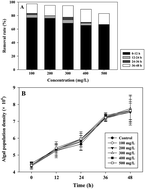
| Fig. 1 The removal rate of amoxicillin by the individual algal treatment (A) and the algal population growth during the treatment (B). | ||
![]() | ||
| Fig. 2 The removal rate of cefradine by the individual algal treatment (A) and the algal population growth during the treatment (B). | ||
:
1 and 7
:
1, 88.20% and 84.13% of the antibiotic was removed, respectively, after the Fenton treatment process. Additionally, with an increase in the H2O2/Fe2+ molar ratio, the contributions of the green algae increased from less than 20% to 54.47% (10
:
1) and 43.08% (20
:
1). More antibiotic was treated by the algal action and the primary removal efficiency attributed to the algal action in the first 12 h. Similar results were obtained when the combined treatment was applied to remove cefradine (Fig. 3B). Only 4.50%, 5.16%, 5.84% and 6.02% of the target antibiotic was residual, respectively after the total treatment. The contributions of the Fenton process and the green algae also varied at the different H2O2/Fe2+ molar ratios. With an increase in the ratio, the contributions of the green algae increased from 22.80% (4
:
1) to 57.11% (10
:
1) and then declined to 26.44% (20
:
1). Additionally, regardless of the H2O2/Fe2+ molar ratio, the primary removal efficiency attributed to the algal action in the first 12 h.
![]() | ||
| Fig. 3 The removal rate of the antibiotics amoxicillin (A) and cefradine (B) by the combined Fenton-algal treatment system. | ||
However, compared with the satisfactory growth capacity during the individual algal treatment process, the algal population densities were significantly lower than that of those in control during the entire treatment process for the two antibiotics (Fig. 4). For amoxicillin and cefradine, although the algal population increased slightly during the treatment when the H2O2/Fe2+ molar ratio was at 4
:
1, the maximum population size was 4.84 ± 0.02 and 4.29 ± 0.03 cells per mL, respectively, which was 61.91% and 52.45% of that in control. However, the algal population declined continuously during 48 h at any other given molar ratios of H2O2 and Fe2+ when treating the two antibiotics. As can be clearly seen in Fig. 4, the inhibition in the algal growth may be due to the impact of the residual H2O2, Fe iron and the antibiotic.
![]() | ||
| Fig. 4 The algal population after the Fenton oxidation process in the combined Fenton-algal treatment system. | ||
:
1. Therefore, the Fenton reagent dosage was reduced 4 times at the given H2O2/Fe2+ molar ratio. The removal efficiency of the two antibiotics using the combined Fenton-algal treatment, which reduced the dosage of the Fenton reagent, is presented in Fig. 5. Generally, at the end of the treatment, only 6.68% and 7.77% of the two antibiotics was residual, respectively. As the Fenton reagent dose was reduced, the final removal rate could reach to greater than 90%, which was nearly equal to that of the above normal combined treatment system. For amoxicillin, although the reduced amount of the Fenton reagent caused the removal rate of the chemical treatment process to decrease from 45.53% to 35.85%, the total contribution of the algal treatment was improved from 51.86% to 57.47%. Furthermore, we found that the algal population size increased during the entire treatment process, which was slightly lower than that of the control (Fig. 5B). Additionally, because the impact of the residual H2O2 and the Fe iron was weakened when the Fenton reagent was reduced, the algal population grew rapidly until the end of the cefradine treatment. The maximum population size was 9.58 ± 0.07 × 10⁶ cells per mL, which was approximately 17% higher than that in control.
![]() | ||
| Fig. 5 The removal rate of the antibiotics (A) and the algal population (B) by the combined Fenton-algal treatment system with the reduced Fenton regent. | ||
:
16 h light
:
dark condition, which was nearly as high as that under the continuous-light condition.18 For antibiotics, the degradation rate using the algae was also lower than the above results. C. vulgaris removed 36.9% of norfloxacin,13 and a reduction of 44% in the initial concentration of sulfonamides was attributed to the uptake from the algae Ulva lactuca.19 Although approximately 69% of tetracycline could be removed, the treatment time was extended to 62 days.20 In the present study, the removal rate of amoxicillin was higher than the above reported results, while that in cefradine treatment was significantly low. Our previous study also indicated that a 48 h total removal rate for cefradine by the green algae C. pyrenoidosa was lower than those of other cephalosporins even at a relevant lower concentration (10.0 mg L−1).21 Additionally, as mentioned in Fig. 1B and 2B, the removal rate was not improved with an increase in the algal population during any given treatment (such as 0–12 h, 12–24 h, etc.…). Although the total algal biomass was the lowest during the first 12 h, the unit algal cell performed at a high removal capacity, which caused a higher removal rate than any other period in the entire treatment. Particularly, in cefradine treatment, the population growth and the biomass accumulation could not improve the total removal efficiency. Our present resents indicated that the application of the individual algal treatment was limited for the two target antibiotics, especially at the relevant higher concentrations.
The Advanced Oxidation Processes (AOP) are characterized by their capacity for oxidizing and decomposing most organic contaminants. Due to the ease of operation and high efficiency, the Fenton process is one of the most practical oxidation processes used for the degradation of recalcitrant compounds, like herbicide, fungicide,22 especially for the antibiotic sulfathiazole, sulfamethoxazole, sulfamethizole, sulfadimethoxine, sulfamethazine and tiamulin.23 Our preliminary experiment also indicated that Fenton reaction performed a considerable treatment capacity on the two target antibiotics. About 80% of amoxicillin and cefradine was removed after 80 min. Despite its advantages, the primary drawbacks of the commercial application are high-costs, large consumption of reagents, and higher requirements of corrosion resistance for the equipment. Therefore, to overcome the deficiency, the Fenton oxidation has been considered as the pre-treatment and successfully applied to enhance the biodegradability. The combination with the biological process was performed as a cost-effective treatment step. Thus, multiform combined biological processes have been reported, such as the sequencing batch membrane bioreactor (SBMBR) system,24 sequencing batch reactor (SBR) system,25 anaerobic baffled reactor (ABR)26 and immobilized biomass reactor (IBR).27 Nevertheless, compared with the bacteria in the existing biological treatment system, the eukaryotic algae C. pyrenoidosa used in the current study was not the target organism of amoxicillin and cefradine, therefore, the target antibiotics will not be effective against C. pyrenoidosa. Our current results indicated that the green algae was highly tolerant to the impact of the antibiotics. Thus, the bacteria was replaced by the green algae in the current combined treatment system, which aimed to not only improve the removal efficiency but also avoid the emergence of the resistant bacteria strains and the antibiotic resistance genes (ARGs). To our knowledge, the Fenton oxidation and the algal treatment have been combined here for the first time. In the current treatment, the target of this integration between the chemical oxidation (Fenton reagent) and the algal treatment is to combine the best characteristics of each process, including both the economical and efficient advantages. Additionally, a higher removal rate and a shorter treatment occurred due to the combined Fenton-algal treatment when compared to the individual algal treatment. For amoxicillin and cefradine, the highest removal rates (97.36% and 22.52%) were obtained after 48 h of individual algal action, respectively, when the concentration of the antibiotics was 100 mg L−1. Furthermore, 97.63% and 91.08% of the antibiotic was removed, respectively after 12 h of algal action combined with the Fenton process, even if the relevant concentrations were increased to 1 g L−1. On the other hand, sewage sludge production during the current wastewater treatment has increased dramatically with implementation of environmental programs.28 The cost associated with sludge management has been around more than half of the total STPs operating costs.29 Thus, the sharp rise in sludge production and the increasing operation cost should be considered when more amount of wastewater needed to be treated by rapidly increasing population, industrialization, and urbanization in the near future. In contrast, when the satisfactory removal capacity has been obtained in the combined Fenton-algal treatment, the sharp rise in algae production not occurred in the present study. Thus, the cost of the excess algae management could be reduced in our combined treatment system.
Previous studies have indicated that the antibiotic removal increased with an increasing Fe2+ and then decreased with further increases in the Fe2+ dose because high Fe2+ doses caused a scavenging effect on hydroxyl radicals.30 In the current study, due to the settled dose of H2O2 (166.5 mg L−1), a higher H2O2/Fe2+ molar ratio indicates that more Fe2+ was added into the Fenton system. Additionally, our result indicated that the removal efficiency of the Fenton process and the contributions of the green algae varied with the change in the Fe2+ dose. Thus, during the coupling reaction, the treatment progress depended simultaneously on the amounts of Fenton reagent and the removal capability of the algae after the Fenton oxidation. Consequently, an appropriate H2O2/Fe2+ molar ratio should be considered.
Reactive oxygen species (ROS) are the by-products of normal respiration and photosynthesis processes in algae, which thought to be the main reason for the degradation of aniline.31 When the algae were exposed to environmental stress, especially the allelochemicals, ROS such as superoxide radical (O2−), hydrogen peroxide (H2O2) and singlet oxygen (O2) was produced in the cell, which serves as a response.32–35 Thus, the degradation mechanism of the antibiotics in the present study might also be contributed due to the action of ROS. On the other hand, the action of the green algae on the target antibiotic possibly included the adsorption and/or degradation, where occurred at cellular surface and/or inside the cell. Until now, information related to the metabolism of antibiotics or the destructive compounds by microalgae has not been published. We have also not detected the residual target antibiotics at the algal cellular surface or in the cell. Compared with the results in Fig. 1–3, it indicated that after the destructive treatment by the Fenton reaction, the target antibiotics were degraded to small molecular organic fragments. They could be easier eliminated by the algae as a carbon source and nitrogen source than the index compounds. Thus, it is feasible and available that the algal treatment could be combined with the Fenton reaction.
It also should be noted that the reduced amount of the Fenton reagent could not decrease the contribution of the Fenton treatment process, while the total removal rate of cefradine using the subsequent algal action was improved slightly from 53.99% to 55.27%. Thus, although the concentration of Fe2+ and H2O2 used in the current study was lower than that of the previous research,30 the Fenton regent could be reduced further in the current combined treatment system, which may avoid additional waste and a higher operational cost. Our hypothesis that the Fenton regent could be further reduced in the combined system has also been verified. In the present combined treatment, the Fenton reaction could be mainly attribute to decompose the target antibiotics into the possible by-products which could be utilized by the algae much easier. Therefore, coupling the chemical pre-oxidation with the biological post-treatment is conceptually beneficial because it can lead to increased overall treatment efficiencies compared with the efficiency, cost and possible environmental risk of each individual stage. However, how the structural changes of the target antibiotics in the chemical and biological treatment, respectively has not been known. The more advanced analytical methods like HPLC-MS/MS and algal metabonomics technique should be considered in our following study, which could help us to better deduce the chemical reactions and decipher the removal mechanism. The Fenton reagent could be further reduced if the optimum opportunity is confirmed when the target antibiotics were changed to an appropriate by-products or fragments for the algal utilization.
Footnote |
| † These authors contributed equally. |
| This journal is © The Royal Society of Chemistry 2015 |