S. Sfaeloua,
D. Raptisab,
V. Dracopoulosb and
P. Lianos*ab
aDepartment of Chemical Engineering, University of Patras, 26500 Patras, Greece
bFORTH/ICE-HT, P.O. Box 1414, 26504 Patras, Greece. E-mail: lianos@upatras.gr
First published on 3rd November 2015
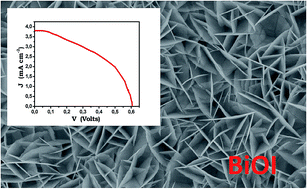
An inorganic solar cell was constructed using a thin compact supporting layer of titania with BiOI nanoflakes as a functional material, a Pt/FTO cathode and a I3−/I− redox electrolyte. The efficiency of the cell was 1.03% but this leaves a lot of ground for improvement, which is mainly expected to come from the optimization of the BiOI nanostructure.
In the present work, we have studied BiOI as active component of a liquid electrolyte solar cell using a BiOI/TiO2 photoanode. The construction of an all-inorganic solar cell is for sure advantageous vs. dye-sensitized solar cells or other hybrid organic–inorganic solar cells. For example, organometal halide perovskite solar cells demonstrated unprecedentedly high efficiency12 but they are vulnerable to ambient conditions, especially humidity. As it will be seen below, BiOI is far from approaching perovskite efficiencies, however, it offers a lot of ground for improvement, it is relatively stable and for this reason, it is worth being studied.
Cell construction is detailed in the experimental section. Briefly, the cell is composed of a BiOI/TiO2/FTO photoanode, a Pt/FTO cathode and a I3−/I− liquid electrolyte. BiOI/TiO2/FTO photoanode was made of a thin layer of compact nanoparticulate titania on which SILAR deposited BiOI forms nanocrystalline flakes of the characteristic shape seen in Fig. 1. The top image (A) of Fig. 1 shows pure compact titania nanostructure composed of nanoparticles of approximate size 10–20 nm and equivalent pore size. Image (B) shows a thin layer of BiOI, deposited by only 5 SILAR cycles, through which titania layer is visible. Finally, the bottom image (C) shows BiOI nanoflakes deposited by 15 SILAR cycles, thus making a thicker layer. Additional SILAR cycles created an even thicker film with similar nanostructure. A cross-sectional image of FTO layer, titania and BiOI layer can be seen in Fig. 2. It is obvious that these three layers are clearly separated without interpenetration. This is obviously expected, since the size of the BiOI nanoflakes is larger than 250 nm, therefore, they are too large to enter titania nanostructure.
![]() | ||
| Fig. 1 FESEM images of a BiOI film formed over titania: (A) titania alone; (B) BiOI deposited by 5 SILAR cycles; and (C) BiOI deposited by 15 SILAR cycles. Scale bar always corresponds to 200 nm. | ||
![]() | ||
| Fig. 2 Cross-sectional FESEM image of a BiOI/TiO2/FTO photoanode, made by 15 SILAR cycles. The scale bar is 200 nm. | ||
Verification of the formation of BiOI crystallites was done with XRD measurements presented in Fig. 3. Indeed, the only detectable lines correspond to BiOI and the FTO substrate. The titania film was too thin to give a detectable signal. Such photoanodes are visible-light responsive. Indeed, Fig. 4 reveals the presence of a species absorbing light up to 570 nm and a tail extending to higher wavelengths, which is apparently inactive, as revealed by the action spectrum of the cell also shown in Fig. 4. It is obvious from these results that BiOI/TiO2/FTO photoanodes are functional up to 570 nm, which corresponds to a band gap of 2.18 eV. The maximum theoretical photocurrent density for equivalent 1 sun incident radiation is approximately13 11 mA cm−2, for this wavelength range.
![]() | ||
| Fig. 3 XR diffractogram of a BiOI/TiO2/FTO photoanode. No titania lines were detected, obviously because titania layer was too thin to give a detectable signal. | ||
![]() | ||
| Fig. 4 Diffuse reflection absorption spectrum of a BiOI/TiO2/FTO photoanode and action spectrum of the corresponding solar cell. | ||
Cells made by using the above BiOI/TiO2/FTO photoanode produced current–voltage curves similar to curve (1b) shown in Fig. 5. The short-circuit current density Jsc was 3.8 mA cm−2, i.e. far below the upper theoretical limit of 11 mA cm−2, given in the previous paragraph. The open-circuit voltage Voc was 0.61 V and the fill factor 0.45, giving an overall efficiency PCE = 1.03%. This value is, of course, much lower than the corresponding values obtained with dye-sensitized solar cells14,15 but we believe that there is a lot of ground for improvement. The most serious reason for the low efficiency is low current density. There exists an obvious reason for the low current density value. BiOI nanoflakes are too large entities leaving a lot of space between them empty and thus decreasing the conductivity channels. Indeed, each flake is about only 12 nm thick but more than 250 nm wide. Packing in such a material is very poor, therefore, transfer of photogenerated charge carriers is equally poor. In addition, the interface with the underlying titania layer is apparently limited only to the geometrical area separating the two layers, without interpenetration. Thus charge (electron) transfer is additionally limited. Nevertheless, the present results are much improved compared to what was achieved in other works,3–7 where current densities smaller than 1 mA cm−2 have been reported. This rather impressive improvement is most probably due to the presence of the compact nanoparticulate titania layer between the FTO and the BiOI layer. This layer plays a multiple role: it encourages adsorption of precursor ions facilitating BiOI formation; facilitates electron conduction towards the electrode and prevents short circuits. A question then might arise as to the contribution of titania itself on the recorded current. Similar cells made without BiOI, where photoanodes supported only the titania layer gave current–voltage characteristics represented by curve (2) of Fig. 5. It is obvious that the titania film alone provides a negligible contribution.
The above data were obtained by using a BiOI/TiO2/FTO photoanode made by 15 SILAR cycles deposition. This number proved to be optimal. Indeed, photoanodes made by 7 and 20 SILAR cycles gave dramatically lower performance as clearly seen in Fig. 5. Nevertheless, more SILAR cycles and thicker BiOI film resulted in higher open-circuit voltage (curve 1c). Apparently, there is an optimal and at the same time crucial number of SILAR deposition cycles that makes the most efficient photoanode. We believe that this matter necessitates further studies in combination with the titania layer thickness. However, it seems that the most critical issue is to find ways for synthesizing a more dense material with smaller BiOI nanoparticles.
Comparison of action spectrum (IPCE(%)) and absorption spectrum in Fig. 3 shows that the two spectra are not similar. We believe that this discrepancy is an artefact and it is not fully representative of an optional action spectrum. The current produced is relatively low and action spectrum is recorded with high error. The important finding to keep in mind is the coincidence of the absorption threshold with the action spectrum threshold. It is for sure necessary to increase current in order to record a better action spectrum. Nevertheless, the discrepancy between the two spectra might also come from the possibility that not all of the synthesized BiOI nano-flakes are solar-cell active. Literature data16,17 indicate that most studied BiOI semiconductors show a p-type behaviour with valence band located around +2.4 V and conduction band around +0.6 V vs. NHE. The band gap (1.8 eV) then perfectly fits the long tail in the absorption spectrum of Fig. 4. Such a semiconductor cannot sensitize titania by electron injection since the titania conduction band lies much higher (around −0.2 V vs. NHE) than the conduction band of BiOI. However the above values are not unique. Other BiOI syntheses18 locate conduction band at −1.3 V and valence band at +0.5 V vs. NHE. This value was presently verified by preliminary UPS measurements. All these data indicate that BiOI presents a complicated behaviour and necessitates substantial additional work to clarify its properties.
:
F transparent conductive electrodes (FTO, resistance 8 Ω square−1) were purchased from Pilkington (USA).
| This journal is © The Royal Society of Chemistry 2015 |