Mohammed Adnan Mezaalab,
Limin Qua,
Guanghua Lia,
Rui Zhanga,
Jiang Xuejiaoa,
Ke Zhanga,
Wei Liua and
Lixu Lei
*a
aSchool of Chemistry and Chemical Engineering, Southeast University, Nanjing, 211189, People's Republic of China. E-mail: lixu.lei@seu.edu.cn; Fax: +86-25-52090618; Tel: +86-25-52090620-6421
bDepartment of Chemistry, College of Science, University of Karbala, Karbala, 56001, Iraq
First published on 27th October 2015
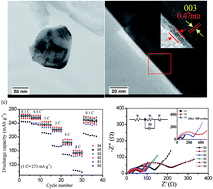
Nickel-rich layered lithium transition-metal oxides, Li1.2Ni1−xMxO2 (M = transition metal), have been studied intensively as high-energy positive-electrode materials for lithium batteries because of their high specific capacity and relatively low-cost. However, oxygen loss from the lattice during the initial charge and gradual structural transformation during cycling can lead to capacity degradation and potential decay of the cathode materials. This is due to the small size and highly oxidizing nature of tetravalent nickel. Herein, we report for the first time a series of promising core–shell structured positive-electrode materials with a general formula [Li1.2−xNaxNi0.62Co0.14Mn0.248O2], where x = 0, 0.05, 0.08, 0.10 and 0.12. The results clearly show that the manganese oxide coating has greatly improved the cycling stability and inhibited side reactions with the electrolytes. However, the manganese oxide coating can also retard the electrode reactions because it extends the diffusion path for lithium ion and results in increases in the charge transfer resistance. Sodium doping expands the lattice due to the fact that Na has higher ionic radii than those of Li. This facilitates the diffusion of Li-ions, reduces the charge transfer resistance and improves the electrochemical performance of the materials. Furthermore, sodium doping not only improves the discharge capacity, but it also improves the cycling stability even further. This is because Na has higher ionic radii than that of Li and hence Na has less tendency to migrate to “tetrahedral” sites in the Li/Na layer and restrict the structural transformation. However, the addition of Na higher than 0.1 decreases the capacity as Na has a higher weight than that of Li.
Among all the positive-electrode materials, LiCoO2 is the most used and qualified. However, its energy density also fails to meet the demands of today's consumers, it is not stable to heavy duties and very expensive because Co is rare.4,5 Therefore, researches on substitution of Co for cheaper and abundant elements, such as Mn and Ni, have been main concerns in last decades. One of the successful examples is Li[Ni1/3Co1/3Mn1/3]O2, which has already been commercialized for auto-mobile applications because it is relatively cheaper than LiCoO2 and its outstanding safety characteristics. However, its capacity of 155 mA h g−1 is quite low to be use in next generation EVs applications.6,7
It has been found that Ni-rich materials (Ni content > 60%) are promising cathode candidates for Li-ion batteries because of their high energy density, and low cost. In addition, they can deliver higher discharge capacities and work at higher voltages (4.4–4.8 V)8–10 than Li[Ni1/3Co1/3Mn1/3]O2, because the higher Ni content makes the main active redox species (Ni2+ ↔ Ni4+) more in the layered structure. However, fast capacity fading, poor thermal stability still plague their mass application. Furthermore, they can easily transform into an electrochemically inactive NiO-like or spinel phase with high volumetric changes. This is due to the small size and highly oxidizing nature of tetravalent nickel and it can result in the loss of oxygen, and migration of nickel ions to the lithium-depleted layer. The increased formation of NiO phase results in capacity fading, and moreover, repeated volumetric changes can result in the pulverization of the original active materials. This instability of the delithiated phase also causes safety issues and capacity fading.2,8,11–16 In addition, cycling the positive-electrode material at a temperature greater than 60 °C can also catalyze the reaction between electrode surface and electrolytes, which forms a non-conducting solid electrolyte interface (SEI) layer that increases the diffusion path of Li+ ion and deteriorates the electrochemical performance of the material.17–19
To date, intensive research has been carried out to improve such structural stability of Ni-rich materials via surface coating or core shell structuring.10,17,20–27 Sun et al. reported a Ni-rich core–shell structured Li[(Ni0.8Co0.1Mn0.1)0.8(Ni0.5Mn0.5)0.2]O2, which delivers 200 mA h g−1 at 40 mA g−1 and it delivers a discharge capacity of 120 mA g−1 at 1C and retains a discharge capacity of 98% after 500 cycles. They have attributed the high capacity to the core (Li[Ni0.8Co0.1Mn0.1]O2) and the good thermal stability to the manganese rich-shell (Li[Ni0.5Mn0.5]O2 shell).11 Recently, Cho et al. have synthesized a Ni-rich positive-electrode material LiNi0.6Co0.2Mn0.2O2 coated with SiO2 layer, their result showed that its cycle performance and thermal stability can be improved because SiO2 has reduced the side reaction between the electrode and electrolyte, although the discharge capacity of the material decrease along with increase of Si content due to sluggish kinetics of Li+ diffusion.28 Lu et al. reported a LiMO2 material coated with nanoscale Li2TiO3. They found that the thin film of Li2TiO3 has significantly improved the cyclic stability of the material, and the charge transfer resistance of the coated material is much smaller than the uncoated one after many cycles.20 However, all the materials reported above (ref. 11 and 20) were cycled at relatively low upper voltage of 4.3 V.
Although considerable research has been done to improve the electrochemical performance of nickel rich materials, it is still need further efforts to design and prepare a more stable nickel rich materials for LIBs. On the other hand, among the positive electrode candidates currently being studied, Li-rich layered oxides are the most attractive for next generation LIBs due to their high specific capacities exceeding 200 mA h g−1.29–32
Sun et al. reported (Li1.2Ni0.62Co0.15Mn0.25O2) positive-electrode materials. Their results showed that this material has poor cycling stability and low thermal stability. They also reported that increasing Mn content in the shell can improve the thermal stability of the material.33 Therefore, in this study, we have chosen the Li-excess Ni-rich materials system (Li1.2Ni0.62Co0.14Mn0.24O2) to further enhance its stability and to improve its electrochemical performance via manganese coating well as sodium doping, because as reported earlier that manganese coating can provide good thermal stability to the material, while sodium doping can increase the discharge capacity.11,34–36 Our results show that coating the material has significantly improved its cycling stability. However, by using the impedance spectroscopy techniques, we have found that coating the material has increased the charge transfer resistance due to increases of the diffusion path of Li-ions. It has been reported that sodium doping can enlarges the lattices volume, reduces the charge transfer resistance and increases the discharge capacity of layered structure materials.35,37,38 Therefore, we have doped the surface modified materials with sodium to reduce its charge transfer resistance and to further improve its electrochemical performance. Na has higher ionic radii than that of Li and because of this fact, Na has expanded the lattice, reduced the charge transfer resistance and significantly increased the discharge capacity of the surface modified materials.
Coating of manganese oxide on the surface of Ni0.62Co0.14Mn0.24CO3 was achieved as followed: 0.177 g of MnSO4·H2O was dissolved in 50 ml of deionized water and added into 100 ml of aqueous suspension containing 2 g of the precursor Ni0.62Co0.14Mn0.24CO3 and 0.223 g of Na2CO3. The resulted suspension was aged for 12 h at 60 °C, filtered, washed three times with deionized water and dried in a vacuum at 100 °C.
The final lithiated positive-electrode material materials Li1.2−xNaxNi0.62Co0.14Mn0.248O2 (x = 0, 0.05, 0.08, 0.10 and 0.12) were obtained by mixing stoichiometric powder of the coated precursor with a proper amount of Li2CO3 and Na2CO3. The mixture was first heated at 450 °C for 8 h, followed by baking at 850 °C for 12 h in air. The furnace ramp rate was maintained at 2 °C min−1. The coated material with the nominal formula [Li1.2−xNaxNi0.62Co0.14Mn0.248O2], where x = 0, 0.05, 0.08, 0.1 and 0.12, have been denoted as S1, S2, S3, S4 and S5, respectively.
The material Li1.2Ni0.62Co0.14Mn0.24O2 without coating, denoted as S0, was synthesized with a similar method, except that the uncoated precursor is mixed with a proper amount of Li2CO3 directly.
The morphology of the materials was observed using a scanning electron microscope (SEM, FESEM Hitachi SU8010). Transmission electron microscopy (TEM) was performed on a JEM2000EX transmission electron microscope. Chemical compositions of the samples were determined using inductively coupled plasma (ICP-OES, Optima 8000).
To test the electrochemical performance, powder samples were mixed with acetylene carbon black (AB) and poly(vinylidene fluoride) (PVDF), to a weight ratio of 80
:
10
:
10, then dispersed in 1-methyl-2-pyrrolidinone (NMP). The slurry was spread onto a piece of aluminum foil, a typical loading of the thin electrodes is about 2–3 mg cm−2 and then dried in vacuum oven at 100 °C for 24 h. The test CR 2032 coin cells were assembled in an Ar-filled glove box with Li metal as the counter electrode, 1 M LiPF6 dissolved in ethylene carbonate (EC) and dimethyl carbonate (DMC) as the electrolyte. The cells were galvanostatically charged/discharged within the range of 2.5–4.8 V at room temperature instead of upper voltage of 4.5 V. The cells were galvanostatically charged at different current densities to 4.8 V, followed by additional constant-voltage (CV) charging step at 4.8 V for 20 min and then discharged galvanostatically at the same current density as the charging process to 2.5 V using a battery cycler (Land battery testing system) at room temperature. The current densities used were 27, 136, 273, 546, 1092 and 2184 mA g−1, corresponding to C rates, 0.1, 0.5, 1, 2, 4 and 8C (1C = 273 mA g−1). Cyclic voltammetry (CV) tests were performed on a CHI660D electrochemical workstation at a sweep rate of 0.5 mV s−1. The electrochemical impedance spectroscopy (EIS) was carried out on an electrochemical analyzer within a frequency range between 105 Hz and 0.01 Hz and an AC amplitude of 5 mV.
| Sample No. | Observed molar ratio | Proposed molar ratio |
|---|---|---|
| S0 | Li1.18Ni0.62Co0.155Mn0.31 | Li1.2Ni0.62Co0.14Mn0.24 |
| S1 | Li1.19Ni0.62Co0.157Mn0.322 | Li1.2Ni0.62Co0.14Mn0.248 |
| S2 | Li1.118Na0.046Ni0.62Co0.157Mn0.322 | Li1.15Na0.05Ni0.62Co0.14Mn0.248 |
| S3 | Li1.115Na0.077Ni0.62Co0.155Mn0.322 | Li1.12Na0.08Ni0.62Co0.14Mn0.248 |
| S4 | Li1.09Na0.098Ni0.62Co0.155Mn0.322 | Li1.1Na0.1Ni0.62Co0.14Mn0.248 |
| S5 | Li1.108Na0.107Ni0.62Co0.156Mn0.321 | Li1.08Na0.12Ni0.62Co0.14Mn0.248 |
The XRD patterns in Fig. 1 show that the synthesized samples are all phase-pure without any impurity peaks detected. All the diffraction peaks of the XRD pattern could be indexed based on the layered hexagonal structure of α-NaFeO2 type lattice belonging to the space group R
m.39–42 There is no reflection appears in the ∼20–23° 2θ range that indicates the absence of Li2MnO3 phase due to the low content of manganese, and the patterns can be described inarguably as a single phase LiMO2 (see ref. 43 for more information).43,44 In the XRD patterns, the (006)/(102) peaks of sample S4 are well spilt, suggesting a well-defined layered structure formed in the lattice. A careful analysis of the XRD pattern indicates that the (003) peak of the Na-doped samples move slightly toward the lower angle region. This suggests that the Na ions could be completely introduced into the alkali ion layer in the lattice, which enlarges substantially the Li slab space.38 The lattice parameters and particle sizes are shown in Table 2. The carefully refined lattice parameters indicate that there is no lattice expansion as a result of manganese coating. It can be seen that sodium doping increases the values of a, c and I003/I104 due to the fact that Na has higher ionic radii than Li. This lattice expansion can makes the lithium intercalation/de-intercalation easier as well as decreases the degree of cation mixing, which make well-defined layered structure.45
![]() | ||
| Fig. 1 X-ray powder diffraction patterns of the pristine and the surface modified samples. Sample S4′ is the S4 after 100 charge–discharge cycles. | ||
| Sample No. | a (Å) | c (Å) | c/a | I003/I104 | Particle sizea (nm) |
|---|---|---|---|---|---|
| a Particle size of the surface modified and the pristine materials evaluated by SEM. | |||||
| S0 | 2.862 | 14.270 | 4.989 | 1.259 | 300–500 |
| S1 | 2.863 | 14.270 | 4.984 | 1.284 | 200–300 |
| S2 | 2.875 | 14.292 | 4.971 | 1.396 | 80–200 |
| S3 | 2.890 | 14.300 | 4.948 | 1.595 | 80–200 |
| S4 | 2.896 | 14.320 | 4.944 | 1.620 | 80–200 |
| S5 | 2.898 | 14.342 | 4.948 | 1.621 | 80–200 |
Fig. 2 shows the SEM images of the samples. The grains of the pristine sample S0 are irregular with dimensions ranging from 300 nm to 500 nm. However, it is less aggregated than the manganese coated sample S1. The grains of the sodium doped samples are secluded from each other and has better crystallinity than the undoped samples. These results indicate that sodium doping significantly improves the crystallinity of the material. The structure and morphology of the rod-like particles appearing in all of the sodium doped samples. They have the same α-NaFeO2 type structure (space group R
m) as shown in Fig. 3, but they are impurity particles coming from the crucible.
The structure and morphology of the pristine sample S0 and the surface modified material S4 were further characterized by Transmission Electron Microscope (TEM), which is shown in Fig. 4. The irregular primary particle of the pristine material is well-crystallized, and its selected area electron diffraction (SAED) pattern exhibits sets of lattice fringes with 0.470 nm, 0.245 nm, 0.237 nm, 0.235 nm, and 0.200 nm interplanar spacing, which corresponds to the (003), (101), (006), (012), and (104) diffractions of the layered structure (α-NaFeO2 type, space group R
m), respectively.46 Spinel phase in the pristine samples were observed in TEM diffraction pattern, but it could not be observed in the XRD pattern due to the low content of the spinel phase.
The high-resolution transmission electron microscope (HRTEM) image of sodium doped material S4 shows well-crystallized particles and a very uniform shell of ∼2.4 nm thickness. The SAED pattern of the sample S4 exhibits a lattice fringe of 0.142 nm, which can be indexed to the (110) diffraction of the α-NaFeO2 type structure (space group R
m). As shown in the enlarged image, the inner part shows a typical layered structure with interplanar spacing of 0.47 nm which corresponds to spacing of (003) planes. These results are in good agreement with the XRD patterns.
Scanning transmission electron microscopy was used to characterize the nanoscale coat on sample S4, Li1.09Na0.098Ni0.62Co0.155Mn0.322O2 (Fig. 5). It can be seen that the intensities of Mn and Li in the shell are much higher than those of Ni and cobalt. This indicates that the outer layer was manganese oxide, but it was lithiated by Li2CO3 at high temperature. The shell thickness is about 2.5 nm which is in good agreement with the previous TEM results. Moreover, Ni, Co and Mn are homogeneously distributed in the core of the particles, as reflected by the EDS line scan results.
![]() | ||
| Fig. 5 (a) HAADF-STEM image and (b) STEM-EDS for (Ni, CO and Mn) and STEM-EELS for (Li), intensity line profiles extracted from the spectrum image data along the red line drawn on (a). | ||
| Cycling state | Rs and Rct (Ω) | S0 | S1 | S2 | S3 | S4 | S5 |
|---|---|---|---|---|---|---|---|
| 1st cycle | Rs | 6.552 | 6.680 | 3.276 | 3.124 | 3.008 | 3.012 |
| Rct | 124.9 | 150.1 | 89.28 | 72.93 | 64.89 | 69.35 | |
| 100th cycle | Rs | 8.9 | 6.762 | 3.298 | 3.1354 | 3.400 | 3.981 |
| Rct | 560.8 | 151.1 | 91.09 | 75.16 | 67.89 | 75.31 |
To evaluate the effect of Mn coating and sodium doping on the stability of the materials, samples S0, S1 and S4 have been cycled between 2.0 and 4.8 V at 546 mA g−1. The pristine material S0 delivers a discharge capacity of 175 mA h g−1 initially and its capacity retention is only 74% after 100 cycles (Fig. 6b), while the discharge capacity of the Mn-coated sample S1 is 215 mA h g−1 and retains 92% of its capacity after 100 cycles. This results clearly indicates the manganese coated layer is very effective to inhibit the side reactions with the electrolytes.
As can be seen in Fig. 6b, the sample S4 delivers a discharge capacity of 228 mA h g−1 and retains 95% of its capacity after 100 cycles. This indicates that sodium doping not only increases the discharge capacity, but it does further improves the cycling stability due to the fact that Na has higher ionic radii than Li and because of that Na has less tendency to migrate to “tetrahedral” sites in the Li/Na layer and restricts the structural transformation.
To further study the effect of Na doping and manganese coating on the cycling stability, the cells were cycled between 2.0 and 4.8 V at current densities of 27, 136, 273, 546, 1092 and 2184 mA g−1 at room temperature (Fig. 6c). It can be seen that the pristine sample S0 delivers a discharge capacity of 245 mA h g−1 at 0.1C, which falls to 104 mA h g−1 at 8C and 201 mA h g−1 at 0.1C after overall 37 cycles, which is 84% of the initial value, while those for Mn-coated S1 are 244 mA h g−1 at 0.1C, 144 mA h g−1 at 8C and 239 mA h g−1 at 0.1C at the 100th cycle, which is 97% of the initial value. Such a large capacity fading of the pristine sample could be attributed to the high reactivity of Ni4+ and Co3+ at high voltage toward the electrolytes, which results in the loss of oxygen, migration of the transition metal ions into the lithium-depleted layer, and subsequent degradation of the active material.14–17 In a comparison with the recently reported LiMO2 in ref. 43, the coated sample S1 in this work exhibits much improved cycling performance under higher current density.
Sodium doping has increased the discharge capacity remarkably (Fig. 6c) at all rates. Among the four sodium-doped samples, S4 delivers the highest discharge capacity at all the rates (Fig. 6c). Such excellent rate capability of the Na-doped samples could be attributed to the enlargement of the Li slab space by the Na doping that facilitates the diffusion of lithium ion in the bulk of the material and to the orientation growth of the Na-doped lattice along the direction of the layer, which promotes the fast insertion and extraction of Li ions. It is noteworthy that when the current is reduced back to 0.1C, the discharge capacity of the S4 cell can recover to 257 mA h g−1 while the pristine cell delivers only 201 mA h g−1. Furthermore, it is found that the discharge capacity increases along with the increase of I003/I104 values (Table 2) as evaluated from the XRD data. These indicate that sodium doped samples can tolerate the impact of high current density and restrict the structure transformation which result in an increase in the utilization of the materials.35,37,38
Cyclic voltammetry measurements have also been carried out to evaluate the effects of surface modification and sodium doping (Fig. 7). The fresh electrode was scanned anodically (Li extraction), followed by a corresponding cathodic scan (Li insertion). One pair of redox peaks was observed for all the prepared samples. It is known that the anodic peaks located in the potential range between 4 and 4.2 V are due to the oxidation process of Ni2+ and Co3+ to higher oxidation states.47 Moreover, sample S0 shows a pair of a broad redox peaks with high potential difference (ΔEp), which indicates that the redox reaction is hard to take place reversibly. In addition, the anodic peak current of sample S0 is very small in comparison with the others, which indicates a slower rate of the redox reaction. All the surface modified materials show sharper redox peaks, and smaller ΔEp than the pristine material S0, and the peaks of sodium doped samples are even sharper. Moreover, the anodic peaks of all surface modified materials are at lower potentials than the pristine material, which means that the polarization is reduced. Among all the samples, the anodic peak intensity of sample S4 is the highest, which means S4 components are very easy to be oxidized.
![]() | ||
| Fig. 7 Cyclic voltammograms of coated and pristine LiMO2 half-cells at a sweep rate of 0.5 mV s−1 in the range of 4.5–2 V at room temperature. | ||
Fig. 8 shows the electrochemical impedance spectroscopy (EIS) of the materials after the first cycle, which shows that the charge transfer resistance (Rct) of the surface modified material is higher than that of the pristine material (Table 3). This means that Mn-coating has increased the diffusion path of Li+ ion. However, sodium doping has significantly decreased the Rct values, and sample S4 has the smallest Rct value among all the synthesized samples, which is in accordance with its superior electrochemical performance. This is due to the fact that sodium has a higher ionic radii than Li which expands the lattice c. To further evaluate the structure stability, we have also measured the electrochemical impedance spectroscopy after cycling the cells for 100 times at 2C (Table 3 and the inset of Fig. 8). It is clear that the Rct value of sample S0 increases from 124.9 to 560.8 Ω, but those of the Mn oxide coated samples did not change significantly. This phenomenon has also been found in the literature.28 Therefore, manganese coating has significantly inhibited the growth of SEI film on the surface of the electrode material, as it is well known that the SEI film thickens upon cycling due to the high reactivity of nickel and cobalt ions toward the electrolyte and results in deterioration of the electrochemical performance.23
![]() | ||
| Fig. 8 Nyquist plots and the equivalent circuit of the half-cells after the 1st cycle. The inset is the Nyquist plots of the cells after 100 charge–discharge cycles at 2C. | ||
The XRD pattern of the synthesized sample S4 after 100 charge–discharge cycles shows that the material is still single phase without any impurity peaks detected (Fig. 1-S4′). All the diffraction peaks of the XRD pattern could be indexed based on the layered hexagonal structure of α-NaFeO2 type lattice belonging to the space group R
m.39–42 The calculated a and c values of the cycled material are 2.893 and 14.315, respectively, which are very slightly smaller to the corresponding values of the original material. The 003 peak of the cycled material is a little broader with lower intensity than the original material's peak, which means that the crystallinity of the material is reduced upon cycling. These results indicate that the synthesized material is very stable even when it cycled at high potential of 4.8 V.
To further evaluate the structure stability of the material, we have characterized the material after being cycled for 100 charge–discharge cycles by the high-resolution transmission electron microscope (HRTEM) (Fig. 9). The SAED pattern exhibits a lattice fringes of 0.47, 0.235, 0.243, 0.186 and 0.143 nm, which can be indexed to the 003, 006, 101, 015 and 018 diffractions of the α-NaFeO2 type structure, respectively (space group R
m). As shown in the enlarged image, the inner part shows a typical layered structure with interplanar spacing of 0.47 nm which corresponds to spacing of (003) planes. These results are in good agreement with the XRD pattern. Therefore, the outer Li–Mn–O layer of the particle (shell) has significantly improved the stability of the structure, the material still exhibits single phase and there is little structural changes observed after 100 charge–discharge cycles.
![]() | ||
| Fig. 9 TEM images and electron diffraction patterns of the S4 material after 100 charge–discharge cycles. | ||
All the synthesized materials are single phased and isostructural with LiNiO2 (α-NaFeO2 type, space group R
m). The coating layer increases the diffusion path of lithium ion and increases the charge transfer resistance (Rct). However, it has significantly improved the cycling stability even when the material cycled at high voltage of 4.8 V and high current density.
A proper amount of sodium doping has improved the crystallinity of the material, substantially expanded the Li slab space due to the higher ionic radii of Na than that of Li which resulted in reduced Rct value and improved the discharge capacity. Furthermore, sodium has improved the cycling stability even further due to the fact that Na has higher ionic radii than that of Li and because of this fact, Na has less tendency to migrate to “tetrahedral” sites in the Li/Na layer and restricts the structural transformation. However, addition of Na higher than 0.1 decreases the capacity as Na is higher weight than that of Li.
| This journal is © The Royal Society of Chemistry 2015 |