DOI:
10.1039/C5RA12700A
(Paper)
RSC Adv., 2015,
5, 77417-77422
An amino-decorated NbO-type metal–organic framework for high C2H2 storage and selective CO2 capture†
Received
30th June 2015
, Accepted 7th September 2015
First published on 7th September 2015
Abstract
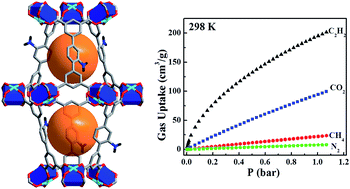
A novel amino-decorated NbO-type metal–organic framework [Cu2(C22H11NO8)(H2O)2]·(DMF)6·(H2O), (ZJU-8, ZJU = Zhejiang University; DMF = N,N-dimethylformamide) has been synthesized and structurally characterized. The activated ZJU-8a exhibits both a high C2H2 uptake capacity (195 cm3 g−1 at 1 bar) and a moderately high adsorption selectivity for CO2 over N2 (12.27) and CH4 (7.38) at room temperature.
1. Introduction
Emerging as a novel class of crystalline porous materials, microporous metal–organic frameworks (MOFs) have great potential applications in gas storage and separation due to their large surface areas, tunable pore sizes and shapes.1–4 Meanwhile, the pore surfaces can be systematically modified through the immobilization of specific sites, such as open metal sites and functional groups including –NH2, and –COOH, to induce their stronger interactions with gas molecules.5,6
The NbO-type series of MOFs, self-assembled from a tetratopic bis(isophthalic acid) linker and a copper paddle-wheel Cu2(COO)4 cluster, have already attracted extensive attention since the first NbO-type MOF-505 was reported ten years ago.7–9 Specifically, ligand extension and decoration are good strategies to tune their porosities and functionalize their pore surfaces for gas storage and separation. For example, the introduction of the Lewis basic sites into the framework leads ZJU-5 to exhibit stronger interaction with C2H2 molecules,7b while the central “dynamic” pyrimidine groups within UTSA-76 significantly enhances the methane storage and working capacities.7c Herein, we report a novel amino-decorated NbO-type metal–organic framework [Cu2(L)(H2O)2]·(DMF)6·(H2O) (ZJU-8, ZJU = Zhejiang University; DMF = N,N-dimethylformamide) built from the tetracarboxylate link H4L (Scheme 1) (H4L = 2′-amino-[1,1′:4′,1′′-terphenyl]-3,3′′,5,5′′-tetracarboxylic acid). The activated ZJU-8a exhibits high porosity with a Brunauer–Emmett–Teller (BET) surface area of 2501 m2 g−1 and pore volume of 1.0224 cm3 g−1. With multifunctional adsorption sites, ZJU-8a shows a high C2H2 uptake capacity of 195 cm3 g−1 at 1 bar and 298 K; meanwhile, ZJU-8a exhibits a moderately high adsorption selectivity for CO2/N2 (15/85) of 12.27 and CO2/CH4 (50/50) of 7.38 at 298 K, respectively.
 |
| | Scheme 1 The organic linker H4L for the construction of ZJU-8. | |
2. Experimental
2.1. Gas sorption measurements
A Micromeritics ASAP 2020 surface area analyser was used to measure gas sorption isotherms. In order to remove guest solvent molecules in the framework, the as-synthesized sample of ZJU-8 was treated with anhydrous acetone for 3 days and then activated at 373 K under high vacuum until the outgas rate was <5 μm Hg min−1 before measurements.
2.2 Fitting of pure component isotherms
Experimental adsorption isotherms for CO2, N2 and CH4 in ZJU-8a were measured at 273 and 298 K and fitted on the basis of the dual site Langmuir–Freundlich equation:| |
 | (1) |
where p (kPa) is the pressure of the bulk gas at equilibrium with the adsorbed phase, N (mol kg−1) is the adsorbed amount per mass of adsorbent, Nmax1 and Nmax2 (mol kg−1) are the saturation capacities of sites 1 and 2, b1 and b2 (kPa−1) are the affinity coefficients of sites 1 and 2, and n1 and n2 represent the deviations from an ideal homogeneous surface. The fitting parameters of DSLF equation are presented in Table S3.†
Adsorption isotherms and gas selectivities calculated by Ideal Adsorbed Solution Theory (IAST)10 for mixed CO2/N2 (15/85) and CO2/CH4 (50/50) in the ZJU-8a. The adsorption selectivities, Sads, are defined by the following equation:
| |
 | (2) |
in which
pi the bulk gas pressure of species
i, and
qi the component molar loading of species
i.
2.3 Estimation of the isosteric heats of gas adsorption
A virial-type expression was employed to calculate the enthalpies of adsorption on ZJU-8a. The data were fitted using the equation:| |
 | (3) |
where the p is pressure, n is the amount adsorbed, and A0, A1, etc., are virial coefficients.
The isosteric heat of adsorption, Qst, defined as
| |
 | (4) |
2.4 Synthesis and characterization of ZJU-8
A mixture of the organic link H4L (15 mg, 0.0356 mmol) and Cu(NO3)2·2.5H2O (30 mg, 0.0645 mmol) was dissolved into 8 mL mixed DMF/H2O solvent (3/1, v/v) in a 20 mL screw-capped vial, then 100 μL HCl (37%, aq.) was added, the mixture was sonicated until homogenous. The vial was capped and placed in a precise oven at 80 °C for 1 day. The resulting blue rhombic shaped crystals were washed with DMF three times to afford ZJU-8 materials. Yield: 68%, calculated based on the ligand. According to the single-crystal structure determination, elemental analyses and thermogravimetric analysis (Fig. S1†), ZJU-8 can be formulated as [Cu2(L)(H2O)2]·(DMF)5·(H2O). TGA under a nitrogen atmosphere reveals a weight loss of 43.77% up to 528 K, corresponding to the loss of free DMF and H2O molecules and terminal water molecules (calcd 43.52%). Elemental analysis: calcd (C37H52Cu2N6O16, %): C, 46.10; H, 5.03; N, 8.72; found: C, 46.01; H, 5.31; N, 9.13.
3. Result and discussion
ZJU-8 was synthesized via a solvothermal reaction of Cu(NO3)2·2.5H2O and amino-decorated ligand H4L at 80 °C. The structure was characterized by single-crystal X-ray diffraction analysis and is isoreticular to other NbO-type MOFs. The framework of ZJU-8 is built from paddle-wheel Cu2(CO2)4 secondary building units (SBUs) which were connected by L4−. The copper atoms will become unsaturated upon axial aqua ligand removal. In the crystal structure, there exist two kinds of cages (Fig. 1) which are alternately stacked along the c axis. The first cage with a spherical-like pore of about 10.5 Å in diameter is formed from six ligands and six paddlewheel SBUs; while the second one with a shuttle-shaped cage of approximately 9.5 × 22.5 Å is constructed from twelve ligands and six paddlewheel SBUs, each cage has open triangular windows of 5.0 Å in dimension along c axis. PLATON program11 showed the accessible pore volume of ZJU-8 is 63.3% (7355 Å3 out of 11
618 Å3 per unit cell volume), which is slightly smaller than the non-modified prototype NOTT-101 (ref. 8a) of 67.4% (7801 Å3 out of 11
569 Å3 per unit cell volume). After removal of the coordinated water, the framework density is 0.690 g cm−3.
 |
| | Fig. 1 (a) a spherical-like cage of about 10.5 Å in diameter and (b) a shuttle-shaped cage of about 9.5 × 22.5 Å (Cu, blue; C: gray; O: red; H: black) in the crystal structure of ZJU-8. | |
To confirm the permanent porosity of ZJU-8a, N2 sorption isotherm at 77 K was measured. Prior to measurements, the acetone-exchanged sample of ZJU-8 was vacuum-dried at 373 K to obtain the activated ZJU-8a. The phase purity of both the fresh and de-solvated samples were confirmed by powder X-ray diffraction (Fig. S2†), suggesting ZJU-8a maintains its crystalline nature. The reversible type-I N2 sorption isotherm at 77 K (Fig. 2) clearly indicated the microporous nature of the framework. At P/P0 = 0.99, ZJU-8a can adsorb 661 cm3 g−1 N2 with the corresponding pore volume of 1.0224 cm3 g−1. The calculated Brunauer–Emmett–Teller (BET) surface area is 2501 m2 g−1 (Fig. S4†), which is slightly larger than the nitro-decorated NJU-Bai 14 (ref. 9a) of 2384 m2 g−1, benzothiadiazole-based ZJNU-40 (ref. 7g) of 2209 m2 g−1 and naphthyl-modified ZJU-7 (ref. 7e) of 2198 m2 g−1. Obviously, the pore volume and BET surface area of ZJU-8a are systematically smaller than those of the prototype NOTT-101 (ref. 7f) (1.080 cm3 g−1 and 2805 m2 g−1) because of the occupancy of the amino groups inside the pore spaces.
 |
| | Fig. 2 N2 sorption isotherms of ZJU-8a at 77 K. Solid symbols: adsorption, open symbols: desorption. | |
The explosive nature of C2H2 needs us to store it under suitable low pressure. Among diverse porous materials, MOFs are promising ones for such an important application. The high surface area, open metal sites and functional amino groups within the framework of ZJU-8a encouraged us to study its C2H2 uptake capacity. C2H2 sorption isotherms (Fig. 3) were measured at both 273 K and 298 K. ZJU-8a exhibits high acetylene uptakes of 272 and 195 cm3 g−1 at 1 bar at 273 K and 298 K, respectively. The gravimetric acetylene storage at 298 K of 195 cm3 g−1 uptakes is among the highest for MOFs (e.g. HKUST-1 (ref. 12a) (201 cm3 g−1), CoMOF-74 (ref. 12b) (197 cm3 g−1), ZJU-5 (ref. 7b) (193 cm3 g−1), ZJU-70 (ref. 12c) (191 cm3 g−1), NOTT-101 (ref. 12d) (184 cm3 g−1), PCN-16 (ref. 7i) (176 cm3 g−1)) and FJI-H8 (ref. 12e) (224 cm3 g−1). To our best knowledge, ZJU-8a shows the highest gravimetric acetylene uptake capacity among these series of NbO-type MOF materials at room temperature (Table S4†). Considering the framework density of 0.690 g cm−3, the volumetric capacities are 188 and 134 cm3 cm−3 at 273 K and 298 K, respectively. The initial Qst of acetylene adsorption is 29.6 kJ mol−1 (Fig. S5†), which is comparable to those in other MOFs with copper paddlewheels.
 |
| | Fig. 3 C2H2 sorption isotherms at 273 K and 298 K. Black: 273 K; red: 298 K; solid symbols: adsorption, open symbols: desorption. | |
Carbon dioxide (CO2), which is a major greenhouse gas, has attracted more and more attention owing to the greenhouse effect. MOF materials have shown great potential as adsorbents for CO2 capture and separation to reduce anthropogenic CO2 emission and lower the concentration of CO2 in the atmosphere. It has been reported that the incorporating of nitrogen-containing organic groups is capable of increasing CO2 binding affinity.13,14 Herein, we inspected the role of –NH2 group in the process of selective adsorption of CO2/N2 and CO2/CH4. Accordingly, CO2, CH4 and N2 sorption isotherms were measured at 273 K and 298 K at low pressure. As show in Fig. 4, ZJU-8a can systematically take up much more CO2 than CH4 and N2, indicating that ZJU-8a has potential application in the separation of CO2/N2 and CO2/CH4 mixtures. ZJU-8a exhibited a CO2 uptake capacity of 165 cm3 g−1 at 273 K and 95 cm3 g−1 at 298 K at 1 bar, respectively. Remarkably, the gravimetric CO2 adsorption capacity at room temperature is slightly higher than those of prototype MOF NOTT-101 (ref. 12d) (83 cm3 g−1), NOTT-125 (ref. 13e) (93 cm3 g−1), HNUST-1 (ref. 9b) (93 cm3 g−1), UTSA-40 (73 cm3 g−1)7j and NU-135 (ref. 9f) (79 cm3 g−1).
 |
| | Fig. 4 CO2 (blue), CH4 (red) and N2 (green) sorption isotherm at 273 K (a) and 298 K (b). Solid symbols: adsorption, open symbols: desorption. | |
The well-known Ideal Adsorbed Solution Theory (IAST) was used to calculate the adsorption selectivities and CO2 uptake of ZJU-8a for the following binary gas mixtures: CO2/N2 (15/85) and CO2/CH4 (50/50), which mimic post-combustion capture applications and biogas treatment. As shown in Fig. 5, ZJU-8a exhibits high selectivity for these two mixture compositions. Specifically, the IAST selectivity in a 15
:
85 molar ratio of CO2 and N2 mixtures has high value of 43.6 at 273 K and 12.3 at 298 K at a very low pressure. The CO2/CH4 selectivities were calculated to be 8.2 at 273 K and 7.4 at 298 K at low pressure for an equimolar gas mixture, which are systematically higher than those found in prototype MOF NOTT-101,7g suggesting that incorporation of –NH2 group into the framework is a promising method to enhance CO2 adsorptive separation capacity. Fig. S6 and 7† present IAST calculations for gas uptake from 15/85 CO2/N2 and 50/50 CO2/CH4 gas mixtures maintained under isothermal conditions at 273 K and 298 K, respectively. Apparently, ZJU-8a can take up much more CO2 in all the cases. To understand the interaction between the framework and gas molecules, the isosteric enthalpy of adsorption, Qst, was calculated by using the pure component isotherm fitted by the virial method. As show in Fig. S8–10,† the Qst of CO2, CH4 and N2 are 21.9, 13.1 and 9.7 kJ mol−1 at zero loading, respectively, indicating that ZJU-8a exhibits a higher binding affinity for CO2 than those for CH4 and N2 during the adsorption process.
 |
| | Fig. 5 The adsorption selectivity predicted by IAST of ZJU-8a for CO2/N2 (15/85) (a) and CO2/CH4 (50/50) (b) at 273 and 298 K, respectively. | |
4. Conclusions
In summary, we have successfully constructed a novel amino-decorated NbO-type metal–organic framework ZJU-8. With high BET surface area of 2501 m2 g−1 and pore volume of 1.0224 cm3 g−1, the activated ZJU-8a exhibits high gravimetric acetylene storage capacity of 195 cm3 g−1 at 1 bar at room temperature. Meanwhile, the strategy of incorporating –NH2 group into framework through the enhanced interactions with acidic CO2 and narrowing down the pore sizes has been proved a promising method to enhance CO2 adsorption and separation capacities.
Acknowledgements
This work was supported by the National Natural Science Foundation of China (Grants 51272231 and 51229201), Program for Innovative Research Team in University of Ministry of Education of China (IRT13R54), The Project was supported by the Natural Science Foundation of Zhejiang province, China (LZ15E020001), Grant AX-1730 from the Welch Foundation (B. C.).
Notes and references
-
(a) M. Eddaoudi, J. Kim, N. Rosi, D. Vodak, J. Wachter, M. O'Keeffe and O. M. Yaghi, Science, 2002, 295, 469–472 CrossRef CAS PubMed;
(b) H. Furukawa, N. Ko, Y. B. Go, N. Aratani, S. B. Choi, E. Choi, A. Ö. Yazaydin, R. Q. Snurr, M. O'Keeffe, J. Kim and O. M. Yaghi, Science, 2010, 329, 424–428 CrossRef CAS PubMed;
(c) M. P. Suh, H. J. Park, T. K. Prasad and D.-W. Lim, Chem. Rev., 2012, 112, 782–835 CrossRef CAS PubMed;
(d) G. Férey, C. Mellot-Draznieks, C. Serre, F. Millange, J. Dutour, S. Surblé and I. Margiolaki, Science, 2005, 309, 2040–2042 CrossRef PubMed;
(e) J.-R. Li, J. Sculley and H.-C. Zhou, Chem. Rev., 2012, 112, 869–932 CrossRef CAS PubMed;
(f) S. S.-Y. Chui, S. M.-F. Lo, J. P. H. Charmant, A. G. Orpen and I. D. Williams, Science, 1999, 283, 1148–1150 CrossRef CAS;
(g) B. Chen, M. Eddaoudi, S. T. Hyde, M. O'Keeffe and O. M. Yaghi, Science, 2001, 291, 1021–1023 CrossRef CAS PubMed;
(h) E. D. Bloch, W. L. Queen, R. Krishna, J. M. Zadrozny, C. M. Brown and J. R. Long, Science, 2012, 335, 1606–1610 CrossRef CAS PubMed.
-
(a) Y. He, W. Zhou, G. Qian and B. Chen, Chem. Soc. Rev., 2014, 43, 5657–5678 RSC;
(b) K. Sumida, D. L. Rogow, J. A. Mason, T. M. McDonald, E. D. Bloch, Z. R. Herm, T.-H. Bae and J. R. Long, Chem. Rev., 2012, 112, 724–781 CrossRef CAS PubMed;
(c) Z. Zhang, S. Xiang and B. Chen, CrystEngComm, 2011, 13, 5983–5992 RSC;
(d) Y. He, W. Zhou, R. Krishna and B. Chen, Chem. Commun., 2012, 48, 11813–11831 RSC;
(e) H.-L. Jiang, T. A. Makal and H.-C. Zhou, Coord. Chem. Rev., 2013, 257, 2232–2249 CrossRef CAS PubMed;
(f) B. Li, H. Wang and B. Chen, Chem.–Asian J., 2014, 9, 1474–1498 CrossRef CAS PubMed;
(g) T. M. McDonald, J. A. Mason, X. Kong, E. D. Bloch, D. Gygi, A. Dani, V. Crocella, F. Giordanino, S. O. Odoh, W. S. Drisdell, B. Vlaisavljevich, A. L. Dzubak, R. Poloni, S. K. Schnell, N. Planas, K. Lee, T. Pascal, L. F. Wan, D. Prendergast, J. B. Neaton, B. Smit, J. B. Kortright, L. Gagliardi, S. Bordiga, J. A. Reimer and J. R. Long, Nature, 2015, 519, 303–308 CrossRef CAS PubMed;
(h) Y.-X. Tan, Y.-P. He and J. Zhang, RSC Adv., 2015, 5, 7794–7797 RSC.
-
(a) S. Yang, X. Lin, W. Lewis, M. Suyetin, E. Bichoutskaia, J. E. Parker, C. C. Tang, D. R. Allan, P. J. Rizkallah, P. Hubberstey, N. R. Champness, K. Mark Thomas, A. J. Blake and M. Schröder, Nature Matrials, 2012, 11, 710–716 CrossRef CAS PubMed;
(b) K. Koh, A. G. Wong-Foy and A. J. Matzger, J. Am. Chem. Soc., 2009, 131, 4184–4185 CrossRef CAS PubMed;
(c) H. Wu, W. Zhou and T. Yildirim, J. Am. Chem. Soc., 2009, 131, 4995–5000 CrossRef CAS PubMed;
(d) Z. Guo, H. Wu, G. Srinivas, Y. Zhou, S. Xiang, Z. Chen, Y. Yang, W. Zhou, M. O'Keeffe and B. Chen, Angew. Chem., Int. Ed., 2011, 50, 3178–3181 CrossRef CAS PubMed;
(e) J. Cai, X. Rao, Y. He, J. Yu, C. Wu, W. Zhou, T. Yildirim, B. Chen and G. Qian, Chem. Commun., 2014, 50, 1552–1554 RSC;
(f) J. Cai, J. Yu, H. Xu, Y. He, X. Duan, Y. Cui, C. Wu, B. Chen and G. Qian, Cryst. Growth Des., 2013, 13, 2094–2097 CrossRef CAS;
(g) H. Xu, J. Cai, S. Xiang, Z. Zhang, C. Wu, X. Rao, Y. Cui, Y. Yang, R. Krishna, B. Chen and G. Qian, J. Mater. Chem. A, 2013, 1, 9916–9921 RSC.
-
(a) Y. Peng, G. Srinivas, C. E. Wilmer, I. Eryazici, R. Q. Snurr, J. T. Hupp, T. Yildirim and O. K. Farha, Chem. Commun., 2013, 49, 2992–2994 RSC;
(b) B. Li, Z. Zhang, Y. Li, K. Yao, Y. Zhu, Z. Deng, F. Yang, X. Zhou, G. Li, H. Wu, N. Nijem, Y. J. Chabal, Z. Lai, Y. Han, Z. Shi, S. Feng and J. Li, Angew. Chem., Int. Ed., 2012, 51, 1412–1415 CrossRef CAS PubMed;
(c) B. Zheng, J. Bai, J. Duan, L. Wojtas and M. J. Zaworotko, J. Am. Chem. Soc., 2010, 133, 748–751 CrossRef PubMed;
(d) Y. Yan, M. Suyetin, E. Bichoutskaia, A. J. Blake, D. R. Allan, S. A. Barnett and M. Schröder, Chem. Sci., 2013, 4, 1731–1736 RSC;
(e) P.-Q. Liao, D.-D. Zhou, A.-X. Zhu, L. Jiang, R.-B. Lin, J.-P. Zhang and X.-M. Chen, J. Am. Chem. Soc., 2012, 134, 17380–17383 CrossRef CAS PubMed;
(f) L. Wen, P. Cheng and W. Lin, Chem. Sci., 2012, 3, 2288–2292 RSC.
-
(a) H. Deng, C. J. Doonan, H. Furukawa, R. B. Ferreira, J. Towne, C. B. Knobler, B. Wang and O. M. Yaghi, Science, 2010, 327, 846–850 CrossRef CAS PubMed;
(b) T.-L. Hu, H. Wang, B. Li, R. Krishna, H. Wu, W. Zhou, Y. Zhao, Y. Han, X. Wang, W. Zhu, Z. Yao, S. Xiang and B. Chen, Nat. Commun., 2015, 6, 7328 CrossRef CAS PubMed;
(c) S. Yuan, W. Lu, Y.-P. Chen, Q. Zhang, T.-F. Liu, D. Feng, X. Wang, J. Qin and H.-C. Zhou, J. Am. Chem. Soc., 2015, 137, 3177–3180 CrossRef CAS PubMed;
(d) A. Torrisi, R. G. Bell and C. Mellot-Draznieks, Cryst. Growth Des., 2010, 10, 2839–2841 CrossRef CAS;
(e) J. Park, Z. U. Wang, L.-B. Sun, Y.-P. Chen and H.-C. Zhou, J. Am. Chem. Soc., 2012, 134, 20110–20116 CrossRef CAS PubMed;
(f) J. L. C. Rowsell and O. M. Yaghi, J. Am. Chem. Soc., 2006, 128, 1304–1315 CrossRef CAS PubMed;
(g) F. A. Almeida Paz, J. Klinowski, S. M. F. Vilela, J. P. C. Tome, J. A. S. Cavaleiro and J. Rocha, Chem. Soc. Rev., 2012, 41, 1088–1110 RSC.
-
(a) M. Kandiah, M. H. Nilsen, S. Usseglio, S. Jakobsen, U. Olsbye, M. Tilset, C. Larabi, E. A. Quadrelli, F. Bonino and K. P. Lillerud, Chem. Mater., 2010, 22, 6632–6640 CrossRef CAS;
(b) B. Chen, S. Xiang and G. Qian, Acc. Chem. Res., 2010, 43, 1115–1124 CrossRef CAS PubMed;
(c) G. Chang, M. Huang, Y. Su, H. Xing, B. Su, Z. Zhang, Q. Yang, Y. Yang, Q. Ren, Z. Bao and B. Chen, Chem. Commun., 2015, 51, 2859–2862 RSC;
(d) X. Duan, R. Song, J. Yu, H. Wang, Y. Cui, Y. Yang, B. Chen and G. Qian, RSC Adv., 2014, 4, 36419–36424 RSC;
(e) X. Duan, Q. Zhang, J. Cai, Y. Yang, Y. Cui, Y. He, C. Wu, R. Krishna, B. Chen and G. Qian, J. Mater. Chem. A, 2014, 2, 2628–2633 RSC;
(f) G. Chen, Z. Zhang, S. Xiang and B. Chen, CrystEngComm, 2013, 15, 5232–5235 RSC;
(g) H. Xu, Y. He, Z. Zhang, S. Xiang, J. Cai, Y. Cui, Y. Yang, G. Qian and B. Chen, J. Mater. Chem. A, 2013, 1, 77–81 RSC;
(h) G. Xu, Y. Peng, Z. Hu, D. Yuan, B. Donnadieu, D. Zhao and H. Cheng, RSC Adv., 2015, 5, 47384–47389 RSC.
-
(a) B. Chen, N. W. Ockwig, A. R. Millward, D. S. Contreras and O. M. Yaghi, Angew. Chem., Int. Ed., 2005, 44, 4745–4749 CrossRef CAS PubMed;
(b) X. Rao, J. Cai, J. Yu, Y. He, C. Wu, W. Zhou, T. Yildirim, B. Chen and G. Qian, Chem. Commun., 2013, 49, 6719–6721 RSC;
(c) B. Li, H.-M. Wen, H. Wang, H. Wu, M. Tyagi, T. Yildirim, W. Zhou and B. Chen, J. Am. Chem. Soc., 2014, 136, 6207–6210 CrossRef CAS PubMed;
(d) Q. Zhang, J. Yu, J. Cai, R. Song, Y. Cui, Y. Yang, B. Chen and G. Qian, Chem. Commun., 2014, 50, 14455–14458 RSC;
(e) J. Cai, Y. Lin, J. Yu, C. Wu, L. Chen, Y. Cui, Y. Yang, B. Chen and G. Qian, RSC Adv., 2014, 4, 49457–49461 RSC;
(f) Y. He, W. Zhou, T. Yildirim and B. Chen, Energy Environ. Sci., 2013, 6, 2735–2744 RSC;
(g) C. Song, Y. He, B. Li, Y. Ling, H. Wang, Y. Feng, R. Krishna and B. Chen, Chem. Commun., 2014, 50, 12105–12108 RSC;
(h) H.-M. Wen, B. Li, D. Yuan, H. Wang, T. Yildirim, W. Zhou and B. Chen, J. Mater. Chem. A, 2014, 2, 11516–11522 RSC;
(i) Y. Hu, S. Xiang, W. Zhang, Z. Zhang, L. Wang, J. Bai and B. Chen, Chem. Commun., 2009, 7551–7553 RSC;
(j) Y. He, S. Xiang, Z. Zhang, S. Xiong, C. Wu, W. Zhou, T. Yildirim, R. Krishna and B. Chen, J. Mater. Chem. A, 2013, 1, 2543–2551 RSC.
-
(a) X. Lin, I. Telepeni, A. J. Blake, A. Dailly, C. M. Brown, J. M. Simmons, M. Zoppi, G. S. Walker, K. M. Thomas, T. J. Mays, P. Hubberstey, N. R. Champness and M. Schröder, J. Am. Chem. Soc., 2009, 131, 2159–2171 CrossRef CAS PubMed;
(b) Z. Wang, B. Zheng, H. Liu, P. Yi, X. Li, X. Yu and R. Yun, Dalton Trans., 2013, 42, 11304–11311 RSC;
(c) D. Zhao, D. Yuan, A. Yakovenko and H.-C. Zhou, Chem. Commun., 2010, 46, 4196–4198 RSC;
(d) D. Sun, S. Ma, J. M. Simmons, J.-R. Li, D. Yuan and H.-C. Zhou, Chem. Commun., 2010, 46, 1329–1331 RSC;
(e) T. K. Prasad, D. H. Hong and M. P. Suh, Chem.–Eur. J., 2010, 16, 14043–14050 CrossRef CAS PubMed;
(f) S. Yang, X. Lin, A. Dailly, A. J. Blake, P. Hubberstey, N. R. Champness and M. Schröder, Chem.–Eur. J., 2009, 15, 4829–4835 CrossRef CAS PubMed;
(g) X.-S. Wang, S. Ma, K. Rauch, J. M. Simmons, D. Yuan, X. Wang, T. Yildirim, W. C. Cole, J. J. López, A. d. Meijere and H.-C. Zhou, Chem. Mater., 2008, 20, 3145–3152 CrossRef CAS.
-
(a) M. Zhang, Q. Wang, Z. Lu, H. Liu, W. Liu and J. Bai, CrystEngComm, 2014, 16, 6287–6290 RSC;
(b) B. Zheng, H. Liu, Z. Wang, X. Yu, P. Yi and J. Bai, CrystEngComm, 2013, 15, 3517–3520 RSC;
(c) R.-R. Cheng, S.-X. Shao, H.-H. Wu, Y.-F. Niu, J. Han and X.-L. Zhao, Inorg. Chem. Commun., 2014, 46, 226–228 CrossRef CAS PubMed;
(d) B. Zheng, R. Yun, J. Bai, Z. Lu, L. Du and Y. Li, Inorg. Chem., 2013, 52, 2823–2829 CrossRef CAS PubMed;
(e) C. Song, Y. Ling, Y. Feng, W. Zhou, T. Yildirim and Y. He, Chem. Commun., 2015, 51, 8508–8511 RSC;
(f) R. D. Kennedy, V. Krungleviciute, D. J. Clingerman, J. E. Mondloch, Y. Peng, C. E. Wilmer, A. A. Sarjeant, R. Q. Snurr, J. T. Hupp, T. Yildirim, O. K. Farha and C. A. Mirkin, Chem. Mater., 2013, 25, 3539–3543 CrossRef CAS.
- A. L. Myers and J. M. Prausnitz, AIChE J., 1965, 11, 121–127 CrossRef CAS PubMed.
- L. Spek, PLATON, The University of Utrecht, Utrecht, The Netherlands, 1999 Search PubMed.
-
(a) S. Xiang, W. Zhou, J. M. Gallegos, Y. Liu and B. Chen, J. Am. Chem. Soc., 2009, 131, 12415–12419 CrossRef CAS PubMed;
(b) S. Xiang, W. Zhou, Z. Zhang, M. A. Green, Y. Liu and B. Chen, Angew. Chem., Int. Ed., 2010, 49, 4615–4618 CrossRef CAS PubMed;
(c) X. Duan, C. Wu, S. Xiang, W. Zhou, T. Yildirim, Y. Cui, Y. Yang, B. Chen and G. Qian, Inorg. Chem., 2015, 54, 4377–4381 CrossRef CAS PubMed;
(d) Y. He, R. Krishna and B. Chen, Energy Environ. Sci., 2012, 5, 9107–9120 RSC;
(e) J. Pang, F. Jiang, M. Wu, C. Liu, K. Su, W. Lu, D. Yuan and M. Hong, Nat. Commun., 2015, 6, 7575 CrossRef PubMed.
-
(a) J. An, S. J. Geib and N. L. Rosi, J. Am. Chem. Soc., 2010, 132, 38–39 CrossRef CAS PubMed;
(b) D. M. D'Alessandro, B. Smit and J. R. Long, Angew. Chem., Int. Ed., 2010, 49, 6058–6082 CrossRef PubMed;
(c) T. M. McDonald, W. R. Lee, J. A. Mason, B. M. Wiers, C. S. Hong and J. R. Long, J. Am. Chem. Soc., 2012, 134, 7056–7065 CrossRef CAS PubMed;
(d) J.-B. Lin, J.-P. Zhang and X.-M. Chen, J. Am. Chem. Soc., 2010, 132, 6654–6656 CrossRef CAS PubMed;
(e) N. H. Alsmail, M. Suyetin, Y. Yan, R. Cabot, C. P. Krap, J. Lü, T. L. Easun, E. Bichoutskaia, W. Lewis, A. J. Blake and M. Schröder, Chem.–Eur. J., 2014, 20, 7317–7324 CrossRef CAS PubMed.
-
(a) Q. Lin, T. Wu, S.-T. Zheng, X. Bu and P. Feng, J. Am. Chem. Soc., 2012, 134, 784–787 CrossRef CAS PubMed;
(b) J. An and N. L. Rosi, J. Am. Chem. Soc., 2010, 132, 5578–5579 CrossRef CAS PubMed;
(c) R. Vaidhyanathan, S. S. Iremonger, G. K. H. Shimizu, P. G. Boyd, S. Alavi and T. K. Woo, Science, 2010, 330, 650–653 CrossRef CAS PubMed;
(d) L. Li, S. Tang, C. Wang, X. Lv, M. Jiang, H. Wu and X. Zhao, Chem. Commun., 2014, 50, 2304–2307 RSC;
(e) P. Ju, L. Jiang and T.-B. Lu, Chem. Commun., 2013, 49, 1820–1822 RSC;
(f) Y.-Q. Chen, Y.-K. Qu, G.-R. Li, Z.-Z. Zhuang, Z. Chang, T.-L. Hu, J. Xu and X.-H. Bu, Inorg. Chem., 2014, 53, 8842–8844 CrossRef CAS PubMed;
(g) D.-M. Chen, N. Xu, X.-H. Qiu and P. Cheng, Cryst. Growth Des., 2015, 15, 961–965 CrossRef CAS.
Footnote |
| † Electronic supplementary information (ESI) available: Crystallographic data, Thermogravimetric analysis, synthesis route of the ligand, calculation of BET surface area of ZJU-8, comparison of C2H2 adsorption on various NbO-type MOFs and the isosteric enthalpy of adsorption. CCDC 1406816. For ESI and crystallographic data in CIF or other electronic format see DOI: 10.1039/c5ra12700a |
|
| This journal is © The Royal Society of Chemistry 2015 |
Click here to see how this site uses Cookies. View our privacy policy here.