

Biocatalytic green approach for epoxidation of fatty compounds derived from soyadeodistillate under acid free conditions†
Sunil Kumar Sumana,
Manisha Dhawariaa,
Jyoti Porwala,
Mounika Ailaa,
Neha Karanwala,
Babita Behrab,
Savita Kaula,
Sanjoy Ghoshd and
Suman L. Jain*c
aBiofuel Division, CSIR-Indian Institute of Petroleum, Dehradun-248005, India
bAnalytical Sciences Division, CSIR-Indian Institute of Petroleum, Dehradun-248005, India
cChemical Sciences Division, CSIR-Indian Institute of Petroleum, Dehradun-248005, India. E-mail: suman@iip.res.in; Tel: +91-135-2525788
dDepartment of Biotechnology, Indian Institute of Technology, Roorkee-247667, India
First published on 11th June 2015
Abstract
An efficient green approach for the biocatalytic epoxidation of fatty compounds derived from soyadeodistillate using Fermase CalB enzyme with hydrogen peroxide under acid free conditions is described. To the best of our knowledge this is the first report on the chemoenzymatic epoxidation of fatty esters having branched alkyl chain without using additional acid as an oxygen carrier. After completion of the reaction the immobilized enzyme catalyst was easily recovered by filtration and reused for successive four runs with the marginal loss in catalytic activity.
Introduction
Biocatalytic processing of renewable feedstocks such as fats and oils has been considered to be an attractive, more sustainable approach than the classical chemical agents. Owing to their selectivity, higher stability and milder reaction conditions, lipases are well thought-out to be more promising biocatalysts and have widely been used for various processes. In reality these enzymes are well known to accept a wide variety of substrates and can be used in various forms such as liquid, solid and immobilized to various solid supports.1,2 Epoxidation of fats, oils or fatty acids has great industrial importance as these compounds are used as intermediates for the production of polymers, plasticizers and plastic stabilizers, resins, and other high value chemicals.3–8 Several methods and strategies for the biocatalytic epoxidation of fatty acids and esters using lipase as catalyst have been reported in the literature.9 Similarly, epoxidation of oils from plant sources such as rapeseed, soybean, linseed and sapindus mukorossi were used using hydrogen peroxide as oxygen donor and stearic acid as active oxygen carrier with immobilized lipase.10,11 Chemo-enzymatic epoxidation of the methyl esters of sunflower oil with lipase from Candida antarctica B and aqueous H2O2 using octanoic acid as the oxygen carrier has been reported.12 Most of the existing methods known for the epoxidation of these fatty derivatives in higher yield are associated with the drawback of using additional carboxylic acid. Acids such as acetic acid, octanoic acid as oxygen carrier to generate in situ peroxy acid with hydrogen peroxide which subsequently utilize to perform the epoxidation of fatty compounds are used.13–15 However, a very few reports are known where the substrate fatty acid itself facilitates oxygen transfer and require no additional acid for the epoxidation.16 In a report Klaas et al.17 reported lipase-catalyzed epoxidation of carboxylic acid esters with hydrogen peroxide through perhydrolysis route at room temperature without mineral acid. However, the main drawback of this method is its limited applicability only for smaller substrates and it does not work for the epoxidation of branched carboxylic acid esters.Herein, we report a green acid free biocatalytic chemoenzymatic epoxidation of fatty compounds mainly derived from soya deodistillate and its higher range of esters containing branched alkyl chains using Fermase CalB as immobilized bio-catalyst (Scheme 1). Soyadeodistillate is a complex mixture composed of fatty acids; in which linoleic acid is the major fatty acid18 and this is a by-product from soybean oil refining industry.
 | ||
| Scheme 1 Chemoenzymatic Fermase CalB catalyzed epoxidation of fatty compounds. | ||
In this process the enzyme play important role for the formation of peroxy acid intermediate from the perhydrolysis reaction between the fatty ester compounds and oxidant H2O2, which donates an oxygen atom to the double bond of fatty compound to give corresponding epoxides.19,20
Results and discussions
Initially we studied the epoxidation of linoleic acid as a model compound using Fermase CalB as catalyst and hydrogen peroxide as oxidant. The effect of various reaction parameters such as hydrogen peroxide catalyst concentration, temperature and reaction time for product formation were studied. After obtaining the optimized reaction conditions, the reaction was further explored to esters of soyadeodistillate.Effect of catalyst concentration
The minimum catalyst concentration required for getting the maximum possible conversion of double bonds in linoleic acid to epoxy groups was performed by varying the catalyst amount from 2.5 to 15 wt% with respect to the substrate. The epoxide yield was found to be increased up to 98% as the catalyst concentration was increased from 2.5 to 10 wt% (Fig. 1). A further increase in the catalyst concentration (15 wt%) did not influence the epoxide yield to any significant extent. Hence, we have chosen 10 wt% with respect to two double bond as the optimum one. | ||
| Fig. 1 Effect of catalyst concentration (linoleic acid (1 mmol) H2O2 (2.5 mmol) temperature 35 °C and reaction time 14 h). | ||
Effect of temperature
Temperature change in any enzymatic reaction has great impact on catalytic activity and influence the reaction rate.21 The effect of temperature was studied by varying the temperature range from 20 to 50 °C under described reaction conditions. As shown in Fig. 2, the reaction was found to be very slow at room temperature (25 °C) and afforded only 50% conversion in 12 h. Epoxidation yield was found to be increased up to 98% at 35 °C (Fig. 2). Further increase in temperature affected the reaction adversely, only 20% conversion of linoleic acid to corresponding epoxide was achieved at 50 °C under identical experimental conditions. Reduction of yield perhaps due to high temperature that promotes the degradation of H2O2 and/or enzyme inactivation.22 | ||
| Fig. 2 Effect of temperature (linoleic acid (1 mmol) H2O2 (2.5 mmol), catalyst (10 wt%) and reaction time 8 h). | ||
Effect of reaction time
Product formation study was carried out by using linoleic acid and its conversion to epoxide. Samples were withdrawn at regular interval of time, purified and analysed by 1H NMR till the completion of reaction (Fig. 3). It is clearly observed in Fig. 3 that vinylic (C![[double bond, length as m-dash]](https://www.rsc.org/images/entities/char_e001.gif) C) protons at 5.4 ppm is completely missing as the reaction proceeds from A to D (3 to 15 h), after 12 h of reaction there is no change in product pattern as shown in Fig. 3. Thus, we have considered the 12 h as the optimum reaction time for the epoxidation of esters.
C) protons at 5.4 ppm is completely missing as the reaction proceeds from A to D (3 to 15 h), after 12 h of reaction there is no change in product pattern as shown in Fig. 3. Thus, we have considered the 12 h as the optimum reaction time for the epoxidation of esters.
 | ||
| Fig. 3 Kinetic study of epoxidation of linoleic acid at 35 °C at different reaction time (A, B, C, D, E are 1H NMR of 3, 6, 9, 12 and 15 h samples respectively). | ||
Effect of hydrogen peroxide amount
The influence of hydrogen peroxide amount with respect to substrate was studied by varying the molar ratio of linoleic acid and H2O2 from 1![[thin space (1/6-em)]](https://www.rsc.org/images/entities/char_2009.gif) :2 to 1:5 under otherwise identical experimental conditions. The conversion of the linoleic acid to corresponding epoxide was found to be increased with increasing the concentration of the oxidant and a maximum conversion of 95% was achieved when the molar ratio was 1:2.5. A further increase in H2O2 amount did not affect the conversion and selectivity for epoxide formation to any significant extent.
:2 to 1:5 under otherwise identical experimental conditions. The conversion of the linoleic acid to corresponding epoxide was found to be increased with increasing the concentration of the oxidant and a maximum conversion of 95% was achieved when the molar ratio was 1:2.5. A further increase in H2O2 amount did not affect the conversion and selectivity for epoxide formation to any significant extent.
Based on the above optimization conditions we explored the potential of the reaction for epoxidation of esters derived from soyadeodistilates under optimized reaction conditions. The results of these experiments are summarized in Table 1 (entry 2–4). The esters of soyadeodistilates are prepared as discussed in the experimental section. Ester of soyadeodistillate namely (9Z,12Z)-hexyl octadeca-9,12-dienoate, (9Z,12Z)-octyl octadeca-9,12-dienoate and (9Z,12Z)-2-ethylhexyl octadeca-9,12-dienoate were converted to corresponding epoxides in higher yields i.e. 93%, 92% and 93% respectively without using additional acids as oxygen carrier. This is the important finding which makes the developed methodology superior than the existing one.17
| Entry | Substrates | Products | Saponification value of substrate | Acid value of substrate | Yieldb (%) |
|---|---|---|---|---|---|
| a Reaction conditions: substrate (1 mmol), aq. H2O2 (2.5 mmol), temperature 35 °C, catalyst (10 wt% with respect to fatty compound), time 12 h.b Isolated yields. | |||||
| 1 |  |
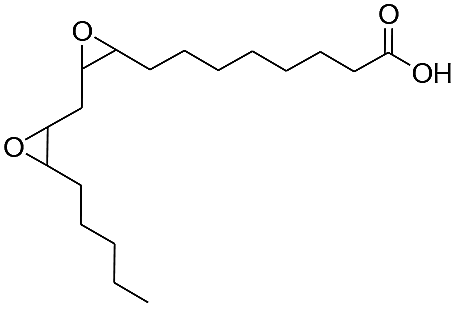 |
108 ± 0.46 | 70 ± 0.12 | 95 |
| 2 |  |
 |
90.03 ± 0.44 | 0.1 ± 0.011 | 93 |
| 3 |  |
 |
88.9 ± 0.43 | 0.06 ± 0.02 | 92 |
| 4 |  |
 |
88.9 ± 0.42 | 0.04 ± 0.12 | 93 |
Furthermore, the developed method was found to be highly effective for the selective epoxidation of long chain terminal alkenes. The oxidation of dodecene under optimized reaction conditions afforded 76.2% conversion to the corresponding epoxide selectively without any evidence for the formation of any by-product.
Characterization of products
The disappearance of bond H–C stretching and –CC– stretching corresponding to signals at 3008 cm−1 and 1514 cm−1 indicates the consumption of double bonds and formation of FTIR signal at 1033.3 cm−1 due to oxirane ring (Fig. S1†). In 1H NMR spectra of product the disappearance of peak between 5.3–5.5 ppm due to the protons attached to –CC– confirming the formation of epoxide successfully. In addition, the appearance of a multiplet in the range of 2.5–3.5 ppm, because of epoxide protons, confirmed the formation of respective epoxidized products. The 1H NMR spectra of linoleic acid and its corresponding epoxide are presented in (Fig. S2†). 1H NMR spectra of soyadeodistillate, ester of soyadeodistillate [(9Z,12Z)-2-ethylhexyl octadeca-9,12-dienoate] and their corresponding epoxides are presented in (Fig. S3A–D†).
Enzyme reusability
To check the recyclability of the immobilized enzyme, epoxidation of linoleic acid was considered as a model reaction. The recyclability of the enzyme was checked under optimized reaction conditions for subsequent four cycles (Fig. 4). At the end of each cycle, the immobilized enzyme was recovered and washed with distilled water. The substrate with same concentration as previous reaction was added to start a new batch of the reaction. As shown in Fig. 4, the recovered enzyme catalyst exhibited marginal decrease in catalytic activity with each successive run. More than 80% of initial activity of enzyme was retained after 4 cycles. The loss of activity after each cycle might be due to the mechanical instability of support material and agitation of reaction mixture. | ||
| Fig. 4 Results of catalytic recycling experiments. | ||
Conclusion
The enzymatic process can be seen as a promising alternative to the classical epoxidation19 reaction. Waste plant oil i.e., soyadeodistillates and its esters were tested for epoxidation in this study under very mild conditions and result showed their successful conversion to corresponding epoxides. In present study the epoxidation process is established without using additional acid as oxygen carrier and the developed methodology also worked effectively for the epoxidation of branched fatty acid esters to give excellent product yields. This is a very important finding which makes the developed method more attractive and superior over the existing one. These results are crucial for the chemical industry and represent the prospect of developing green and sustainable methods.Experimental
Materials and methods
Aqueous hydrogen peroxide (30 wt%) was purchased from Merck (Mumbai, India), linoleic acid from Lobachemie (Mumbai, India) and soyadeodistillate from local vendor (Dehradun, India). Immobilized biocatalyst Fermase CalB was obtained from FERMENTA BIOTECH INDIA. Fermase is a recombinant lipase expressed in Pichia stripitis. All other chemicals and reagents were of analytical grade and used as received.Fourier transform infrared spectra were recorded on Perkin-Elmer spectrum RX-1 FTIR spectrophotometer using potassium bromide window for the disappearance of double bond C–C stretching (str). Solution state NMR spectra (in CDCl3) were recorded on 11.7T Bruker Avance III 500.13 MHz spectrometer using a 5 mm BBFO probe. The conventional 1H NMR experiment is carried out using 5% w/v sample solution in CDCl3 (99.8%, Aldrich) with 64 number of scans, a π/2 pulse length of 13.4 μs, 10 s recycle delay, 64K time domain data. The FID is exponentially multiplied and Fourier transformed with 0.3 Hz apodization and referenced to TMS at 0 ppm.
Experimental procedure for enzymatic epoxidation
The epoxidation experiments were carried out in a 25 ml round bottomed flask equipped with a magnetic stirrer and reflux condenser. The reaction mixture containing fatty compound linoleic acid conc. (3 mmol) oxidant hydrogen peroxide (3.5 mmol) and Fermase CalB catalyst 10% of substrate wt. The resulting mixture was stirred at 35 °C at a constant rotation of 300 rpm for 12 h and the progress of reaction was monitored by 1H NMR spectroscopic analysis. All the experiments were carried out in duplicate. After completion of the reaction, the immobilized enzyme catalyst was separated via filtration and washed with ethyl acetate to remove product. The combined organic layer was thoroughly washed with warm water and then dried over anhydrous MgSO4, concentrated under reduced pressure to give pure epoxidized product.Controlled experiments were performed and treated in the same way. After completion of reaction catalyst was recovered and washed for further use.
Synthesis of soyadeodistillate esters
Esterification reaction was carried out with 1:1 molar ratio of acid and alcohol in the presence of 1.5% PTSA (p-toluene sulfonic acid) as catalyst and toluene as azeotropic solvent in a three neck 1 L round bottomed flask with dean stark apparatus, a condenser and a thermometer pocket. The reaction mixture was heated at 110 °C and the reactions were carried out till the theoretical quantities of water were collected. The reaction mixture was cooled, toluene was recovered under vacuum and product was passed through activated basic alumina to remove traces of residual acid and product with a 97.4% yield and a purity >98% was achieved. The product was analyzed using IR and 1H NMR analysis.
Saponification value and free fatty acid content (acid value) of substrates
Saponification and acid values of substrates were determined according to ASTM-D-974/11 and ASTM-D-94/07 respectively. Acid value titrations were performed as described using a Metrohm743, titrando, auto titrator equipped with a model 801 stirrer. The titration end point was determined by the instrument and visually verified using a phenolphthalein indicator. Each sample was run in triplicate and mean values were reported.Acknowledgements
Authors are thankful to Director, CSIR-Indian Institute of Petroleum for giving permission to publish these results. CSIR, New Delhi is kindly acknowledged for funding. Immobilized biocatalyst Fermase CalB obtained from FERMENTA BIOTECH INDIA is highly appreciated. Analytical Sciences Division of the Institute is kindly acknowledged for providing analysis of the samples. MA and NK are thankful to CSIR, New Delhi for working as Technical HR under XII five year project.Notes and references
- K. M. Koeller and C. H. Wong, Nature, 2001, 409, 232–240 CrossRef CAS PubMed.
- C. Mateo, J. M. Palomo, L. Fernandez and J. M. Guisan, Enzyme Microb. Technol., 2007, 40, 1451–1463 CrossRef CAS PubMed.
- T. Linker, Angew. Chem., Int. Ed., 1997, 36, 2060–2062 CrossRef CAS PubMed.
- E. J. Vries and D. B. Janssen, Curr. Opin. Biotechnol., 2003, 14, 414–420 CrossRef.
- U. Törnvall, P. Börjesson, L. M. Tufvesson and R. Hatti-Kaul, Ind. Biotechnol., 2009, 5, 184–192 CrossRef.
- H. Kim-Piu, W. Wing-Leung, L. Kim-Ming, L. Cheuk-Piu, H. C. Tak and W. Kwok-in, Chem.–Eur. J., 2008, 14, 7988–7996 CrossRef PubMed.
- J. O. Metzger and U. Bornscheuer, Appl. Microbiol. Biotechnol., 2006, 71, 13–22 CrossRef CAS PubMed.
- A. Campanella, E. Rustoy, A. Baldessari and M. A. Baltanás, Bioresour. Technol., 2010, 101, 245–254 CrossRef CAS PubMed.
- F. Bjorkling and S. E. Godtfredsen, J. Chem. Soc., Chem. Commun., 1990, 1301–1303 RSC.
- M. Klass and S. Warwel, Ind. Crops Prod., 1999, 9, 125–132 CrossRef.
- S. Shangde, K. Xiaoqiao, C. Longlong and Y. Guolong, Ind. Crops Prod., 2011, 3, 676–682 Search PubMed.
- R. S. Luciano, J. Braz. Chem. Soc., 2009, 20, 1473–1477 CrossRef PubMed.
- H. Lu and S. Sun, Eur. J. Lipid Sci. Technol., 2010, 112, 1101–1105 CrossRef CAS PubMed.
- A. E. Gerbase, J. R. Gregorio, M. Martinelli and M. C. Brasil, J. Am. Oil Chem. Soc., 2002, 79, 179–181 CrossRef CAS PubMed.
- A. Campanella and C. Fontanini, Chem. Eng. J., 2008, 144, 466–475 CrossRef CAS PubMed.
- S. Warwel and M. R. Gen. Klaas, J. Mol. Catal. B: Enzym., 1995, 1, 29–35 CrossRef CAS.
- M. R. Gen Klaas and S. Warwel, J. Mol. Catal. A: Chem., 1997, 117, 311–319 CrossRef.
- C. I. Benites, V. O. C. Chonca, S. M. P. M. Reis and O. C. De Oliveirra, Chem. Eng. Trans., 2009, 17, 903–908 Search PubMed.
- L. L. Lock, V. A. Corbellini and P. Valente, Tecno-Logica, 2007, 11, 18–25 Search PubMed.
- F. Bjorkling, H. Frykman, S. E. Godtfredsen and O. Kirk, Tetrahedron, 1992, 48, 4587–4592 CrossRef CAS.
- V. V. Yankah and C. C. Akoh, J. Am. Oil Chem. Soc., 2000, 77, 495–500 CrossRef CAS PubMed.
- C. Orellana-Coca, S. Camocho, D. Adlercreutz, B. Mattiasson and R. Hatti-Kaul, Eur. J. Lipid Sci. Technol., 2005, 107, 864–870 CrossRef CAS PubMed.
Footnote |
| † Electronic supplementary information (ESI) available. See DOI: 10.1039/c5ra08582a |
| This journal is © The Royal Society of Chemistry 2015 |