
Yan Li Wang,
Qian Wang,
Hui Jun Liu* and
Chao Liu Zeng
Institute of Metal Research, Laboratory for Corrosion and Protection, Institute of Metal Research, Chinese Academy of Sciences, 62 Wencui Road, Shenyang 110016, China. E-mail: liuhj@imr.ac.cn; Fax: +86-24-23904551; Tel: +86-24-23904553
First published on 31st March 2015
The corrosion of structural materials in molten fluorides, influenced by the microstructure of the structural materials, is considered to be a great challenge for the development of molten salt reactors using fluorides as fuel carriers or coolants. In this paper, the corrosion behavior of the monocrystal and polycrystal N5 superalloy in molten (Li,Na,K)F eutectic salt at 700 °C is investigated. The results indicate that the mass loss of the polycrystal is much higher than that of the monocrystal after immersion in molten (Li,Na,K)F for 100 h. The corrosion of the monocrystal and the polycrystal N5 superalloys occurs mainly through the preferential dissolution of Cr and Al, which leads to an Al/Cr-depleted layer and some internal voids. Furthermore, the corrosion rate of the polycrystal N5 superalloy is obviously accelerated by the existence of grain boundaries, which results in a mass loss of about 16.995 mg cm−2 and a Al/Cr-depleted layer of around 175 μm, compared to 11.373 mg cm−2 and 125 μm, respectively, for the monocrystal N5 superalloy.
However, the intergranular corrosion of the structural materials is the typical corrosion pattern in MSR.10 The corrosion mechanism of the alloys in molten fluoride salt has already been investigated by many researchers.8–15 Olson, et al. reported that the alloys always underwent intergranular corrosion and the deepest penetration and the first attack always occured at the grain boundaries of the alloy.8 Moreover, it is speculated that the precipitation of Cr carbides due to the higher C content in the alloy at the grain boundaries could result in the intergranular void structure.9 You, et al. also discovered the intergranular corrosion of Ni-based alloys in molten (Li,Na,K)F after long time immersion.11 Apart from Ni-based alloys, Kondo, et al. also observed selective corrosion in the grain boundary of SS304 and SS316L during the static corrosion test in molten salt LiF–BeF2.12 Hence, the corrosion behavior of structural materials may be influenced by the diffusion paths of elements through the grain boundaries. However, to our knowledge, the effects of microstructure on the corrosion behavior of structural materials in molten fluoride salt are scarcely investigated and are highly desirable.
The objective of this work is to investigate the influence of the microstructure on the corrosion behavior of structural materials in molten fluoride salts at 700 °C through the electrochemical and the oxidation tests. Therefore, some useful information may be obtained by investigation of the corrosion behavior of the Ni-based structural alloy in molten (Li,Na,K)F.
| KF + H2O → K2O + 2HF | (2.1) |
Therefore, the initial molten (Li,Na,K)F would contain a small amount of HF (in several ppm).
All electrochemical experiments were performed in a closed 304 stainless steel chamber under the protection of the pure Ar by a Princeton Applied Research PARSTAT 2273 potentiostat/Galvanostat system as reported in the previous study.18 A conventional three-electrode system was utilized, in which the reference electrode was a Pt electrode, the counter electrode was a high-density graphite plate (supplied by Sinosteel Shang-hai Advanced Graphite Materials Company, China) with the dimension of 30 mm × 15 mm, and the working electrodes were the monocrystal and polycrystal N5 superalloys as described in Section 2.1. The potentiodynamic polarization curves were measured at a scan rate of 20 mV min−1 and at the temperature of 700 °C.
For the oxidation kinetics analysis, a high-density graphite crucible containing with 297 g salt was used. The samples were obtained by terminating the immersion test after varied durations from 0 to 100 h, then taken out of the melt, cooled in air down to the room temperature, cleaned in distilled water and alcohol, and weighed by a balance with an accuracy of 10−4 g. Each mass change was repeated three times, and the average values obtained were used for oxidation kinetics analysis.
| Element | Co | Cr | Mo | W | Ta | Al | Re | Hf | Ni |
|---|---|---|---|---|---|---|---|---|---|
| Content/wt% | 7.5 | 7 | 1.5 | 5 | 6.5 | 6.2 | 3 | 0.15 | Bal. |
![]() | ||
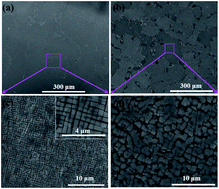
| Fig. 1 Microstructure with different magnifications of the N5 superalloys. (a) and (c) monocrystal (the insert shows the corresponding image at high magnification); (b) and (d) polycrystal. | ||
![]() | ||
| Fig. 2 Free corrosion potentials of the monocrystal and the polycrystal N5 superalloys in molten (Li,Na,K)F at 700 °C in an Ar gas environment. | ||
The potentiodynamic polarization curves of the monocrystal and the polycrystal N5 superalloys in molten (Li,Na,K)F at 700 °C in an Ar gas environment are shown in Fig. 3. The results reveal that both of the monocrystal and the polycrystal are in active states at the corrosion potential. The kinetic parameters of the monocrystal and the polycrystal N5 superalloys in molten (Li,Na,K)F at 700 °C are obtained by Tafel extrapolation method and the results are shown in Table 2. It can be seen that the self-corrosion potentials of the monocrystal and the polycrystal N5 superalloys are about −327 and −328 mV vs. Pt, respectively. Moreover, the corrosion current density of polycrystal N5 superalloy is approximately 589.3 μA cm−2, which is slightly higher than that of the monocrystal N5 superalloy as 585.0 μA cm−2. In addition, the polarization resistance for the monocrystal is about 52.5 Ω cm2, a little larger than that for the polycrystal with the value of about 47.2 Ω cm2. Therefore, there is no big difference between the monocrystal and the polycrystal N5 superalloys under steady-state polarization condition in molten (Li,Na,K)F.
![]() | ||
| Fig. 3 Potentiodynamic polarization curves of the monocrystal and the polycrystal N5 superalloys in molten (Li,Na,K)F at 700 °C in an Ar gas environment at a scan rate of 20 mV min−1. | ||
| Alloy | ba/mV dec−1 | bc/mV dec−1 | Ecorr/mV vs. Pt | Icorr/μA cm−2 | Rp/Ω cm2 |
|---|---|---|---|---|---|
| Monocrystal | 193.5 | 131.4 | −327 | 585.0 | 52.5 |
| Polycrystal | 148.8 | 238.3 | −328 | 589.3 | 47.2 |
![]() | ||
| Fig. 4 The representative oxidation kinetics plots for the corrosion of the monocrystal and the polycrystal N5 superalloys in molten (Li,Na,K)F at 700 °C in an Ar gas environment. | ||
![]() | ||
| Fig. 5 Surface morphologies of the monocrystal (a) and polycrystal (b) N5 superalloys corroded in molten (Li,Na,K)F at 700 °C for 100 h in an Ar gas environment. | ||
The cross-sectional morphologies of the monocrystal and the polycrystal N5 superalloys after immersion in molten (Li,Na,K)F at 700 °C for 100 h under pure Ar environment are illustrated in Fig. 6 and 7, respectively. It is obvious that the corrosion depth of polycrystal N5 superalloy is larger than that of the monocrystal after immersion in molten (Li,Na,K)F for 100 h (Fig. 6a and 7a). In addition, both of the monocrystal and the polycrystal N5 superalloys are eroded by selective dissolution of Cr and Al into the melt instead of aluminous and chromic oxide scale formation, which result in the non-uniform corrosion. Finally, a 125 μm Cr/Al-depleted zone with many voids is formed in the corrosion layer of the monocrystal N5 superalloy after 100 h immersion in molten (Li,Na,K)F (Fig. 6a and b). However, the polycrystal N5 superalloy experiences much more severe corrosion by forming a much deeper Cr/Al-depleted zone with a depth of around 175 μm with many internal voids (Fig. 7a and b).
It is clear that both of the monocrystal and the polycrystal N5 superalloys are eroded along the boundaries of the γ/γ′ phase as shown in Fig. 6c and 7c, respectively. And both the cubic γ′-phase in the monocrystal N5 superalloy and irregular bulk γ′-phase in the polycrystal N5 superalloy are eroded into cellular structure with some corrosion products in the voids (Fig. 6d and 7d). Coupled with the results of the EDX, it is found that the Ta-rich phase is still uncorroded (Fig. 6c and 7c), which is due to the fact that W and Ta are more stable than Cr, Al and Ni in molten (Li,Na,K)F.4 Moreover, the N5 superalloy undergoes more severe corrosion along the γ/Ta-rich phase boundary and form bigger holes than those in the normal corrosion layer.
In addition, the selective grain boundary corrosion and unconnected voids along the grain boundary are also observed after the polycrystal N5 superalloy immersion in molten (Li,Na,K)F at 700 °C for 20 h under Ar environment as shown in Fig. 8. The preferential corrosion along the grain boundary may be due to that grain boundaries are more chemically reactive than the grains.4 The results further confirm that the first attack always occurs at the grain boundary of the alloy.
![]() | ||
| Fig. 8 Microstructures of the polycrystal N5 superalloy after immersion in molten (Li,Na,K)F at 700 °C for 20 h under Ar environment. | ||
The corrosion of the monocrystal and the polycrystal N5 superalloys is mainly caused via a fluoridation process, which is induced by the dissolved HF in molten (Li,Na,K)F. Therefore, The elements of Cr, and Al in the N5 superalloy can form as fluorides, such as AlF3 and CrF2, and then dissolve in the molten (Li,Na,K)F due to these fluorides is more stable than HF according to Gibbs free energy.4 In addition, the potential–acidity diagrams for Ni, Co, Cr, and Al in molten (Li,Na,K)F (a(LiF) = 0.465) salt at 700 °C are calculated and shown in Fig. 9, based on the Nernst Equations and the thermodynamic data from HSC Chemistry version 6.0 database.† The calculate principal is referred to the potential–acidity diagrams in LiF–BeF2 fluoride salt reported by Delpech.19 It illustrates that the stability domains of elements Ni, Co, Cr, and Al under their different forms are as a function of potential and oxoacidity (related to the oxide concentration in the salt) in a fluoride environment. From Fig. 9, we can deduce that the main elements of N5 superalloy, Ni and Co, possess more positive potential than Cr and Al. Therefore, the elements of Cr, and Al in the N5 superalloy, formed as AlF3 and CrF2, can be easily dissolved in the molten (Li,Na,K)F. Finally the elements of Co and Ni are relatively enriched because of the preferential dissolution of Al and Cr via fluoridation process.
![]() | ||
| Fig. 9 Potential-acidity diagrams calculated for the elements of Ni (a), Co (b), Cr (c), and Al (d) in molten (Li,Na,K)F (a(LiF) = 0.465) salt at 700 °C. | ||
The general corrosion and boundary corrosion mechanisms during the immersion of the monocrystal and the polycrystal N5 superalloys in molten (Li,Na,K)F can be explained as following. For the general corrosion, the CrF2 and AlF3, which are caused by the fluoridation of alloying elements of Cr and Al, are dissolved into molten (Li,Na,K)F. At the same time, the phase (γ/Ta-rich phase and γ/γ′ phase) boundaries are selectively eroded because the Cr concentration at the boundary is much higher than the other parts due to the formation of chromic carbides.4 However, because of the grain boundary, a deeper depletion of Cr and Al and more voids are formed on the polycrystal N5 superalloy. Therefore, the grain boundary regions can be firstly penetrated by the molten (Li,Na,K)F, and then the Al and Cr are expected to be depleted at a much faster rate than Co and Ni. This may be the reason that the corrosion rate of the polycrystal N5 superalloy is much higher than that of the monocrystal as discussed in Section 3.3.
In addition, all of these results reveal that the phase and grain boundaries in the N5 superalloy are channels for the inward diffusion of the melt and the outward diffusion of Cr and Al ions. The different mass loss values between the monocrystal and the polycrystal implies that the corrosion resistance is definitely affected by the microstructure of the N5 superalloy.
Finally, according to Olson and Stretcher's report,4,20,21 possible corrosion mechanisms for the severe corrosion in the phase boundary and grain boundary is considered to be the electrochemical process and summarized as following. A circuit of electrochemical cell is formed due to the potential difference between the anodic boundary and the cathodic phases and grains. Therefore, the Cr enriched boundary may be eroded more easily than the normal area which is subjected to the general corrosion. In addition, the fluoridation will be stronger for Al than that for Cr because the AlF3 is more thermodynamically stable than CrF2 as shown in Fig. 9c and d, respectively.
The above results clearly show that the corrosion resistance of the alloy is significantly influenced by the grain size of the structure alloy. Actually, the welding process may give rise to the difference in grain size of the welding area, weld heat affected zone and matrix. Their corrosion may be accelerated significantly with the change of grain size. Therefore, the influence of microstructure on corrosion, intergranular corrosion, is a great challenge for MSR using molten fluorides, and thus should be given special attention.
Footnote |
| † HSC Chemistry is a commercial software including a thermochemical database, developed and sold by Outukumpu, Finland. See http://www.outokumpu.com/hsc for more details. |
| This journal is © The Royal Society of Chemistry 2015 |