Maasoumeh Jafarpour*,
Abdolreza Rezaeifard*,
Vahid Yasinzadeh and
Hossein Kargar
Catalysis Research Laboratory, Department of Chemistry, Faculty of Science, University of Birjand, Birjand, 97179-414, Iran. E-mail: mjafarpour@birjand.ac.ir; rrezaeifard@birjand.ac.ir; rrezaeifard@gmail.com; Fax: +98 56 32202515; Tel: +98 56 32202516
First published on 20th April 2015
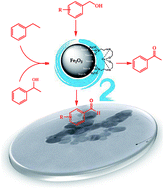
In this work, a novel organosilicon aldehyde was prepared for the first time. It could be used as an appropriate linker by condensation with ethanol amine producing a new bidentate Schiff base ligand. Its cobalt complex was prepared under ultrasonic agitation and characterized by FT-IR and NMR spectra. Attachment to magnetic nanoparticles (γ-Fe2O3, MNP) coated with starch (SMNP) under ultrasonic irradiation produced a magnetically separable Schiff base catalyst. TEM images revealed a uniform spherical shape with average size of 12–15 nm for as-prepared catalyst. The selective benzylic C–H oxidation of a variety of benzylic alcohols as well as alkyl benzenes to the related carbonyl compounds using molecular oxygen in combination with n-hydroxyphthalimide (NHPI) were efficiently enhanced under the catalytic influence of title magnetically separable catalyst. The reactions proceeded smoothly under heterogeneous conditions and catalyst could be recovered and reused efficiently by an external magnetic field. The strong attachment of catalyst to magnetic support was confirmed by FT-IR spectra.
As always in research involving catalysis, attention must also be paid to the vital issue of catalyst integrity, recovery and recycling. Accordingly, heterogeneous catalytic systems are preferred over homogeneous ones due to easier recyclability. However, they usually suffer from low catalytic activity relative to their homogeneous counterparts.
Recently, the use of nanomaterials whose activity is very high under mild conditions extended because of their very large surface area.24–28 The control of chemical reactions by changing the size, dimensionality, chemical composition and morphology of the reaction center and by changing the kinetics using nanopatterning of the reaction centers is the central aim of nanocatalysis.29 However, the small size of nanoparticles make their separation from the reaction solution and recycling difficult, which impedes their use in industrial processes.30 In order to circumvent such recycling problems, magnetic nanoparticles, whose flocculation and dispersion can be controlled reversibly by applying a magnetic field, were extensively employed as a recyclable support matrix in past decade.
As a part of our ongoing research for developing more efficient processes for oxidation of organic compounds,31–43 herein we wish to report the synthesis and catalytic performance of a new cobalt Schiff base complex anchored on magnetic nanoparticles in the aerobic oxidation of benzylic C–H bonds of saturated hydrocarbons and alcohols to the related carbonyl compounds.
The first step of this investigation is the preparation of a bidentate Schiff base ligand by condensation of a new synthesized organosilicon aldehyde with ethanol amine. Its cobalt complex was attached to starch coated magnetic nanoparticles under ultrasonic irradiation producing a magnetically separable nanocatalyst (CoL2@SMNP) (Scheme 1).
The efficiency, selectivity and oxidative stability of title nanocatalyst in the heterogeneous aerobic oxidation of alkyl benzenes and benzyl alcohols in the presence of n-hydroxyphthalimide (NHPI) as radical generator were evaluated which provide its effective reusability and removing by-products (Scheme 2).
Progresses of the reactions were monitored by TLC using silica-gel SIL G/UV 254 plates and also by GC on a Shimadzu GC-16A instrument using a 25 m CBP1-S25 (0.32 mm ID, 0.5 μm coating) capillary column. NMR spectra were recorded on a Brucker Avance DPX 250 and 400 MHz instruments.
FeCl2·4H2O (1.99 g) and FeCl3·6H2O (3.25 g) were dissolved in deionized water (30 ml) under Ar atmosphere at room temperature. A NH4OH solution (0.6 M, 200 ml) was then added drop wise (drop rate = 1 ml min−1) to the stirring mixture at room temperature to reach the reaction pH to 11. The resulting black dispersion was continuously stirred for 1 h at room temperature and then heated to reflux for 1 h to yield a brown dispersion. The magnetic nanoparticles were then separate by an external magnet and washed with deionized water until it was neutralized. The as-synthesized sample was heated at 2 °C min−1 up to 250 °C and then kept in the furnace for 3 h to give a reddish-brown powder.
![]() | ||
| Fig. 1 FT-IR spectra of (a) (3-oxopropyl)trimethoxysilan, (b) Schiff base ligand and (c) cobalt Schiff base complex. | ||
![]() | ||
| Fig. 2 1HNMR spectra of (a) (3-oxopropyl)trimethoxysilan, (b) Schiff base ligand and (c) cobalt Schiff base complex. | ||
Condensation of the synthesized aldehyde with ethanol amine in ethanol produced the Shiff base ligand. The FT-IR spectra (Fig. 1b) represents the characteristic imine band at 1656 cm−1 indicating the successful preparation of the Schiff base ligand.
Then reaction of HL with Co(OAc)2 in ethanol gave the desired complex, CoL2, as a deep purple powder. A lower frequency was observed for imine band in FT-IR spectra of complex indicating of coordination to Co center (1640 cm−1) through azomethine nitrogen. This was further supported by 1H NMR spectra. A sharp singlet at 7.6 ppm in the 1H NMR spectrum of the free Schiff base, (Fig. 2b) assigned to the azomethine proton shifted downfield (7.9 ppm) after complexation (Fig. 2c). Moreover, the absence of a broad singlet at 4.8 ppm in the spectrum of the cobalt complex (Fig. 2c) compared with the uncoordinated ligand indicates the deprotonation and coordination of the hydroxyl group.
At the second step of this work, prepared CoL2 complex was immobilized on the starch coated magnetic nanoparticles (SMNP) using ultrasonic agitation (CoL2@SMNP). The use of a co-precipitation method for preparation of the γ-Fe2O3 (MNP) gave nanoparticles with a diameter of approximately 10 nm.44 It was coated with a dense starch layer (SMNP) followed by loading with CoL2 (CoL2@SMNP).
The XRD pattern of CoL2@SMNP (Fig. 3, right) exhibit characteristic peaks at the same 2θ values as bare γ-Fe2O3 demonstrating that the crystalline structure of iron oxide remains intact after being attached to Co Schiff base complex.
The FT-IR spectra of bare γ-Fe2O3 nanoparticles, SMNP and CoL2@SMNP nanocomplex, have been depicted in Fig. 4. The spectrum of the bare γ-Fe2O3 nanoparticles, (Fig. 4a), exhibits two peaks at 634 and 582 cm−1 and a weak band around 441 cm−1, which are assigned to typical Fe–O vibrations of the maghemite structure.46–50 The spectrum also represents a broad band around 3390 cm−1 corresponding to O–H stretching vibrations of surface hydroxyl groups and adsorbed water. Bending vibration of adsorbed water can be observed at 1600 cm−1.47
In the FT-IR spectra of the SMNP (Fig. 4b), new bands in 1020, 1080 and 1156 cm−1 associated with acetal groups of amylose and amylopectin in starch were appeared. The peaks at 1156 and 1080 cm−1 represent the C–O stretching vibrations in the C–O–H groups, whereas the 1020 cm−1 peak corresponds to the C–O stretching vibration in the C–O–C groups. The peaks at 2922 and 1422 cm−1 related to the C–H stretching vibration of methylene groups. The peaks at 1650 and 3376 cm−1 were assigned to δ(O–H) bending of water and hydrogen bonded hydroxyl groups of amylose and amylopectin of starch, respectively.51–54
The absorption bands at 578 and 630 cm−1 can be assigned to the Fe–O stretching vibration for the γ-Fe2O3 nanoparticles.
Comparison of the FT-IR spectra of CoL2@SMNP nanocomplex Fig. 4c with those of MNP and SMNP confirms the formations of the respective composite according to significant spectral changes. It revealed the presence of major bands at 1643 cm−1 which are attributed to imine band and a strong peak at 1120 cm−1 corresponding to the Si–O band. It can be observed that there is a weak peak at 472 cm−1, which correspond to the Co–N band.
The loading of cobalt complex on the support was determined by atomic absorption spectroscopy, which showed a value of 0.17 mmol g−1 based on Co.
Transmission electron microscopy (TEM) observations clearly revealed spherical CoL2@SMNP nanocomplex with size ranging between 12–15 nm (Fig. 5).
A systematic examination of the solvent nature was performed in various solvents, such as acetonitrile, acetic acid, dichloroethane, ethyl acetate, toluene, ethanol and water, using 0.5 mol% of CoL2@SMNP in the presence of NHPI (0.1 mmol) at different temperatures (Fig. 6). The best yield and conversion rate were obtained in CH3CN at 70 °C.
The reaction was further optimized with respect to amount of solvent, NHPI and catalyst (Fig. 6).
Inspection of the results in Fig. 6iv revealed that the efficiency of oxidation was dependent on the NHPI amount, so that the reaction did not proceed in the absence of NHPI under any conditions. NHPI has been demonstrated to be a free radical oxidation catalyst.55,56 Therefore, a radical mechanism may be suggested for title oxidation system using O2, similar to previous reports in the presence of cobalt complexes.5,57 This was further supported by retarded oxidation of benzyl alcohol in the presence of radical scavengers such as 2,6-di-tert-butyl-4-methylphenol under the same conditions.
It should be noted that no oxidation product was observed when the title catalyst was replaced by γ-Fe2O3 as well as SMNP. However, the reaction proceeded well in the presence of unsupported CoL2, and the same result was obtained under the same conditions demonstrated well the efficiency of CoL2 preserved after being immobilized on magnetic nanoparticles.
Under the optimized conditions using a continuous stream of O2 at 70 °C, benzyl alcohol converted completely in the presence of 0.5 mol% of CoL2@SMNP within 16 h and 90% of the pertinent aldehyde was secured as the sole product.
To establish the general applicability of the method, various benzylic alcohols were subjected to the oxidation protocol under the catalytic influence of the title heterogeneous catalyst (Table 1). Different benzylic alcohols oxidized smoothly under oxidation procedure with second benzylic alcohols faster than primary ones. For example, 1-phenyl ethanol and benzyl alcohol were converted to the corresponding carbonyl compounds after 14 and 16 h, respectively (Table 1, entries 1, 11). Our results revealed that, the oxidation performance affected by electronic properties of substrates. Electron-releasing groups on the phenyl rings of alcohols accelerated the reaction (Table 1, entries 2–5), while electron-acceptor ones retarded it (Table 1, entries 8, 9). For example, in the oxidation of 4-nitro- and 4-methoxy benzyl alcohol, 35 and 72% yields of the pertinent aldehydes were obtained respectively at the same time (16 h).
| Entry | Alcohol | Productb | Yieldc % (isolated yield %) |
|---|---|---|---|
a Reaction conditions: 1000 : 100 : 5 molar ratio for alcohol : NHPI : catalyst in CH3CN (3 ml) under continues stream of O2 (5–7 ml min−1) at 70 °C.b The products were identified by 1H NMR spectra in comparison with authentic samples.58 The selectivity of products were >99% based on GC analysis.c GC yield after 16 h except for entry 11 which has been run for 14 h. |
|||
| 1 | ![]() |
![]() |
97 (90) |
| 2 | ![]() |
![]() |
72 (65) |
| 3 | ![]() |
![]() |
72 (65) |
| 4 | ![]() |
![]() |
57 (49) |
| 5 | ![]() |
![]() |
77 (70) |
| 6 | ![]() |
![]() |
44 |
| 7 | ![]() |
![]() |
60 (54) |
| 8 | ![]() |
![]() |
35 |
| 9 | ![]() |
![]() |
44 |
| 10 | ![]() |
![]() |
52 |
| 11 | ![]() |
![]() |
100 (92)c |
| 12 | ![]() |
![]() |
65 (59) |
| 13 | ![]() |
![]() |
67 (60) |
| 14 | ![]() |
![]() |
55 (48) |
The chemoselectivity of the procedure was prominent. While, the primary benzylic alcohol containing sulfide group, oxidized to the corresponding aldehyde (52% yield) under the influence of title catalytic system, sulfide group remained completely intact (Table 1, entry 10). It should be noted that no trace of ester and benzoic acid was observed resulting from over oxidation of secondary and primary alcohols, respectively. The catalytic system didn't show any reactivity toward aliphatic alcohols.
The desired yields and selectivities of the carbonyl compounds obtained in the oxidation of benzyl alcohols prompted us to apply this catalytic system for oxidation of alkyl benzenes. Control experiments revealed that the same reaction conditions used for alcohol oxidation can be applicable successfully for oxidation of alkyl benzenes albeit with more amount of NHPI (15 mol%). The complete oxidation of ethyl benzene took 9 h in acetonitrile at 70 °C and acetophenone was obtained quantitatively contaminated with a small percentage of the pertinent alcohol (<3%).
The good/high yields (65–97%) and high selectivity (80–97%) of ketones were achieved in the oxidation of other alkyl benzenes (Table 2, entries 1, 2, 4–6). The conversion for electron-deficient 4-nitroethylbenzene (Table 2, entry 3), was 61% and the pertinent acetophenone was achieved in 72% yield. The method possesses novelty regarding the chemoselectivity. 2-Phenyl ethanol oxidized to 2-hydroxy acetophenone while, hydroxyl group was tolerated in the reaction (Table 2, entry 7).
| Entry | Alkyl benzene | Productb | Yieldc % | Time (h) | Ketone selectivityd % |
|---|---|---|---|---|---|
a Reaction conditions: 1000 : 150 : 5 molar ratio for alcohol : NHPI : catalyst in CH3CN (3 ml) under O2 (7–10 ml min−1) at 70 °C.b The products were identified by 1H NMR spectroscopy58 or by comparison with the retention times of authentic samples in GC analysis.c GC yield.bd The remainders are the related alcohols.e 2-Adamantanol (7%) and 2-adamantanon (13%) were also produced alongside 1-adamantanol as main product. |
|||||
| 1 | ![]() |
![]() |
97 | 9 | 97 |
| 2 | ![]() |
![]() |
85 | 8 | 90 |
| 3 | ![]() |
![]() |
44 | 11 | 72 |
| 4 | ![]() |
![]() |
76 | 9 | 90 |
| 5 | ![]() |
![]() |
75 | 9 | 80 |
| 6 | ![]() |
![]() |
65 | 9 | 90 |
| 7 | ![]() |
![]() |
77 | 9 | 100 |
| 8 | ![]() |
![]() |
87 | 9 | —e |
The oxidation of adamantane was efficiently promoted by title catalytic aerobic system. The major product was a tertiary CH bond oxygenated product of 1-adamantanol, and secondary CH bond oxygenated products were formed sparsely.
This was further supported by evaluation of the recovery potential of the nanocatalysts in the oxidation of both benzyl alcohols and alkyl benzenes under the conditions mentioned in Tables 1 and 2.
Recovery of CoL2@SMNP catalyst was easy and efficient.
When the magnetic stirring was stopped, the catalyst absorbed on to the magnetic stirring bar. The catalyst was recovered by decantation of the reaction mixture in the presence of an external magnet. It was then washed with ethylacetate or ethanol as safe solvents, dried under vacuum, and used directly for the next round of reaction without further purification. The ease of recovery, combined with the intrinsic stability of the starch-protected γ-Fe2O3 nanoparticle component, allows the catalyst to be recovered efficiently over at least fifth times in the oxidation of benzyl alcohol under mentioned conditions in this study (Fig. 7).
The FT-IR spectra (Fig. 7) of the used catalyst demonstrated that the structure of the catalyst preserved after recovery.
The title nanocatalyst catalyzed heterogeneous aerobic oxidation of alkyl benzenes and benzyl alcohols using NHPI as radical generator. The efficiency, selectivity and oxidative stability of catalyst well documented. Selected processes successfully provided target products in good/excellent yields by using a low catalyst loading of 0.5 mol%, while, its initial activity was preserved after several recoveries regardless of the type of selected reaction. Thus, our method is cost effective which enables the industrially important reactions to be carried out efficiently under aerobic and practically attainable conditions.
| This journal is © The Royal Society of Chemistry 2015 |