
First-principles calculation of metal-doped CaAlSiN3: material design for new phosphors

Seunghun Jang, Jino Im, Bo Keuk Bang, Chang Hae Kim*, Hyunju Chang and Ki-jeong Kong*
Advanced Materials Division, Korea Research Institute of Chemical Technology (KRICT), 141, Gajeong-ro, Yuseong-gu, Daejeon 305-600, Korea. E-mail: changhae@krict.re.kr; kong@krict.re.kr; Fax: +82-42-860-7508; Tel: +82-42-860-7367

Received 12th March 2015 , Accepted 20th April 2015

First published on 20th April 2015


Abstract

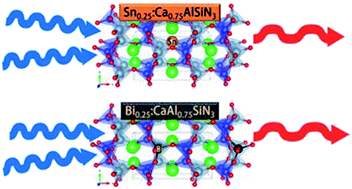
Eu-doped CaAlSiN3 (CASN) is widely utilized as an efficient red phosphor; however, the high price of rare-earth metals has driven efforts toward finding non-rare-earth metal dopants. This paper reports first-principles calculations based on density functional theory (DFT) and geared toward identifying new non-rare-earth metal dopants for use in the CASN-based phosphors. We calculated the formation energies, the electronic structures, and the optical absorption spectra of various metal dopants (Eu, Mn, Sn, and Bi) in CASN. The calculated density of states, band structures, and absorption spectra were consistent with previous experimental observations obtained from Eu- and Mn-doped CASN. The DFT calculations suggested that Sn and Bi are promising candidates as non-rare-earth metal dopants in CASN-based phosphors. Our calculations demonstrate that DFT-based first-principles calculations provide a viable tool for finding new phosphor materials.

Introduction

Rare-earth element doped materials that undergo 5d–4f transitions in nitridosilicates (or nitridoaluminosilicates) as well as oxynitridosilicates have been introduced as efficient down-conversion phosphors for white LEDs. These rare-earth doped phosphors provide many advantages, including a strong absorption band that extends from the UV to the blue spectral regions, a high quantum efficiency, good mechanical properties, and good chemical and thermal stabilities.1–4 Among these many phosphors, Eu-doped CaAlSiN3 (CASN) has been widely utilized because it is an efficient red phosphor and the 5d band displays a large crystal field splitting effect due to a high valence of the host lattice.5–7

Because rare-earth elements, such as Eu, are naturally distributed among only a handful of countries, rare-earth element-doped CASN phosphors tend to be subject to price instabilities. Alternatives to the rare earth elements, therefore, are needed. Recently, Zhang et al. reported the optical properties of Mn-activated CASN and propose a new type of conversion phosphor for white LEDs.8 Although experimental approaches offer researchers direct measures of the phosphor properties, it can be labor-intensive and time-consuming to investigate the potentials of many elements for use as the ion activators of conversion phosphors.

Theoretical approaches can offer effective ways for exploring new conversion phosphors. First-principles studies based on density functional theory (DFT) predict electronic structures and the optical properties in the solid state. The electronic structures may be analyzed to predict the validity of newly proposed phosphors with minimal effort and in short time compared to experimental testing approaches. Over the past few years, DFT-based calculations have been conducted in conjunction with experimental phosphor studies.9,10 However, only few studies have been used to search for new phosphors using DFT-based calculations.

On the other hand, several heavy metal ions with an s2 configuration are potentially useful as new phosphors. Sn2+ or Bi3+, which include an optical transition from the ground state (ns2) to the excited state (ns1np1), has been studied as an activator in oxygen-dominated host lattices, such as Sr2P2O7, SrB6O10, and YPO4.11–15 Surprisingly, experimental and theoretical studies have not yet explored the properties of Sn or Bi as activator ions in a CASN host. Here, we report an investigation of metal (Eu, Mn, Sn, Bi)-doped CASN in which the electronic structures were simulated using DFT methods. The degree of the difficulties associated with incorporating metals into the pure CASN structure and the appropriateness of the estimated absorption and emission energies of the calculated structures were assessed by calculating the formation energy (Eform), the electronic band structure, and the absorption spectra of the metal-doped CASNs. The Eu-doped and Mn-doped CASN study results were consistent with those reported experimentally. The Sn-doped and Bi-doped CASNs have not been tested experimentally, so we predict that these structures may provide alternatives to the Eu-doped CASN phosphors. These studies provide a first step, using DFT-based calculations, toward exploring new conversion phosphors.

Calculation methods

A total of eight metal-doped CASN structures prepared with different metal dopants (Eu, Mn, Sn, Bi) and doping sites (Ca, Al) were examined using first-principles DFT calculations, implemented in the Vienna Ab initio Simulation Package (VASP).16,17 The exchange-correlation functional was approximated using the Perdew–Burke–Ernzerhof (PBE) expression.18 Electron–ion interactions were modeled using the projector-augmented wave (PAW) method.19 The electronic wave functions were expanded in a basis set of plane waves with a kinetic energy cutoff of 400 eV. Geometry relaxation steps were performed under the criterion that the ionic forces were reduced below 0.02 eV Å−1. The k-space integration step was performed with finite sampling of the k-points on a 4 × 6 × 7 mesh in the Brillouin zone for geometry optimization and electronic structure calculations. However, it is well known that the calculated band gap is underestimated in PBE level.

To correct this problem, we adopted the PBE + U method. PBE + U calculations were performed using the rotationally invariant method of Dudarev with an onsite + U correction to treat the Eu 4f and Mn 3d electrons using a single parameter Ueff (= UJ).20,21 The values of the parameters used in this study were Eu: 6.0 eV and Mn: 2.5 eV. Spin-polarized calculations with PBE + U were performed to describe the spin-dependent electronic properties of the Eu- or Mn-doped CASNs exactly.

Prior to modeling the doped CASN systems, the crystal structure of pure CASN was optimized using the crystallographic data reported in a previous study.22 Fig. 1 shows the relaxed structures of the pure CASN along the (a) [001] and (b) [100] directions. The lattice parameters of the pure CASN system were optimized to be a = 9.92 Å, b = 5.69 Å, and c = 5.74 Å, in good agreement with the experimental values, a = 9.85 Å, b = 5.65 Å, and c = 5.71 Å, as well as previous theoretical results, a = 9.89 Å, b = 5.67 Å, and c = 5.84 Å.22,23 The pure CASN system has an orthorhombic crystal structure (space group Cmc21, no. 36) with four Ca, Al, and Si atoms and twelve N atoms in one unit cell.5 The unit cell is denoted in the figures by a black solid line. As shown in Fig. 1(a) and (b), the Ca atom occupied the vacancies formed by the six-membered rings of the corner-sharing SiN4/AlN4 tetrahedra.24 The Al and Si atoms were randomly distributed throughout identical tetrahedral core sites. A variety of combinations of Ca4Al4Si4N12 could be generated based on the corner-sharing four SiN4 and four AlN4 tetrahedra in each unit cell. The geometries of all possible structures were optimized, and one relaxed pure CASN system with the lowest total energy was selected.


image file: c5ra04350f-f1.tif
Fig. 1 Structure of CaAlSiN3 along the (a) [001] and (b) [100] directions (a polyhedral view of the structure on a ball and stick representation).

Results and discussion

In order to investigate the effects of the metal doping process on the host material, the phosphor properties on a pure CASN structure were first examined. Fig. 2 shows the calculated band structures (left) and density of states (DOS) (right) of a pure CASN. The Fermi level indicated by the dashed straight line was set to zero. As shown in the left side of Fig. 2, pure CASN presented an indirect band gap. The band gap between the conduction band minimum (CBM) at the Γ point and the valence band maximum (VBM) at some point in the ΓZ line was 3.37 eV, lower than the experimental band gap (5.20 eV).5 In general, DFT calculations underestimate band gaps, however, in this work, we were only interested in the relative changes in the band gaps before and after metal doping in pure CASN. The DFT-based calculations, therefore, provided reasonable insights into the real system. Select useful information was obtained from the electronic band structures and DOS properties obtained from the DFT calculations. As shown in the right-hand side of Fig. 2, the top of the valence band and the bottom of the conduction band were dominated by the N 2p and Ca 3d states, respectively.
image file: c5ra04350f-f2.tif
Fig. 2 Calculated band structure (left) and DOS (right) of the pure CASN. The dashed straight line represents the Fermi level.

The difficulties associated with incorporating dopants into the CASN structure were estimated by substituting Ca or Al atoms and calculating Eform, which is the difference between the total energies before and after the doping process. Exposing a CASN to high temperatures in the presence of dopants can result in the dopant replacement of specific atoms in the CASN lattice. A stable doped CASN system then results. Eform was calculated to predict the specific atom sites that were preferentially replaced by each dopant atom. Eform was calculated according to

Eform = EM:CASN + μCa or Al − (ECASN + μM),
where EM:CASN is the total energy of the metal (M = Eu, Mn, Sn, Bi)-doped CASN system, ECASN is the total energy of pure CASN, μCa or Al is the total energy per atom of the bulk Ca or Al, and μM is the total energy per atom of the bulk metal. (We considered the total energy per atom in the body-centered cubic structure of Eu, the cubic structures of Mn and Sn, and the monoclinic structure of Bi.)

The Eform values of the different metals doped into Al or Ca sites in the CASN are plotted in Fig. 3. Metal doping into the Si site in CASN was not considered because the Si atom is tetravalent and the metal dopants considered in this study mainly favored bivalent or trivalent complexes. Our Eform calculations predicted that for all dopants, the Eform values of the metal dopants at Ca sites in the CASN were lower than the values at the Al sites. Additionally, Eu provided a lower Eform than the other dopants at both Ca and Al sites.


image file: c5ra04350f-f3.tif
Fig. 3 Formation energies of different metal doping into Al or Ca site in CASN.

Fig. 4 shows the calculated energy band structures and DOS values of the metal-doped CASN systems. The dashed straight lines represent the Fermi level. The spin-polarized calculations were carried out, and the spin-up and spin-down configurations are denoted by the black line, as shown in Fig. 4(a)–(d).


image file: c5ra04350f-f4.tif
Fig. 4 Band structure and DOS of M0.25:Ca0.75AlSiN3 (doping into Ca site) and M0.25:CaAl0.75SiN3 (doping into Al site). (a) and (b) M = Eu, (c) and (d) M = Mn, (e) and (f) M = Sn, and (g) and (h) M = Bi. The dashed straight lines represent the Fermi level. Both spin up and spin down are denoted by the black line in (a)–(d). (e)–(h) are non-polarized calculations.

The Eu0.25:Ca0.75AlSiN3 structure yielded an intermediate band (IB), which is a band located between the conventional conduction and valence bands of the semiconductor, that consisted of the Eu 4f states located immediately below the Fermi level. The Eu 5d state appeared at 2.38 eV above the Fermi level. The band structure of Eu0.25:Ca0.75AlSiN3 featured a direct band gap due to the IB of the Eu 4f state, as shown in the left-hand side of Fig. 4(a). The electronic properties of the Eu0.25:CaAl0.75SiN3 system were similar to those of systems in which Eu was introduced into Ca sites in the CASN in that Eu 4f formed an IB between the band gap. In this case, the IB was an empty state that formed above the Fermi level. The VB increased into the Fermi level by forming an additional band, and the Eu 5d state appeared at 2.80 eV above the Fermi level, as shown in Fig. 4(b). These results predicted that both cases of Eu doping should yield absorption bands at 2.4 eV (516 nm, Ca site) and 2.8 eV (442 nm, Al site).

Most experimental studies of Eu-doped CASNs have examined the substitution of Ca by Eu atoms.5,7 In particular, ref. 5 reported two strong absorption bands at 320 nm (3.88 eV) and 470 nm (2.64 eV) due to the energy splitting of the Eu 5d orbitals. Among the two absorption bands, the smaller absorption energy (2.64 eV) corresponded to our predicted absorption energy (2.4 eV) upon substitution of Eu at Ca sites in CASN. Our calculations provided a relatively good description of the experimental absorption energy of Eu0.25:Ca0.75AlSiN3.

Mn0.25:Ca0.75AlSiN3 is accompanied by the existence of the Mn 3d states, at an energy of 2.38 eV above the Fermi level. Hybridization of the Mn 3d and N 2p states yields an energy below the Fermi level. The Mn-related bands merged with the VB and CB and decreased the band gap relative to the band gap of the pure CASN. The calculated results predicted an absorption band at 2.4 eV (516 nm). Mn0.25:CaAl0.75SiN3 generated IBs (filled and empty, respectively) upon hybridization of Mn 3d and N 2p above and below Fermi level. The states related to Mn 3d were located at 1.90 eV above the Fermi level, close to the CBM.

Zhang et al. reported that in experimental CASN systems, both the Ca and Al sites may be replaced with Mn atoms, yielding two emission peaks at 548 nm (2.26 eV, Ca site) and 627 nm (1.98 eV, Al site).8 The difference between the Eform values of the Mn-doped CASN between the Ca and Al sites was smaller than the difference observed in other cases, as shown in Fig. 3. The simulated electronic band structure and Eform resulting from Mn doping were consistent with the experimental observations reported in ref. 8. Overall, the predicted electronic structures of the Eu- and Mn-doped CASNs indicated that DFT calculations were consistent with the experimental results.

The Sn0.25:Ca0.75AlSiN3 system, illustrated in Fig. 4(e), was examined next. The band structure and DOS represented IB, with hybridization between the Sn 5s, 5p, and N 2p orbitals resulting in a state below the Fermi level. The CBM was located at 2.03 eV above Fermi level. Although the number of IB states was not large, the electronic structure of the Sn-doped CASN may be appropriate for use as a phosphor with the characteristics of a reddish emission profile. The Eform obtained from Sn doping into Ca sites in the CASN was lower than the corresponding value obtained from doping into Al sites. These results indicated that Sn0.25:Ca0.75AlSiN3 may provide an alternative to Eu-doped CASNs. By contrast, Sn0.25:CaAl0.75SiN3 represents a metallic band, as shown in Fig. 4(f).

We next examined the doping of Bi in CASN, as illustrated in Fig. 4(g) and (h). Bi0.25:Ca0.75AlSiN3 exhibited a metallic band structure similar to that of Sn0.25:CaAl0.75SiN3. This metallic band resembled the band displayed by Sn0.25:CaAl0.75SiN3 and was not expected to provide useful phosphor properties. As such, these two cases will not be discussed further below.

Bi doping into the Al sites of the CASN (Bi0.25:CaAl0.75SiN3) yielded much stronger hybridization between the Bi 6s and N 2p orbitals, yielding a state below the Fermi level that represented a very narrow IB and was appropriate for pumping electrons to the CB. Hybridization among the Bi 6p, N 2p, and Ca 3d orbitals yielded a state at 2.09 eV above the Fermi level that provided a moderate absorption energy appropriate for a red phosphor. Our calculations indicated an expected absorption band of 2.1 eV (590 nm) from Bi0.25:CaAl0.75SiN3. Interestingly, the overall band structure of Bi0.25:CaAl0.75SiN3 was very similar to that observed in Eu0.25:Ca0.75AlSiN3. Bi0.25:CaAl0.75SiN3 displayed an electronic structure that was suitable as an alternative to Eu-doped CASN, even if the Eform associated with Bi doping into the Al sites in CASN exceeded that obtained as a result of Bi doping into the Ca sites, as shown in Fig. 3.

The contribution of doping to the optical response was explored by computing the optical properties of the various metal-doped CASN systems. The calculated absorption coefficients are displayed in Fig. 5. Compared with the pure CASN, all absorption spectra of the doped CASN is started in the region within ∼3 eV. The absorption peak of Mn0.25:CaAl0.75SiN3 in the lower-energy region had a threshold energy of 0.3 eV and was attributed to a transition between the empty and filled IB levels above and below the Fermi level in Fig. 4(d). A broad absorption peak at 1.8 eV corresponded to a transition from the VBM to empty IB or from filled IB to CBM. By contrast, the absorption of Mn0.25:Ca0.75AlSiN3 began at ∼2.4 eV, and no notable features were observed.


image file: c5ra04350f-f5.tif
Fig. 5 Absorption coefficient spectra for metal doped CASN system.

The optical absorption spectrum of Eu0.25:Ca0.75AlSiN3 was similar to that of the pure CASN at energies exceeding 4.5 eV. A prominent absorption peak at 3.8 eV arose from a transition from the IB to the CBM at the R or T point, and the contribution of the transition from Eu 4f to 5d at the Γ point in the optical absorption spectrum began at ∼2.4 eV, as shown in Fig. 4(a).

The threshold energies of absorption in Sn0.25:Ca0.75AlSiN3 and Bi0.25:CaAl0.75SiN3 at ∼2.0 eV were attributed to the electronic transition (ns–np, n = 5, 6) between IB and CBM, as shown in Fig. 4(e) and (h). The absorption peak at ∼2.4 eV in Bi0.25:CaAl0.75SiN3 arose from a transition from the IB to the CB at the various points in k-space. The optical study revealed that the IBs introduced by different metal dopants determined the optical properties of the doped CASN system.

Finally, the absorption energy level diagrams of the metal-doped CASNs based on the DFT calculations are presented in Fig. 6. The pure CASN had a large band gap, indicating that the absorption and emission bands were not likely to fall in the visible range; however, as shown in Fig. 6, visible absorption and emission bands in the metal-doped CASN were possible in the following cases: (i) the presence of an IB immediately below the Fermi level; (ii) a risen VBM due to the formation of an additional band. The electronic structure of Mn0.25:Ca0.75AlSiN3 fulfilled the criteria of the latter case, whereas the other four systems corresponded to the former case.


image file: c5ra04350f-f6.tif
Fig. 6 Absorption energy level diagram of metal doped CASN obtained from DFT calculation.

Conclusions

In summary, we investigated metal (Eu, Mn, Sn, and Bi)-doped CASN systems using first-principles calculations based on DFT methods. We calculated the Eform values and the electronic structures of metal-doped CASN and explored the possibility that these systems could provide alternatives to Eu-doped CASN. In the Eu-doped case, Eu0.25:Ca0.75AlSiN3, formed when Ca was substituted with Eu, displayed visible absorption and emission bands due to the formation of an IB immediately below the Fermi level. The calculated DOS in the Mn-doped CASN predicted that the absorption band at 2.4 eV (516 nm) in Mn0.25:Ca0.75AlSiN3 arose from the increase in VBM and the decrease in CBM upon introduction of the additional band. The Mn0.25:CaAl0.75SiN3 system was expected to display an absorption band corresponding to 1.9 eV (516 nm) by generating IB bands above and below the Fermi level. Our DFT calculation results obtained from the Eu- and Mn-doped CASN were reasonably consistent with the experimental observations.

We next carried out similar DFT calculations on Sn- and Bi-doped CASN systems. Only Sn0.25:Ca0.75AlSiN3 and Bi0.25:CaAl0.75SiN3 provided electronic structures that were appropriate for use in a red phosphor application, similar to the electronic structures of the Eu- and Mn-doped CASN. The IB states below the Fermi level in the Sn0.25:Ca0.75AlSiN3 system were generated by Sn metal doping. The narrow IB in Bi0.25:CaAl0.75SiN3 was introduced below the Fermi level, and its overall band structure was very similar to that obtained from Eu0.25:Ca0.75AlSiN3. We concluded that Sn- or Bi-doped CASN may potentially be useful as alternatives to the Eu-doped CASN phosphors. These efforts provide a first step toward exploring new conversion phosphors using DFT-based calculations.

Acknowledgements

This work was supported by the Technology Innovation Program (10044203, Development of phosphor materials based on Blue/UV LED) funded By the Ministry of Trade, industry & Energy (MI, Korea).

Notes and references

  1. H. A. Höppe, H. Lutz, P. Morys, W. Schnick and A. Seilmeier, J. Phys. Chem. Solids, 2000, 61, 2001 CrossRef.
  2. Y. Q. Li, J. E. J. van Steen, J. W. H. van Krevel, G. Botty, A. C. A. Delsing, F. J. DiSalvo, G. de With and H. T. Hintzen, J. Alloys Compd., 2006, 417, 273 CrossRef CAS PubMed.
  3. X. Piao, T. Horikawa, H. Hanzawa and K. Machida, Chem. Lett., 2006, 35, 334 CrossRef CAS.
  4. K. Uheda, H. Takizawa, T. Endo, H. Yamane, M. Shimada, C.-M. Wang and M. Mitomo, J. Lumin., 2000, 87–89, 967 CrossRef CAS.
  5. X. Piao, K.-ichi Machida, T. Horikawa, H. Hanzawa, Y. Shimomura and N. Kijima, Chem. Mater., 2007, 19, 4592 CrossRef CAS.
  6. K. Uheda, N. Hirosaki and H. Yamamoto, Phys. Status Solidi A, 2006, 203, 2712 CrossRef CAS PubMed.
  7. J. Yang, T. Wang, D. Chen, G. Chen and Q. Liu, Mater. Sci. Eng., B, 2012, 177, 1596 CrossRef CAS PubMed.
  8. Z. Zhang, A. C. A. Delsing, P. H. L. Notten, J. Zhao, P. Dorenbos and H. T. Hintzen, ECS J. Solid State Sci. Technol., 2013, 2, R70 CrossRef CAS PubMed.
  9. C. Che Lin, Z. Ren Xiao, G.-Y. Guo, T.-S. Chan and Ru-S. Liu, J. Am. Chem. Soc., 2010, 132, 3020–3028 CrossRef PubMed.
  10. M. Nazarov, M. G. Brik, D. Spassky, B. Tsukerblat, A. Nor Nazida and M. N. Ahmad-Fauzi, J. Alloys Compd., 2013, 573, 6 CrossRef CAS PubMed.
  11. R. C. Ropp and R. W. Mooney, J. Electrochem. Soc., 1960, 107, 15 CrossRef CAS PubMed.
  12. P. W. Ranby, D. H. Mash and S. T. Henderson, Br. J. Appl. Phys., 1955, 6, S18 CrossRef.
  13. M. Leskelä, T. Koskentalo and G. Blasse, J. Solid State Chem., 1985, 59, 272 CrossRef.
  14. G. Blasse and A. Bril, J. Chem. Phys., 1968, 48, 217 CrossRef CAS PubMed.
  15. T. Jüstel, P. Huppertz, W. Mayr and D. U. Wiechert, J. Lumin., 2004, 106, 225 CrossRef PubMed.
  16. G. Kresse and J. Hafner, Phys. Rev. B: Condens. Matter Mater. Phys., 1993, 47, 558 CrossRef CAS.
  17. G. Kresse and J. Furthmuller, Phys. Rev. B: Condens. Matter Mater. Phys., 1996, 54, 11169 CrossRef CAS.
  18. J. P. Perdew, K. Burke and M. Ernzerhof, Phys. Rev. Lett., 1996, 77, 3865 CrossRef CAS.
  19. P. E. Blöchl, Phys. Rev. B: Condens. Matter Mater. Phys., 1994, 50, 17953 CrossRef.
  20. V. I. Anisimov, F. Aryasetiawan and A. I. Lichtenstein, J. Phys.: Condens. Matter, 1997, 9, 767 CrossRef CAS.
  21. S. L. Dudarev, G. A. Botton, S. Y. Savrasov, C. J. Humphreys and A. P. Sutton, Phys. Rev. B, 1998, 57, 1505 CrossRef CAS.
  22. F. Ottinger, Ph.D thesis, Universität Karlsruhe, 2004.
  23. M. Mikami, K. Uheda and N. Kijima, Phys. Status Solidi A, 2006, 203, 2705 CrossRef CAS PubMed.
  24. Z. Zhang, O. M. ten Kate, A. C. A. Delsing, M. J. H. Stevens, J. Zhao, P. H. L. Notten, P. Dorenbos and H. T. Hintzen, J. Mater. Chem., 2012, 22, 23871 RSC.

This journal is © The Royal Society of Chemistry 2015
Click here to see how this site uses Cookies. View our privacy policy here.