Yong Suna,
Hao Cuia,
Li Gongb,
Jing Wanga and
Chengxin Wang*a
aState Key Laboratory of Optoelectronic Materials and Technologies, School of Physics Science and Engineering, Sun Yat-sen (Zhongshan) University, Guangzhou 510275, People's Republic of China. E-mail: wchengx@mail.sysu.edu.cn
bInstrumental Analysis & Research Center, Sun Yat-sen (Zhongshan) University, Guangzhou 510275, People's Republic of China
First published on 15th April 2015
We report a simple method to fabricate Ge–graphite core–shell nanowires on a large scale using a CVD (Chemical Vapor Deposition) system free of catalyst and complicated precursors, which demonstrates interesting V–L–S (vapor–liquid–solid) boundary induced self-catalyzed growth. The novel catalyst-free VLS (vapor liquid solid) mechanism is expected to be generalized for the design of other 1D (one dimensional) metal–graphite hybrids in a controlled manner, based on the fact that tunable shell thickness was achieved on Ge–graphite and a 1D Cu–graphite core–shell was realized in the same way. The Ge–graphite core–shell nanowires deliver very good field emission properties with a threshold field of about 5.33 V μm−1 and a turn-on field of 2.58 V μm−1. The surface wetting measurement confirms the superhydrophobicity of the sample with a WCA (Water Contact Angle) of about 150.8° ± 2°, which decreased to 84.7° after 300 °C (3 h) treatment under vacuum (10−3 Torr). Moreover, the wettability behavior is robust against 365 nm UV (ultraviolet) radiation with the WCA unchanged, indicating stable superhydrophobicity in a UV-rich environment. We hope that this study contributes to the design of 1D metal–graphite nanostructures with the aim to explore more novel functionalities.
A promising approach is to design Ge based 1D heterostructures, such as core–shell configuration, which is commonly employed in nanostructure design.5–8 A shielded layer compactly wrapping a single nanowire would be useful to prevent the nanowire core from contacting the outer environment. Moreover, a hybrid composed of binary phases integrates the advantages of both the components and makes it possible to achieve multi-functionality. By this logic, we reasonably hypothesize that other improved functionalities could be also achieved through appropriate design. Although there is much recent interest in the use of 1D Ge nanostructures for many purposes, such as in lithium ion batteries,9–12 THz,13,14 photovoltaics,15,16 and nanoelectomechanics,17,18 a simple way to realize Ge nanowire-based core–shell nanostructures is still lacking.
Here in this study, we chose carbon as the wrapping shell, with the aim of designing a single crystal Ge nanowire–C core–shell configuration. The idea originates from two important facts: (I) C–Ge is a non-eutectic system under mild conditions; (II) the evaporation temperature of Ge and GeO2 is similar to the cracking temperature of CH4 in a H2 environment. Thus, liquid Ge and solid carbon co-exist in the atmosphere. The LS (Liquid–Solid) interface is a stable and preferential configuration due to the surficial stress and the non-eutectic characteristics of liquid Ge and solid C. The continuous supplementation of Ge and C sources in vapor form may facilitate the low-dimensional growth of the Ge–C composite. After careful experimental exploration, the Ge–graphite core–shell nanowires were finally achieved and related growth kinetics was exposed in detail. In addition, we investigated the field emission property and surface wettability of the as-synthesized sample for the first time. The electron emission threshold field is about 5.33 V μm−1, which is better than that reported for many cold cathode electrons emission materials.19–21 The graphite shell acts as an insulating layer against H2O and oxygen, helping to improve the chemical stability, which is always a bottleneck for the production of Ge materials for the micro-electronics field. The wettability test demonstrated a contact angle of 150.8° ± 2° exposing its superhydrophobicity, which is advantageous in biological, chemical and electronic applications.22 It can be noted that the WCA almost remains unchanged even after UV (5 h, 365 nm) radiation, demonstrating the robust superhydrophobicity in a UV-rich environment. The WCA decreased to less than 90° after a 300 °C (3 h) process at ∼10−3 Torr resulting from the removal of hydrocarbon species. Moreover, this novel structure may be advantageous in other applications, such as in lithium ion batteries, because the carbon layer could help to resist the huge volume expansion of Ge during the alloying reaction and enhance Li+/electron transport.
For the sample characterization, XRD (X-ray diffraction, D8 ADVANCE) was used to confirm the crystallographic phase. SEM (scanning electron microscopy, Quanta 400F), Raman spectroscopy (Renishaw inVia) and TEM (transmission electron microscopy, FEI Tecnai G2 F30) were applied to characterize the morphology, structure and composition, respectively. The FE test system is composed of a high-vacuum chamber (∼10−8 Torr), a picoammeter (Keithley 6485) and digital micrometer controlled anode–cathode device. The surface wettability of the sample was measured by a SL200B contact angle meter (Kino Industry, USA).
![]() | ||
| Fig. 1 The SEM images and phase characterization of the sample. (a–c) The SEM images of the sample at different magnifications. (d) The XRD pattern. (e) The Raman spectra. | ||
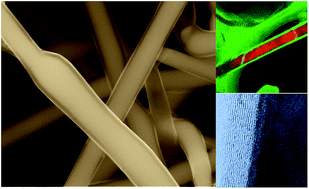
In addition, TEM characterization was employed to investigate the structure and composition of a single nanowire, as shown in Fig. 2. Fig. 2(a) and (b) are typical bright-field images of a single nanowire. Fig. 2(d) is the HRTEM characterization of a piece of the nanowire, which has a relatively thinner graphite shell. The SAED pattern corresponding to the marked area using red circle in Fig. 2(b) is provided as Fig. 2(c). We can conclude that the nanowire is a single crystal with a small amount of defects. Fig. 2(e) is the STEM image of a single nanowire used for elemental analysis. The EDS (energy dispersive spectrometry) mappings of C and Ge are shown in Fig. 2(f)–(g), which shows clearly the Ge–graphite core–shell nanowire configuration.
The self-assembly of the novel structures involves a very interesting kinetic process, which can be demonstrated as an unconventional vapor–liquid–solid (V–L–S) mechanism. The model shown in Fig. 3 was proposed to illustrate the growth process of Ge–graphite core–shell nanowires. Specifically, at high enough temperature, GeO2 would be reduced to Ge clusters in ambient CH4/H2. During the transportation, CH4-derived C would adhere to the surface of the liquid Ge, forming a discrete carbon layer. According to the binary diagram, there is no eutectic phase between Ge and C under moderate conditions, which would result in a sharp solid–liquid interface. In addition, the sizes of the Ge droplet would grow larger, benefiting from the supplementation of the Ge source through the incomplete carbon layer. It can be noted that the final size of the Ge droplet is influenced by special temperatures and the CH4 density. In detail, higher temperatures would result in larger droplets due to the ripenening effect. In addition, a larger carbon source would reduce the diameter of the Ge droplet, as is discussed later. The size of the catalyst finally determines the diameter of a single 1D nanostructure. There is intense surface tension on the mobile liquid Ge droplet, which causes the initial graphite layer floating on the surface to form non-continuously. As the carbon sources is supplemented, the carbon layer will finally ripen into a continuous film, crystallize and form a graphite shell wrapping outside the Ge liquid, with a gap forming at the thinner region, which is weaker against the “inside-out” force imposed by Ge drop, as illustrated in the catalyst growth section in Fig. 3. These gaps create a V–L (Vapor–Liquid) interface, confirming the subsequent supplementation of the Ge source. The graphite shell would be overflowed by growing Ge liquid, which overfills the gap and then absorbs carbon at the interface. The growth of such a 1D composite can be demonstrated by the repeated procedure as described above. In general, the kinetic behavior of the self-assembly relies on the V–L–S (Vapor–Liquid–Solid) triple-phase boundary. The longitude extension of the 1D nanostructures would occur during the migration of the boundary during the growth. Therefore, this novel triple phase boundary induced self-catalyzed growth makes it possible to fabricate Ge–C core–shell nanowires free of catalyst and complex precursors.
![]() | ||
| Fig. 3 The growth mechanism of the Ge nanowires@graphite tubes, which is demonstrated as a V–L–S boundary interface induced self-catalyzed growth. | ||
Moreover, the growth of high-quality Ge–C core–shell nanowires configuration relies on the control of CH4 partial pressure. Herein, a synthetic investigation of the relationship between the proportion of CH4 and the product morphology was carried out. Before CH4 and H2 were passed at the specified flow, an initial proportion of CH4 in the chamber was set to be 10%, 20%, and 50% for comparison, with other conditions remaining the same as described above. The morphological and structural characterizations of the resulting samples are presented in Fig. 4, in which panels (a)–(c) correspond to the different CH4 proportions. As expected, the three conditions result in graphite layers with different thicknesses. In addition, as the CH4 proportion increases, the diameter of Ge cores become thinner and the product yield decreases. An excessive C source such as a 50% CH4 ratio would prevent small Ge clusters from growing into large droplets, which further hinders the propagation of Ge nanowires in the lateral direction by influencing the Ge supplement in the “catalyst growth” step. At the same time, small Ge clusters wrapped by the C layer would be more easily transported away guided by the gas flow without deposition, leaving fewer products. The different intensity ratios between C and Ge signals are distinguished in Raman spectra as displayed in Fig. 4(d), implying different C shell thicknesses.
The growth mechanism demonstrated above would be feasible in not only the Ge–C system, but also in other metal–carbon non-eutectic cases as long as the metal has a suitable melting point and thermal transport kinetics. A GeO2 source with a melting point of ∼1115 °C would be largely reduced to Ge and transported at this temperature in a H2 atmosphere. At the same time, the cracking temperature of CH4 in an H2 environment is approximately 1000 °C. Therefore, a critical condition is satisfied in that liquid Ge clusters coexist with carbon in the chamber. Cu, with a melting point of 1084 °C, was chosen to form Cu nanowires in graphite tubes guided by the abovementioned method after rational design. In this experiment, Cu powder, CH4, and H2 were used as precursors and carrier gas. To create a Cu liquid drop at the same region on a ceramic chip, the reaction temperature was increased to 1250 °C. TEM characterization, including EELS (Electron Energy Loss Spectroscopy), elemental mapping and HRTEM (High Resolution Transmission Electron Microscopy) analysis, confirms the Cu nanowires in graphite tubes configuration, as shown in Fig. 5. However, the morphology is not exactly the same as that of Ge–graphite core–shell nanowires. Several 1D structures tend to clump together in a large Cu sphere, which results from the different intrinsic physical properties of Ge and Cu such as the melting point, the atomic weight, and even the surface energy of the liquid drop. These differences result in diverse transport and liquid kinetics. The growth of most nanostructures proceeds to step II and then ceases due to a shortage of Cu supplement. Although a high-quality and uniform 1D nanostructure was not obtained, the present results are compliant with the assembly mechanism proposed.
Both Ge and CNTs are recognized to be promising field electron emitters due to their low work functions and higher charge carrier mobility. Herein, we investigate the FE performance of this novel configuration as in previous study.26 The field emission I–V characteristics were measured in a vacuum chamber at a pressure of 10−7 Torr at room temperature. Column-shaped stainless-steel probes with a radius of 0.87 mm was used as the anode. The as-synthesized sample on graphite substrate used as the cathode was stuck to a Cu plate by double-sided conductive carbon tape. Under this condition, electrons can be easily transported to the electron emitters through the conductive graphite substrate and the carbon tape. In the measurement circuit, the emission current was directly determined using a picoammeter (Keithley 6485). The inset of Fig. 6(a) shows the device configuration utilized here. The measurement distance between the anode and emitting surface was fixed at 300 μm. As shown in Fig. 6(a), the Ge–C cathode delivers very good performance with a threshold electric field (Ethr, macroscopic electric field required to generate a current density of 10 mA cm−2) of about 5.33 V μm−1, which is lower than many developed cold cathode materials. The electron emission turn-on field (Eto), which is defined as the macroscopic electric field required to generate a current density of 10 μA cm−2, is about 2.58 V μm−1 (bottom left corner of Fig. 6(b) inset). Fig. 6(b) displays the typical FN plots of the emission characteristic, which was calculated based on the Fowler–Nordheim (FN) model,27.
| J = A(β2E2/Φ)exp(−BΦ3/2/βE) |
![]() | ||
| Fig. 6 The field emission measurement of the novel structure. (a) The typical J–E curve; the inset is the device configuration used. (b) The F–N curve, which implies a linear relationship. | ||
As mentioned, for electronic components working in an air environment, molecular H2O contact is a significant problem, which negatively affects the properties of the working material by impacting the carrier mobility, charge doping, and unwanted chemical reaction. At high temperatures, this problem is fatal to the device life and the stability. In this novel structure, except for the shell that insulates Ge from oxygen, as we know, the graphite layer is a type of hydrophobic material with a water contact angle of approximately 85–98° in air.31–35 Since the wetting feature of a special structure is affected enormously by the surface roughness, functional groups and other factors that can change the surface energy,36,37 it is expected that the Ge–graphite core–shell nanowires will display good hydrophobicity, which resist the oxidation of Ge nanowire well. Herein, we investigated the wetting behavior of the sample by measuring its WCA, as shown in Fig. 7. Fig. 7(a) is the image recorded statically during the test, which shows superhydrophobicity with a WCA of about 150.8° ± 2°. There are two popular theories, which can describe the wetting surface of nanostructures. Wenzel's model describes the surface as totally wet with liquid and there are no gas bubbles between the liquid and the solid surface.38 Cassie's model suggests that gas bubbles reside between the liquid and the solid, and the surface is not totally wet.39 According to the morphology of the sample, the 1D nanostructure distributes on the substrate randomly, as shown in Fig. 7(b). This implies that the Wenzel and Cassie theories cannot demonstrate the phenomenon completely. We hypothesize that both the Wenzel and Cassie mechanisms co-exist here, i.e. a metastable state. There are amounts of bubbles between the knitted 1D nanostructures, which indicates the water droplets may partially wet the textured surface due to air trapped partially in the valleys.40
Recently, several important works exposed that the clean graphite surface is not as hydrophobic as we thought, and the measured WCA of 85–98° is mainly due to absorption of airborne hydrocarbons, which was confirmed through the systematic investigation of HOPG and graphene with FTIR (Fourier Transform Infrared Spectroscopy) and XPS (X-ray Photoelectron Spectroscopy) methods.37,41,42 Herein, we hypothesize that the superhydrophobicity originates due to the same reason. After the as-synthesized sample experienced a 300 °C (3 h) process under vacuum (∼10−3 Torr), the WCA decreased to about 84.7° ± 2°, as shown in Fig. 7(c) and (d). This value is larger than most of the results reported for clean HOPG surface.41,43 We think there are two reasons that may account for the phenomenon. First, the roughness of the textured nanostructure surface greatly enhances the hydrophobicity. Second, the high-temperature process under ∼10−3 Torr may be not sufficient enough to remove the surficial hydrocarbons completely due to the rich absorption interface. Interestingly, the WCA recovered after standing in a room for one week. The absorption/desorption effect of airborne hydrocarbons is responsible for this reversible WCA variation. Unlike the wetting behavior of most metallic oxide nanowires, the Ge–graphite core–shell nanowires are almost robust against UV radiation. In general, UV-induced tunable WCA frequently occur on photosensitive materials, in which the photon will result in photochemical reaction. Taking tungsten oxide for example, when the surface is irradiated with UV light, the photogenerated electrons will reduce part of the tungsten and the photogenerated holes will react with lattice oxygen to form oxygen vacancies.40 Water molecules from air are adsorbed and kinetically coordinated to these oxygen vacancies, which greatly improves the surface hydrophilicity.44 For metal oxide, UV radiation can induce efficient absorption of UV energy and promote the transportation of charge carriers, which would result in a CA decrease.45 However, the Ge nanowire@graphite tubes seems non-active upon UV radiation. As shown in Fig. 7(e) and (f), the WCA almost remains the same after UV radiation, which implies the absence of surface photochemical reactions. This feature is actually very important in some applications, which require robust superhydrophobicity free of external influence, especially for devices working under sunlight.
| This journal is © The Royal Society of Chemistry 2015 |