Mahdi Malekshahi Byranvanda,
Ali Dabirian*bc,
Ali Nemati Kharata and
Nima Taghaviniabd
aSchool of Chemistry, University College of Science, University of Tehran, Tehran, Iran. E-mail: alnema@khayam.ut.ac.ir
bDepartment of Physics, Sharif University of Technology, Tehran 14588, Iran. E-mail: taghavinia@sharif.edu
cPhotovoltaics and Thin Film Electronics Laboratory, Ecole Polytechique Federale de Lausanne (EPFL), Rue de la Maladiere 71, Neuchatel 2002, Switzerland. E-mail: ali.dabirian@epfl.ch; Fax: +41 21 695 42 01; Tel: +41 21 695 42 61
dInstitute for Nanoscience and Nanotechnology, Sharif University of Technology, Tehran 14588, Iran
First published on 31st March 2015
Embedded dielectric scatterers comprise an important approach for light trapping in dye-sensitized solar cells (DSCs) due to their simple fabrication process. The challenge in applying these scatterers lies in finding the optimal dimensions and concentration of the scatterers. This requires many experiments and it is often quite difficult to have a starting point for optimizing the concentration. Based on theories of light propagation in random media, we propose a simple model for DSCs with embedded silica spherical particles. Then, by full-wave optical calculations, we determine a narrow range for the concentration of silica particles that leads to the largest optical absorption in the cell. The simulation results were verified by realizing DSCs with different concentrations of silica particles. A power conversion efficiency of 8.08% in an 11 μm-thick N719-sensitized DSC was achieved with 6 vol% embedded silica, which further increased to 9.30% by applying a white scattering layer on the rear-side of the counter electrode. The design approach, presented here, is a general approach that can be applied for other types of solar light harvesting structures with low optical absorption coefficient.
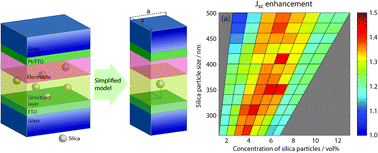
Size, refractive index, and concentration of embedded scattering particles highly influence the cell performance.11 Therefore to maximize cell efficiency we need to optimize these parameters. For refractive index a simple design rule applies; the larger refractive index contrast of particle with mesoporous TiO2 is, the stronger the scattering is. However for size and concentration of the particles it is difficult to devise design rule and therefore we need to run optimization procedures. In addition, there is a narrow particle concentration window that results in optimum light harvesting. It is known that using large quantity of scatterers leads to blocking the light from entering mesoporous layer, and affects cell's transparency and electron transport.20,30 This emphasizes the importance of optical modelling to predict the optimal size and concentration of scattering particles. Despite extensive studies on this subject and recent significant progress in modelling DSCs as random optical media31,32 there is no empirical solution to obtain a first estimate of the size and the concentration of scattering particles that maximizes cell efficiency.
Here we introduce a simplified model for DSCs with embedded dielectric scatterers that we can rigorously simulate using a full-wave electromagnetic wave solver and then we calculate the overall optical absorption within the cell under air mass 1.5 global (AM1.5G) irradiation with 100 mW cm−2 intensity. We carry out these calculations for a large combination of silica particle sizes and concentrations in the cell and then identify the range for size and concentration of the scatterers leading to maximal optical absorption. Our strategy is to use these theoretically predicted optimal conditions for further experimental optimization. In this way we significantly reduce the number of experiments needed to optimize size and concentration of scatterers. We succeeded in obtaining the optimal concentration of silica spheres in a N719-sensitized cell with accuracy of 1 vol% in only four experiments. We further evaluated the cells performance in inverse configuration, in which light enters into the cell from counter electrode (CE) side. Inverse cell operation is quite important for emerging DSCs applications such as building integrated photovoltaics (BIPV) or transparent PV.33 Moreover, to further improve device performance, we applied a white scattering layer on the rear-side of CE.34,35 The approach we introduce here can also be applied to other sensitized solar absorbers such as organometallic perovskite solar cells,36–38 quantum-dot sensitized solar cells,39,40 and Au nanoparticles sensitized devices for water splitting.41–43
For certain experiments, anatase TiO2 scattering paste (PST-300A) containing 200–300 nm particles was screen-printed onto the rear-side of an FTO glass. Nearly 10 μm-thick scattering layers were deposited by multiple screen-printing steps. The layers were dried between successive screen printing steps at 120 °C for 5 minutes. Finally the scattering layers were sintered at 500 °C for 30 min. Pt deposition was conducted on the FTO side as explained and then the cell was encapsulated using this electrode and then the electrolyte was injected.
Dye-sensitized photoanodes were assembled with Pt CE (with a drilled hole) into sandwich-type cell by heating at 120 °C using a hot-melt film (Surlyn) as the spacer between the electrodes. A drop of electrolyte solution was placed on the hole in CE and it was driven into the cell via vacuum backfilling. The electrolyte solution contains 1.0 M 1-butyl-3-methylimidazolium iodide, 0.03 M I2, 0.05 M LiI, 0.1 M GSCN and 0.5 M TBP in acetonitrile and valeronitrile solvent mixture (85
:
15 volumetric ratio). Finally, the hole was sealed using additional Surlyn and a cover glass.
![]() | ||
| Fig. 1 (a) Schematic of a DSC with embedded silica particles. (b) A unit cell of the simplified model for DSC in part (a) that was used in optical simulations. | ||
In developing the equivalent model of DSC we apply the following simplifications to cell structure: (i) an equivalent complex refractive index is obtained for the dye-sensitized layer using the experimentally reported data through effective medium theory.47–49 (ii) Silica particles are considered as perfect spherical dielectric objects with diameters varied in a specific range and they are inserted exactly in middle of the dye-sensitized layer. This is an accurate approximation for silica particles properly synthesized in a Stöber process44 because the particles can be synthesized with narrow size distribution and nearly ideal spherical shape. (iii) Thickness of the sensitized layer is fixed such that there would be always a distance larger than one wavelength (in mesoporous TiO2 layer with refractive index of 1.9) between the particle and interfaces of dye-sensitized layer with either electrolyte or FTO. In this way, we prevent our modelling to be subjected to subwavelength effects that may occur due to small distance between silica particles and each of the interfaces.50 We are aware that in an actual DSC device there are particles with subwavelength distances from the interfaces but population of these events is negligible especially in a mesoporous matrix.
The parameters of the equivalent periodic structure, i.e. lattice constant a and particles dimensions are obtained from the concentration of scattering particles in the medium and the average size of scattering particles, respectively. Basically we choose the lattice constant so that in the equivalent periodic structure there will be a concentration of silica particles identical to that of the actual random structure. Then in our optimization process, we independently vary the size of silica particle and the lateral dimensions of the unit cell, i.e. a in Fig. 1b, keeping thickness of the sensitized layer fixed. We basically tune the concentration through adjustment of lattice constant.
Scattered light from silica particles is subject to secondary scattering from the planar interfaces in the cell and/or from other silica particles in the layers, which is called multiple scattering. The simplified model of the cell, considered here, takes this effect into account because still multiple scattering can occur because of the planar interfaces in the cells as well as other silica particles in the lattice. Here in our modelling we have neglected the multiple scattering effect in which scattered light from one particle directly interact with another particle before reaching the interfaces. This effect could be significant in high concentration of scattering particles51 however in light trapping in DSCs we do not approach those concentrations because dye adsorption and hence optical absorption will be significantly reduced. In addition, highly scattering media are not suitable for light localization due to their large optical backscattering.52
We model sunlight interaction with DSC by solving full-wave Maxwell equation over the entire simplified DSC structure of Fig. 1b using a rigorous coupled-mode approach (RCWA).47,53,54 Full-wave modelling means that we take into account the multiple scattering as well as radiating and evanescent fields. Sunlight illumination was modelled as single–frequency plane wave, perpendicularly irradiated on DSC from the FTO side, which is the default configuration for DSC operation. Wavelength of incident plane wave was varied from 350 nm to 800 nm to account for the broad spectrum of sunlight that is absorbed by a N719-sensitized TiO2 layer. From RCWA calculations we obtained electromagnetic fields over the entire structure and from these data we calculated optical absorption in the sensitized layer as described previously.47 In the next step, we calculate AM1.5G integrated optical absorption, JSCT, of the cells which basically is the maximum photocurrent density that can be obtained from DSC under AM1.5G illumination. JSCT is equivalent to short circuit current density of the actual solar cell device with 100% charge collection efficiency, defined as
, where A(λ) is the optical absorptance of the layer, and ϕAM1.5(λ) is irradiation spectrum of AM1.5G.
Fig. 2a shows the enhancement in calculated JSCT values for DSC with embedded silica particles relative to similar DSC without the scatterers as concentration and size of silica particles vary. We varied silica particle size from 200 nm to 500 nm and kept the layer thickness fixed at 2 μm. The reason for choosing 2 μm is that this thickness is large enough for the 500 nm particle dimension we study here so that there would be always a distance larger than one wavelength between the particle and interfaces of N719-sensitized layer with either electrolyte or FTO.
In our calculations, for every silica particle size, we varied unit cell dimension from silica particle size to particle size multiplied by 5 in 9 steps. For instance, for a 450 nm silica particle the lattice constant is varied from 450 nm to 2250 nm. This variation gives a range of variation in volume fraction (concentration) of silica particles. Therefore graph of Fig. 2a, for every silica particle size, gives a range of concentrations that maximizes optical absorption enhancement. For instance for a 450 nm particle size a concentration of 4 to 8 vol% gives an optimal JSCT enhancement. We use this range as the base for our experimental optimization of silica particles in DSC.
Fig. 2b shows the absorptance spectra calculated for cell without silica particles, and cells with 4, 6, and 9 vol% of 450 nm silica particles. Presence of scatterers improves the optical absorptance over the entire wavelength range of 350–800 nm. This enhancement is more pronounced for 6 vol% concentration of silica particles. The sharp peaks observed at longer wavelengths are the Floquet–Bloch modes, which are the artefacts of periodic approximation made for the cells.45,46 Contribution of these peaks to JSCT is negligible because they have a narrow bandwidth.47
Nearly monodisperse silica particles were synthesized in a Stöber process at 20 °C for 3 hours which gave particles of about 450 nm shown in Fig. 3a. These particles were mixed in a standard transparent TiO2 paste (PST-20T) giving a final concentration of 5, 6, 7, and 8 vol% silica particles in the paste. Top-view and side-view SEM pictures of 6 vol% silica particles embedded in the mesoporous layer are shown in Fig. 3b–d illustrating that silica particles are uniformly mixed in the paste and no aggregation of silica particles takes place. Thickness of the layers was estimated from the SEM image to be nearly 11 μm (ESI, Fig. S1†). The layers were obtained by a five-step of screen printing process. The electrodes were sensitized with N719 dye and then the cells were built using liquid iodide electrolyte, and Pt counter electrode. A reference cell, designated as T in the data, was also built with identical features but without any silica particle.
![]() | ||
| Fig. 3 SEM pictures of (a) silica particles, (b and c) 6 vol% of silica particles embedded in the mesoporous TiO2 layer from the top and (d) from the side. | ||
The cells' photovoltaic data, measured under simulated AM1.5G illumination by masking a 25 mm2 area of the cell, are summarized in Table 1 where the efficiency is calculated from η = JSC × VOC × FF. Fig. 4a shows the J–V curves of cells fabricated with different concentration of scatterers and also of reference DSC (T) with the same thickness but without any silica particle. Maximum power conversion efficiency (η) of 8.08% was obtained with 6 vol% of silica particles in the sensitized layer. This shows 27% improvement in cell efficiency relative to reference cell (T) with 6.36% efficiency. Further increase or decrease in concentration of silica particles does not lead to improvement in efficiency. This confirms the robustness of simplified model combined with full-wave electromagnetic solver in providing a narrow range for searching optimal concentration of silica particles.
| Device | JSC [mA cm−2] | VOC [V] | FF [%] | η [%] |
|---|---|---|---|---|
| T (no silica) | 12.52 | 0.744 | 68.3 | 6.36 |
| 5 vol% Silica particles | 15.68 | 0.739 | 65.4 | 7.53 |
| 6 vol% Silica particles | 16.56 | 0.744 | 65.6 | 8.08 |
| 7 vol% Silica particles | 15.62 | 0.738 | 65.4 | 7.49 |
| 8 vol% Silica particles | 15.06 | 0.739 | 65.4 | 7.23 |
Efficiency improvement of the cell is largely due to improvement in short circuit current density (JSC) whereas open-circuit voltage (VOC) does not change and fill-factor (FF) slightly deteriorates. The reference cell gives JSC = 12.52 mA cm−2, which is increased by 32%, reaching 16.52 mA cm−2 in DSC with 6 vol% silica particles in its sensitized layer. This 32% JSC enhancement is quiet close to the 38% that has been theoretically predicted (Fig. 2a). We should mention that reproducibility in thickness of our DSCs is 95%. This extra 5% thickness would alter the reference cell JSC by less than 0.5 mA cm−2, which is significantly smaller than the extra 4 mA cm−2 that is obtained by adding 6 vol% silica particles.
Fill-factor of the cells with scatterers is slightly smaller than the reference cell but among different concentrations of silica particles FF is not significantly influenced. Slight deterioration in FF after addition of silica particles is expected because presence of these insulating silica particles slightly perturbs electronic transport through the sensitized layer.20,30
JSC is related to incident photon-to-electron conversion efficiency (IPCE) through
, therefore the positive effect of silica particles is expected to be pronounced in IPCE too. Fig. 4b shows the IPCE spectra of DSCs with different concentrations of silica particles, IPCE of the reference cell, and the enhancement in the IPCE of the cell with 6 vol% silica particles relative to reference cell. Presence of silica particles improves IPCE over the entire wavelength range with a stronger improvement taking place in the longer wavelength range where optical absorption coefficient of N719-sensitized layer is weak. This effect is made better visible in IPCE enhancement spectra where the enhancement is more pronounced at λ > 700 nm.
Optical absorbance (−log(transmittance)) spectra, depicted in Fig. 5, show a trend with concentration of silica particles similar to that of IPCE because IPCE is directly related to optical absorption. This graph reconfirms that broadband optical absorption enhancement in the layer is provided by adding silica particles. In addition the layer with 6 vol% of silica particles clearly shows the largest optical absorbance among all different concentrations. This observation further confirms that improvement in cells efficiency, by applying silica particles, is largely due to enhanced optical absorption, which is provided as the result of improved light trapping in sensitized layer caused by silica particles.
![]() | ||
| Fig. 5 Optical absorbance (−log(transmittance)) spectra of DSCs with different concentrations of silica particles in N719-sensitized layer of 11 μm. | ||
The enhancement in near infrared wavelength is not clearly visible in this graph because the absorbance values are very small due to logarithmic nature of an absorbance. Instrumentally it is very difficult to make the improvement in small absorbance range visible due to limited accuracy of UV-vis spectrometers.
We further explored the potential of cells with optimal 6 vol% silica particles by evaluating their performance in inverse configuration (Fig. 6b). Table 2 summarizes photovoltaic data of the cell with 6 vol% of silica particles in different configurations. In inverse operation the efficiency of reference cell drops by 28.8% whereas the drop in efficiency of cell with 6 vol% is 23.7%. Therefore the presence of silica particles slightly improves cell performance in inverse configuration.
| Device | JSC [mA cm−2] | VOC [V] | FF [%] | η [%] |
|---|---|---|---|---|
| T (no silica) | 12.52 | 0.744 | 68.3 | 6.36 |
| T (no silica)/inverse cell | 8.94 | 0.739 | 68.8 | 4.54 |
| T (no silica)/exterior scatterer | 15.49 | 0.739 | 66.3 | 7.59 |
| 6 vol% Silica particles | 16.56 | 0.744 | 65.6 | 8.08 |
| 6 vol% Silica particles/inverse cell | 12.94 | 0.744 | 64.9 | 6.24 |
| 6 vol% Silica particles/exterior scatterer | 19.34 | 0.744 | 64.6 | 9.30 |
The efficiency of the cells was further improved by applying a white scattering layer on the rear side of CE (Fig. 6c). A thick scattering layer of 200–300 nm anatase TiO2 particles (PST-300A) was screen-printed on rear-side of CE. Presence of this layer improved the efficiencies of the reference cell to 7.59% and the efficiency of the cell with 6 vol% silica particles to 9.30% (Table 2). This highlights an important feature of light trapping by embedded scatterers; i.e. cell transparency, which still allows using other light trapping methods like scattering layer to further enhance the efficiency.
IPCE spectra of these cells (ESI, Fig. S5†) shows that in inverse configuration the deterioration in cell performance takes place over the entire spectrum, presumably due to dissipation by the Pt layer as well as the electrolyte. Addition of the scattering layer on the rear side of CE enhances the performance over the entire wavelength as is expected with such scattering layers.
Footnote |
| † Electronic supplementary information (ESI) available: Side-view SEM image to estimate layer thickness, diffuse reflectance and diffuse transmittance spectra of the layers, digital photographs of films, and dye loading data. See DOI: 10.1039/c5ra04020e |
| This journal is © The Royal Society of Chemistry 2015 |