
Structures and luminescence properties of diethyldithiocarbamate-bridged polynuclear gold(I) cluster complexes with diphosphine/triphosphine

Jia Lib, Xiao-Feng Zhua, Li-Yi Zhangb and Zhong-Ning Chen*ab
aCollege of Chemistry, Fuzhou University, Fuzhou, Fujian 350002, China. E-mail: czn@fjirsm.ac.cn
bState Key Laboratory of Structural Chemistry, Fujian Institute of Research on the Structure of Matter, Chinese Academy of Sciences, Fuzhou, Fujian 350002, China

Received 30th January 2015 , Accepted 30th March 2015

First published on 9th April 2015


Abstract

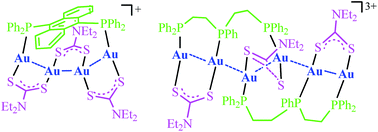
A series of polynuclear gold(I) complexes with bridging diethyldithiocarbamate (Et2dtc) and diphosphine/triphosphine were synthesized, including [{Au2(μ-dpb)(μ-Et2dtc)}SbF6]n (1, dpb = 1,4-bis(diphenylphosphino)benzene), [Au2(μ-dpb)(Et2dtc)2] (2), [Au4(μ-dpn)(μ-Et2dtc)3](SbF6) (3, dpn = 1,4-bis(diphenylphosphino)naphthalene), [Au4(μ-dpn)(μ-Et2dtc)3][Au(Et2dtc)2](SbF6)2 (4), [Au4(μ-dpa)(Et2dtc)3](SbF6) (5, dpa = 9,10-bis(diphenylphosphino)anthracene) and [{Au6(dpep)2(Et2dtc)3}{(SbF6)3}]n (6, dpep = bis(2-diphenylphosphinoethyl)phenylphosphine). The structures of 3·CH2Cl2, 4·2CH2Cl2, 5·2CH2Cl2·H2O and 6 were characterized by X-ray crystallography. The intramolecular Au⋯Au distances across bridging Et2dtc are 2.9376(7)–2.9725(8) Å in 3·CH2Cl2, 2.9762(16)–3.1078(14) Å in 4·2CH2Cl2, 2.9288(9)–3.0514(10) Å in 5·2CH2Cl2·H2O, and 2.9236(12)–3.1914(17) Å in 6, implying significant aurophilic interactions. These gold(I) complexes exhibit intense photoluminescence properties in solid state. Upon lowering the temperature from 298 to 77 K, complexes 5 and 6 exhibit an obvious red-shift from 536 nm to 589 nm for 5 and from 538 nm to 564 nm for 6, implying significant luminescence thermochromism due to thermal contraction upon cooling.

Introduction

The development of gold(I) chemistry represents a fascinating and challenging area which has aroused growing interest during the last two decades.1 Aurophilic Au⋯Au interaction is one of the most intriguing topics in gold chemistry, which is one of the reasons that has driven the rapid development of relevant studies of both the physical and chemical aspects.1 It is generally believed that gold(I) has the propensity to form self-assembly supramolecular assemblies via Au⋯Au interactions, which can lead to interesting electronic and optical properties.1,2 Short Au⋯Au contacts are often observed as a result of the relativistic and correlation effects with the typical energy in the range 7–11 kcal mol−1, which is comparable to the strength of typical hydrogen bond.1

Gold(I) is an electron-rich, soft metal ion to forms stable compounds with soft donors such as S, P and C atoms etc. Among the gold family, gold(I) thiolate complexes are the most representative systems because of their high stability and rich photophysical properties.3 In contrast to the extensive studies on the photochemical and photophysical properties of mono- and dinuclear gold(I) complexes bridged by monodendate or bidendate alkyl phosphine ligands, relevant investigation regarding polynuclear gold(I) cluster complexes, especially complexes bridged by aryl phosphine ligands and multidendate alkyl phosphine ligands has been much less conducted. In this paper we report the synthese, crystal structures and photophysical properties of a series of gold(I) complexes with bridging diethyldithiocarbamate and diphosphine/triphosphine. The structures have been modulated by modifying the phosphine ligands. The diphosphine usually gives tetranuclear structures whereas triphosphine induces the formation of a polymer including hexanuclear unit with a zig-zag arranged gold(I) chain.

Results and discussion

As depicted in Scheme 1, the starting materials are dinuclear or trinucleargold(I) complexes including (μ-dpb)(AuCl)2 (dpb = 1,4-bis(diphenylphosphino)benzene), (μ-dpn)(AuCl)2 (dpn = 1,4-bis(diphenylphosphino)naphthalene), (μ-dpa)(AuCl)2 (dpa = 9,10-bis(diphenylphosphino)anthracene) and Au3(μ-dpep)Cl3 (dpep = bis(2-diphenylphosphinoethyl)phenylphosphine). The reactions of those precursors with NaEt2dtc·3H2O in the appropriate molar ratios give corresponding products containing various number of gold atoms and Et2dtc. Exchange of Cl for SbF6 anion is readily accomplished by metathesis with NaSbF6. The structures of these gold(I) complexes were successfully modulated through the alternation of phosphine ligands. For diphosphine-linked gold(I) arrays, dinuclear or tetranuclear complexes are formed depending on the ratio of Et2dtc. Compared with gold(I) complexes 3, 4, 5 with dpn and dpa, which always contain four gold(I) atoms linked through Et2dtc-supported Au⋯Au interaction, dpb-linked dinuclear gold(I) complex 2 lacks of ligand-supported Au⋯Au interaction. For dpn and dpa with π-extended aryl rings, two –PPh2 groups bend downward because of the repulsion of aryl ring and PPh2 groups, so that the gold(I) atoms at two sides are oriented in close proximity through ligand-supported Au–Au contacts. For dpb complex 2, the gold(I) atoms at two sides are far from each other due to the less repulsion between two –PPh2 and phenyl ring so that they are unlikely linked through Et2dtc-supported intramolecular Au–Au contacts.
image file: c5ra01831e-s1.tif
Scheme 1 The synthesis route of complexes 1–6. (i) 1 equiv. NaEt2dtc; (ii) 2 equiv. NaEt2dtc; (iii) 1.5 equiv. NaEt2dtc.

Complexes 1–6 were characterized by elemental analyses, ESI-MS spectrometry, IR, 1H and 31P NMR spectroscopy, and X-ray crystallography for 3–6. Elemental analyses data coincide well with the calculated values for all the complexes. The infrared spectra of these gold(I) complexes show characteristic ν(N–C[double bond, length as m-dash]S) bands at ca. 1482–1555 cm−1.

Although crystals of 1 suitable for X-ray diffraction studies could not be obtained, the elemental analysis is consistent with the formula {Au2(μ-dpb)(μ-Et2dtc)}(SbF6). The 31P NMR spectrum in CD2Cl2 shows a singlet at 36.44 ppm, suggesting a polymeric structure as depicted in Scheme 1.

The crystal structure of 2 was characterized by X-ray crystallography, but the high R factor value and large residual electron density implied twinning problem. For this reason we do not present the full structure, but we can observe that each Et2dtc is bound to one gold atom through one of the two sulfur atoms. Unlike dinuclear gold complex [Au2(μ-S2CNEt2)(μ-(PPh2)2C[double bond, length as m-dash]CH2)]ClO4, which exhibits Au⋯Au intramolecular interaction,5c complex 2 exhibits no contact between two gold atoms due to long distance between each other.

Crystals of complexes 3–6 suitable for X-ray diffraction were recrystallized by slowly diffusion of diethyl ether, petroleum ether or hexane onto dichloromethane solutions. The crystal structures of 3·CH2Cl2, 4·2CH2Cl2, 5·2CH2Cl2·H2O and 6 were determined by X-ray crystallography. Selected atomic distances and bond angles are presented in Table S2. Perspective views of the complex cations are shown in Fig. 1 for 3·CH2Cl2, Fig. S1 (ESI) for 4·2CH2Cl2, Fig. S2 (ESI) for 5·2CH2Cl2·H2O, and Fig. 2 for 6.


image file: c5ra01831e-f1.tif
Fig. 1 ORTEP drawings of cationic complex 3 with atom-labeling scheme showing 30% thermal ellipsoids. Phenyl rings on the phosphorus atoms and all hydrogen atoms are omitted for clarity.

image file: c5ra01831e-f2.tif
Fig. 2 (a) ORTEP drawing of cationic complex 6 with atom-labeling scheme showing 30% thermal ellipsoids (symmetry code of a: 1 − x, y, 0.5 − z). Phenyl rings on the phosphorus atoms, ethyl groups on the sulfur atoms and all hydrogen atoms are omitted for clarity. (b) A view of the aggregate of Au6 units through intermolecular Au–Au interaction.

Complexes 3 and 5 are tetranuclear gold(I) complexes bridged by one diphosphine and three Et2dtc. The four gold(I) centers exhibit a curved array with two different coordination environments. As depicted in Fig. 1 and S2, the gold atoms at two sides are coordinated by a P donor of diphosphine and a S donor of Et2dtc to give a quasi-linear geometry with the P–Au–S angles in the range 166.47(12)–172.72(11)°. The two gold(I) atoms in the middle are coordinated by two S atoms of two different Et2dtc to afford a distorted linear geometry with the S–Au–S angles in the range 168.85(15)–176.81(16)°. Furthermore, the two gold(I) centers at each side are linked through dpn (3) or dpa (5) with the Au⋯Au separation of 7.71 Å for 3 across bridging dpn and 7.40 Å for 5 across bridging dpa. Other adjacent gold(I) centers are bridged by Et2dtc with Au1⋯Au2, Au2⋯Au3, and Au3⋯Au4 distances being 2.9725(8), 2.9376(7) and 2.9684(8) Å for 3·CH2Cl2 and 3.0514(10), 2.9288(9) and 2.9927(9) Å for 5·2CH2Cl2·H2O, respectively. These ligand-supported Au⋯Au distances are all shorter than the sum of van der Waals radii (3.32 Å), suggesting significant aurophilic interactions.1–5 The Au–P (2.267–2.284 Å) and Au–S bond lengths (2.265–2.327 Å) as well as the Au⋯Au distances (2.9725–3.0514 Å) are typical of those found in other gold(I) systems.4,5

The crystal structure analysis revealed that complex 4 is composed of three distinct ionic units [Au4(μ-dpn)(μ-Et2dtc)3]+, [AuIII(Et2dtc)2]+ and SbF6. The gold(I) atoms are in the same arrangement as those in complex 3 or 5, while the gold(III) atom is situated on square-planar geometry composed of four S atoms. The AuIII–S bond lengths (2.330–2.355 Å) are in the same ranges as those found in other bis(dithiocarbamato)gold(III) complexes.6 The gold(III) results probably from the oxidation of gold(I) under atmospheric conditions in solution.7

For complex 6, six gold(I) centres of the hexanuclear units (Fig. 2a) are bridged by three dithiolate and two dpep ligands to exhibit a zig-zag structure. Each gold(I) atom is linearly (the angles S–Au–P = 172.4–177.8°) bound to one S atom of Et2dtc and one P atom of dpep. The Au–Au interaction between each two adjacent S–Au–P units leads to a chain structure to displays a zig-zag array with Et2dtc-supported Au⋯Au distances in the range 2.9244(12)–3.1952(13) Å. Furthermore, the hexanuclear gold(I) unit aggregates through ligand-unsupported Au–Au interaction to form a one-dimensional polymer (Fig. 2b). The intermolecular Au⋯Au distance is 3.1910(16) Å, which is obviously shorter than the sum of the van der Waals radii for gold (3.32 Å).8 The hexanuclear gold(I) centers exhibit a zig-zag array with the Au⋯Au⋯Au angles being alternately 142.1 and 116.7°. The Au⋯Au⋯Au angle through ligand-unsupported Au–Au interaction is 150.7° in the one-dimensional gold(I) chain. The Au–P and Au–S bond lengths are all in normal range. Compared with trinuclear gold(I) complex coordinated by bis(2-diphenylphosphinomethyl)phenylphosphine and diethyldithiocarbamate,9 complex 6 incorporates three more gold atoms of the monomer unit due to the longer carbon chain, which consequently induces better flexibility of the phosphine ligands and longer distance between two sides of the P atoms.

The UV-vis absorption data of complexes 1–6 are summarized in Table 1. The UV-vis spectra of 1–6 are shown in Fig. 3. The most intense absorption around 230 nm results from the phosphine ligand. The absorption band around 270 nm is most likely attributed to Et2dtc. Shoulders around 340 nm can be assigned to LMCT (S → Au) and/or metal cluster centered transitions as reported in other P–S–Au derivatives.10 For compounds 3 and 4, the shoulders around 310 nm are not clearly exhibited because they are weak and eclipsed by the more intense peak around 270 nm. Complex 5 shows vibronic bands in the range of 380–460 nm, which is observed in the absorption spectra of 9,10-bis(diphenylphosphino)anthracene and consequently attributed to π → π* transitions in the anthracenyl ring.11

Table 1 Absorption data of complexes 1–6
Complex λabs/nm (ε/M−1 cm−1)
1 229(4858), 263(4343), 302(873)
2 229(5372), 269(5912), 304(1438)
3 229(8483), 278(5321), 310(4010)
4 230(10[thin space (1/6-em)]720), 273(8741), 314(6941)
5 228(8123), 273(8997), 313(3263)
6 227(13[thin space (1/6-em)]317), 263(9482), 335(3246)


image file: c5ra01831e-f3.tif
Fig. 3 Absorption spectra of complexes 1–6 in CH2Cl2 solution at 298 K.

Luminescence data of complexes 1–6 are summarized in Table 2. All these gold(I) complexes are luminescent at 298 and 77 K in solid states. However, only complex 5 exhibits room-temperature luminescence in fluid CH2Cl2 whereas other gold(I) complexes are non-emissive in solution at ambient temperature.

Table 2 Luminescence data of complexes 1–6
Complex Medium 298 K 77 K
λem/nm (τem) λem/nm (τem)
1 Solid 530 (7.51 ns) 534 (13.18 μs)
2 Solid 476 (weak) 540 (8.47 ns) 522 (5.77 μs)
3 Solid 543 (2.05 ns) 567 (4.15 μs) 522 (1.13 ms) 564 (1.07 ms)
4 Solid 474 (weak) 528 (8.46 ns) 487 (2.02 μs) 523 (2.12 μs)
5 Solid 536 (2.12 ns) 589 (4.69 μs)
CH2Cl2 477 (4.85 ns)  
6 Solid 538 (2.38 μs) 564 (6.71 μs)


The emission spectrum of complex 5 in CH2Cl2 solution is plotted in Fig. S3 (ESI). Upon irradiation at 380 nm < λex < 460 nm with intense absorption from 9,10-bis(diphenylphosphino)anthracene, complex 5 emits cyan luminescence at 478 nm. It is noteworthy that free 9,10-bis(diphenylphosphino)anthracene is non-emissive because the emission is quenched by a rapid intramolecular electron transfer from the –PPh2 groups. Consequently, 5 is emissive in fluid solution since the lone-pairs of the PPh2 groups bound to the AuI ions are not available for emission quenching.10

The emission spectra of complexes 1–6 in solid states at 298 and 77 K are shown in Fig. S4 and S5, respectively. The emission maxima in solid states at ambient temperature are in the range 528–543 nm upon excitation at ca. 468 nm except for 3. The emission spectrum of 3 is broad with two emission maxima at 543 and 567 nm. For 1–5, the emission maxima in the range 528–543 nm are likely ascribable to spin-allowed metal-centered transitions (5d/6s → 6p) because of the presence of multiple Au–Au interactions or a gold(I) cluster effect10,3a,c for the following reasons. (1) The Stokes shift from excitation maximums are not large. (2) The luminescence lifetimes are in the nanosecond range. (3) Spin-forbidden metal-centered transitions mentioned in relevant literatures3a,c,10 are usually at lower energies and have lifetimes in the microsecond range. On the other hand, the emission of 3 at 567 nm is tentatively ascribed to spin-forbidden metal-centred transition or S → Au LMCT (ligand to metal charge transfer) state in view of the microsecond lifetime (4.15 μs). Whereas for 6, luminescence at 538 nm is most likely ascribed to 3[S → Au]3 LMCT triplet state in view of the microsecond lifetime (2.38 μs).

Upon cooling to 77 K, all the complexes exhibit much more intense luminescence because of the decrease of non-radiative thermal activated process. The emission lifetimes, which are in the microsecond or millisecond domain, are indicative of triplet state luminescence.

Complexes 5 and 6 exhibit pronounced luminescence thermochromism. Upon lowering the temperature from 298 K to 77 K, the solid-state emission shows significant red-shift from 536 nm to 589 nm for 5 and from 538 nm to 564 nm for 6 due to thermal contraction that occurs upon cooling, which leads to a reduction in the band-gap energy.12 As the temperature decreases, the M⋯M distances become shorter, the bonding character increases, and thus the energy levels are lowered. The energy difference between the excited states and the ground state becomes smaller. Therefore, the wavelength of the emission increases with decreasing temperature.13 The emission spectral change of complex 5 upon cooling from 298 to 77 K is depicted in Fig. 4. It is obvious that the emission is progressively red-shifted from 536 to 589 nm as the temperature decreases, in which the emission intensity is gradually enhanced.


image file: c5ra01831e-f4.tif
Fig. 4 Changes in the emission spectra of complex 5 at 298–77 K.

Compound 1 exhibits wavelength-dependent emission in the range 520–560 nm at 77 K (Fig. 5). The emission maximum is shifted from 520 to 560 nm with the shift of the excitation wavelength from 400 nm to 450 nm. This phenomenon is likely explained by the presence of the gold(I) chains with different aggregates at low temperature, in which the gold(I) chains with different lengths emit at different wavelengths.9


image file: c5ra01831e-f5.tif
Fig. 5 Red shift of emission spectra of complex 1 with excitation wavelength going from 400 nm to 450 nm in solid state at 77 K.

Conclusions

We have synthesized a series of novel gold(I) complexes with significant Et2dtc-supported (intramolecular) and/or ligand-unsupported (intermolecular) Au–Au interaction. They exhibit intense luminescence in solid state although most of them are non-emissive in fluid solution. The emission is likely relevant to metal-centered transition and S → Au LMCT state. The structures are successfully modulated through alternation of the phosphine ligands. Diphosphine-bridged gold(I) complexes tend to be dinuclear or tetranuclear depending on the ratios of Et2dtc, whereas triphosphine-linked complex 6 exhibits a zig-zag hexanuclear structure through Et2dtc-supported Au–Au contacts, which further forms aggregating structures through ligand-unsupported Au–Au contact. Complexes 5 and 6 exhibit significant luminescence thermochromism due to thermal contraction upon cooling.

Experimental section

General procedures and materials

All operations were carried out at ambient temperature. The solvents were dried, distilled and degassed prior to use except those for spectroscopic measurements were of spectroscopic grade. NaEt2dtc·3H2O and bis(2-diphenylphosphinoethyl)phenylphosphine (dpep) were commercially available. 1,4-Bis(diphenylphosphino)naphthalene (dpn),14 Au(tht)Cl,15 (μ-dpb)(AuCl)2 (dpb = 1,4-bis(diphenylphosphino)benzene),16(μ-dpa)(AuCl)2 (dpa = 9,10-bis(diphenylphosphino)-anthracene)17 and Au3(μ-dpep)Cl34 were prepared by the described procedures.
(μ-dpn)(AuCl)2. To a dichloromethane (20 mL) solution of dpn (0.496 mg, 1 mmol) was added Au(tht)Cl (640 mg, 2 mmol). Upon stirring for 2 h, the resulting colorless solution was concentrated to 5 mL by rotary evaporation. Diethyl ether was added to precipitate the product as a white solid. Yield: 932 mg (97%). Anal. calcd for C34H26Au2Cl2P2 (%): C, 42.48; H, 2.73. Found: C, 42.26; H, 2.76. ESI-MS (m/z): 925.0 [M − Cl]+. 1H NMR (400 MHz, CD2Cl2, ppm): 8.61–8.55 (m, 2H, naphthalenyl), 7.72–7.51 (m, 22H, phenyl and naphthalenyl), 7.01–6.92 (m, 2H, naphthalenyl). 31P NMR (162 MHz, CD2Cl2, ppm): δ 27.21.
[{Au2(μ-dpb)(μ-Et2dtc)}SbF6]n (1). To a dichloromethane (20 mL) solution of (μ-dpb)(AuCl)2 (96 mg, 0.1 mmol) was slowly added a methanol (2 mL) solution with 1 equiv. NaEt2dtc·3H2O (22.5 mg, 0.1 mmol). After the resulting yellow mixture was stirred for 0.5 h, a methanol (2 mL) solution with 2 equiv. NaSbF6(51.6 mg, 0.2 mmol) was then added. The solvents were removed under reduced pressure. The solid residue was extracted with dichloromethane and the solution was passed through a glass filter. Addition of petroleum ether onto the concentrated dichloromethane solution afforded 1 as yellow solid, which was washed with petroleum ether. Yield: 117 mg (96%). Anal. calcd for C35H34Au2F6NP2S2Sb·0.5C5H12·H2O (%): C, 35.23; H, 3.31; N, 1.10. Found: C, 35.38; H, 3.30, N, 1.11. ESI-MS (m/z): 988.1 [M − nSbF6]n+, 1333.0 [M − SbF6 + Et2dtc + Au]+, 1677.8 [M − SbF6 + 2 Et2dtc + Au + H]+. 1H NMR (400 MHz, CD2Cl2, ppm): 7.67–7.21 (m, 24H, Ph), 4.12–4.04 (q, 4H, CH2 of Et2dtc); 1.49–1.41 (t, 6H, CH3 of Et2dtc). 31P NMR (162 MHz, CD2Cl2, ppm): δ 36.4. IR (KBr, cm−1): 1509 (C–N), 1436 (C[double bond, length as m-dash]C), 1272, 1201, 1099 (C[double bond, length as m-dash]S).
[Au2(μ-dpb)(Et2dtc)2] (2). This compound was prepared by the same procedure as that of 1 except using 2 equiv. NaS2CNEt2·3H2O instead of 1 equiv. NaEt2dtc·3H2O. Diffusion of petroleum ether onto the concentrated dichloromethane solution in a few days afforded the product as white crystals. Yield: 96.6 mg (85%). Anal. calcd for C40H44Au2N2P2S4·2H2O (%): C, 40.96; H, 4.12; N, 2.39. Found: C, 40.85; H, 4.15; N, 2.35. ESI-MS (m/z): 1336.2 [M]+, 988.1 [M − Et2dtc]+, 1333.0 [M + Au]+, 1677.3 [M + 2Au + Et2dtc]+. 1H NMR (400 MHz, CD2Cl2, ppm): 7.71–7.48 (m, 24H, Ph), 3.94–3.86 (q, 8H, CH2 of Et2dtc); 1.37–1.29 (t, 12H, CH3 of Et2dtc). 31P NMR (162 MHz, CD2Cl2, ppm): δ 35.8. IR (KBr, cm−1): 1482 (C–N), 1436 (C[double bond, length as m-dash]C), 1267, 1210, 1102 (C[double bond, length as m-dash]S).
[Au4(μ-dpn)(μ-Et2dtc)3](SbF6) (3). This compound was prepared by the same procedure as that of 1 except using (μ-dpn)(AuCl)2 instead of (μ-dpb)(AuCl)2. Recrystallization of the product by slowly diffusion of petroleum ether onto a dichloromethane solution afforded 3 as yellow crystals. Yield: 66.7 mg (68%). Anal. calcd for C49H56Au4F6N3P2S6Sb·0.5C5H12·2H2O (%): C, 30.37; H, 3.27; N, 2.06. Found: C, 30.48; H, 3.30; N, 2.12. ESI-MS (m/z): 1728.9 [M − SbF6]+, 1383.1 [M − SbF6 − Au − Et2dtc]+, 1038.3 [M − SbF6 − 2Au − 2Et2dtc]+. 1H NMR (400 MHz, CD2Cl2, ppm): 8.60–8.50 (s, 2H, naphthalenyl), 7.96–7.43 (m, 22H, phenyl and naphthalenyl), 7.05–6.97 (m, 2H, naphthalenyl), 4.22–3.67 (m, 12H, CH2 of Et2dtc); 1.41–1.28 (t, 12H, CH3 of Et2dtc), 1.17–1.09 (t, 6H, CH3 of Et2dtc). 31P NMR (162 MHz, CD2Cl2, ppm): δ 32.80. IR (KBr, cm−1): 1488 (C–N), 1424 (C[double bond, length as m-dash]C), 1271, 1202, 1101 (C[double bond, length as m-dash]S).
[Au4(μ-dpn)(μ-Et2dtc)3][Au(Et2dtc)2](SbF6)2 (4). This compound was prepared by the same procedure as that of 3 except using 2 equiv. NaEt2dtc·3H2O instead of 1 equiv. NaS2CNEt2·3H2O. Recrystallization of the product by slowly diffusion of petroleum ether onto a dichloromethane solution afforded 4 as brown crystals. Yield: 64.6 mg (60%). Anal. calcd for C59H76Au5F12N5P2S10Sb2 (%): C, 26.30; H, 2.84; N, 2.60. Found: C, 26.46; H, 2.79; N, 2.56. ESI-MS (m/z): 1728.0 [M − AuIII(Et2dtc)2 − 2SbF6]+, 1038.3 [M − AuIII(Et2dtc)2 − 2SbF6 − 2Au − 2Et2dtc]+, 493.0 [AuIII(Et2dtc)2]+. 1H NMR (400 MHz, CD2Cl2, ppm): 8.52–8.44 (s, 2H, naphthalenyl), 7.79–7.41 (m, 22H, phenyl and naphthalenyl), 6.99–6.90 (m, 2H, naphthalenyl), 4.35–3.46 (m, 20H, CH2 of Et2dtc); 1.42–1.24 (m, 24H, CH3 of Et2dtc), 1.11–1.04 (t, 6H, CH3 of Et2dtc). 31P NMR (162 MHz, CD2Cl2, ppm): δ 32.8. IR (KBr, cm−1): 1555, 1496 (C–N), 1439 (C[double bond, length as m-dash]C), 1273, 1201, 1098, 1073 (C[double bond, length as m-dash]S).
[Au4(μ-dpa)(μ-Et2dtc)3](SbF6) (5). This compound was prepared by the same procedure as that of 1 except using (μ-dpa)(AuCl)2 instead of (μ-dpb)(AuCl)2. Recrystallization of the product by slowly diffusion of petroleum ether onto a dichloromethane solution afforded 5 as red crystals. Yield: 78.5 mg (78%). Anal. calcd for C53H58Au4F6N3P2S6Sb·C5H12·1.5H2O (%): C, 32.95; H, 3.48; N, 1.99. Found: C, 32.89; H, 3.50; N, 2.07. ESI-MS (m/z): 1778.4 [M − SbF6]+, 1088.4 [M − SbF6 − 2Au − 2Et2dtc]+, 1433.1 [M − SbF6 − Au − Et2dtc]+. 1H NMR (400 MHz, CD2Cl2, ppm): δ 8.35–6.85 (m, 28H, phenyl and anthracenyl), 4.06–3.71 (m, 12H, CH2 of Et2dtc), 1.40–1.28 (t, 12H, CH3 of Et2dtc), 0.88–0.82 (t, 6H, CH3 of Et2dtc). 31P NMR (162 MHz, CD2Cl2, ppm): δ 31.0. IR (KBr, cm−1): 1495 (C–N), 1435 ν (C[double bond, length as m-dash]C), 1271, 1201, 1097 (C[double bond, length as m-dash]S).
[{Au6(dpep)2(Et2dtc)3}]n(SbF6)3n (6). To an dichloromethane (30 mL) solution of Au3(dpep)Cl3 (123 mg, 0.1 mmol) was added a methanol (2 mL) solution of NaEt2dtc (34 mg, 0.15 mmol). Upon stirring at room temperature for 0.5 h, to the yellow solution was added a methanol (2 mL) solution of NaSbF6 (78 mg, 0.3 mmol). The solvents were removed under reduced pressure. The solid residue was extracted with dichloromethane and the solution was passed through a glass filter and was concentrated to ca. 2 mL in volume. Diffusion of diethyl ether or hexane onto the concentrated yellow solution in a few days afforded the product as yellow crystals. Yield: 133 mg (78%). Anal. calcd for C83H96Au6F18N3P6S6Sb3 (%): C, 29.29; H, 2.84; N, 1.23. Found: C, 29.01; H, 2.98; N, 1.16. ESI-MS (m/z): 3167.6 [M − SbF6]+, 1481.2 [M − 2SbF6 + CH3OH]2+, 738.2 [M − 2SbF6 + H2O + 2H]4+. 1H NMR (400 MHz, CD2Cl2, ppm): 8.04–7.28 (m, 50H, phenyl), 4.18–3.39 (m, 12H, CH2 of Et2dtc); 3.17–1.68 (m, 16H, PCH2CH2), 1.39–1.04 (m, 18H, CH3 of Et2dtc). 31P NMR (162 MHZ, CD2Cl2, ppm): δ 34.2 (P(CH2)2P(CH2)2P), 30.5 (P(CH2)2P(CH2)2P). IR (KBr, cm−1): 1488 (band) ν(C–N), 1436 (C[double bond, length as m-dash]C), 1269, 1197, 1102, 1066, 1034 (C[double bond, length as m-dash]S).

Physical measurements

Elemental analyses (C, H, N) were carried out on a Perkin-Elmer model 240C automatic instrument. Electrospray mass spectra (ESI-MS) were recorded on a Finnigan LCQ mass spectrometer using dichloromethane-methanol as mobile phase. UV-vis absorption spectra were measured on a Perkin-Elmer Lambda-25 UV-vis spectrometer. Infrared spectra were recorded on a Magna-750 FT-IR spectrophotometer with KBr pellet. 1H and 31P NMR spectra were measured on a Varian UNITY-500 spectrometer with SiMe4 as the internal reference and 85% H3PO4 as external standard, respectively. Emission and excitation spectra were recorded on an Edinburgh Analytical Instrument (FLS920 fluorescence spectrometer). The emission lifetimes were determined using a LED laser at 375 nm excitation.

Crystal structural determination

Crystals of 3·CH2Cl2, 4·2CH2Cl2, 5·2CH2Cl2·H2O and 6 suitable for X-ray diffraction were grown by layering petroleum ether, diethyl ether or hexane onto the corresponding dichloromethane solutions, respectively. The data collections were performed on a RIGAKU MERCURY CCD diffractometer by ω scan technique at room temperature using graphite-monochromated Mo Kα (λ = 0.71073 Å) radiation. The structures were solved by Patterson method and the heavy atoms were located from E-map. The remaining non-hydrogen atoms were determined from the successive difference Fourier syntheses. The non-hydrogen atoms were refined anisotropically. The hydrogen atoms were generated geometrically with isotropic thermal parameters. The structures were refined on F2 by full-matrix least-squares methods using the SHELXTL-97 program package.18 The crystallographic data of 3·CH2Cl2, 4·2CH2Cl2, 5·2CH2Cl2·H2O and 6 are summarized in Table S1.

For 6, the structure contains large voids that are occupied by extremely disordered anions. This reduces the overall precision of the model and limits refinement of the structure to a significant extent. While the connectivity of the Au6 cluster is unambiguous, only two anions could be accurately located. The SQUEEZE routine of PLATON was therefore applied to the data.19 A void volume of 1359.7 Å3 was calculated to contain 577 electrons per unit cell. This value represents 288 electrons per Au6 cluster. The missing anions are calculated to be 105 electrons per cluster, leaving 183 electrons due to solvate molecules disordered in the lattice.

Acknowledgements

We are grateful for financial support from the NSFC (91122006, 21390392, 21473201, and U1405252) and the 973 project (2014CB845603) from MSTC.

Notes and references

  1. (a) P. Pyykkö, Chem. Rev., 1997, 97, 597 CrossRef PubMed; (b) P. Pyykkö, Annu. Rev. Phys. Chem., 2012, 63, 45 CrossRef PubMed; (c) R. J. Puddephatt, Coord. Chem. Rev., 2001, 216–217, 313 CrossRef CAS; (d) R. J. Puddephatt, Chem. Soc. Rev., 2008, 37, 2012 RSC; (e) M. J. Katz, K. Sakai and D. B. Leznoff, Chem. Soc. Rev., 2008, 37, 1884 RSC.
  2. (a) X. He and V. W.-W. Yam, Coord. Chem. Rev., 2011, 255, 2111 CrossRef CAS PubMed; (b) J. C. Vickery, M. M. Olmstead, E. Y. Fung and A. L. Balch, Angew. Chem., Int. Ed., 1997, 36, 1179 CrossRef CAS PubMed; (c) Y.-A. Lee and R. Eisenberg, J. Am. Chem. Soc., 2003, 125, 7778 CrossRef CAS PubMed; (d) W. E. van Zyl, J. M. López-de-Luzuriaga, A. A. Mohamed, R. J. Staples and J. P. Fackler, Inorg. Chem., 2002, 41, 4579 CrossRef CAS PubMed; (e) C.-M. Che, H.-Y. Chao, V. M. Miskowski, Y. Li and K.-K. Cheung, J. Am. Chem. Soc., 2001, 123, 4985 CrossRef CAS PubMed; (f) H.-Y. Chao, W. Lu, Y. Li, M. C. Chan, C.-M. Che, K.-K. Cheung and N. Zhu, J. Am. Chem. Soc., 2002, 124, 14696 CrossRef CAS PubMed; (g) Q.-M. Wang, Y.-A. Lee, O. Crespo, J. Deaton, C. Tang, H. J. Gysling, M. Concepcion Gimeno, C. Larraz, M. D. Villacampa and A. Laguna, J. Am. Chem. Soc., 2004, 126, 9488 CrossRef CAS PubMed.
  3. (a) S. S. Tang, C.-P. Chang, I. J. Lin, L.-S. Liou and J.-C. Wang, Inorg. Chem., 1997, 36, 2294 CrossRef CAS PubMed; (b) K. Ortner, L. Hilditch, Y. Zheng, J. R. Dilworth and U. Abram, Inorg. Chem., 2000, 39, 2801 CrossRef CAS; (c) J. Vicente, P. González-Herrero, Y. García-Sánchez, P. G. Jones and M. Bardají, Inorg. Chem., 2004, 43, 7516 CrossRef CAS PubMed; (d) B.-C. Tzeng, W.-H. Liu, J.-H. Liao, G.-H. Lee and S.-M. Peng, Cryst. Growth Des., 2004, 4, 573 CrossRef CAS; (e) S. Naeem, L. Delaude, A. J. White and J. D. Wilton-Ely, Inorg. Chem., 2010, 49, 1784 CrossRef CAS PubMed; (f) T. K.-M. Lee, N. Zhu and V. W.-W. Yam, J. Am. Chem. Soc., 2010, 132, 17646 CrossRef CAS PubMed.
  4. (a) M. N. I. Khan, C. King, D. D. Heinrich, J. P. Fackler Junior and L. C. Porter, Inorg. Chem., 1989, 28, 2150 CrossRef CAS; (b) E. R. Knight, N. H. Leung, A. L. Thompson, G. Hogarth and J. D. E. T. Wilton-Ely, Inorg. Chem., 2009, 48, 3866 CrossRef CAS PubMed; (c) M. Bardají, A. Laguna, J. Vicente and P. G. Jones, Inorg. Chem., 2001, 40, 2675 CrossRef PubMed; (d) M.-R. Azani, O. Castillo, M. L. Gallego, T. Parella, G. Aullon, O. Crespo, A. Laguna, S. Alvarez, R. Mas-Balleste and F. Zamora, Chem.–Eur. J., 2012, 18, 9965 CrossRef CAS PubMed; (e) M. L. Gallego, A. Guijarro, O. Castillo, T. Parella, R. Mas-Balleste and F. Zamora, CrystEngComm, 2010, 12, 2332 RSC.
  5. (a) J. Arias, M. Bardaji and P. Espinet, Inorg. Chem., 2008, 47, 1597 CrossRef CAS PubMed; (b) S. Onaka, M. Yaguchi, R. Yamauchi, T. Ozeki, M. Ito, T. Sunahara, Y. Sugiura, M. Shiotsuka, K. Nunokawa and M. Horibe, J. Organomet. Chem., 2005, 690, 57 CrossRef CAS PubMed; (c) E. J. Fernandez, J. M. Lopez-de-Luzuriaga, M. Monge, E. Olmos, M. C. Gimeno, A. Laguna and P. G. Jones, Inorg. Chem., 1998, 37, 5532 CrossRef CAS PubMed.
  6. (a) P. Beurskens, H. Blaauw, J. Cras and J. J. Steggerda, Inorg. Chem., 1968, 7, 805 CrossRef CAS; (b) J. Cras, J. Noordik, P. Beurskens and A. Verhoeven, J. Cryst. Mol. Struct., 1971, 1, 155 CrossRef CAS; (c) M. Hong, Z. Huang, X. Lei, F. Jiang and H. Liu, Acta Crystallogr., Sect. C: Cryst. Struct. Commun., 1992, 48, 1101 CrossRef.
  7. J. Vicente, P. González-Herrero, Y. García-Sánchez, P. G. Jones and M. Bardají, Inorg. Chem., 2004, 43, 7516 CrossRef CAS PubMed.
  8. A. Bondi, J. Phys. Chem., 1964, 68, 441 CrossRef CAS.
  9. M. Bardají, A. Laguna, P. G. Jones and A. K. Fischer, Inorg. Chem., 2000, 39, 3560 CrossRef.
  10. (a) S.-Y. Yu, Z.-X. Zhang, E. C.-C. Cheng, Y.-Z. Li, V. W.-W. Yam, H. P. Huang and R. Zhang, J. Am. Chem. Soc., 2005, 127, 17994 CrossRef CAS PubMed; (b) Q.-F. Sun, T. K.-M. Lee, P.-Z. Li, L.-Y. Yao, J.-J. Huang, J. Huang, S.-Y. Yu, Y.-Z. Li, E. C.-C. Cheng and V. W.-W. Yam, Chem. Commun., 2008, 5514 RSC.
  11. J. H. Yip and J. Prabhavathy, Angew. Chem., Int. Ed., 2001, 40, 2159 CrossRef CAS.
  12. I. O. Koshevoy, E. S. Smirnova, M. Haukka, A. Laguna, J. C. Chueca, T. A. Pakkanen, S. P. Tunik, I. Ospino and O. Crespo, Dalton Trans., 2011, 40, 7412 RSC.
  13. (a) D. Sun, S. Yuan, H. Wang, H.-F. Lu, S.-Y. Feng and D.-F. Sun, Chem. Commun., 2013, 49, 6152 RSC; (b) S. Yuan, S.-S. Liu and D. Sun, CrystEngComm, 2014, 16, 1927 RSC; (c) S. Yuan, H. Wang, D.-X. Wang, H.-F. Lu, S.-Y. Feng and D. Sun, CrystEngComm, 2013, 15, 7792 RSC.
  14. H. Zorn, H. Schindlbauer and H. Hagen, Monatsh. Chem., 1964, 95, 422 CrossRef CAS.
  15. R. Usón, A. Laguna and M. Laguna, Inorg. Synth., 1989, 26, 85 CrossRef PubMed.
  16. V. J. Catalano, M. A. Malwitz, S. J. Horner and J. Vasquez, Inorg. Chem., 2003, 42, 2141 CrossRef CAS PubMed.
  17. K. Zhang, J. Prabhavathy, J. H. Yip, L. L. Koh, G. K. Tan and J. J. Vittal, J. Am. Chem. Soc., 2003, 125, 8452 CrossRef CAS PubMed.
  18. G. M. Sheldrick, SHELXL-97, Program for the Refinement of Crystal Structures, University of Göttingen, Göttingen, Germany, 1997 Search PubMed.
  19. P. Van der Sluis and A. Spek, Acta Crystallogr., Sect. A: Found. Crystallogr., 1990, 46, 194 CrossRef.

Footnote

Electronic supplementary information (ESI) available: Figures and tables giving additional structural and photophysical results, and X-ray crystallographic files in CIF format for the determination of crystal structures for 3·CH2Cl2, 4·2CH2Cl2, 5·2CH2Cl2·H2O and 6. CCDC 936708–936711. For ESI and crystallographic data in CIF or other electronic format see DOI: 10.1039/c5ra01831e

This journal is © The Royal Society of Chemistry 2015
Click here to see how this site uses Cookies. View our privacy policy here.