
QSPR study on the photolysis half-life of PCDD/Fs adsorbed on spruce (Picea abies (L.) Karst.) needle surfaces under sunlight irradiation by using a molecular distance-edge vector index

Long Jiao*ab, Xiaofei Wanga, Shan Binga, Zhiwei Xuec and Hua Li*b
aCollege of Chemistry and Chemical Engineering, Xi'an Shiyou University, Xi'an 710065, P. R. China. E-mail: mop@xsyu.edu.cn; Fax: +86-29-88382702; Tel: +86-29-88383172
bCollege of Chemistry and Materials Science, Northwest University, Xi'an 710069, P. R. China. E-mail: nwufxkx2012@126.com; Fax: +86-29-88303527; Tel: +86-29-88302635
cNo. 203 Research Institute of Nuclear Industry, Xian yang 712000, P. R. China

Received 9th November 2014 , Accepted 17th December 2014

First published on 17th December 2014


Abstract

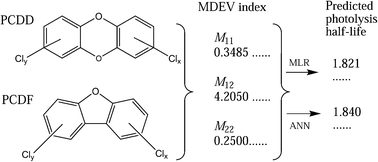
The quantitative structure property relationship (QSPR) for the photolysis half-life (t1/2) of polychlorinated dibenzo-p-dioxins and polychlorinated dibenzofurans (PCDD/Fs) on spruce (Picea abies (L.) Karst.) needle surfaces under sunlight irradiation was investigated. Molecular distance-edge vector (MDEV) index was used as the structural descriptor of PCDD/Fs. The quantitative relationship between the MDEV index and log[thin space (1/6-em)]t1/2 was modeled by using multivariable linear regression (MLR) and artificial neural network (ANN) respectively. Leave-one-out cross validation and external validation were carried out to assess the prediction ability of the developed models. For the MLR method, the prediction root mean square relative error (RMSRE) of leave-one-out cross validation and external validation is 3.47 and 4.25 respectively. For the ANN method, the prediction RMSRE of leave-one-out cross validation and external validation is 2.68 and 3.52 respectively. It is demonstrated that there is a quantitative relationship between the MDEV index and log[thin space (1/6-em)]t1/2 of PCDD/Fs. Both MLR and ANN are practical for modeling this relationship. The developed MLR model and ANN model can be used to predict the log[thin space (1/6-em)]t1/2 of PCDD/Fs. Thus, the log[thin space (1/6-em)]t1/2 of each PCDD/F congener was predicted by using the developed models.

1. Introduction

Polychlorinated dibenzo-p-dioxins and polychlorinated dibenzofurans (PCDD/Fs) are toxic persistent organic pollutants which are detectable in almost all compartments of the global ecosystem in trace amounts. There are a total of 75 polychlorinated dibenzo-p-dioxins (PCDD) and 135 polychlorinated dibenzofurans (PCDF) congeners. PCDD/Fs have gained much attention due to their environmental persistence, high toxicity, bioaccumulation through the food chain, and the adverse effects on human health. PCDD/Fs are not produced intentionally and do not serve any useful purpose. They are formed as byproducts of chlorine chemical industry and combustion processes. After released into the atmosphere, PCDD/Fs may transfer to other environmental compartments such as soil, aqueous, and sediments where they can last for years or decades before degradation.1–6

Photo-degradation is degradation of a photodegradable molecule caused by the absorption of photons. It is an important abiotic transformation of the compounds in the environment.7,8 Photo-degradation reaction has been regarded as an important approach to eliminate the contamination of PCDD/Fs, and thus been studied by many researchers.7–11 Niu et al.10,11 have reported that PCDD/Fs can be efficiently degraded on the spruce (Picea abies (L.) Karst.) needle surfaces under sunlight irradiation. Photolysis half-life (t1/2) is an important parameter for characterizing the photo-degradation reactions and assessing the environmental risk of PCDD/Fs. However, determining the t1/2 of PCDD/Fs is a hard work because of the complexity of analytical methods, high cost of experiments, large expenditures of time and lack of the standards.7,12–14 Measured photolysis t1/2 data for PCDD/Fs are rather scarce.7,15 Thus, the quantitative structure property relationship (QSPR) method, which is fast, simple and cost-effective for predicting the property of compounds, has been paid much attention to preliminarily estimate the photolysis t1/2 of PCDD/Fs. Several QSPR models for predicting the t1/2 of PCDD/Fs under various reaction conditions have been studied.7,16–18 Niu et al.7 has investigated the QSPR model for the photolysis t1/2 of PCDD/Fs on the spruce (Picea abies (L.) Karst.) needle surfaces under sunlight irradiation. They suggested that there is no quantitative relationship between the t1/2 and quantum chemical descriptors of PCDDs and just built a QSPR model for the t1/2 of PCDFs by using quantum chemical descriptors. However, the generation and selection of quantum chemical descriptors are somewhat complicated and time-consuming. Therefore, it is still worthwhile to investigate the QSPR model for the t1/2 of PCDD/Fs.

The aim of this work is to develop a reliable and easy-to-use QSPR model for estimating the photolysis t1/2 of PCDD/Fs. Topological index is a kind of structural descriptor which is commonly used in QSPR researches. It can effectively describe the structure of a molecule without the need for detailed molecular orbital calculations. It is useful because, despite its mathematical simplicity, it is able to differentiate molecules with different structures.19,20 Thus, molecular distance-edge vector (MDEV) index,21–24 a kind of topological index, was used as the structural descriptor of PCDD/Fs in this work. Multivariable linear regression (MLR) and artificial neural network (ANN) were used to model the quantitative relationship between the t1/2 and MDEV index of PCDD/Fs.

2. Experiments and methods

2.1. Data set

The MDEV index was calculated according to the algorithm presented in Section 2.2. The MDEV index of the 70 PCDD/Fs, of which the log[thin space (1/6-em)]t1/2 value is known, is listed in Table 1. The experimental log[thin space (1/6-em)]t1/2 of these 70 PCDD/Fs was taken from ref. 7 and 10 and listed in Table 2.
Table 1 MDEV index of the investigated PCDD/Fsa
No. Compound M11 M12 M22
a The ones marked by an asterisk are the PCDD/F congeners in the Group II (see text).
1 1,2,3,9-T4CDD 0.3485 4.2050 0.2500
2 1,2,6,7-T4CDD 0.2862 4.2050 0.2500
3 1,2,6,8-T4CDD 0.2457 4.2050 0.2500
4 1,2,6,9-T4CDD 0.2353 4.2275 0.2500
5* 1,2,8,9-T4CDD 0.3064 4.2050 0.2500
6 1,3,6,8-T4CDD 0.1986 4.2050 0.2500
7 1,3,7,8-T4CDD 0.2376 4.1825 0.2500
8 1,3,7,9-T4CDD 0.1997 4.2050 0.2500
9 1,4,7,8-T4CDD 0.2232 4.2050 0.2500
10* 2,3,7,8-T4CDD 0.2782 4.1600 0.2500
11 1,2,3,4,6-P5CDD 0.5825 5.2675 0.2500
12 1,2,3,6,7-P5CDD 0.4959 5.2450 0.2500
13 1,2,3,6,8-P5CDD 0.4520 5.2450 0.2500
14 1,2,3,6,9-P5CDD 0.4450 5.2675 0.2500
15* 1,2,3,7,8-P5CDD 0.4878 5.2225 0.2500
16 1,2,3,7,9-P5CDD 0.4546 5.2450 0.2500
17 1,2,3,8,9-P5CDD 0.5080 5.2450 0.2500
18 1,2,4,6,7-P5CDD 0.4369 5.2675 0.2500
19 1,2,4,7,8-P5CDD 0.4248 5.2450 0.2500
20* 1,2,4,8,9-P5CDD 0.4450 5.2675 0.2500
21 1,2,3,4,6,7-H6CDD 0.7577 6.3075 0.2500
22 1,2,3,4,6,9-H6CDD 0.7068 6.3300 0.2500
23 1,2,3,4,7,8-H6CDD 0.7375 6.2850 0.2500
24 1,2,3,6,7,8-H6CDD 0.7179 6.2850 0.2500
25* 1,2,3,7,8,9-H6CDD 0.7252 6.2850 0.2500
26 1,2,3,4,6,7,8-H7CDD 0.9953 7.3475 0.2500
27 1,2,3,4,6,7,9-H7CDD 0.9444 7.3700 0.2500
28 O8CDD 1.2931 8.4100 0.2500
29 1,2,6,7-T4CDF 0.3064 4.2761 1.0000
30* 1,2,6,9-T4CDF 0.2671 4.3472 1.0000
31 1,2,7,8-T4CDF 0.3064 4.2761 1.0000
32 1,3,4,8-T4CDF 0.2774 4.2761 1.0000
33 1,3,6,8-T4CDF 0.2166 4.2761 1.0000
34 1,4,6,8-T4CDF 0.2062 4.2986 1.0000
35* 2,3,4,6-T4CDF 0.3533 4.2275 1.0000
36 2,3,6,7-T4CDF 0.2943 4.2050 1.0000
37 2,3,7,8-T4CDF 0.2895 4.2050 1.0000
38 2,4,6,7-T4CDF 0.2578 4.2275 1.0000
39 3,4,6,7-T4CDF 0.3064 4.2050 1.0000
40* 1,2,3,4,6-P5CDF 0.5947 5.3386 1.0000
41 1,2,3,4,9-P5CDF 0.6143 5.3872 1.0000
42 1,2,3,6,7-P5CDF 0.5161 5.3161 1.0000
43 1,2,3,6,9-P5CDF 0.4815 5.3872 1.0000
44 1,2,3,7,9-P5CDF 0.4871 5.3647 1.0000
45* 1,2,3,8,9-P5CDF 0.5478 5.3872 1.0000
46 1,2,4,6,7-P5CDF 0.4571 5.3386 1.0000
47 1,2,4,7,8-P5CDF 0.4498 5.3386 1.0000
48 1,2,4,8,9-P5CDF 0.4889 5.4097 1.0000
49 1,2,6,7,9-P5CDF 0.4767 5.3872 1.0000
50* 1,3,4,6,9-P5CDF 0.4178 5.3872 1.0000
51 1,3,4,7,8-P5CDF 0.4450 5.3161 1.0000
52 1,3,6,7,8-P5CDF 0.4748 5.3161 1.0000
53 2,3,4,6,7-P5CDF 0.5161 5.2675 1.0000
54 2,3,4,6,8-P5CDF 0.4723 5.2900 1.0000
55* 2,3,4,7,8-P5CDF 0.5039 5.2675 1.0000
56 1,2,3,4,6,7-H6CDF 0.7779 6.3786 1.0000
57 1,2,3,4,6,8-H6CDF 0.7414 6.4011 1.0000
58 1,2,3,4,8,9-H6CDF 0.8096 6.4497 1.0000
59 1,2,3,6,7,8-H6CDF 0.7535 6.3786 1.0000
60* 1,2,3,6,7,9-H6CDF 0.7068 6.4272 1.0000
61 1,2,3,7,8,9-H6CDF 0.7731 6.4272 1.0000
62 1,2,4,6,7,8-H6CDF 0.6993 6.4011 1.0000
63 1,2,4,6,7,9-H6CDF 0.6552 6.4497 1.0000
64 1,2,4,6,8,9-H6CDF 0.6673 6.4722 1.0000
65* 2,3,4,6,7,8-H6CDF 0.7461 6.3300 1.0000
66 1,2,3,4,6,7,8-H7CDF 1.0357 7.4411 1.0000
67 1,2,3,4,6,7,9-H7CDD 0.9964 7.4897 1.0000
68 1,2,3,4,6,8,9-H7CDD 1.0085 7.5122 1.0000
69 1,2,3,4,7,8,9-H7CDD 1.0553 7.4897 1.0000
70* O8CDF 1.3653 8.5522 1.0000


Table 2 Result of leave-one-out cross validation and external validationa
No. Compound Experimental log[thin space (1/6-em)]t1/2 Predicted log[thin space (1/6-em)]t1/2 Relative error (%)
MLR ANN MLR ANN
a The ones marked by an asterisk are the PCDD/F congeners in the Group II (see text).
1 1,2,3,9-T4CDD 1.90 1.819 1.840 −4.26 −3.16
2 1,2,6,7-T4CDD 1.89 1.820 1.861 −3.70 −1.53
3 1,2,6,8-T4CDD 1.91 1.816 1.857 −4.92 −2.77
4 1,2,6,9-T4CDD 1.79 1.824 1.861 1.90 3.97
5* 1,2,8,9-T4CDD 1.95 1.828 1.857 −6.26 −4.77
6 1,3,6,8-T4CDD 1.90 1.811 1.866 −4.68 −1.79
7 1,3,7,8-T4CDD 1.94 1.812 1.860 −6.60 −4.12
8 1,3,7,9-T4CDD 1.90 1.811 1.853 −4.68 −2.47
9 1,4,7,8-T4CDD 1.76 1.824 1.871 3.64 6.31
10* 2,3,7,8-T4CDD 1.74 1.824 1.858 4.83 6.78
11 1,2,3,4,6-P5CDD 1.82 1.892 1.852 3.96 1.76
12 1,2,3,6,7-P5CDD 1.82 1.878 1.848 3.19 1.54
13 1,2,3,6,8-P5CDD 1.74 1.879 1.855 7.99 6.61
14 1,2,3,6,9-P5CDD 1.89 1.871 1.875 −1.01 −0.79
15* 1,2,3,7,8-P5CDD 1.76 1.874 1.845 6.48 4.83
16 1,2,3,7,9-P5CDD 1.82 1.875 1.856 3.02 1.98
17 1,2,3,8,9-P5CDD 1.85 1.878 1.856 1.51 0.32
18 1,2,4,6,7-P5CDD 1.85 1.873 1.855 1.24 0.27
19 1,2,4,7,8-P5CDD 1.91 1.866 1.857 −2.30 −2.77
20* 1,2,4,8,9-P5CDD 1.84 1.872 1.840 1.74 0.00
21 1,2,3,4,6,7-H6CDD 1.97 1.929 1.910 −2.08 −3.05
22 1,2,3,4,6,9-H6CDD 1.87 1.931 1.915 3.26 2.41
23 1,2,3,4,7,8-H6CDD 1.96 1.927 1.908 −1.68 −2.65
24 1,2,3,6,7,8-H6CDD 1.88 1.930 1.906 2.66 1.38
25* 1,2,3,7,8,9-H6CDD 1.97 1.928 1.906 −2.13 −3.25
26 1,2,3,4,6,7,8-H7CDD 1.92 1.991 1.960 3.70 2.08
27 1,2,3,4,6,7,9-H7CDD 1.98 1.980 1.960 0.00 −1.01
28 O8CDD 2.02 2.049 1.960 1.44 −2.97
29 1,2,6,7-T4CDF 1.73 1.698 1.710 −1.85 −1.16
30* 1,2,6,9-T4CDF 1.61 1.699 1.686 5.53 4.72
31 1,2,7,8-T4CDF 1.65 1.704 1.688 3.27 2.30
32 1,3,4,8-T4CDF 1.64 1.701 1.695 3.72 3.35
33 1,3,6,8-T4CDF 1.76 1.687 1.692 −4.15 −3.86
34 1,4,6,8-T4CDF 1.70 1.691 1.700 −0.53 0.00
35* 2,3,4,6-T4CDF 1.64 1.703 1.687 3.84 2.87
36 2,3,6,7-T4CDF 1.70 1.697 1.699 −0.18 −0.06
37 2,3,7,8-T4CDF 1.66 1.700 1.693 2.41 1.99
38 2,4,6,7-T4CDF 1.72 1.693 1.698 −1.57 −1.28
39 3,4,6,7-T4CDF 1.72 1.696 1.696 −1.40 −1.40
40* 1,2,3,4,6-P5CDF 1.67 1.758 1.720 5.27 2.99
41 1,2,3,4,9-P5CDF 1.71 1.768 1.724 3.39 0.82
42 1,2,3,6,7-P5CDF 1.74 1.751 1.732 0.63 −0.46
43 1,2,3,6,9-P5CDF 1.82 1.746 1.721 −4.07 −5.44
44 1,2,3,7,9-P5CDF 1.65 1.753 1.717 6.24 4.06
45* 1,2,3,8,9-P5CDF 1.71 1.755 1.716 2.63 0.35
46 1,2,4,6,7-P5CDF 1.69 1.748 1.716 3.43 1.54
47 1,2,4,7,8-P5CDF 1.69 1.748 1.717 3.43 1.60
48 1,2,4,8,9-P5CDF 1.67 1.754 1.721 5.03 3.05
49 1,2,6,7,9-P5CDF 1.72 1.750 1.719 1.74 −0.06
50* 1,3,4,6,9-P5CDF 1.65 1.744 1.704 5.70 3.27
51 1,3,4,7,8-P5CDF 1.70 1.746 1.711 2.71 0.65
52 1,3,6,7,8-P5CDF 1.68 1.749 1.718 4.11 2.26
53 2,3,4,6,7-P5CDF 1.78 1.748 1.722 −1.80 −3.26
54 2,3,4,6,8-P5CDF 1.72 1.746 1.718 1.51 −0.12
55* 2,3,4,7,8-P5CDF 1.74 1.748 1.708 0.46 −1.84
56 1,2,3,4,6,7-H6CDF 1.76 1.808 1.821 2.73 3.47
57 1,2,3,4,6,8-H6CDF 1.78 1.804 1.806 1.35 1.46
58 1,2,3,4,8,9-H6CDF 1.79 1.812 1.827 1.23 2.07
59 1,2,3,6,7,8-H6CDF 1.87 1.801 1.821 −3.69 −2.62
60* 1,2,3,6,7,9-H6CDF 1.85 1.801 1.809 −2.65 −2.22
61 1,2,3,7,8,9-H6CDF 1.90 1.802 1.824 −5.16 −4.00
62 1,2,4,6,7,8-H6CDF 1.76 1.802 1.803 2.39 2.44
63 1,2,4,6,7,9-H6CDF 1.81 1.795 1.810 −0.83 0.00
64 1,2,4,6,8,9-H6CDF 1.92 1.782 1.808 −7.19 −5.83
65* 2,3,4,6,7,8-H6CDF 1.85 1.801 1.808 −2.65 −2.27
66 1,2,3,4,6,7,8-H7CDF 1.93 1.853 1.929 −3.99 −0.05
67 1,2,3,4,6,7,9-H7CDD 1.89 1.856 1.898 −1.80 0.42
68 1,2,3,4,6,8,9-H7CDD 1.93 1.854 1.927 −3.94 −0.16
69 1,2,3,4,7,8,9-H7CDD 1.93 1.856 1.931 −3.83 0.05
70* O8CDF 2.00 1.924 1.946 −3.80 −2.70


Root mean square relative error (RMSRE) was used to indicate the prediction performance of the obtained QSPR models. The RMSRE is defined as eqn (1):

 
image file: c4ra14178d-t1.tif(1)
where REi is the relative error of the ith sample, and n is the number of samples.

2.2. MDEV index

When calculating the MDEV index of PCDD/Fs, each non-hydrogen atom is regarded as a point and each chemical bond is considered as an edge. The whole molecule is regarded as a topological graph. Correspondingly, the MDEV index is defined as eqn (2):
 
image file: c4ra14178d-t2.tif(2)

In eqn (2), k and l mean the type of atoms (k = 1 or l = 1 denotes the chlorine atom, and k = 2 or l = 2 denotes the benzene ring); Items i and j are the coding number of a chlorine atom or a benzene ring. The item dik,jl represents the nearest relative distance between two atoms. For example, di1,j1 means the nearest relative distance between the ith and jth chlorine atom. The relative distance between the two adjacent non-hydrogen atoms is defined as d = 1. According to eqn (2), there are three elements, M11, M12 and M22, in the MDEV index for a PCDD/F molecule. For example, the MDEV index of 1,3,7,9-T4CDD (the structure is shown in Fig. 1a) was calculated as follows:

 
image file: c4ra14178d-t3.tif(3)


image file: c4ra14178d-f1.tif
Fig. 1 Structure of (a) 1,3,7,9-T4CDD and (b) 1,2,6,7-T4CDF.

The MDEV index of 1,2,6,7-T4CDF (the structure is shown in Fig. 1b) was calculated as follows:

 
image file: c4ra14178d-t4.tif(4)

2.3. Artificial neural network

There are many introductory articles25–37 about the theory of ANN in literatures, only a brief outline of ANN is presented here for the sake of brevity.

ANN is a multivariable calibration method which is capable of modeling complex functions. Its basic processing unit is the neuron (node). An ANN is composed of a number of neurons organized in layers. Multilayer perceptron (MLP) feed forward artificial neural network, trained with back propagation (BP) algorithm, is one of the most popular network architectures in use today. This kind of ANN is also known as back propagation artificial neural network. An MLP–ANN consists of a series of layers. The first layer has a connection from the network input. Each subsequent layer has a connection from the previous layer. The final layer produces the output of network. Each neuron in a particular layer is connected with all neurons in the next layer. The connection between the neurons is characterized by the weights. In the BP algorithm, input variables are multiplied by the weights of each neuron. These products are summed for each neuron, and then the sums are transformed with a non-linear transfer function. The transformed sums are then processed by the output neurons where they are summed and transformed to get the output variables. Then, the error between the target values and the outputs is calculated. This error is propagated backwards through the network for adjusting the weights to minimize the error. The procedure will be repeated until the error is minimized.

2.4. Leave-one-out cross validation

Leave-one-out cross validation23,38 is a conventional algorithm for estimating the predictive performance of a multivariable calibration model. Usually, practical calibration experiments have to be based on a limited set of available samples. The idea behind the leave-one-out cross validation algorithm is to predict the property value of each sample in turn with the calibration model which is developed with the other samples. When applying the algorithm to a dataset with n samples, the calibration modeling is performed n times, each time using (n − 1) samples for modeling and one sample for testing. Thus, the procedure of leave-one-out cross validation can be divided into n segments. In each segment i (i = 1,…, n), there are three steps: (1) taking sample i out as temporary ‘test set’, which is not used to develop the calibration model, (2) developing a calibration model with the remaining (n − 1) samples, (3) testing the developed model with sample i, calculating and storing the prediction error of the sample. The advantage of leave-one-out cross validation over random sub-sampling is that each sample is used for both training and validation, and each sample is used for validation exactly once.

2.5. External validation

External validation12,23,39 is a classical algorithm which is commonly used to estimate the predictive ability of a calibration model. When using this algorithm, working dataset is divided into two subsets: a calibration set, which is used to develop the model, and a test set, which is used to assess the predictive ability of the developed model. Obviously, test set is designed to give an independent assessment of the predictive ability of the developed model. It is not used in developing the model at all, and thus is independent of the calibration set. Usually, the samples in calibration set and test set are randomly chosen from the working dataset.

2.6. Software

All data processing was done with subroutines developed in MATLAB (Ver.7.0). MLP–ANN, trained with back propagation algorithm, was used in this work. The computation was performed on a personal computer equipped with an i5-2450M processor.

3. Result and discussion

The MDEV index of all the PCDD/Fs was calculated. The result is listed in Tables 1 and 3. Obviously, the MDEV index of different PCDD/F molecules is quite different. MDEV index is shown to be able to describe the structural differences among these compounds. It is reasonable to use the MDEV index as the structural descriptor to develop the QSPR model of PCDD/Fs.
Table 3 Predicted log[thin space (1/6-em)]t1/2 of PCDD/Fs
No. Compound M11 M12 M22 Predicted log[thin space (1/6-em)]t1/2
MLR ANN
1 1-CDD 0.0000 1.0625 0.2500 1.691 1.830
2 2-CDD 0.0000 1.0400 0.2500 1.690 1.830
3 1,2-D2CDD 0.1111 2.1025 0.2500 1.735 1.850
4 1,3-D2CDD 0.0625 2.1025 0.2500 1.729 1.842
5 1,4-D2CDD 0.0400 2.1250 0.2500 1.727 1.842
6 1,6-D2CDD 0.0204 2.1250 0.2500 1.724 1.844
7 1,7-D2CDD 0.0156 2.1025 0.2500 1.723 1.844
8 1,8-D2CDD 0.0204 2.1025 0.2500 1.724 1.839
9 1,9-D2CDD 0.0278 2.1250 0.2500 1.725 1.849
10 2,3-D2CDD 0.1111 2.0800 0.2500 1.734 1.849
11 2,7-D2CDD 0.0123 2.0800 0.2500 1.722 1.848
12 2,8-D2CDD 0.0156 2.0800 0.2500 1.722 1.848
13 1,2,3-T3CDD 0.2847 3.1425 0.2500 1.786 1.858
14 1,2,4-T3CDD 0.2136 3.1650 0.2500 1.778 1.858
15 1,2,6-T3CDD 0.1471 3.1650 0.2500 1.770 1.858
16 1,2,7-T3CDD 0.1391 3.1425 0.2500 1.768 1.858
17 1,2,8-T3CDD 0.1471 3.1425 0.2500 1.769 1.858
18 1,2,9-T3CDD 0.1593 3.1650 0.2500 1.772 1.858
19 1,3,6-T3CDD 0.1033 3.1650 0.2500 1.765 1.858
20 1,3,7-T3CDD 0.0938 3.1425 0.2500 1.763 1.858
21 1,3,8-T3CDD 0.0953 3.1425 0.2500 1.763 1.858
22 1,3,9-T3CDD 0.1059 3.1650 0.2500 1.765 1.858
23 1,4,6-T3CDD 0.0882 3.1875 0.2500 1.764 1.850
24 1,4,7-T3CDD 0.0760 3.1650 0.2500 1.761 1.858
25 2,3,6-T3CDD 0.1471 3.1425 0.2500 1.769 1.858
26 2,3,7-T3CDD 0.1391 3.1200 0.2500 1.768 1.858
27 1,2,3,4-T4CDD 0.4983 4.2050 0.2500 1.843 1.851
28 1,2,3,6-T4CDD 0.3412 4.2050 0.2500 1.824 1.857
29 1,2,3,7-T4CDD 0.3283 4.1825 0.2500 1.822 1.857
30 1,2,3,8-T4CDD 0.3331 4.1825 0.2500 1.822 1.857
31 1,2,4,6-T4CDD 0.2774 4.2275 0.2500 1.817 1.842
32 1,2,4,7-T4CDD 0.2620 4.2050 0.2500 1.814 1.858
33 1,2,4,8-T4CDD 0.2653 4.2050 0.2500 1.815 1.858
34 1,2,4,9-T4CDD 0.2822 4.2275 0.2500 1.817 1.858
35 1,2,7,8-T4CDD 0.2862 4.1825 0.2500 1.817 1.858
36 1,2,7,9-T4CDD 0.2498 4.2050 0.2500 1.813 1.858
37 1,3,6,9-T4CDD 0.1867 4.2275 0.2500 1.806 1.859
38 1,4,6,9-T4CDD 0.1764 4.2500 0.2500 1.805 1.859
39 1,2,3,4,7-P5CDD 0.5623 5.2450 0.2500 1.881 1.846
40 1,2,4,6,8-P5CDD 0.3916 5.2675 0.2500 1.861 1.855
41 1,2,4,6,9-P5CDD 0.3860 5.2900 0.2500 1.861 1.855
42 1,2,4,7,9-P5CDD 0.3931 5.2675 0.2500 1.861 1.855
43 1,2,3,4,6,8-H6CDD 0.7091 6.3075 0.2500 1.930 1.917
44 1,2,3,6,7,9-H6CDD 0.6622 6.3075 0.2500 1.924 1.914
45 1,2,3,6,8,9-H6CDD 0.6670 6.3075 0.2500 1.925 1.914
46 1,2,4,6,7,9-H6CDD 0.6080 6.3300 0.2500 1.919 1.911
47 1,2,4,6,8,9-H6CDD 0.6113 6.3300 0.2500 1.919 1.911
48 1-CDF 0.0000 1.1111 1.0000 1.558 1.739
49 2-CDF 0.0000 1.0625 1.0000 1.557 1.739
50 3-CDF 0.0000 1.0400 1.0000 1.556 1.739
51 4-CDF 0.0000 1.0625 1.0000 1.557 1.739
52 1,2-D2CDF 0.1111 2.1736 1.0000 1.603 1.723
53 1,3-D2CDF 0.0625 2.1511 1.0000 1.596 1.725
54 1,4-D2CDF 0.0400 2.1736 1.0000 1.594 1.726
55 1,6-D2CDF 0.0278 2.1736 1.0000 1.593 1.726
56 1,7-D2CDF 0.0204 2.1511 1.0000 1.591 1.727
57 1,8-D2CDF 0.0278 2.1736 1.0000 1.593 1.726
58 1,9-D2CDF 0.0400 2.2222 1.0000 1.596 1.725
59 2,3-D2CDF 0.1111 2.1025 1.0000 1.601 1.724
60 2,4-D2CDF 0.0625 2.1250 1.0000 1.596 1.725
61 2,6-D2CDF 0.0204 2.1250 1.0000 1.590 1.727
62 2,7-D2CDF 0.0156 2.1025 1.0000 1.589 1.728
63 2,8-D2CDF 0.0204 2.1250 1.0000 1.590 1.727
64 3,4-D2CDF 0.1111 2.1025 1.0000 1.601 1.724
65 3,6-D2CDF 0.0204 2.1025 1.0000 1.590 1.728
66 3,7-D2CDF 0.0156 2.0800 1.0000 1.589 1.728
67 4,6-D2CDF 0.0278 2.1250 1.0000 1.591 1.727
68 1,2,3-T3CDF 0.2847 3.2136 1.0000 1.654 1.696
69 1,2,4-T3CDF 0.2136 3.2361 1.0000 1.646 1.701
70 1,2,6-T3CDF 0.1593 3.2361 1.0000 1.640 1.705
71 1,2,7-T3CDF 0.1471 3.2136 1.0000 1.638 1.706
72 1,2,8-T3CDF 0.1593 3.2361 1.0000 1.640 1.705
73 1,2,9-T3CDF 0.1789 3.2847 1.0000 1.644 1.703
74 1,3,4-T3CDF 0.2136 3.2136 1.0000 1.646 1.702
75 1,3,6-T3CDF 0.1107 3.2136 1.0000 1.633 1.709
76 1,3,7-T3CDF 0.0985 3.1911 1.0000 1.631 1.724
77 1,3,8-T3CDF 0.1059 3.2136 1.0000 1.633 1.724
78 1,3,9-T3CDF 0.1229 3.2622 1.0000 1.636 1.722
79 1,4,6-T3CDF 0.0956 3.2361 1.0000 1.632 1.724
80 1,4,7-T3CDF 0.0808 3.2136 1.0000 1.630 1.725
81 1,4,8-T3CDF 0.0882 3.2361 1.0000 1.631 1.724
82 1,4,9-T3CDF 0.1078 3.2847 1.0000 1.635 1.722
83 1,6,7-T3CDF 0.1593 3.2136 1.0000 1.639 1.721
84 1,6,8-T3CDF 0.1181 3.2361 1.0000 1.635 1.723
85 1,7,8-T3CDF 0.1593 3.2136 1.0000 1.639 1.706
86 2,3,4-T3CDF 0.2847 3.1650 1.0000 1.653 1.696
87 2,3,6-T3CDF 0.1519 3.1650 1.0000 1.637 1.706
88 2,3,7-T3CDF 0.1424 3.1425 1.0000 1.635 1.708
89 2,3,8-T3CDF 0.1471 3.1650 1.0000 1.636 1.707
90 2,4,6-T3CDF 0.1107 3.1875 1.0000 1.632 1.708
91 2,4,7-T3CDF 0.0985 3.1650 1.0000 1.630 1.710
92 2,4,8-T3CDF 0.1033 3.1875 1.0000 1.631 1.709
93 2,6,7-T3CDF 0.1471 3.1650 1.0000 1.636 1.707
94 3,4,6-T3CDF 0.1593 3.1650 1.0000 1.638 1.706
95 3,4,7-T3CDF 0.1471 3.1425 1.0000 1.636 1.707
96 1,2,3,4-T4CDF 0.4983 4.2761 1.0000 1.711 1.686
97 1,2,3,6-T4CDF 0.3533 4.2761 1.0000 1.694 1.684
98 1,2,3,7-T4CDF 0.3364 4.2536 1.0000 1.691 1.691
99 1,2,3,8-T4CDF 0.3485 4.2761 1.0000 1.693 1.690
100 1,2,3,9-T4CDF 0.3729 4.3247 1.0000 1.698 1.688
101 1,2,4,6-T4CDF 0.2896 4.2986 1.0000 1.687 1.693
102 1,2,4,7-T4CDF 0.2701 4.2761 1.0000 1.684 1.686
103 1,2,4,8-T4CDF 0.2822 4.2986 1.0000 1.686 1.686
104 1,2,4,9-T4CDF 0.3092 4.3472 1.0000 1.690 1.691
105 1,2,6,8-T4CDF 0.2700 4.2986 1.0000 1.684 1.686
106 1,2,7,9-T4CDF 0.2774 4.3247 1.0000 1.686 1.686
107 1,2,8,9-T4CDF 0.3382 4.3472 1.0000 1.694 1.690
108 1,3,4,6-T4CDF 0.2896 4.2761 1.0000 1.686 1.685
109 1,3,4,7-T4CDF 0.2701 4.2536 1.0000 1.683 1.686
110 1,3,4,9-T4CDF 0.3018 4.3247 1.0000 1.689 1.692
111 1,3,6,7-T4CDF 0.2578 4.2536 1.0000 1.681 1.687
112 1,3,6,9-T4CDF 0.2111 4.3247 1.0000 1.678 1.689
113 1,3,7,8-T4CDF 0.2530 4.2536 1.0000 1.681 1.687
114 1,3,7,9-T4CDF 0.2214 4.3022 1.0000 1.678 1.688
115 1,4,6,7-T4CDF 0.2475 4.2761 1.0000 1.681 1.687
116 1,4,6,9-T4CDF 0.2033 4.3472 1.0000 1.677 1.689
117 1,4,7,8-T4CDF 0.2401 4.2761 1.0000 1.680 1.688
118 1,6,7,8-T4CDF 0.3607 4.2761 1.0000 1.695 1.689
119 2,3,4,7-T4CDF 0.3364 4.2050 1.0000 1.690 1.692
120 2,3,4,8-T4CDF 0.3412 4.2275 1.0000 1.691 1.691
121 2,3,6,8-T4CDF 0.2505 4.2275 1.0000 1.680 1.687
122 2,4,6,8-T4CDF 0.2140 4.2500 1.0000 1.676 1.689
123 1,2,3,4,7-P5CDF 0.5704 5.3161 1.0000 1.750 1.721
124 1,2,3,4,8-P5CDF 0.5826 5.3386 1.0000 1.753 1.722
125 1,2,3,6,8-P5CDF 0.4796 5.3386 1.0000 1.740 1.716
126 1,2,3,7,8-P5CDF 0.5113 5.3161 1.0000 1.743 1.714
127 1,2,4,6,8-P5CDF 0.4207 5.3611 1.0000 1.734 1.713
128 1,2,4,6,9-P5CDF 0.4251 5.4097 1.0000 1.736 1.716
129 1,2,4,7,9-P5CDF 0.4281 5.3872 1.0000 1.735 1.715
130 1,2,6,7,8-P5CDF 0.5282 5.3386 1.0000 1.746 1.719
131 1,3,4,6,7-P5CDF 0.4571 5.3161 1.0000 1.737 1.713
132 1,3,4,6,8-P5CDF 0.4159 5.3386 1.0000 1.732 1.711
133 1,3,4,7,9-P5CDF 0.4207 5.3647 1.0000 1.734 1.713
134 1,4,6,7,8-P5CDF 0.4693 5.3386 1.0000 1.739 1.719
135 1,2,3,4,6,9-H6CDF 0.7507 6.4497 1.0000 1.806 1.820
136 1,2,3,4,7,8-H6CDF 0.7657 6.3786 1.0000 1.805 1.815
137 1,2,3,4,7,9-H6CDF 0.7489 6.4272 1.0000 1.805 1.827
138 1,2,3,6,8,9-H6CDF 0.7189 6.4497 1.0000 1.802 1.826
139 1,3,4,6,7,8-H6CDF 0.6945 6.3786 1.0000 1.797 1.812
140 1,3,4,6,7,9-H6CDF 0.6478 6.4272 1.0000 1.792 1.813


3.1. MLR model

Generally, a simple model should always be chosen in preference to a complex one, if the latter does not fit the data better. Thus, we firstly investigated whether MLR is practical for modeling the quantitative relationship between the MDEV index and log[thin space (1/6-em)]t1/2 of PCDD/Fs. The MDEV index was used as the independent variable and the log[thin space (1/6-em)]t1/2 was used as the dependent variable to develop the regression model. In order to assess the predictive performance of the developed model, two validation methods, leave-one-out cross validation and external validation, were carried out. The 70 samples shown in Table 1 were randomly split into two groups: Group I, which comprises 56 samples, and Group II, which comprises 14 samples (marked by asterisk in Tables 1 and 2). Firstly, Group I was used to complete the leave-one-out cross validation. The result of leave-one-out cross validation is presented in Table 2. Fig. 2a illustrates the plot of the predicted log[thin space (1/6-em)]t1/2 versus the experimental log[thin space (1/6-em)]t1/2. As shown in Table 2 and Fig. 2a, the predicted log[thin space (1/6-em)]t1/2 is in agreement with the experimental log[thin space (1/6-em)]t1/2. For the 56 compounds, the RMSRE of prediction is 3.47. Subsequently, external validation was carried out to further assess the predictive performance of the MLR model. In this procedure, the model was developed by using all the 56 compounds in Group I as the calibration set. The obtained regression equation is log[thin space (1/6-em)]t1/2 = 0.08967M11 + 0.03002M12 − 0.1726M22 + 1.7170. Then, the log[thin space (1/6-em)]t1/2 of the samples in Group II was predicted by using this regression equation. The result is shown in Table 2 and the plot of predicted log[thin space (1/6-em)]t1/2 versus experimental log[thin space (1/6-em)]t1/2 is shown in Fig. 2a. For the 14 compounds, the prediction RMSRE is 4.25. Obviously, the predicted log[thin space (1/6-em)]t1/2 is in agreement with the experimental log[thin space (1/6-em)]t1/2.
image file: c4ra14178d-f2.tif
Fig. 2 Experimental log[thin space (1/6-em)]t1/2 versus the predicted log[thin space (1/6-em)]t1/2 of (a) MLR model; (b) ANN model.

The result of leave-one-out cross validation and external validation demonstrates that the MDEV index is quantitatively related to the log[thin space (1/6-em)]t1/2 of PCDD/Fs. MLR is practicable for modeling the quantitative relationship between the MDEV index and log[thin space (1/6-em)]t1/2 of PCDD/Fs. In the previous research reported by Niu et al.,7 it is proposed that quantum chemical descriptors is not quantitatively related to the t1/2 of PCDDs. Fortunately, we can build a QSPR model for the t1/2 of PCDDs by using the MDEV index as the structural descriptor. In addition, building a QSPR model based on MDEV index is easier than based on quantum chemical descriptors. Thus, predicting the log[thin space (1/6-em)]t1/2 of PCDD/Fs by using the QSPR model based on MDEV index is convenient and practicable. Then, an MLR model was developed by using all the 70 PCDD/Fs listed in Table 1. The obtained regression equation is log[thin space (1/6-em)]t1/2 = 0.1220M11 + 0.02914M12 − 0.1785M22 + 1.7045. The log[thin space (1/6-em)]t1/2 of the other 140 PCDD/Fs was then predicted by using this regression equation. The result is shown in Table 3. The log[thin space (1/6-em)]t1/2 value of these PCDD/Fs has not been experimentally determined as yet. This prediction result can be used as an estimation of the log[thin space (1/6-em)]t1/2 of these compounds.

3.2. ANN model

Although the result of Section 3.1 illustrates the developed MLR model can be used to predict the log[thin space (1/6-em)]t1/2 of PCDD/Fs, the model is not perfect, because the prediction error of several compounds is somewhat large. For example, the prediction error for 1,2,3,6,8-P5CDD reaches 7.99%. It has been proved by Niu et al.7 that the combination of frontier molecular orbital energies, (ELUMOEHOMO)2 is significant to the log[thin space (1/6-em)]t1/2 of PCDD/Fs. That is to say, there might be a nonlinear relationship between the structure and the log[thin space (1/6-em)]t1/2 of PCDD/Fs. Probably, developing a linear model is not the best choice to model the relationship between the structure and log[thin space (1/6-em)]t1/2 of PCDD/Fs. A nonlinear QSPR model might be better than a linear model for predicting the log[thin space (1/6-em)]t1/2. ANN is a commonly used multivariable calibration method for establishing nonlinear calibration model. Thus, we investigated whether a better model can be obtained by using ANN. A 3-6-1 ANN (i.e. there are 3 nodes in the input player, 6 nodes in the hidden layer and 1 node in the output layer) with a sigmoid transfer function was used. The learning rate and momentum was set as 0.6 and 0.3 respectively. In each run of ANN, verification set consists of 14 randomly selected samples. The MDEV index and log[thin space (1/6-em)]t1/2 was used as input and output variables respectively. Previous to training procedure, the input and output variables were normalized.

Leave-one-out cross validation and external validation were carried out to assess the prediction performance of the developed model. Group I was used to complete the leave-one-out cross validation. The result of leave-one-out cross validation is listed in Table 2. Fig. 2b is the plot of predicted log[thin space (1/6-em)]t1/2 versus experimental log[thin space (1/6-em)]t1/2. As shown in Table 2 and Fig. 2b, the predicted log[thin space (1/6-em)]t1/2 is in good agreement with the experimental log[thin space (1/6-em)]t1/2. For all the 56 compounds, the RMSRE of prediction is 2.68. Then, all the 70 samples were used to complete the external validation. A 3-6-1 ANN was developed by using all the 56 compounds in Group I as the calibration set. And the log[thin space (1/6-em)]t1/2 of the samples in Group II was then predicted by using the obtained network. The result of external validation is shown in Table 2. The plot of predicted log[thin space (1/6-em)]t1/2 versus experimental log[thin space (1/6-em)]t1/2 is shown in Fig. 2b. As shown in Table 2 and Fig. 2b, the predicted log[thin space (1/6-em)]t1/2 is in good agreement with the experimental log[thin space (1/6-em)]t1/2. For the 14 samples, the prediction RMSRE is 3.52. The result of leave-one-out cross validation and external validation demonstrates the prediction accuracy of the obtained ANN model is slightly higher than that of the MLR model. Obviously, the improvement of prediction accuracy is benefited from the use of ANN. As we expected, ANN is a practicable method for developing the calibration model between the MDEV index and log[thin space (1/6-em)]t1/2 of PCDD/Fs. Using ANN is slightly better than using MLR for modeling the quantitative relationship between the MDEV index and log[thin space (1/6-em)]t1/2 of PCDD/Fs.

Since ANN model is practicable for predicting the log[thin space (1/6-em)]t1/2 of PCDD/Fs, a 3-6-1 ANN was developed by using all the 70 PCDD/Fs listed in Table 1. The log[thin space (1/6-em)]t1/2 of the rest 140 PCDD/Fs was then predicted by using the obtained network. Table 3 lists the prediction result. Certainly, the prediction result obtained from ANN model can also be used as an estimation of the log[thin space (1/6-em)]t1/2 of these compounds and should be more accurate than the prediction result obtained from the MLR model.

4. Conclusion

The QSPR model for the photolysis half-life of PCDD/Fs was investigated. Both MLR model and ANN model were developed. The predictive ability of the established models was assessed by using leave-one-out cross validation and external validation. The validation result indicates the developed models are practicable for predicting the log[thin space (1/6-em)]t1/2 of PCDD/Fs.

It is demonstrated that MDEV index is quantitatively related to the log[thin space (1/6-em)]t1/2 of PCDD/Fs. It is reasonable to establish the QSPR model for the log[thin space (1/6-em)]t1/2 of PCDD/Fs by using the MDEV index as structural descriptor. Although a QSPR model for the t1/2 of PCDDs cannot be built by using the quantum chemical descriptors, the QSPR model based on MDEV index is able to describe the quantitative relationship between the log[thin space (1/6-em)]t1/2 and structure of PCDDs. MDEV index can be generated easier than quantum chemical descriptors. Accordingly, using MDEV index as structural descriptor is easier than using quantum chemical descriptor when developing the QSPR model for the log[thin space (1/6-em)]t1/2 of PCDFs.

Moreover, the validation result demonstrates that both MLR and ANN are practicable for modeling the quantitative relationship between the MDEV index and log[thin space (1/6-em)]t1/2 of PCDD/Fs. Compared with the MLR model, the ANN model shows higher prediction accuracy. Hence, using ANN is slightly superior to MLR for developing the QSPR model of the log[thin space (1/6-em)]t1/2 of PCDD/Fs.

The proposed method is easy-to-use and practicable for predicting the log[thin space (1/6-em)]t1/2 of PCDD/Fs. Thus, the log[thin space (1/6-em)]t1/2 of each PCDD/F congener was predicted by using the obtained models. The obtained log[thin space (1/6-em)]t1/2 can be used as an estimation of the log[thin space (1/6-em)]t1/2 of PCDD/Fs and can be used to study the photolysis reactions of PCDD/Fs.

Acknowledgements

The work was supported by the National Natural Science Foundation of China no. 21305108 and no. 21375105, the Natural Science Basic Research Plan in Shaanxi Province of China (Program no. 2014JM2039) and the Innovative Research Team of Xi'an Shiyou University (no. 2013QNKYCXTD01).

References

  1. J. D. Atkinson, P. C. Hung, Z. Zhang, M. B. Chang, Z. Yan and M. J. Rood, Chemosphere, 2015, 118, 136–142 CrossRef CAS PubMed.
  2. L. Do, T. H. Xuan, S. Lundstedt and P. Haglund, Anal. Methods, 2013, 5, 1231–1237 RSC.
  3. L. Kjeller, K. C. Jones, A. E. J. Ton and C. Rappe, Environ. Sci. Technol., 1996, 30, 1398–1403 CrossRef CAS.
  4. M. H. Moon, H. J. Kim, S. Y. Kwon, S. J. Lee, Y. S. Chang and H. Lim, Anal. Chem., 2004, 76, 3236–3243 CrossRef CAS PubMed.
  5. P. Rulle, Chemosphere, 2000, 40, 457–512 CrossRef.
  6. M. Vallejo, M. F. S. Román, I. Ortiz and A. Irabien, Chemosphere, 2015, 118, 44–56 CrossRef CAS PubMed.
  7. J. F. Niu, L. P. Huang, J. W. Chen, G. Yu and K. W. Schramm, Chemosphere, 2005, 58, 917–924 CrossRef CAS PubMed.
  8. M. H. Dung and P. W. O'Keefe, Environ. Sci. Technol., 1994, 28, 549–554 CrossRef CAS PubMed.
  9. F. Schuler, P. Schmid and C. H. Schlatter, Chemosphere, 1998, 36, 21–34 CrossRef CAS.
  10. J. F. Niu, J. W. Chen, B. Henkelmann, X. Quan, F. L. Yang, A. Kettrup and K. W. Schramm, Chemosphere, 2003, 50, 1217–1225 CrossRef CAS.
  11. J. F. Niu, J. W. Chen, D. Martens, X. Quan, F. L. Yang, A. Kettrup and K. W. Schramm, Environ. Pollut., 2003, 123, 39–45 CrossRef CAS.
  12. L. Jiao and H. Li, Chemometr. Intell. Lab. Syst., 2010, 103, 90–95 CrossRef CAS PubMed.
  13. G. Y. Yang, X. C. Zhang, Z. Y. Wang, H. X. Liu and X. H. Ju, J. Mol. Struct.: THEOCHEM., 2006, 766, 25–33 CrossRef CAS PubMed.
  14. G. Y. Yang, J. Yu, Z. Y. Wang, X. L. Zeng and X. H. Ju, QSAR Comb. Sci., 2007, 26, 352–357 CAS.
  15. R. A. Larson and E. J. Weber, Reaction mechanisms in environmental organic chemistry, Lewis Publishers CRC Press Inc., Boca Raton, USA, 1st edn, 1994, pp. 359–413 Search PubMed.
  16. J. W. Chen, X. Quan, W. J. G. M. Peijnenburg and F. L. Yang, Chemosphere, 2001, 43, 235–241 CrossRef CAS.
  17. J. W. Chen, X. Quan, F. L. Yang and W. J. G. M. Peijnenburg, Sci. Total Environ., 2001, 269, 163–170 CrossRef CAS.
  18. M. Tysklind, K. Lundgren, C. Rappe, L. Eriksson, J. Jonsson, M. Sjostrom and U. G. Ahlborg, Envrion. Sci. Technol., 1992, 26, 1023–1030 CrossRef CAS.
  19. I. Gutman and J. Tosovic, J. Serb. Chem. Soc., 2013, 78, 805–810 CrossRef CAS.
  20. L. Pogliani and J. V. de Julián-Ortiz, RSC Adv., 2014, 4, 44733–44740 RSC.
  21. S. S. Liu, H. L. Liu, Z. N. Xia, C. Z. Cao and Z. L. Li, J. Chem. Inf. Comput. Sci., 1999, 39, 951–957 CrossRef CAS.
  22. H. H. Liu, X. Xiao, J. Qin and Y. M. Liu, J. Chongqing Inst. Tech., 2005, 19, 67–70 Search PubMed.
  23. L. Jiao, Z. W. Xue, G. F. Wang, X. F. Wang and H. Li, Chemometr. Intell. Lab. Syst., 2014, 137, 91–96 CrossRef CAS PubMed.
  24. C. S. Yin, W. M. Guo, T. Lin, S. S. Liu, R. Q. Fu, Z. X. Pan and L. S. Wang, J. Chin. Chem. Soc., 2001, 48, 739–749 CAS.
  25. S. Bunsan, W. Y. Chen, H. W. Chen, Y. H. Chuang and N. Grisdanurak, Chemosphere, 2013, 92, 258–264 CrossRef CAS PubMed.
  26. A. A. D'Archivio, M. A. Maggi, P. Mazzeo and F. Ruggieri, Anal. Chim. Acta, 2009, 646, 47–61 CrossRef PubMed.
  27. O. Deeb, Chemometr. Intell. Lab. Syst., 2010, 104, 181–194 CrossRef CAS PubMed.
  28. M. Fatemi and Z. Ghorbannezhad, J. Serb. Chem. Soc., 2011, 76, 1003–1014 CrossRef CAS.
  29. P. Garg and J. Verma, J. Chem. Inf. Model., 2006, 46, 289–297 CrossRef CAS PubMed.
  30. V. K. Gupta, H. Khani, B. Ahmadi-Roudi, S. Mirakhorli, E. Fereyduni and S. Agarwal, Talanta, 2011, 83, 1014–1022 CrossRef CAS PubMed.
  31. M. Jalali-Heravi, M. Asadollahi-Baboli and P. Shahbazikhah, Euro. J. Med. Chem., 2008, 43, 548–556 CrossRef CAS PubMed.
  32. L. Jiao, Chemosphere, 2010, 80, 671–675 CrossRef CAS PubMed.
  33. F. Marini, A. L. Magrì, R. Bucci and A. D. Magrì, Anal. Chim. Acta, 2007, 599, 232–240 CrossRef CAS PubMed.
  34. D. Mikami, T. Ohki, K. Yamaji, S. Ishihara, D. Citterio, M. Hagiwara and K. Suzuki, Anal. Chem., 2004, 76, 5726–5733 CrossRef CAS PubMed.
  35. Q. L. Wang, O. G. Apul, P. F. Xuan, F. Luo and T. Karanfil, RSC Adv., 2013, 3, 23924–23934 RSC.
  36. Statsoft, http://www.statsoft.com/textbook/neural-networks, accessed 6 October, 2014.
  37. L. Pogliani and J. V. de Julián-Ortiz, RSC Adv., 2013, 3, 14710–14721 RSC.
  38. H. A. Martens and P. Dardenne, Chemometr. Intell. Lab. Syst., 1998, 44, 99–121 CrossRef CAS.
  39. P. Gramatica, QSAR Comb. Sci., 2007, 26, 694–701 CAS.

This journal is © The Royal Society of Chemistry 2015
Click here to see how this site uses Cookies. View our privacy policy here.