Ultra-sensitive humidity sensors based on ZnSb2O4 nanoparticles

Mianzeng Zhonga, Zhongming Wei*b, Xiuqing Menga, Fengmin Wua and Jingbo Li*ac
aZhejiang Provincial Key Laboratory of Solid State Optoelectronic Devices, Zhejiang Normal University, Jinhua 321004, China. E-mail: jbli@semi.ac.cn
bNano-Science Center & Department of Chemistry, University of Copenhagen, Universitetsparken 5, DK-2100 Copenhagen Ø, Denmark. E-mail: zmwei@semi.ac.cn
cState Key Laboratory of Superlattices and Microstructures, Institute of Semiconductors, Chinese Academy of Sciences, P.O. Box 912, Beijing 100083, China

Received 29th October 2014 , Accepted 19th November 2014

First published on 1st December 2014


Abstract

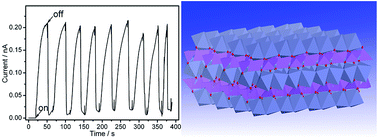
ZnSb2O4 nanoparticles with an average size of about 53 nm are synthesized by a facile hydrothermal method. The humidity sensing characteristics of the devices based on our ZnSb2O4 nanoparticles are investigated systematically. Such humidity sensors show excellent performance with ultra-high sensitivity, fast response/recovery speed, a wide range of relative humidity (RH) response, and excellent stability and reversibility. The responsive mechanisms in the low and high humidity ranges are also analyzed and simulated.

Introduction

Nanostructures, especially nanoparticles (NPs), have attracted particular attentions due to their unique optical, electronic and chemical properties.1–3 During the past decade, NPs have been widely applied in the fields of photoelectric devices, catalysis, energy storage, solar energy conversions, and gas sensors.4–7 As is well-known, humidity detection is very important in industrial processing and people's daily life. Moisture exists in almost every corner on the earth, and they can affect the normal operation of some electronics and industrial machines seriously. In order to achieve better detection of humidity in the working environment, various detecting techniques have been explored. In particular, interests in nanostructure-based humidity detectors have increased rapidly.8–14 A large number of nanostructured materials, such as carbon nanotubes,13 TiO2 nanoparticles,10 SnO2 nanoparticles,12 ZnO nanotetrapods,14 and so on, have been applied as the active part in humidity detectors to achieve high response. However, the real utilization of humidity detectors based on these materials is limited by their relatively low sensitivity, low chemical and thermal stability, long response and recovery time, and low repeatability.10–14 Therefore, it is extremely important to find alternative materials which are very sensitive to water molecules for the practical use of high efficiency humidity sensors.

As a spinel-type oxide, ZnSb2O4 has a tetragonal crystal structure with the P42/mbc(135) space group and with cell parameters a = b = 0.8527 nm, c = 0.5942 nm.15 ZnSb2O4 is also a typical ceramic material with excellent electrical and magnetic properties, and high chemical and thermal stability.16 These properties make ZnSb2O4 particularly suitable for the electronic applications. But till now, most of the reports were focused on the preparation of ZnSb2O4 nanostructures including nanowires and nanobelts.16 Only a few records about its application in gas sensors, varistors, and photoelectric devices appeared.16–18 And there is rare study on the humidity sensor of ZnSb2O4. In this communication, ZnSb2O4 NPs were prepared by a facile hydrothermal method, and a new type ZnSb2O4 NPs based humidity sensor was also fabricated. This humidity sensor exhibits remarkable humidity sensitivity properties, including a large relative humidity (RH) on/off ratio, fast response time and recovery time to the RH in N2 in a wide range of 0–100% at room temperature (25 °C). In addition to the relatively high humidity sensitivity compare with the other reported nanostructures, such humidity sensor also showed excellent repeatability and stability.

Experimental

Synthesis of ZnSb2O4 nanoparticles

The ZnSb2O4 nanoparticles were synthesized by a simple hydrothermal method. In a typical synthesis procedure, 4 mmol of zinc acetate dihydrate (Zn(CH3COO)2·2H2O) was added to 9 mL solution including 4 mL deionized water and 5 mL hydrazine hydrate (N2H4·H2O). And 3 mmol of antimony(III) chloride (SbCl3) was also added to another 9 mL solution including 4 mL deionized water and 5 mL hydrazine hydrate (N2H4·H2O). With vigorous stirring, the two precursors were completely dissolved. Then the two solutions were mixed together. After that, 2 mmol of Ethylene Diamine Tetraacetic Acid (EDTA) was added to the above mixture solution under magnetic stirring. The final homogeneous solution was transferred into a Teflon-lined stainless-steel autoclave with a capacity of 25 mL, which was sealed and kept at 200 °C for 30 h and then cooled to room temperature under ambient conditions. After the autoclave was cooled down to room temperature, the black products were washed several times with ethanol and distilled water, followed by during at 80 °C for 10 h under vacuum.

Humidity sensor fabrication and electric transport property measurements

An indium tin oxide (ITO) glass was cut into two isolated pieces with a sharp knife. The gap between the two electrodes was ca. 60–80 μm. The two parts of ITO glass on the glass separated by the gap served as two electrodes. The as-synthesized ZnSb2O4 nanoparticles were dispersed in ethanol, then dropped on the surface of the gap between the two electrodes, and dried naturally in room temperature. A thin film of ZnSb2O4 nanoparticles was formed and covered the gap between the two ITO pieces. Schematic of the ZnSb2O4 nanoparticles-based humidity sensor is shown in Fig. S1. The response and recovery time are defined as the time required to reaching 90% and 10% of the final equilibrium value, respectively.

Characterization

The phase composition and crystallographic structure of samples were examined by X-ray diffraction (XRD) technique with Cu Kα irradiation. The sizes and morphologies of the products were studied using a field emission scanning electron microscope (FESEM; S-4800, Hitachi, Minato-ku, Tokyo, Japan) and high-resolution transmission electron microscopy (HRTEM; JEM-2100F, JEOL). The humidity properties measurements were done on a CHI660D electrochemical workstation by the three-electrode method.

Results and discussion

The synthesized sample was examined by XRD techniques, as shown in Fig. 1a. All the observed diffraction peaks in the pattern were well indexed according to the power diffraction card of tetragonal ZnSb2O4 (JCPDS-15-0802; a = b = 8.5168 Å, and c = 5.9331 Å), and no secondary phase was found. Fig. 1b is the corresponding crystallographic model. The crystallite size of the particles was also calculated by Scherrer Formula (the details of calculation see ESI). The average crystallite size of ZnSb2O4 particles is about 53 nm. Fig. 1b shows the crystal structure of such tetragonal ZnSb2O4 with ordering variant in the 3D-framework.15
image file: c4ra13398f-f1.tif
Fig. 1 (a) X-ray diffraction patterns of ZnSb2O4 NPs, (b) crystal structure of tetragonal ZnSb2O4.

The morphology of the as-prepared ZnSb2O4 NPs was also characterized by scanning electron microscopy (SEM) and transmission electron microscopy (TEM). The FESEM images (Fig. 2a and b) reveal that a large number of spherical particles were uniformly distributed on surface of the substrate. The diameter of the spherical particles are mainly in the range of 50–60 nm. Thus, the NPs have high interparticle porosity which is essential for the adsorption of small molecules. The TEM image and HRTEM image of ZnSb2O4 NPs are shown in Fig. 2c and d. The clear lattice fringes show that the ZnSb2O4 NPs have a well-defined crystal structure. Meanwhile, the distance of the lattice fringes in HRTEM (Fig. 2d) is 0.316 nm, which is consistent with the (520) planes of the tetragonal ZnSb2O4.


image file: c4ra13398f-f2.tif
Fig. 2 (a and b) FESEM images of ZnSb2O4 NPs. (c) Low-magnification TEM image of ZnSb2O4 NPs, (d) a HRTEM image of ZnSb2O4 NPs.

The ZnSb2O4 NPs-based humidity sensor was fabricated with ITO electrode pairs and then its sensing characteristics about humidity were investigated systematically with an electrochemical workstation. Fig. 3a shows the typical IV curves obtained when the humidity sensor was exposed to different static air of 0–100% RH in N2 at 25 °C. Before each test, the N2 was flowed into the chamber for about 30 min to remove all the other gases. All IV curves measured under different RH atmospheres exhibited good linear behavior, which presents a good Ohmic contact in the device. At the same time, it can be found that the electric conductivity of ZnSb2O4 NPs obviously depended on the environmental humidity. The electric conductivity increased about four orders of magnitude as the relative humidity changed from 0% to 100%. In addition, the current of the humidity sensor in dry N2 (RH = 0%) is measured to be about 3 × 10⁻¹⁴ A, and that in 100% RH N2 is measured to be about 2 × 10⁻¹⁰ A. A low current value in dry air is important for the practical humidity sensors.19 The low current value here indicates a high sensitivity and low noise of the ZnSb2O4 NPs-based sensors.


image file: c4ra13398f-f3.tif
Fig. 3 (a) IV curves of ZnSb2O4 NPs-based humidity sensor with different RH values from 0 to 100% RH at 25 °C. Inset is the magnified IV curves of the low RH range from 0 to 50%. (b) The Rdry/Rhumid − RH curve, Rdry and Rhumid are the resistances measured under dry N2 and different RH values. Inset shows the linear part of the curve. (c) Time-resolved current of the humidity sensor in response to dynamic switches between 0% RH in N2 (“off” status) and 100% RH in N2 (“on” status). The bias voltage between two electrodes was kept constantly at 2.0 V. (d) The response and recovery time under fast change of RH values between 0% RH in N2 (“off” status) and 100% RH in N2 (“on” status). The bias voltage between two electrodes was kept constantly at 2.0 V.

The sensitivity, response and recovery time, and repeatability are three key parameters to determine the property of a humidity sensor.11–20 The sensitivity of the humidity sensor is defined as Rdry/Rhumid, which Rdry and Rhumid are the resistance of the device under dry air/N2 and different humidity. The corresponding dependence of the sensitivity on the RH is displayed in Fig. 3b. The maximum sensitivity (RH = 100%) of our device can reach as high as 6000, which well surpasses the humidity sensors reported previously.10–14 In addition, when RH is less than 50%, the device sensitivity presents a good linear relationship with the RH, which is a good advantage for low-humidity sensing task.11 Fig. 3c shows the current response of the ZnSb2O4 NPs-based sensor to dynamic switches between dry N2 (RH = 0%) and moist N2 (RH = 100%) at 25 °C. When the device was exposed to the moist air of 100% RH (at “on” state), the current increased rapidly and finally reached saturation. When the device was switched to dry N2 (at “off” state) again, the current decreased quickly and then reached a relatively stable value which is higher than the initial current value. However, we also can see that the device didn't recover to the initial value from the second cycle. The physical desorption of the water molecules is a fast process, it only takes a few seconds to complete (Fig. 3c and d). But the process of water molecules chemical desorption requires a relatively long time (about 5 min) to complete (see Fig. S3). The current of the device increased and decreased rapidly in accordance with the RH from 100 to 0%, which demonstrates high sensitivity and fast response. The most important point is that, such high sensitivity and fast response can maintain after scores of cycles. The current was still rapidly changed together with the humidity switch between dry N2 and given RH N2. That means the device revealed an excellent repeatability and stability.

Fig. 3d shows the current response to humidity in the process of water molecules physisorption (RH = 100% to RH = 30%). The response and recovery time are calculated to about 25 s and 2.4 s, respectively. However, when the whole process of water molecules adsorption (physisorption and chemisorption) is considered, the initial baseline takes about 5 min to recover (Fig. S3). These values are much lower than the previous reports of nanostructure based humidity sensors. The humidity sensor parameters of present and previous woks are shown in Table 1 for comparison. Our NPs-based humidity sensors showed an ultra-high sensitivity and relatively fast response time. The humidity sensors are also studied in air atmosphere. The test results show that the initial resistance (RH = 0%) tested in air atmosphere is slightly larger (about 2 times) than that tested in N2. However, the response/recovery speed and sensitivity of the humidity sensors tested in air atmosphere are almost the same as the results tested in N2. These results are consistent well with the previous work.21,22 The results were obtained on three devices (each of them was tested twice). We find that in addition to the difference of the resistance, these devices have good humidity properties. The difference of the resistance is due to the dimension of the gap on the ITO glass.

Table 1 Comparison of the humidity sensing parameters between ZnSb2O4 NPs and other nanostructure humidity sensors
Humidity sensors RH on/off ratio Response time (s) Recovery time (s) Reference
Carbon nanotubes 2.3 2 30 13
TiO2 nanoparticles 1000 10 5 10
SnO2 nanoparticles 65 32 25 12
ZnO nanotetrapods 530 36 17 14
ZnSb2O4 nanoparticles >6000 <25 <3 This work


The experimental results presented above indicate that the electric conductivity of ZnSb2O4 is obviously affected by water molecules, and such electric conductivity change caused by water molecules is reversible. The response to humidity of ZnSb2O4 can be divided into two cases: the low humidity range and the high humidity range.11,23–25 In the low humidity, the water molecules chemisorb on the surface of ZnSb2O4 NPs, the process of water molecules chemisorb is described in Fig. 4b. At first, the water molecules were polarized in the electrostatic field present on the surface of ZnSb2O4 NPs, decomposing into hydroxyl (OH) and protons (H+). Then OH reacted with Zn2+ exposed on the surface of ZnSb2O4 NPs and form Zn2+–OH. The protons (H+) crosses over the energy barrier, and transformed from a vacancy on the surface of the samples to another.11 Such protons function as the charge carriers and transported on the surface of ZnSb2O4 NPs. The number of protons increased with the increase of the relative humidity, leading to the increase of ZnSb2O4 electric conductivity.


image file: c4ra13398f-f4.tif
Fig. 4 The possible water absorption schemes: (a) before absorption, (b) the chemisorb process of water molecules, (c) the joint physisorption and chemisorb process of water molecules.

In the high humidity range, the interaction between water molecules and the surface of the NPs were a joint process of physisorption and chemisorption. Fig. 4c depicts the process of water molecules chemisorption and physisorption which occurs on the surface of ZnSb2O4. With the increase of RH values, water molecules are physisorbed on top of the chemisorbed layer. This physisorption process also benefits from the high interparticle porosity on the sample surface of ZnSb2O4 NPs. With an ionic-conduction mechanism,14 the charge carriers (protons) hop through the physical adsorbed water molecules on the sample surface. Such transportation was more efficient compare to that in the low humidity condition. As a result, the electric conductivity of device increased rapidly with the enhancing of RH. When the device was exposed to dry air again, the water molecules which adsorbed on the surface of ZnSb2O4 NPs in the form of physisorption could be fastly desorbed. In the meantime, without the water pathway, the device current decreased rapidly to a relatively low value which corresponds to the chemisorption saturation. And then the current drop back to the stable “off” status in a second step. This mechanism is consistent well with the experimental data.

In order to further understand the results, experiment data were fitted by linear and exponential equation in the two different regions. When the RH < 50%, the RH-IRH/Idry N2 curve (insert picture in Fig. 3b) exhibits good linear behavior and the experimental data is fitted by a linear equation:

 
IRH/Idry N2 = a + bRH (1)
where the calculated intercept a is −4.83, and the slope b is 13.88. This is due to the interaction between water molecules and the surface of ZnSb2O4 NPs dominated by chemisorption, while physisorption plays a minor role. However, when the RH > 50%, the RH-IRH/Idry N2 curve (Fig. 3b) is nonlinear and the experimental data can be described using an exponential equation:
 
IRH/Idry N2 = aexp(−RH/b) + c (2)
where a is 132.29, b is −26.62, and c is −48.29. In this range, the physisorption of water molecules play a main role in the increase of electric conductivity. This mechanism is a reasonable explanation for the humidity sensitive characteristics of our devices.

Meanwhile, the effect of oxygen in air absorbed on the surface of ZnSb2O4 nanoparticles is also studied. As ZnSb2O4 nanoparticles are exposed to air, the adsorbed oxygen molecules deprive the electrons in the NP and form oxygen species (such as O, O2−, and O2), which led to the surface depletion in the NP's conductance channel.11,21,22,26,27 So the initial resistance (RH = 0%) tested in air atmosphere is slightly larger (about 2 times) than that tested in N2. However, the response/recovery speed and sensitivity of the humidity sensors tested in air atmosphere and in N2 have almost same result. This is due to the content of oxygen is assumed to be unchanged while the content of water molecules changed greatly, so water molecules play the key role in the control of the resistance of the humidity sensor.

The desorption of the water molecules can be also divided into two stages: physical desorption and chemical desorption. At first, the physical absorbed water molecules are removed with the introducing of dry N2. That's the physical desorption process and can be very fast. However, the chemical desorption is a relatively complex process. Hydroxyl (OH) recombine with protons (H+), and form water molecules, the resulting water molecules are subsequently completely removed with the continuous introduce of dry N2. So it takes more time to complete this process.

Conclusions

In summary, we fabricated the ultra-sensitive and stable humidity sensors based on ZnSb2O4 nanoparticles which synthesized via a facile hydrothermal method. With a high interparticle porosity, such humidity sensors exhibited high sensitivity, fast response and recovery speed, large RH on/off ratio of ∼6000, and excellent stability and reversibility. Within the low and the high humidity ranges, the sensors showed different response mechanisms and processes which were analyzed in details. All these outstanding characteristics make this type of humidity sensors have the tremendous promising applications in precise humidity detection and control.

Acknowledgements

J. Li gratefully acknowledges financial support from the National Natural Science Foundation of China under Grant no. 91233120, the National Basic Research Program of China (Grant no. 2011CB921901).

Notes and references

  1. J. Z. Zhang, Acc. Chem. Res., 1997, 30, 423–429 CrossRef CAS.
  2. A. K. Bhunia, P. K. Samanta, S. Saha and T. Kamilya, Appl. Phys. Lett., 2014, 104, 123703 CrossRef PubMed.
  3. W. Hou and S. B. Cronin, Adv. Funct. Mater., 2013, 23, 1612–1619 CrossRef CAS.
  4. T. C. Pappas, W. M. S. Wickramanyake, E. Jan, M. Motamedi, M. Brodwick and N. A. Kotov, Nano Lett., 2007, 7, 513–519 CrossRef CAS PubMed.
  5. C. Clavero, Nat. Photonics, 2014, 8, 95–103 CrossRef CAS.
  6. W. J. E. Beek, M. M. Wienk and R. A. J. Janssen, Adv. Mater., 2004, 16, 1009–1013 CrossRef CAS.
  7. X. Zou, J. Wang, X. Liu, C. Wang, Y. Jiang, Y. Wang, X. Xiao, J. C. Ho, J. Li, C. Jiang, Y. Fang, W. Liu and L. Liao, Nano Lett., 2013, 13, 3287–3292 CrossRef CAS PubMed.
  8. F. S. Tsai and S. J. Wang, Sens. Actuators, B, 2014, 193, 280–287 CrossRef CAS PubMed.
  9. G. Wang, Q. Wang, W. Lu and J. Li, J. Phys. Chem. B, 2006, 110, 22029–22034 CrossRef CAS PubMed.
  10. Z. Wang, L. Shi, F. Wu, S. Yuan, Y. Zhao and M. Zhang, Nanotechnology, 2011, 22, 275502 CrossRef PubMed.
  11. J. Feng, L. Peng, C. Wu, X. Sun, S. Hu, C. Lin, J. Dai, J. Yang and Y. Xie, Adv. Mater., 2012, 24, 1969–1974 CrossRef CAS PubMed.
  12. M. Parthibavarman, V. Hariharan and C. Sekar, Mater. Sci. Eng., C, 2011, 31, 840–844 CrossRef CAS PubMed.
  13. H. Yu, T. Cao, L. Zhou, E. Gu, D. Yu and D. Jiang, Sens. Actuators, B, 2006, 119, 512–515 CrossRef CAS PubMed.
  14. Y. Qiu and S. Yang, Adv. Funct. Mater., 2007, 17, 1345–1352 CrossRef CAS.
  15. P. Villars, K. Cenzual, R. Gladyshevskii, O. Shcherban, V. Dubenskyy, V. Kuprysyuk, I. Savysyuk and R. Zaremba, “ZnSb2O4”. Structure Types. Part 11: Space groups (135) P42/mbc–(123) P4/mm, Springer, Berlin Heidelberg, 2012, p. 52 Search PubMed.
  16. D. W. Zeng, C. S. Xie, M. Dong, R. Jiang, X. Chen, A. H. Wang, J. B. Wang and B. Shi, Appl. Phys. A, 2004, 79, 1865–1868 CrossRef CAS PubMed.
  17. M. A. L. Nobre and S. Lanfredi, Appl. Phys. Lett., 2002, 81, 451–453 CrossRef CAS PubMed.
  18. S. Ezhilvalavan and T. R. N. Kutty, Appl. Phys. Lett., 1996, 68, 2693–2695 CrossRef CAS PubMed.
  19. D. J. Xue, J. Tan, J. S. Hu, W. Hu, Y. G. Guo and L. J. Wan, Adv. Mater., 2012, 24, 4528–4533 CrossRef CAS PubMed.
  20. Z. Li, H. Zhang, W. Zheng, W. Wang, H. Huang, C. Wang, A. G. MacDiarmid and Y. Wei, J. Am. Chem. Soc., 2008, 130, 5036–5037 CrossRef CAS PubMed.
  21. N. M. Kiasari and P. Servati, IEEE Electron Device Lett., 2011, 32, 982–984 CrossRef CAS.
  22. N. M. Kiasari, S. Soltanian, B. Gholamkhass and P. Servati, Sens. Actuators, A, 2012, 182, 101–105 CrossRef PubMed.
  23. Z. Chen and C. Lu, Sens. Lett., 2005, 3, 274–295 CrossRef CAS PubMed.
  24. K. S. Chou, T. K. Lee and F. J. Liu, Sens. Actuators, B, 1999, 56, 106–111 CrossRef CAS.
  25. S. W. Chen, O. K. Khor, M. W. Liao and C. K. Chung, Sens. Actuators, B, 2014, 199, 384–388 CrossRef CAS PubMed.
  26. M. Zhuo, Y. Chen, J. Sun, H. Zhang, D. Guo, H. Zhang, Q. Li, T. Wang and Q. Wan, Sens. Actuators, B, 2013, 186, 78–83 CrossRef CAS PubMed.
  27. J. Huang, J. Wang, A. A. Zhukova, M. N. Rumyantseva, A. M. Gaskov, K. Yu, C. Gu and J. Liu, Sens. Lett., 2009, 7, 1025–1029 CrossRef CAS PubMed.

Footnote

Electronic supplementary information (ESI) available: Details of humidity testing of ZnSb2O4 NPs-based humidity sensor and calculation of the crystallite size of the particles. See DOI: 10.1039/c4ra1338f

This journal is © The Royal Society of Chemistry 2015
Click here to see how this site uses Cookies. View our privacy policy here.