N. R. Elezovic*a,
V. R. Radmilovicb,
J. Kovacc,
B. M. Babicd,
Lj. M. Gaijic-Krstajice and
N. V. Krstajicb
aInstitute for Multidisciplinary Research, University of Belgrade, Kneza Viseslava 1, Belgrade, Serbia. E-mail: nelezovic@tmf.bg.ac.rs
bFaculty of Technology and Metallurgy, University of Belgrade, Belgrade, Serbia
cJozef Stefan Institute, Jamova 39, Ljubljana, Slovenia
dVinča Institute of Nuclear Sciences, University of Belgrade, Serbia
eInstitute of Technical Sciences of the Serbian Academy of Sciences and Arts, Knez Mihailova 35, Belgrade, Serbia
First published on 19th January 2015
A platinum nanocatalyst on Sb doped tin oxide support (Sb–SnO2) was synthesized and characterized as a catalyst for oxygen reduction reaction in 0.1 mol dm−3 NaOH solution at 25 °C. Sb (5%) doped tin oxide support was synthesized by a modified hydrazine reduction procedure. The platinum nanocatalyst (20% Pt) on Sb–SnO2 support was synthesized by a borohydride reduction method. The synthesized support and catalyst were characterized by high resolution transmission electron microscopy (HRTEM) and X-ray photoelectron spectroscopy (XPS) and X-ray diffraction technique (XRD). X-ray photoelectron spectroscopy was applied to characterize the chemical status of elements before and after Pt-treatment. XPS spectra of Sn 3d, Pt 4f, Sb 3d and O 1s revealed that the Pt-deposition on Sb–SnO2 support induced the reduction of the Sn(4+) oxidation state to Sn(2+) and Sn(0) states, while Pt remained in the metallic state and Sb was in the (3+) oxidation state. Homogenous Pt nanoparticle distribution over the support, without pronounced particle agglomeration, was confirmed by HRTEM technique. The average Pt particle size was 2.9 nm. The electrochemically active Pt surface area of the catalyst was determined by the integration of the cyclic voltammetry curve in the potential region of underpotential deposition of hydrogen, after double layer charge correction, taking into account the reference value of 210 μC cm−2 for full monolayer coverage. This calculation gave the value of 51 m2 g−1. The kinetics of the oxygen reduction reaction with Pt/Sb–SnO2 catalyst was studied by cyclic voltammetry and linear sweep voltammetry using a rotating gold disc electrode. Two different Tafel slopes were observed: one close to 60 mV dec−1 in the low current density region, and another at ∼120 mV dec−1 in the higher current densities region, as was already referred in previous reports for the oxygen reduction reaction with polycrystalline Pt, as well as with different Pt based nanocatalysts. The specific activities for oxygen reduction, expressed in terms of kinetic current densities per electrochemically Pt active surface area, as well as per mass of Pt loaded, at the constant potential of practical interest (0.85 V and 0.90 V vs. RHE), were compared to a carbon supported (Vulcan XC-72) catalyst. The Pt/Sb–SnO2 catalyst exhibited similar catalytic activity for oxygen reduction reaction like carbon supported one. The advantages of the carbon free support application in terms of the durability and stability of the catalysts were proved by accelerated stability tests.
It could be expected that the kinetics of oxygen reduction reaction in alkaline solution is generally faster than in acid solution. According to previous reports it can be attributed to a lower degree of specific anion adsorption.1 As the adsorption of spectator ions inhibits many electrocatalytic processes, the decreased anion adsorption in alkaline media implies that most of electrocatalytic processes should be more facile in alkaline solutions than in acidic solutions.4
The other important advantage over aggressive acid electrolytes is the fact that with alkaline electrolytes less expensive electrode materials can be used. Only a few materials are stable under a strongly acidic environment, especially under the strongly oxidizing conditions encountered at oxygen cathodes.1
Recently, many non-noble catalysts were introduced as prospective candidates for alkaline fuel cell application. X. Li et al. investigated non-precious metal catalysts synthesized from the precursors of carbon, nitrogen and transition metal for oxygen reduction in alkaline fuel cells and showed comparable activity for oxygen reduction with Pt/C as benchmark catalyst.5 A cobalt tetraferrocenylporphyrin catalyst onto modified graphene support was synthesized by a solvothermally assisted method and the results showed that this catalyst exhibited an outstanding electrocatalytic performance towards the ORR, which is comparable with commercial Pt/C catalyst in alkaline media.6 The NaCo2O4/C cathode catalysts were prepared by a dry-up method and tested for oxygen reduction in alkaline solutions. The maximum power density of 27 mW cm−2 was obtained.7 Nitrogen/sulfur co-doped carbon materials were investigated as non-precious metal catalysts for the ORR in alkaline media. The promising catalytic activity towards the ORR and 4-electron transfer pathway in 0.1 mol 0.1 KOH was revealed.8 Metal N doped nanoporous carbon (N–M–nC, M = Fe, Co) was prepared by the in situ incorporation of metal during the formation of the nanoporous carbon skeleton followed by NH3 treatment. It was shown that the performance of the catalyst is comparable to that of commercial Pt/C.9 Nitrogen-doped graphene-supported Co/CoNx was referred to as a highly efficient electrocatalyst for oxygen reduction reaction in an alkaline medium as well.10
Platinum based catalysts are among the most active catalysts for oxygen reduction in alkaline solutions, from single crystals to nanoparticles on carbon support, owing to high catalytic activity and stability.11–14 The problem of the catalysts' durability and stability, caused by carbon degradation, especially at high anodic potentials, was recognized.15,16 In order to overcome this problem, Pt supported catalysts on metal oxides, such as Ti, Nb, Sn, were studied mainly in acidic solutions due to their potential for oxygen reduction.17–21 SnO2 belongs to the broad-band semiconductors, with relatively high electronic conductivity, however further increase in the conductivity of such oxides can be expected by doping with hypervalent or hypovalent ions such as Nb, Sb or Al.22
In this study, antimony doped tin oxide support was synthesized by modified hydrazine reduction and fully characterized by XRD, XPS and TEM techniques. A platinum nanoparticle based catalyst was synthesized onto this support. This catalyst was tested for oxygen reduction in alkaline solution. The aim of this study was to reveal the influence of the carbon free support on the Pt catalyst's performance. The obtained results were compared to a Pt catalyst on commercial carbon support – Vulcan XC-72. The advantages of this carbon free support in terms of durability and stability at high anodic potentials were proved experimentally by accelerated stability tests.
High angle annular dark field (HAADF), bright field (BF), and electron energy loss spectroscopy (EELS) techniques in a scanning transmission electron microscope (STEM) were applied for measuring the surface properties of the supports and catalysts. TEM characterization was performed at the National Center for Electron Microscopy NCEM-Berkeley, Lawrence Berkeley National Laboratory. Details related to the TEM measurements experimental procedure are described in ref. 24.
The X-ray photoelectron spectroscopy (XPS or ESCA) analyses were carried out on the PHI-TFA XPS spectrometer produced by Physical Electronics Inc. Sample powders were deposited on vacuum compatible carbon adhesive tape and introduced into the ultra-high vacuum spectrometer. The analyzed area was 0.4 mm in diameter and the analyzed depth was about 3–5 nm. This high surface sensitivity is a general characteristic of the XPS method. Sample surfaces were excited by X-ray radiation from monochromatic Al source at the photon energy of 1486.6 eV. The high-energy resolution spectra were acquired with an energy analyzer operating at a resolution of about 0.6 eV and pass energy of 29 eV. During data processing the spectra from the surface were aligned by setting the C 1s peak at 284.8 eV, which is a characteristic for the C–C bond. The accuracy of binding energies was about ±0.2 eV. Two different XPS measurements were performed on each sample in order to check the homogeneity and reproducibility of acquired spectra, both of which were very high.
The average crystallite size can be calculated from the Scherrer equation,
![]() | (1) |
Fig. 2a shows the XPS core lever spectra of Sb 3d. On the Sb–SnO2 sample, the Sn 3d5/2 peak is at 487.3 eV. It can be assigned to the Sn(4+) in SnO2.
On the Pt/Sb–SnO2 sample, the Sn 3d5/2 spectra were significantly different from that on the Sb–SnO2 and were fitted with three components (Fig. 2b). The main component at 487.2 eV is related with the Sn(4+) state and it is about 65% of the relative intensity of the total Sn 3d signal. The second component is at 486.3 eV and it may be related with the reduced Sn(2+) state.26,27 It is about 30% of the relative intensity of the Sn 3d signal. The third component is at 485.3 eV and it is related to metallic Sn(0). The last component is about 5% of the relative intensity of the total Sn 3d signal. The main result of the XPS method is that the reduction of Sn took place during Pt-treatment and the reduced SnOx is stable after treatment.
Fig. 3 shows the Pt 4f spectra from Pt/Sb–SnO2 sample. It consists of doublets of Pt 4f7/2 and 4f5/2 at binding energies of 70.8 eV and 74.1 eV, respectively. Spectra are asymmetric towards the high binding energy side. The binding energy and spectra shape show that Pt is present mainly in the metallic form.26–28 Some other oxidation states of Pt can not be completely ruled out due the noisy spectra related to the very low concentration of Pt (about 1 at%) in the treated Sb–SnO2 crystals. It might be possible that an interaction exists between Sn-metallic atoms and Pt-metallic atoms but the XPS method has not enough chemical sensitivity to prove this interaction directly.
The XPS spectra of Sb 3d and O 1s are shown in Fig. 4.
![]() | ||
| Fig. 4 XPS spectra of the Sb 3d5/2 and O 1s obtained on the Sb + SnO2 sample (a) and Pt/Sb–SnO2 sample (b). | ||
The Sb 3d spectra consist of doublet structure of 3d5/2 at 531.0 eV and 3d3/2 at 540.3 eV. Unfortunately, the main Sb 3d5/2 peak interferes strongly with the O 1s peak in the energy interval of 530–533 eV. We succeeded in decomposing the O 1s spectra into two components. The first component is at 530.9 eV and is related with O(2−) oxygen atoms in an oxide lattice structure. The second component is at 532.3 eV and is probably related to H2O, OH or CO species on the surface.28 The main differences between the non-treated and Pt-treated samples is that the Sb–SnO2 sample contains a smaller contribution from adsorbed H2O, OH or CO species (O 1s component at 532.3 eV) (Fig. 4a), whereas these species are much more present on the surface of Pt/Sb–SnO2 (Fig. 4b). This may be also related to a much higher carbon C 1s signal present on these two samples. It is interesting to note that the Sb components are lower in the Pt/Sb–SnO2 sample if compared to Sb+ in the SnO2 sample. The binding energy of Sb 3d5/2 is at 531.0 eV, which indicates that the Sb-atoms are mainly in the (3+) oxidation state.28
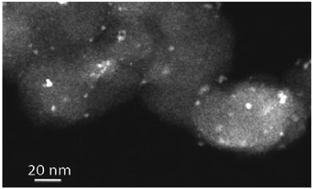
TEM results revealed a homogenous Pt particle distribution, with an average particle size diameter of 2.9 nm.24 The typical platinum particle clusters, as well as the FFT (Fast Fourier Transformation) of particles in the marked red square, taken close to [112] Pt zone axis are presented in Fig. 5.
![]() | ||
| Fig. 6 Cyclic voltammograms obtained at Pt/Sb–SnO2 and Sb–SnO2 support, in 0.1 mol dm−3 NaOH at sweep rate of 100 mV s−1, at 25 °C. | ||
The characteristic platinum shape for alkaline solutions can be seen, with three well defined peaks in the potential range of the underpotential deposition of hydrogen (from 0.03 V to 0.45 V vs. RHE). The electrochemically active surface area (EASA) of Pt, determined by the integration of the anodic part of the cyclic voltammogram in the potential range from 0.03 V to 0.45 V vs. RHE, was 51 m2 g−1. This value is about 30% lower than the EASA determined at the Pt/Sb–SnO2, by the same method, in acidic solution,24 as it was expected for Pt based catalysts. The support was conductive and inert, with no electrochemical reactions taking place in this potential range, as it is clearly shown in the inset of Fig. 6. The cyclic voltammogram of the carbon supported Pt catalyst, used as benchmark, is shown in Fig. 7.
![]() | ||
| Fig. 7 Cyclic voltammogram obtained at Pt/C catalyst, in 0.1 mol dm−3 NaOH at a sweep rate of 100 mV s−1, at 25 °C. | ||
The oxygen reduction reaction was investigated by linear sweep voltammetry, at the sweep rate of 20 mV s−1, at different rotation rates. The polarization curves, obtained by positive sweep, are presented in Fig. 8.
It can be seen that well defined diffusion limiting current densities were obtained, close to the corresponding theoretical values for the same electrolyte and rotation rates, expressed per geometric surface area of the electrode. This fact is the indication of proper Pt loading per geometric surface area for rotating disc electrode measurements.29
As the oxygen reduction belongs to the mixed control processes, the total current density can be expressed by Lewich–Koutecky equation:
| j−1 = jk−1 + (Bω1/2)−1 | (2) |
The measured total current density (j) is the function of the kinetic current density (jk) and diffusion limiting current density (jD = Bω1/2), and B is defined by following equation:
| B = 0.620nFCO2DO22/3ν−1/6 | (3) |
Taking into account previously reported values30 for the constants in eqn (3) for 0.1 mol dm−3 NaOH solution: DO2 – diffusion coefficient of oxygen (2.22 × 10⁻⁵ cm2 s−1), ν – the kinematics viscosity of the solution (1.1 × 10⁻² cm2 s−1) and CO2 – the bulk concentration of dissolved oxygen molecules (1.13 × 10⁻⁶ mol cm−3), the number of electrons exchanged close to four was calculated from Levich–Koutecky dependence (Fig. 9).
The kinetic current densities at each potential value can be determined from the intercept of Levich–Koutecky dependence (Fig. 9), j vs. ω−1/2. The mass transfer currents contribution corrected Tafel plot is presented in Fig. 10.
According to previously published studies, the Tafel slope values for oxygen reduction at bulk platinum catalysts in alkaline solution should be close to −60 mV dec−1 at low current densities, and −120 mV dec−1 in the potential region of high current densities.31,32 Experimentally obtained Tafel slope values: −0.056 V dec−1 and −0.119 V dec−1 are in good accordance to the already accepted reported values.
It is common to compare catalytic activities for oxygen reduction at Pt based catalysts at 0.85 V vs. RHE, where the mass contribution current can be considered as negligible. The obtained kinetic current density value of 0.198 mA cm−2 (Fig. 10) is in good accordance to the corresponding value at Pt catalyst on carbon based support, obtained at the same experimental conditions.33
The stability and durability of the catalyst were investigated by repetitive cycling in the potential region from 0 V to 1.4 V vs. RHE. Cyclic voltammograms obtained after repetitive cycling was integrated in the potential region of underpotential deposition of hydrogen and the obtained charge amount was divided by that initially obtained. The dependence of determined normalized electrochemically active surface area on the cycle number is presented in Fig. 11. The stability test proved clearly the advantage of the Pt catalyst on the Sb–SnO2 support over the carbon supported one.
Having in mind the already referred to and widely accepted disadvantages of carbon based supports,15,16 and the results obtained in this study, the benefit of Sb–SnO2 application is clear. Although the comparable catalytic values, in comparison to carbon supported one were determined, synthesized Pt catalyst on the new tin oxide based support material exhibited better stability at high anodic potentials. It makes this catalyst promising as a fuel cell cathode to overcome carbon based supports durability disadvantages.
The electrochemically determined active surface area of Pt was 51 m2 g−1. The determined catalytic activity for oxygen reduction, expressed in terms of kinetic current density per real Pt surface area at the constant potential value of 0.85 V vs. RHE was 0.198 mA cm−2, whereas the corresponding mass activity was 101 mA mgPt−1. The testing of the catalyst's stability and durability proved the benefit of this catalyst for long term application.
| This journal is © The Royal Society of Chemistry 2015 |