S. Lu,
Y. J. Ma,
H. Y. Xuan,
A. Wang,
B. Zhao,
X. D. Li,
J. H. Zhou,
Y. Lin,
L. Zhou* and
S. H. Wei*
College of Chemistry and Materials Science, Analysis and Testing Centre, Jiangsu Key Laboratory of Biofunctional Materials, Jiangsu Collaborative Innovation Centre of Biomedical Functional Materials, Key Laboratory of Applied Photochemistry, Nanjing Normal University, Wenyuan Road No. 1, Nanjing, China. E-mail: zhoulin@njnu.edu.cn; shwei@njnu.edu.cn; Fax: +86-25-85891761; Tel: +86-25-85891761
First published on 6th November 2014
The stable 4
:
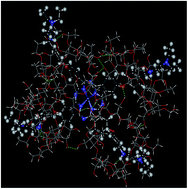
1 host–guest complex of phthalocyanine (Pc) and hydroxypropyl-beta-cyclodextrin was designed, computer modeled and prepared. The complex formation can greatly increase water solubility, reactive oxygen generation ability, biocompatibility and, thereby, the in vitro phototoxicity of Pc to cancer cells.
:
1 or 2
:
1) directly through host–guest mode driving for intermolecular hydrogen bond or hydrophobic force is a simple method to prepare the complex.7 However, the binding constants are rather low, which induced separation of PS and CD in solution, making CD far from being an ideal vehicle for the drug transport of Pc or other PSs with similar structure, such as porphyrin.8 The popular methods to solve this problem were using covalent bond to link PC and CD8,9 or using CD dimmer to form host–guest structure with Pc.10 Systemic studies indicated that such complexes of CD and Pc have great water disperse ability, low aggregation degree and satisfied PDT activity. However, most of above process involves complicated synthetic steps, which are not general and not always possible. Therefore, it remains a big challenge in preparing stable complex of CD and Pc, or other PSs with similar structure, such as porphyrin, with simple but effective method.
Our group has reported a tetra-1,2-diethylamino substituted zinc(II) phthalocyanine (ZnPc), which have ideal PDT efficacy but low solubility and high aggregation degree in aqueous solutions.11 We choose hydroxypropyl-beta-cyclodextrin (HP-β-CD) as host CD because of its suited cavity size to ZnPc, good water solubility and abundant –OH in its molecule structure. There are four homogeneous chains structure in ZnPc; and, in these chains, there are abundant –NH2 group, which can form multiple hydrogen bond with the –OH group of HP-β-CD. Furthermore, hydrogen bond can also be formed between –OH of adjacent CD molecules. So, we proposed that HP-β-CD can form stable host–guest 4
:
1 complex (HP-β-CD)4-ZnPc with ZnPc because of the abundant intermolecular interactions and such complex can greatly improve solubility and reduce aggregation degree in aqueous solutions, and therefore, increase phototoxicity.
Under N2 atmosphere, ZnPc was synthesized by undec-7-ene (DBU) catalytic method as our previous report (Fig. S1†).11 In a typical experiment (see ESI† for experimental details), the host–guest complex of ZnPc and CD were prepared by mixing ZnPc (150 μL, 1 × 10⁻³ M in methanol) and HP-β-CD (600 μL, 1 × 10⁻³ M in Mili-Q water) in 10 mL of methanol by vigorous magnetic stirring. Then, the mixture was heated to reflux and stirring for 5 h under 80 °C. After evaporation of the solvent at 40 °C, the complex solid was got. The solid can be redissolved in Mili-Q water for further experimentation. The result complex can be well dispersed in aqueous solution for a long time. Free ZnPc control was prepared by dissolving HB in Millipore™ water using traces of ethanol (<5‰) as latent solvent.
To verify that ZnPc was successfully formed 4
:
1 host–guest complex with HP-β-CD, the experiment evidences, including UV-vis spectra, thermogravimetric (TG) analysis, differential thermal analysis (DTA), 1H NMR and FTIR spectra (Fig. S2–S4, Table S1–S3†), were provides. As showed in Fig. 1A, ZnPc showed aggregate absorption band at 640 nm and monomer absorption band at 678 nm. And ZnPc mainly existed as aggregate form in water. For PDT, aggregates of Pc always reduce 1O2 generation and, thereby, the in vitro phototoxicity activity. When forming complex with HP-β-CD, ZnPc mainly existed as monomer form in water, which indicated that the interaction with HP-β-CD can effectively decrease aggregation degree of ZnPc. Besides, the monomer absorption band was obviously red-shifted from 678 to 690 nm, which indicated that the environment of HA ZnPc molecules has been changed, i.e., the HP-β-CD molecules can prevent the inner ZnPc molecules from water molecules, and the ZnPc molecules exist in the hydrophobic surroundings.
Furthermore, the absorption intensity of ZnPc continuously increased as the interaction ratio between HP-β-CD and ZnPc was increased from 2
:
1 to 4
:
1. When the interaction ratio continuously increased higher than 4
:
1 (5
:
1 and 6
:
1), the absorbance intensity of ZnPc was decreased on the contrary, which implied that the interaction ratio of 4
:
1 (between ZnPc and HP-β-CD) is the boundary (Fig. 1A insert panel). Therefore, the optimized interaction ratio between ZnPc and HP-β-CD was 1
:
4 because at this condition, the monomer absorbance intensity reached maximum, which is helpful for 1O2 generation, and therefore, the in vitro phototoxicity to cancer cells. Above results indicated that ZnPc was successfully formed 4
:
1 host–guest complex with HP-β-CD.
All the TG curves, including ZnPc, HP-β-CD, physical mixture of them and (HP-β-CD)4-ZnPc, were showed in Fig. 1B. The decomposition temperature of ZnPc and HP-β-CD was 306.8 and 328.3 °C, separately. The decomposition temperature of the host–guest complex was greatly enhanced to 341.9 °C. However, no similar result was detected in the physical complex mixture (detail data in Table S1†). This phenomenon indicated that there are strong interactions between ZnPc and HP-β-CD and such interaction greatly improve the thermo stability of the complex, which further improved that the 4
:
1 host–guest complex of ZnPc and HP-β-CD was successfully formed.
The interaction between ZnPc and HP-β-CD was performed using the Discovery Studio 2.1 (DS 2.1) software package (Accelrys, USA). ZnPc and HP-β-CD were defined as guest and host, separately. The ZDOCK module under the CHARMm force field was used to dock ZnPc and HP-β-CD. Among docked 100 poses, according to the score height, the highest score of configurations was chosen to the optimum combination mode between ZnPc and HP-β-CD. As shown in Table 1, their binding energy had an obvious decrease from −68.28 to −1348.10 kcal mol−1 with the increase of interaction ratio from 1
:
1 to 4
:
1. Such results indicated that the most stable condition can be obtained after the 4
:
1 host–guest complex formed. These calculation results are consistent with the experimental data.
| Ratio between HP-β-CD and ZnPc | 1 : 1 |
2 : 1 |
3 : 1 |
4 : 1 |
| Binding energy (kcal mol−1) | −68.28 | −405.81 | −870.23 | −1348.10 |
By the analysis of the geometric configuration, it can be found that there are two kinds of hydrogen bonds can form in (HP-β-CD)4-ZnPc. Firstly, there are ten hydrogen bonds between –OH group of adjacent HP-β-CD molecules (shown in Fig. 2). These hydrogen bonds can fix four HP-β-CD molecules together to stable the (HP-β-CD)4-ZnPc complex.
![]() | ||
| Fig. 2 The hydrogen bond (green dash line) in (HP-β-CD)4-ZnPc between ZnPc and HP-β-CD and adjacent CD molecules. | ||
Secondly, the –NH2 group of ZnPc can form multiple hydrogen bonds with the –OH group of HP-β-CD. The hydrogen bond positions and structural parameters were shown in (Fig. 3 and Table 2), which indicated that the hydrogen bond details in the four side chains of ZnPc. The N–H⋯O hydrogen bonds can be formed between the NH from ZnPc and O from HP-β-CD. The O–H⋯N hydrogen bond can be formed between the N from ZnPc and OH from HP-β-CD.
| Bond position | d(D–H) (Å) | d(H⋯A) (Å) | d(D⋯A) (Å) | ∠DHA (°) |
|---|---|---|---|---|
| A:N70–H77⋯O67:D | 1.03 | 2.00 | 2.90 | 144.02 |
| A:N103–H106⋯O100:D | 1.02 | 2.25 | 3.22 | 159.9 |
| A:N177⋯H180–O163:D | 1.03 | 2.20 | 2.91 | 124.4 |
| A:N144–H151⋯O67:D | 1.03 | 2.41 | 2.67 | 92.7 |
| A:N144⋯H74–O67:D | 0.97 | 1.98 | 2.67 | 126.0 |
The combination of above two kinds of hydrogen bonds, hydrogen bonds between –OH group of adjacent HP-β-CD molecules and hydrogen bonds between –NH2 group of ZnPc and –OH group of HP-β-CD, may favor the contribution of the stability of the host–guest complex.
1O2, the main cytotoxic species in PDT was detected using the sodium of 9,10-anthracenedipropionicacid (ADPA) as a chemical trap by detecting the absorbance intensity decreasing at ∼380 nm (λmax of ADPA).12 As showed in Fig. 4A, the anthracene absorbance intensity in (HP-β-CD)4-ZnPc and ADPA mixture showed a continuous decrease over 150 s irradiation by 665 nm LED, suggesting the 1O2 generation (similar result was detected in ZnPc solution, Fig. S5†). On the contrary, HP-β-CD without ZnPc produced no change in the absorbance of ADPA with irradiation, confirming that the bleaching of ADPA in the presence of ZnPc is caused by the generated 1O2 and not by the irradiating light or HP-β-CD.
The relative 1O2 generation rate constant (k) can be extrapolated by a linear fit using the experimental points as previous reports.13 According to the tailored specifically equations (details in ESI†), the relative rate constant k with ADPA for ZnPc and (HP-β-CD)4-ZnPc were shown to be 2.75 × 10⁻³ (correlation coefficient R = 0.954) and 6.17 × 10⁻³ (R = 0.943), separately (Fig. 4B), which indicated that the host–guest complex form is very effective to improve the 1O2 generation of ZnPc. The increased 1O2 generation of ZnPc in the complex could be caused by many reasons, such as the decreased aggregation degree of ZnPc and the decreased rate of physical quenching of 1O2 because of the protection from HP-β-CD molecules.
As showed in Fig. 5, drastic changes in the morphology of human cervical carcinoma (HeLa) cells, which were treated with ZnPc or (HP-β-CD)4-ZnPc, have been observed after irradiation. The treated cells was not smooth and extension as control cells. And their nuclear morphology was greatly changed. To further identify the chromatin changes, in nuclear, of photodamage cells, the chromatin of these cells were stained with membrane-permeable blue Hoechst 33
342. The chromatin fluorescence of the control cells stained dimly and occupied the majority of the cell nuclear. In contrast, the cells treated with ZnPc or (HP-β-CD)4-ZnPc and irradiated showed obvious morphology changes, such as chromatin shrinkage, chromatin condensation and fragmentation. These changes are apparently induced by the ROS generated by ZnPc.
A very important reason for HP-β-CD can be exploited as drug delivery system is its superior biocompatibility and our results showed that no obvious toxicity was detected on HeLa cells at high concentration of 80 μM (Fig. S6†). The properties of an ideal PS include low dark cytotoxicity, and effective cellular uptaken ability, intracellular ROS generation ability and excellent phototoxicity. As showed in Fig. 6A, after forming the host–guest complex with HP-β-CD, the dark toxicity of ZnPc was obviously decreased, which indicated that the existence of HP-β-CD improved the biocompatibility of ZnPc. Cellular uptake of ZnPc and (HP-β-CD)4-ZnPc with different incubation time from 2 to 24 h was showed in Fig. 6B.
A significant increasing in cellular uptake efficiency was shown for (HP-β-CD)4-ZnPc comparing with ZnPc, which is possibly due to its positive charge property and nano-size distribution (Fig. S7 and S8†).14 In vitro ROS inside cancer cells was detected in situ using 2′,7′-dichlorofluorescin-diacetate (DCFH-DA) as probe, which can diffuse into cells, be deacetylated by esterase and then oxidized to the fluorescent 2′,7′-dichlorfluorescein (DCF) in the presence of ROS. As shown in Fig. 6C, results are expressed as the fluorescence intensity ratio of DCFtreated/DCFuntreated, which indicated that in vitro ROS generation ability of (HP-β-CD)4-ZnPc was obvious superior to ZnPc, which induce the superior in vitro phototoxicty to HeLa cells comparing with ZnPc (Fig. 6D).
In summary, we have successfully developed a simple and efficient approach to self-assemble 4
:
1 host–guest complex of amino group substituted zinc(II) phthalocyanine and HP-β-CD. The structure of the 4
:
1 (HP-β-CD)4-ZnPc complex was verified by both experiments and molecular modeling. Different like previous reported, such 4
:
1 complex is very stable in aqueous solution because abundant hydrogen bonds can not only be formed between ZnPc and HP-β-CD, but also formed between adjacent HP-β-CD molecules. Such interaction can greatly improve solubility and reduce aggregation degree of ZnPc in aqueous solutions. The result new (HP-β-CD)4-ZnPc complex exhibited superior 1O2 production, intracellular ROS generation cellular uptaken ability and phototoxicity to cancer cell to free ZnPc. The promising phototoxicity of (HP-β-CD)4-ZnPc ensures its potential as effective PDT drugs and it opens up the possibility to explore these simple method to prepared other stable host–guest complex for other PSs with similar structure as Pc, such as derivatives of porphyrin, pyropheophorbide, porphin and et al.
Footnote |
| † Electronic supplementary information (ESI) available: Details of 1H NMR, TG, FTIR, ADPA bleaching by ZnPc, 1O2 generation rate calculation process, The toxicity of HP-β-CD, size distribution, TEM and zeta potential of (HP-β-CD)4-ZnPc. See DOI: 10.1039/c4ra12654h |
| This journal is © The Royal Society of Chemistry 2014 |