Ying-li Dong,
Xian-fa Zhang,
Xiao-li Cheng,
Ying-ming Xu*,
Shan Gao,
Hui Zhao and
Li-hua Huo*
Key Laboratory of Functional Inorganic Material Chemistry, Ministry of Education, School of Chemistry and Materials Science, Heilongjiang University, Harbin 150080, People's Republic of China. E-mail: lhhuo68@yahoo.com; Fax: +86-0451-86608040; Tel: +86-0451-86608426
First published on 23rd October 2014
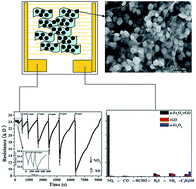
Nanosphere-like α-Fe2O3 modified reduced graphene oxide nanosheets were prepared by a simple hydrothermal method without any surfactant or template. The nanocomposites were characterized by X-ray diffraction (XRD), Raman spectra (RS), Fourier transform infrared (FT-IR) spectra, X-ray photoelectron spectroscopy (XPS), scanning electron microscopy (SEM), and transmission electron microscopy (TEM) techniques. The α-Fe2O3 nanospheres have a hierarchical structure, with diameter of about 40–50 nm, and grow uniformly on the surface of single graphene nanosheets. α-Fe2O3/rGO nanocomposites exhibit high response of 150.63% to 90 ppm NO2 at room temperature, 65.5 times higher than the response of pure graphene, and the detection limit for NO2 can be decreased down to 0.18 ppm. A mechanism is proposed for sensing of the nanocomposites: the high response of the nanocomposites to NO2 at room temperature is the synergistic effect of the two sensing materials and large specific surface area of the nanocomposites.
However, graphene happens to reunite among sheets because of van der Waals interactions, resulting in low sensitivity and irreversibility of sensors.8,9 To overcome these problems, organic functional groups (sulfonated, ethylenediamine)10 and noble metals (Pd,11 Au,12 Ag12) have been investigated as modifying materials. Recently, semiconducting metal oxides, such as SnO2,13 NiO,14 WO3,15 ZnO,16 and Fe2O3,17 have been chosen as modifying materials because of their easy synthesis, low cost, and good stability. Their composites exhibit high sensitivity and reversibility at working temperature of 150–300 °C. Also, some metal oxide/graphene composites have been investigated under decreasing working temperature, and they show certain response to some test gases at room temperature. For example, Cu2O nanowire,18 Co3O4 nanoparticles,19 SnO2 nanoparticles,20 and indium-doped SnO2 nanoparticles21 have been studied in modification of reduced graphene oxide, exhibiting certain responses with long response-recovery characteristics to NO2. Radial flower-like SnO2,22 ZnO quantum dots,23 TiO2 nanoparticles,24 and Cu2O nanoparticles25 also have been considered as composites with graphene to detect NH3, HCHO, O2, and H2S, respectively, but with low responses at room temperature. However, the selectivity of most nanocomposite materials was not investigated in the cited reports. There is interest in investigation of new nanocomposites that show good selectivity to target gases at room temperature.
Ferric oxide nanomaterials are a kind of functional material whose composites with graphene have been applied mainly in Li-ion batteries,26 frictional materials,27 high-performance catalysts,28 supercapacitors,29 and biosensors.30 Two studies of Fe2O3–graphene nanocomposites used in gas sensors at high temperature were recently reported. Liang et al. prepared α-Fe2O3 nanoparticle modified graphene nanocomposites at 180 °C via an ethanol solvothermal route, which showed response of about 29 to 1000 ppm ethanol at 280 °C.17 In another paper, Fe2O3 nanoparticle-coated graphene nanosheets were obtained by a super critical CO2 assisted thermal method followed by vertical magnetic field assembly with directed flow. The material exhibited a CL emission of about 450 absorption units in response to 15 ppm H2S at 190 °C with good selectivity.31
In a previous investigation, we reported that the working temperature of the sensors could be decreased down to room temperature when the microstructure of the sensing materials was controlled through construction of the 3D hierarchical structure32 or adjustment of special morphology.33 Similarly, if hierarchical α-Fe2O3 nanomaterial with special morphology was used to modify graphene, it might be possible to decrease the working temperature of such nanocomposites.
There is a need for efficient sensors to selectively detect low concentrations of nitrogen dioxide (NO2) in a short time at low temperature. The rapid development of the automobile industry has caused nitrogen dioxide, produced mainly by automobiles and power plants, to become one of the main pollutants in the atmospheric environment. It is well known that NO2 can destroy the ozone layer, and can also do great harm to human health, e.g. respiratory system of human. According to reports, the Lethal Concentration 50 (LC50) of NO2 is 126 mg m−3, with an exposure time of no longer than 8 h to 3 ppm NO2.21
In this paper, we report a simple and low cost hydrothermal synthesis route to prepare α-Fe2O3/rGO nanocomposites at 120 °C, in which nanosphere-like α-Fe2O3 of 40–50 nm diameter are constructed by a few nanometer-sized nanoparticles and reduced graphene oxide (rGO) intercalated single sheets. These nanocomposites exhibit excellent response and selectivity to NO2 at room temperature.
![]() | ||
| Fig. 1 The experimental reaction diagram of α-Fe2O3/rGO nanocomposites (a), schematic of α-Fe2O3/rGO nanocomposites on the sensor substrate (b) and schematic of sensing test (c). | ||
The gas-sensing properties of the nanocomposite sensors were tested in a closed container at room temperature (ca. 25 °C) by a dynamic gas test method with a gas inlet and a gas outlet using JF02E type gas sensor tester (Kunming, China). The different concentrations of test gas were obtained through mixing test gas and dry air, all from standard bottles and controlled by the mass flow controllers. The concentration of test gas was controlled at a constant rate of 200 standard cubic centimeter (sccm) per minute during the testing process as shown in Fig. 1c.
The sensitive degree of the sensors was detected by the change of the sensor resistance, and the data were collected using a computer. To begin the sensing measurement, the sensors were put into the closed container, and dry air flowed into the container to keep the container clean. Then the test gas flowed into the container, and changes of signals were collected by a computer during the gas passing. After 80 s, the test gas flow was stopped, but the dry air was kept circulating in the whole container. The response is defined as S = [(Ra − Rg)/Rg] × 100%, in which Ra is the resistance of the sensors in the dry air flow and Rg is the resistance of the sensors in the test gas. Because of the long recovery time of graphene materials,6,35,36 the response time was controlled as 80 s. The recovery time is defined as the time needed to reach 63% of total signal change.
To investigate any influence of humidity on the gas sensing property of the nanocomposites, the responses of the nanocomposites to different relative humidities (11.3–75.3% RH) were also tested by a static gas test method. The test method used was as described in the literature.37 Table 1 shows standard equilibrium relative humidity in the confined space on the top of saturated salt solutions at room temperature (25 °C).37
| Salt | LiCl | MgCl2 | Mg(NO3)2 | NaCl |
|---|---|---|---|---|
| Humidity (%RH) | 11.3 | 32.8 | 54.4 | 75.3 |
Characteristics of carbon materials can be distinguished well by Raman spectra. In the carbon materials, the in-plane vibration of C sp2 atoms corresponds to G band, located at about 1587 cm−1; disorders and defects of the graphitic layer correspond to D band, located at about 1330 cm−1.39 The intensity ratio of D/G (ID/IG) indicates disorder and defect structures and defect density of carbon materials.39,40 Fig. 3 shows the Raman spectra of graphene oxide (a), rGO (b), and α-Fe2O3/rGO nanocomposites (c), with similar G bands and D bands, indicating the existence of carbon material in the nanocomposites. The ID/IG ratio increases from 0.7325 for GO to 0.8630 for rGO, suggesting higher defects and disorders of rGO. This is because more functional groups dropped out when graphene oxide was reduced to rGO. However, the ID/IG ratio of α-Fe2O3/rGO nanocomposites is the highest (0.9834) in the three materials, indicating the highest defects and disorders of carbon material in the nanocomposites, which might result from the α-Fe2O3 nanoparticles modified on the surface of rGO.
![]() | ||
| Fig. 3 Raman spectra of graphene oxide (a), reduced graphene oxide (rGO) (b), and α-Fe2O3/rGO nanocomposites (c). | ||
Fig. 4 shows the FT-IR spectra of the nanocomposites and related single materials. The FT-IR spectrum of graphene oxide (Fig. 4a) displays the characteristic absorption bands for the stretching vibration of hydroxyl groups (3376 cm−1), the stretching vibration of water molecules (3141 cm−1), the stretching vibration of carboxyl groups on the edges of the layer planes or conjugated carbonyl groups (1719 cm−1),41 the vibration of carboxyl C–O (1417 cm−1), epoxy C–O (1223 cm−1), and alkoxyl C–O (1053 cm−1) of graphene oxide.28 The band, located at 1621 cm−1 might be from skeletal vibration of unoxidized graphitic domains.42 In the FT-IR spectrum of rGO (Fig. 4b), there are three bands at 1719 (C
O),41 1580 (C
C),43 and 1223 cm−1 (epoxy C–O), but other functional groups from graphene oxide disappear. These changes suggest that graphene oxide was reduced completely by our synthetic method. In the case of the nanocomposites (Fig. 4c), absorption bands of 1719 cm−1 (C
O), 1580 cm−1 (C
C), and 1223 cm−1 (epoxy C–O) are also found, suggesting that rGO indeed existed in the nanocomposites. In addition, there are two strong absorption bands located at 550 and 470 cm−1 (Fig. 4c), which are the characteristic Fe–O vibration in α-Fe2O3 nanomaterial.44 In conclusion, FT-IR spectra analysis confirms that the product is an α-Fe2O3/rGO nanocomposite.
To research the surface compositions and chemical states of α-Fe2O3/rGO nanocomposites, XPS analysis was carried out (Fig. 5). The XPS full survey spectrum (Fig. 5a) indicates that the nanocomposites contain O, Fe, and C elements with sharp peaks located at binding energies of 973.5 (auger electron peak of O), 898.3, 884.0, 786.2 (auger electron peak of Fe), 847.1 (Fe2s), 724.5 (Fe2p), 531.6 (O1s), 284.6 (C1s), 98.5 (Fe3s), and 55.6 eV (Fe3p), respectively.
![]() | ||
| Fig. 5 XPS spectra of full survey (a), the fine spectrum of Fe2p (b), the fine spectrum of C1s of graphene oxide (c), reduced graphene oxide (d), and α-Fe2O3/rGO nanocomposites (e). | ||
The fine spectrum of Fe2p (Fig. 5b) shows the chemical state of Fe. Two distinct wide peaks, located at binding energies of 713.3 and 726.2 eV for Fe2p3/2 and Fe2p1/2, respectively, are characteristic of Fe3+ species in Fe2O3, in good agreement with previous reports.45,46
To gain further insights into chemical states and changes of C elements in α-Fe2O3/rGO nanocomposites, the fine spectra of C1s of graphene oxide, rGO, and the nanocomposites were compared. As shown in Fig. 5c, four wide peaks can be observed in the fine spectrum of C1s of graphene oxide, located at 284.3, 286.4, 287.6, and 288.6 eV, corresponding to C–C, C–O (epoxy and alkoxy), C
O (carbonyl), and O–C
O (carboxyl) of GO, respectively.47 Table 2 shows the percent content of chemical states of C1s in three materials. As can be seen, the percent content of C–O is the highest in graphene oxide, this is because many epoxy, alkoxy, carbonyl, and carboxyl groups exist on the surface of graphene oxide.
| Materials | The chemical states of C1s (%) | |||
|---|---|---|---|---|
| C–C | C–O | C O |
O–C O |
|
| Graphene oxide | 39.86 | 50.4 | 5.64 | 4.09 |
| RGO | 88.5 | 7.64 | 1.87 | 1.99 |
| α-Fe2O3/rGO nanocomposites | 50.12 | 25.59 | 13.91 | 10.37 |
After graphene oxide was reduced, four wide peaks were observed in the fine spectrum of C1s of rGO, located at 284.6, 286.0, 287.3, and 288.6 eV (Fig. 5d). The binding energy positions are similar to those of GO. The percent content of C–C is the highest in rGO, however, with the percent contents of the rest of the valence bonds decreasing (see Table 2) in comparison with those of GO. That is, the numbers of epoxy, alkoxy, and carboxyl groups on the edges of rGO decrease, resulting from deoxygenation and reduction of graphene oxide, which confirms the consequence of FT-IR analysis.
From the fine spectrum of C1s in the nanocomposites (Fig. 5e), four wide peaks are also seen at 284.6, 286.0, 287.5, and 288.9 eV, which are consistent with those of rGO. The percent contents of all oxygen-containing functional groups in the nanocomposites increase, but the percent content of C–C is still the highest. This indicates that there is obvious bonding interaction between the modified α-Fe2O3 particles and carbon material, with some oxygen-containing functional groups preserved in the composites, although GO is reduced during the nanocomposite synthesis. This is consistent with the above analysis results.
The morphology of the α-Fe2O3/rGO nanocomposites and the distribution of the oxide on the rGO layer can be observed from SEM (Fig. 6b) and TEM (Fig. 6c and d) images. The oxide particles are uniformly distributed on the surface of the rGO layer (Fig. 6b). They have an irregular hierarchical sphere-like assembly with a size of about 40–50 nm, constructed by a few nanometer-sized smaller particles (Fig. 6d). In comparison with the pure rGO (Fig. 6a), the monolayer of rGO can be clearly seen in the nanocomposites (Fig. 6b and d). This indicates that the existence of α-Fe2O3 nanospheres prevents the reunion of rGO layers. This will be of benefit for the nanocomposites in adsorption and reaction with test gas.
![]() | ||
| Fig. 6 SEM images of reduced graphene oxide (a) and α-Fe2O3/rGO nanocomposites (b). TEM images of α-Fe2O3/rGO nanocomposites (c and d). | ||
Surface information of the α-Fe2O3/rGO nanocomposites was further obtained by nitrogen adsorption and desorption measurements. Fig. 7 shows representative N2 adsorption and desorption isotherms of the nanocomposites. The specific surface area of the nanocomposites was calculated to be 193.15 m2 g−1 using the Brunauer–Emmett–Teller (BET) method. The measured value is larger than that of rGO (120.20 m2 g−1), because the existence of α-Fe2O3 nanospheres prevents reunion of the rGO layers.
Fig. 8b shows dynamic responses of α-Fe2O3/rGO nanocomposites to 0.18–90 ppm NO2. The recovery time of α-Fe2O3/rGO nanocomposites was in the range of 44–1648 s. The recovery time is 44 s when the concentration of NO2 was 0.18 ppm.
To compare gas responses of the α-Fe2O3/rGO nanocomposites, reduced graphene oxide and pure α-Fe2O3 sensors were also fabricated using the same conditions and the sensing properties were tested to a series of gases under the same conditions at room temperature (Fig. 8c and d). As shown in Fig. 8c, rGO and α-Fe2O3 sensors are almost insensitive to NO2 at 54 ppm concentration. Increasing the NO2 concentration to 90 ppm, the rGO sensor exhibits 2.29% response to NO2, which is still much lower than that of the nanocomposite sensor (150.63%). This indicates better sensing property of nanocomposites to NO2 than that of single sensing materials.
Fig. 8d shows the responses of the three materials to NO2 (54 ppm), CO (54 ppm), HCHO (54 ppm), H2S (0.1%), NH3 (0.1%), and C2H5OH (54 ppm). The three sensors are almost all insensitive to CO and HCHO, but show low and similar responses to H2S, NH3, and C2H5OH, with the nanocomposites being a little more sensitive to H2S (4.56%) than the others. The nanocomposites and rGO show similar and a little larger responses (4.4%) to NH3 than α-Fe2O3, and α-Fe2O3 exhibits twice the response (6.96%) of rGO and nanocomposite sensors to C2H5OH. However, all the responses of the three sensors to these three gases were negligible in comparison with that of nanocomposites to NO2. The selectivity coefficients of the nanocomposites to NO2 and other gases are in the range of 19.34–275.8. This indicates that the nanocomposites show excellent selectivity to NO2 at room temperature.
Fig. 9 shows the responses of α-Fe2O3/rGO nanocomposites to the humidity from 11.3 to 75.3% RH at room temperature. It can be seen that the relative responses of the nanocomposites to the humidity in the whole measured range are 0–86.48%. This means that the low humidity (<54.4% RH) has no obvious effect on the NO2 gas (90 ppm) sensing property of the nanocomposites. Even at high humidity (75.3% RH), the nanocomposites still exhibit almost twice the response to NO2 (90 ppm) than to humidity (75.3% RH). So any influence of water vapors on the NO2 gas sensing property of the nanocomposites can be disregarded in this study.
![]() | ||
| Fig. 9 Responses of α-Fe2O3/rGO nanocomposites to humidity from 11.3 to 75.3% RH at room temperature. | ||
| NO2 (gas) + e− ↔ NO2− | (1) |
α-Fe2O3 is well known as an n-type semiconductor with oxygen vacancies or metal ions as electron donors. The oxygen molecules in air act as acceptors by trapping electrons from the α-Fe2O3 conduction band, and become chemisorbed oxygen O2− (<100 °C) on the surface of sensing material,49 illustrated as follows:
| O2 (gas) → O2 (ads) | (2) |
| O2 (ads) + e− → O2− (ads) (<100 °C) | (3) |
However, pure α-Fe2O3 is almost insensitive to NO2 at room temperature. After α-Fe2O3 composited with rGO, α-Fe2O3/rGO nanocomposites exhibited good response to NO2, which might be explained by the following sensing mechanism:
When α-Fe2O3/rGO nanocomposites are exposed to NO2 (shown in Fig. 10), an electron of rGO is captured by NO2, which leads to decreased resistance. At the same time, NO2 reacts with O2− (ads) on the surface of α-Fe2O3 of the nanocomposites, forming an intermediate complex NO3−.50 The reaction between O2− (ads) on the surface of α-Fe2O3 and NO2 molecules can be described as follows:
| 2NO2 (gas) + O2− (ads) → 2 NO3− (ads). | (4) |
The reaction of NO2 and O2− (ads) leads to unbalance of charge on the surface of α-Fe2O3. rGO provides more electrons to α-Fe2O3 to form O2− (<100 °C) on the surface of α-Fe2O3; in consequence more holes are produced in rGO, resulting in decrease of nanocomposite resistance.
When the nanocomposites are exposed to air again, NO2(ads) species desorb, leaving the electrons to the nanocomposites. The electrons combine with the holes again, making the resistance of the nanocomposites increase to the starting value.
In addition, there is another possible reason to explain such excellent sensing property of the nanocomposites to NO2 at room temperature: uniformly distributed α-Fe2O3 nanospheres can separate rGO layers perfectly, especially these nanospheres as they have a hierarchical nanostructure further assembled by a few nanometer-sized particles. The specific surface area of the composites increases greatly compared with that of rGO, which is of benefit for more NO2 molecules to adsorb and react on the surface of the nanocomposites. As a consequence, the nanocomposites exhibit high response to NO2.
| This journal is © The Royal Society of Chemistry 2014 |