Facile synthesis of mesoporous MOF/silica composites

Xinlong Yan*a, Xiaoyan Hua and Sridhar Komarnenib
aSchool of Chemical Engineering & Technology, China University of Mining and Technology, XuZhou 221116, P. R. China. E-mail: yanxl@cumt.edu.cn
bMaterials Research Institute, The Pennsylvania State University, University Park, PA 16802, USA

Received 2nd September 2014 , Accepted 29th October 2014

First published on 29th October 2014


Abstract

HKUST-1 MOF/silica composites with narrow mesopore size distribution were prepared by facile hydrothermal synthesis in the presence of cetyltrimethylammonium bromide (CTAB).

Metal–organic frameworks (MOFs), also known as porous coordination polymers, are crystalline porous materials formed by bridging transition metal cations via organic spacers such as tri-carboxylic acids, have led to many potential applications because of their ultrahigh surface area and tunable porosity.1,2 A great amount of effort has been made to build MOFs with new structures and explore their various applications.3,4 However, there are two major drawbacks that limit the actual applications of this kind of materials, one is the low chemical stability, and the second is the poor mechanical strength.5

Recently, MOF composites have attracted a lot of attention because of their new physical and chemical properties and improved performances that cannot be achieved by the single phase and pure MOFs alone.6 Introducing silica on/in MOFs has been reported to strengthen the MOFs stability for biomedical imaging7 and improve its mechanical properties.8 However, most of the reported composites to date are analogous to microporous materials.9,10 While high micropore volumes and large surface areas are desirable for many applications, such narrow pores do not allow for hosting large molecules and faster mass diffusion, thereby limiting their uses in separation, catalysis and adsorption.11 Kondo12 and Koodali et al.,13 prepared mesoporous MOF-5/SBA-15 and CuBTC/SBA-15 composites by using pre-synthesized SBA-15 as matrix, respectively. LeVan et al.,14 synthesized mesoporous CuBTC/MCM-41 composites through incorporation of CuBTC into MCM-4 support. However, these methods need two-step procedure, which is complex and time-consuming. Jaroniec et al.,15 reported one-step microwave hydrothermal synthesis of mesoporous MOF/silica composites with the help of P123 surfactant. However, no detailed information such as morphology, composition and mesopore size distribution etc. was previously reported.

Here we report a facile method to prepare mesoporous MOF/silica composites with narrow pore size distribution in the presence of cetyltrimethylammonium bromide (CTAB) under hydrothermal treatment. Briefly, 1.093 g of Cu(NO3)2 in 15 mL DI water was added into a solution of H3BTC (0.525 g) in 15 mL ethanol. To the above solution, different amounts of TEOS (3 mmol, 5 mmol and 7 mmol) were added. The resulting solution was stirred at room temperature for 10 min, followed by the addition of 1.312 g of CTAB. Each sol was transferred to the Teflon lined autoclaves and hydrothermally treated at 120 °C for 24 h. All samples were filtered, thoroughly washed with ethanol and water several times and dried at 50 °C overnight. The composites were labeled according to the amount of TEOS added as MOF/Si-x, where x = 3, 5, 7. As a reference material, a sample of pure Cu3(BTC)2 (HKUST-1) was prepared according to the methods previously reported.16,17 The resulting materials were characterized by powder X-ray diffraction (XRD), scanning electron microscopy (SEM), in situ energy dispersive X-rays (EDX), transmission electron microscopy (TEM), X-ray photoelectron spectroscopy, nitrogen adsorption at 77 K and thermogravimetric analysis (TG) (see ESI for details).

Fig. 1 shows the powder XRD patterns of the pure HKUST-1 and the composites prepared. The well-resolved patterns are analogous to those for the HKUST-1 type framework, identified as Cu3(BTC)2(H2O)3 phase with cubic symmetry,16 which indicates that the formation of mesoporous composites does not affect the formation of perfect MOF crystals. Compared with the pure HKUST-1 sample, the intensity of the main diffraction peaks of the composites decreased and no other peaks could be observed in the patterns, which is consistent with the XPS results (Fig. S6b), indicating that the amorphous SiO2 formed in the composites. The small-angle X-ray diffraction patterns (Fig. S1) of the composites are indistinguishable, suggesting a disordered mesostructure without long-range order in the arrangement of the mesopores.


image file: c4ra09626f-f1.tif
Fig. 1 X-ray diffraction patterns of MOF/silica composites.

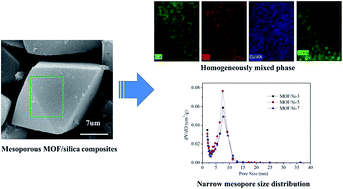
The SEM images of all samples show relatively regular diamond or cube shaped particles with sizes of ∼15um (Fig. 2). This morphology is similar to that of pure HKUST-1 crystals (Fig. S2). Elemental mapping indicates a homogeneous distribution of Cu, C, O and Si in MOF-silica composite particles, which is also confirmed by the EDS line-scan (Fig. S3), indicating that a homogeneously mixed phase formed in the composites.


image file: c4ra09626f-f2.tif
Fig. 2 SEM images (a) MOF/Si-3; (b) MOF/Si-5; (c) MOF/Si-7 and (d) MOF/Si-5 and corresponding elemental mappings.

Fig. 3 shows the N2 adsorption–desorption isotherms and pore size distribution of MOF-silica composites, and Table 1 summarizes the textural properties of the samples prepared at different TEOS concentrations in this work. The isotherms of pure HKUST-1 sample are type I according to the IUPAC classification (Fig. S4), which is characteristic of microporous materials. However, the composite samples are of type IV and shows steep hysteresis of type H1 over the range of 0.6 < P/P0 < 0.9, corresponding to the mesostructure of the material. The BET surface area and the total pore volume of three samples are calculated to be in the range of 453–509 m2 g−1 and 0.36–0.42 cm3 g−1, respectively. Note that, the BET surface area of pure microporous HKUST-1 is 1820 m2 g−1. With the addition of CTAB surfactant to the synthesis mixture, the hierarchically micro- and mesoporous HKUST-1 MOF could be obtained and it exhibited BET surface area of ∼1000 m2 g−1.18 Here, the BET surface area of samples prepared by adding CTAB and TEOS decreased to about 500 m2 g−1. This decreased surface area phenomenon could be explained as follows: first, the composites contain large amount of SiO2 (the estimated weight of silica element in the MOF-Si-5 composites is 19 wt% by XPS) and mesoporous SiO2 with occluded surfactant usually have a low surface area; second, the micropores of HKUST-1 were partially blocked, thus, the surface area of the composites decreased. When the amount of TEOS was increased, the surface area of resulting composites slightly decreased as expected because of dilution effect from silica. However, the general tendency of isotherms remained the same, and the mesopore diameter of all samples is about 7.6 nm with a narrow pore-size distribution (Fig. 2b). These results imply that this kind of mesoporous composite could be prepared using larger silica/MOF ratios. TEM image demonstrate that MOFs/composites have disordered wormhole mesopore structures (Fig. 4), which is consistent with the small-angle XRD characterization. The average pore diameters measured from the TEM images agree well with those derived from the N2 adsorption–desorption isotherms. It was quite difficult to obtain high-quality TEM images for these materials, possibly because the samples are highly sensitive to the electron beam. The similar phenomenon was also reported by Qiu et al.18


image file: c4ra09626f-f3.tif
Fig. 3 Nitrogen adsorption-desorption isotherms (a) and pore size distributions (b) for MOF/silica composites.
Table 1 Porosity properties of mesoporous MOF-silica composites
Samples SBET m2 g−1 Slangmuir m2 g−1 Vt cm3 g−1 Vmeso cm3 g−1 Vmicro cm3 g−1
Pure HKUST-1 1820 2438 0.91 0.09 0.82
MOF/Si-3 509 533 0.39 0.29 0.10
MOF/Si-5 484 499 0.42 0.30 0.12
MOF/Si-7 453 475 0.36 0.23 0.13


image file: c4ra09626f-f4.tif
Fig. 4 TEM image of MOF/Si-5 sample.

The X-ray photoelectron spectroscopy (XPS) was performed to investigate the surface characteristic of the MOF/Si-5 composite (Fig. S5 and S6). XPS scans in the carbon region (Fig. S6a) show that carbon exists in two forms in Cu3(BTC)2. The peak at 284.8 eV represents carbons in the benzene ring of BTC, and the separate 1 s peak at 288.6 eV represents carbons in the carboxylic acid groups of BTC.19 In the copper region (Fig. S3c), two peaks are observed at 935.0 eV (Cu 2p3/2) and 955.2 eV (Cu 2p1/2), respectively, which are characteristic of Cu(II). In addition, the presence of satellite peaks also confirmed this species,20–22 this result means that copper in the composite material is bound to oxygen atoms from BTC in a similar way to the complexation of copper that occurs in CuBTC. However, it should be noted that two more peaks at 933.0 eV and 953.0 eV could be observed, this might be caused by a change of the coordination environment of Cu2+ center or partial Cu2+ reduction.21,23–25 The thermal gravimetric analysis (TGA) of the as-synthesized samples performed under nitrogen flow is shown in Fig. S7. The results showed that all samples exhibited good thermal stability up to ∼275 °C. With a further increase in temperature, a primarily weight loss appeared in the temperature range of 275–600 °C, which could be ascribed to the decomposition of BTC. Above 600 °C, no obvious mass loss could be found. Therefore, the estimated amount of HKUST-1 in the composite MOF/Si-3, MOF/Si-5 and MOF/Si-7 are 62 wt%, 55 wt% and 54 wt%, respectively.

In conclusion, mesostructured MOF/silica composites with a narrow pore size distribution were successfully prepared through a facile hydrothermal process. This is the first report where the MOF crystals were incorporated in situ into mesostructured silica support with the help of CTAB surfactant. The synthesis method allowed us to make mesoporous MOF/silica composites using larger silica/MOF ratios.

Acknowledgements

This work was supported by Fundamental Research Funds for the Central Universities (no. 2014QNA29), the Natural Science Foundation of Jiangsu Province (no. BK20140182) and the Priority Academic Program Development of Jiangsu Higher Education Institutions.

References

  1. P. Horcajada, T. Chalati, C. Serre, B. Gillet, C. Sebrie, T. Baati, J. F. Eubank, D. Heurtaux, P. Clayette, C. Kreuz, J.-S. Chang, Y. K. Hwang, V. Marsaud, P.-N. Bories, L. Cynober, S. Gil, G. Feérey, P. Couvreur and R. Gref, Nat. Mater., 2010, 9, 172 CrossRef CAS PubMed.
  2. J. Lee, O. K. Farha, J. Roberts, K. A. Scheidt, S. T. Nguyen and J. T. Hupp, Chem. Soc. Rev., 2009, 38, 1450 RSC.
  3. N. Stock and S. Biswas, Chem. Rev., 2011, 112, 933 CrossRef PubMed.
  4. S. Horike, D. Umeyama and S. Kitagawa, Acc. Chem. Res., 2013, 46, 2376 CrossRef CAS PubMed.
  5. L. Ma, C. Abney and W. Lin, Chem. Soc. Rev., 2009, 38, 1248 RSC.
  6. Q. L. Zhu and Q. Xu, Chem. Soc. Rev., 2014, 43, 5468 RSC.
  7. K. M. L. Taylor-Pashow, J. D. Rocca, Z. Xie, S. Tran and W. Lin, J. Am. Chem. Soc., 2009, 131, 14261 CrossRef CAS PubMed.
  8. Z. Li and H. C. Zeng, J. Am. Chem. Soc., 2014, 136, 5631 CrossRef CAS PubMed.
  9. D. Buso, K. M. Nairn, M. Gimona, A. J. Hill and P. Falcaro, Chem. Mater., 2011, 23, 929 CrossRef CAS.
  10. Z. Karimi and A. Morsali, J. Mater. Chem. A, 2013, 1, 3047 CAS.
  11. G. Férey, Chem. Soc. Rev., 2008, 37, 191 RSC.
  12. A. Kondo, S. Takanashi and K. Maeda, J. Colloid Interface Sci., 2012, 384, 110 CrossRef CAS PubMed.
  13. C.-M. Wu, M. Rathi, S. P. Ahrenkiel, R. T. Koodali and Z. Wang, Chem. Commun., 2013, 49, 1223 RSC.
  14. A. M. B. Furtado, J. Liu, Y. Wang and M. D. LeVan, J. Mater. Chem., 2011, 21, 6698 RSC.
  15. J. Gorka, P. F. Fulvio, S. Pikus and M. Jaroniec, Chem. Commun., 2010, 46, 6798 RSC.
  16. S. S.-Y. Chui, S. M. F. Lo, J. P. H. Charmant, A. G. Orpen and I. D. Williams, Science, 1999, 283, 1148 CrossRef CAS.
  17. X. Yan, S. Komarneni, Z. Zhang and Z. Yan, Microporous Mesoporous Mater., 2014, 183, 69 CrossRef CAS PubMed.
  18. L. G. Qiu, T. Xu, Z. Q. Li, W. Wang, Y. Wu, X. Jiang, X. Y. Tian and L. D. Zhang, Angew. Chem., 2008, 120, 9629 CrossRef.
  19. J. F. Moulder, W. F. Stickle, P. E. Sobol and K. D. Bomben, Handbook of X-ray Photoelectron Spectroscopy: A Reference of Standard Spectra for Identification and Interpretation of XPS Data, Chigasaki City, Japan, 2007 Search PubMed.
  20. C. M. Chanquía, K. Sapag, E. Rodrıíguez-Castellón, E. R. Herrero and G. A. Eimer, J. Phys. Chem. C, 2010, 114, 1481 Search PubMed.
  21. H. Chen, L. Wang, J. Yang and R. T. Yang, J. Phys. Chem. C, 2013, 117, 7565 CAS.
  22. L. Peng, J. Zhang, J. Li, B. Han, Z. Xue and G. Yang, Chem. Commun., 2012, 48, 8688 RSC.
  23. Q. Luo, X. Song, M. Ji, S. E. Park, C. Hao and Y. Li, Appl. Catal., A, 2014, 478, 81 CrossRef CAS PubMed.
  24. C. Chiericatti, J. C. Basilico, M. L. Z. Basilico and J. M. Zamaro, Microporous Mesoporous Mater., 2012, 162, 60 CrossRef CAS PubMed.
  25. O. Shekhah, J. Liu, R. A. Fischer and Ch. Wöll, Chem. Soc. Rev., 2011, 40, 1081 RSC.

Footnote

Electronic supplementary information (ESI) available. See DOI: 10.1039/c4ra09626f

This journal is © The Royal Society of Chemistry 2014
Click here to see how this site uses Cookies. View our privacy policy here.