
Run-Ning Zhaoa,
Yanhong Yuana,
Ju-Guang Han*b and
Yuhua Duanc
aInstitute of Applied Mathematics and Physics, Shanghai DianJi University, Shanghai 201306, People's Republic of China
bNational Synchrotron Radiation Laboratory, University of Science and Technology of China, Hefei 230029, People's Republic of China. E-mail: jghan@ustc.edu.cn
cUS Department of Energy, National Energy Technology Laboratory, Parsons Project Services Inc., South Park, Pittsburgh, PA 15236, 15129, USA
First published on 22nd October 2014
The geometry and electronic and magnetic properties of ApGe (Ap = Ac–Lr) diatoms have been studied using first-principles density functional theory, with relativistic effects being taken into account. The calculated natural populations of ApGe diatoms show that the electronic charge is transferred mainly from Ap to Ge, most of the Ap 5f subshell in ApGe being inert and not involved in chemical bonding. The calculated highest occupied molecular orbital–lowest unoccupied molecular orbital (HOMO–LUMO) gaps of the ApGe diatoms exhibit an oscillating behavior from AcGe to BkGe, and a slight increase from CfGe to NoGe. The calculated magnetic moments of ApGe show that the total magnetic moment depends mainly on the 5f electrons of Ap in the ApGe diatoms, which generate the magnetic properties. Our calculated results are in good agreement with the published theoretical and experimental data.
Rare earth lanthanide (Ln) atoms retain a significant proportion of their magnetic moment due to their localized f-electrons, even when enclosed in a silicon or germanium cage. Ln-doped silicon clusters have attracted considerable interest and have been extensively investigated.4–9 In some ways the actinide elements (Aps) are unusual transition metals, and possess important optical and magnetic properties. Although there have been some studies of the properties of Ap-doped silicon clusters,11 no systematic computational investigation of ApGe (Ap = Ac–Lr) diatoms has previously been reported. In the present study, in order to explore the properties of the ApGe diatoms we carried out a detailed study of their relative stability and structural and magnetic properties, including relativistic effects.
In examining the unusual properties of the Ap-doped germanium clusters, the main objective of this research was therefore to investigate the equilibrium geometry, electronic structure, HOMO–LUMO gaps, and magnetic properties of all the ApGe (Ap = Ac–Lr) diatoms.
This paper is organized as follows. In the second section, we briefly describe the theoretical methods, in particular the challenges in including the relativistic effect of Ap, due to its complicated 5f electrons. In the third section we show our results on ApGe diatoms and compare them with other available reports, and in the final section our conclusions are summarized.
Currently calculations are carried out at the DFT level, with the hybrid exchange and correlation (mPW3PBE) functions in combination with the 6-31G* basis sets for the Ge atom, and large-core Stuttgart quasi-relativistic effective core potentials (ECP60MWB) to describe the Ac–Lr elements,12 as implemented in the Gaussian 09 package.13 By including the relativistic effect in the calculations, the geometries of the ApGe diatoms are systematically optimized, with evaluation of their harmonic vibrational frequencies, in order to confirm the stability of the diatoms. Different spin-polarization among the ApGe diatoms was taken into account during the calculations.
| System | State | S | M μB | Ap–Ge Å | Freq. cm–1 | Egap eV | ET Hartree | EXPa | ΔE eV | Electronic configuration |
|---|---|---|---|---|---|---|---|---|---|---|
| a Experimental value of U–Ge bond length in UGe2 from ref. 15. | ||||||||||
| AcGe | 2Σ | 1/2 | 1 | 2.568 | 209.9 | 2.592 | –2450.252590 | 0.00 | π2σ1 | |
| 4Σ | 3/2 | –2450.243666 | 0.243 | |||||||
| 6Σ | 5/2 | –2450.230537 | 0.600 | |||||||
| ThGe | 5Σ | 2 | 4 | 2.785 | 208.8 | 1.953 | –2482.222694 | 0.00 | π2σ2 | |
| 1Σ | 0 | –2482.188385 | 0.934 | |||||||
| 3Σ | 1 | –2482.210041 | 0.344 | |||||||
| 7Σ | 3 | –2482.158679 | 1.742 | |||||||
| PaGe | 6Σ | 5/2 | 5 | 2.817 | 194.4 | 2.009 | –2515.917154 | 0.00 | π2σ1δ2 | |
| 2Σ | 1/2 | –2515.910331 | 0.186 | |||||||
| 4Σ | 3/2 | –2515.913799 | 0.091 | |||||||
| 8Σ | 7/2 | –2515.902412 | 0.401 | |||||||
| 10Σ | 9/2 | –2515.614437 | 8.237 | |||||||
| UGe | 7Σ | 3 | 6 | 2.606 | 241.3 | 2.379 | –2551.491658 | 2.9 Å | 0.00 | π2σ1δ2σ1 |
| 1Σ | 0 | –2551.412798 | 2.146 | |||||||
| 3Σ | 1 | –2551.456322 | 0.962 | |||||||
| 5Σ | 2 | –2551.465769 | 0.704 | |||||||
| 9Σ | 4 | –2551.475624 | 0.436 | |||||||
| NpGe | 8Σ | 7/2 | 7 | 2.799 | 174.4 | 2.125 | –2589.031611 | 0.00 | π2σ2δ2σ1π2 | |
| 2Σ | 1/2 | –2589.008786 | 0.621 | |||||||
| 4Σ | 3/2 | –2588.968581 | 1.715 | |||||||
| 6Σ | 5/2 | –2589.030343 | 0.035 | |||||||
| 10Σ | 9/2 | –2589.016210 | 0.419 | |||||||
| PuGe | 9Σ | 4 | 8 | 2.821 | 164.2 | 2.281 | –2628.559074 | 0.00 | π2δ2σ1π2σ1 | |
| 1Σ | 0 | –2628.356581 | 5.510 | |||||||
| 3Σ | 1 | –2628.521824 | 1.014 | |||||||
| 5Σ | 2 | –2628.558930 | 0.004 | |||||||
| 7Σ | 3 | –2628.546279 | 0.348 | |||||||
| 11Σ | 5 | –2628.549354 | 0.264 | |||||||
| AmGe | 10Σ | 9/2 | 9 | 2.877 | 152.9 | 2.180 | –2670.153363 | 0.00 | π2σ1φ2δ2σ1π2σ1 | |
| 2Σ | 1/2 | –2670.022318 | 3.566 | |||||||
| 4Σ | 3/2 | –2670.070004 | 2.268 | |||||||
| 6Σ | 5/2 | –2670.152255 | 0.030 | |||||||
| 8Σ | 7/2 | –2670.142162 | 0.305 | |||||||
| 12Σ | 11/2 | –2670.142868 | 0.286 | |||||||
| CmGe | 11Σ | 5 | 10 | 2.772 | 185.8 | 2.421 | –2713.746694 | 0.00 | φ2δ2π2σ1σ1π2σ1σ1 | |
| 1Σ | 0 | –2713.439898 | 8.348 | |||||||
| 3Σ | 1 | –2713.680887 | 1.791 | |||||||
| 5Σ | 2 | –2713.733842 | 0.350 | |||||||
| 7Σ | 3 | –2713.730669 | 0.436 | |||||||
| 9Σ | 4 | –2713.732632 | 0.383 | |||||||
| BkGe | 8Σ | 7/2 | 7 | 2.809 | 138.9 | 2.249 | –2759.463138 | 0.00 | φ2δ2σ1π2σ1π2σ1π2 | |
| 2Σ | 1/2 | –2759.381102 | 2.232 | |||||||
| 4Σ | 3/2 | –2759.462998 | 0.004 | |||||||
| 6Σ | 5/2 | –2759.4506428 | 0.340 | |||||||
| 10Σ | 9/2 | –2759.442905 | 0.551 | |||||||
| CfGe | 7Σ | 3 | 6 | 2.859 | 144.5 | 2.261 | –2807.816048 | 0.00 | φ2δ2π2σ1σ2π2σ1 | |
| 1Σ | 0 | –2807.641810 | 4.741 | |||||||
| 3Σ | 1 | –2807.800501 | 0.423 | |||||||
| 5Σ | 2 | –2807.804571 | 0.312 | |||||||
| 9Σ | 4 | –2807.792690 | 0.636 | |||||||
| EsGe | 6Σ | 5/2 | 5 | 2.854 | 140.2 | 2.254 | –2858.439614 | 0.00 | δ2π2σ2π2σ1σ1π2 | |
| 4Σ | 3/2 | –2858.434834 | 0.130 | |||||||
| 8Σ | 7/2 | –2858.367622 | 1.959 | |||||||
| 8Σ | 9/2 | –2858.321145 | 3.224 | |||||||
| FmGe | 5Σ | 2 | 4 | 2.862 | 138.0 | 2.241 | –2911.394515 | 0.00 | φ2σ1π2δ2σ1π2δ2σ2π2 | |
| 1Σ | 0 | –2911.299952 | 2.573 | |||||||
| 3Σ | 1 | –2911.339428 | 1.499 | |||||||
| 7Σ | 3 | –2911.364406 | 0.819 | |||||||
| 9Σ | 4 | –2911.244991 | 4.069 | |||||||
| MdGe | 4Σ | 3/2 | 3 | 2.867 | 135.7 | 2.254 | –2966.046304 | 0.00 | π2σ1δ2σ1π2σ1σ2π2 | |
| 2Σ | 1/2 | –2966.008704 | 1.023 | |||||||
| 6Σ | 5/2 | –2966.002579 | 1.190 | |||||||
| 8Σ | 7/2 | –2965.849340 | 5.360 | |||||||
| NoGe | 3Σ | 1 | 2 | 2.874 | 132.1 | 2.274 | –3023.333921 | 0.00 | φ2π2δ2φ2δ2σ1π2σ2σ1π2 | |
| 1Σ | 0 | –3023.293248 | 1.107 | |||||||
| 5Σ | 2 | –3023.293791 | 1.092 | |||||||
| 7Σ | 3 | –3023.085637 | 6.756 | |||||||
| LrGe | 4Σ | 3/2 | 3 | 2.804 | 155.6 | 3.062 | –3082.315620 | 0.00 | φ2σ1φ2δ2σ1π2δ2π2σ2σ1σ2π2σ1 | |
| 2Σ | 1/2 | –3082.295981 | 0.534 | |||||||
| 6Σ | 5/2 | –3082.218427 | 2.645 | |||||||
| 8Σ | 7/2 | –3081.940385 | 10.211 | |||||||
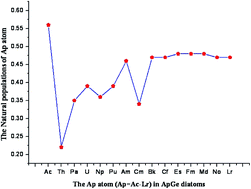
For an AcGe diatom, at the mPW3PBE level, in combination with the 6–31G* basis sets for Ge atom and ECP60MWB ECP for Ac element, the calculated bond length and vibrational frequency are 2.568 Å and 209.9 cm−1, respectively. The electronic state obtained for the most stable doublet AcGe diatom, including consideration of the relativistic effect, is 2Σ. The quartet and sextet spin states are 0.243 and 0.6 eV higher than the doublet spin state, respectively. In addition, the magnetic moment obtained for AcGe is 1 μB. Based upon the calculated natural atomic populations listed in Table 2, AcGe exhibits the largest charge transfer among the ApGe diatoms from the Ac atom to the Ge atom (0.56e), reflecting the fact that AcGe diatoms are formed by both ionic and covalent bonding.
| System | Ge | Ap | Ap natural orbital populations | |||
|---|---|---|---|---|---|---|
| 5f | 6d | 7p | 7s | |||
| AcGe | −0.56 | 0.56 | 0.06 | 1.15 | 0.09 | 1.17 |
| ThGe | −0.22 | 0.22 | 0.16 | 2.32 | 0.07 | 1.25 |
| PaGe | −0.35 | 0.35 | 1.95 | 1.21 | 0.06 | 1.45 |
| UGe | −0.39 | 0.39 | 3.11 | 1.56 | 0.07 | 0.90 |
| NpGe | −0.36 | 0.36 | 4.57 | 0.57 | 0.08 | 1.43 |
| PuGe | −0.39 | 0.39 | 5.73 | 0.44 | 0.07 | 1.39 |
| AmGe | −0.46 | 0.46 | 6.96 | 0.30 | 0.07 | 1.23 |
| CmGe | −0.34 | 0.34 | 7.02 | 0.95 | 0.08 | 1.62 |
| BkGe | −0.47 | 0.47 | 8.92 | 0.27 | 0.07 | 1.95 |
| CfGe | −0.47 | 0.47 | 9.97 | 0.21 | 0.06 | 1.30 |
| EsGe | −0.48 | 0.48 | 10.98 | 0.19 | 0.05 | 1.30 |
| FmGe | −0.48 | 0.48 | 11.99 | 0.17 | 0.05 | 1.32 |
| MdGe | −0.48 | 0.48 | 12.99 | 0.13 | 0.05 | 1.35 |
| NoGe | −0.47 | 0.47 | 13.99 | 0.13 | 0.04 | 1.38 |
| LrGe | −0.47 | 0.47 | 14.00 | 0.54 | 0.14 | 1.84 |
The electron configuration of Th is [Rn]7s26d2. The ThGe diatom is optimized with different spin states, and the most stable quintet ThGe isomer obtained has an electronic state of 5∑. The calculated bond length and frequency of the neutral quintet ThGe diatom are 2.785 Å and 208.8 cm−1, respectively. In addition, the 5f and 6d orbitals of the Th atom have electronic charges of 0.16e and 0.32e, respectively, from the 7s orbitals. Clearly the 5f orbitals of Th are have a slight involvement in the chemical bonding with Ge.
In the PaGe diatom the electron configuration of Pa is [Rn]7s25f26d1. The PaGe isomer, with sextet spin state, is optimized to be the most stable state. It should be realized that the doublet and quartet spin states of the PaGe isomer are only 0.186 and 0.091 eV higher than the sextet spin state (Table 1). The Pa–Ge bond length and vibrational frequency calculated for the most stable neutral PaGe isomer are, respectively, 2.817 Å and 194.4 cm−1. From Table 2, it can be seen that the variation in the natural population of Pd 5f orbitals is very small, with a range of only 0.05e. Hence, in the PaGe isomer the Pa 5f orbitals remain for the most part inert.
In the literature there have been few studies reported of a U–Ge-related system, but with a duality of 5f electrons in a ferromagnetic superconductor, UGe2 has recently been widely investigated.14,15 The data obtained point to the dual behavior of the 5f electrons in UGe2, simultaneously possessing both local and itinerant character in two different substates.15 The valence state of uranium in this compound has been confirmed to be U5+ by X-ray photoelectron spectroscopy and electron paramagnetic resonance.15 However, the calculated frequency and U–Ge bond length of the septet UGe diatom, with electronic state 7Σ, are 241.3 cm−1 and 2.606 Å, respectively. The calculated U–Ge bond length in UGe is shorter than the U–Ge bond lengths in UGe2 (2.96, 2.94, and 2.91 Å) or than the U–U bond length in UGe2.15 As can be seen from Table 2, the calculated HOMO–LUMO gap of the UGe cluster is not the smallest, reflecting that the HOMO–LUMO gap of the UGe diatom is different from that of the USi diatom.11 Our calculations indicate that the U 5f orbitals are slightly chemically bonded with Ge, and this makes the properties of U-containing compounds more complicated.
By evaluating the total energy of the NpGe diatom at different spin states, the most stable spin state is identified as S = 7/2. The calculated Np–Ge bond length and frequency in the neutral NpGe isomer are 2.799 Å and 174.4 cm−1, respectively. In addition, the NpGe diatom has a magnetic moment of 7 μB, reflecting that the unfilled 5f orbitals of Np mainly contribute to its high spin state. Compounds of the actinide elements are magnetic, due to the fact that the electrons residing in the more localized 5f orbitals of the actinide atoms are not greatly involved in bonding. Consequently, the magnetic properties of actinide element-doped Gen clusters are often significant. In addition, the sextet spin state is slightly higher in energy than the octet spin state. It can be seen from Table 2 that the calculated natural population of Np 5f orbitals in NpGe is larger than that of U in UGe, reflecting that the 5f orbitals of Np in NpGe are more active and are involved in chemical interaction, whereas U-containing compounds have more complex electronic properties.
Among the actinide elements plutonium is unique in its physicochemical complexities by virtue of the fact that its 5f electrons are on the borderline between delocalized (not associated with a single atom) and localized (associated with a single atom) behavior, and this is therefore considered to be one of the most complex elements. Plutonium sits near the juncture of the actinide series transition from main d-block element chemistry to rare earth-like behavior, as a result of the actinide contraction. Due to its importance and complexity, plutonium has been one of the elements most intensely investigated. Using DFT, Baizaee and Pourghazi explored the structural stability, electronic structure and f hybridization of the intermetallic compounds, PuM3 and Pu3M (M = Ge, Sn, or Pd).16 Their results indicated that the Pu3M structures were more stable than PuM3, and that there was strong hybridization between M 5p with Pu 5f and Pu 6d orbitals in both PuM3 and Pu3M compounds. The Pu atom provides a high magnetic moment, due to its electronic configuration (7s25f6). In addition, the Pu atom is the last element in the actinide series in which the 5f electrons still make some contribution to chemical bonding. Under the interaction of Ge with the Pu atom, the most stable PuGe diatoms consequently show a nonet spin state with a strong magnetic moment. As can be seen from Table 1, the total magnetic moment of the most stable PuGe diatom is 8 μB. Additionally, the quintet spin state of PuGe diatom is 0.004 eV higher in energy than the nonet spin state, and the quintet and nonet spin states are degenerated. According to the calculated natural population, it is obvious that the variation in the 5f orbitals of Pu is 0.27e, and this contributes to chemical bonding. The 6d subshell in the Pu atom obtains 0.44e from the 5f and 7s orbitals of the Pu atom. The calculated Pu–Ge vibrational frequency and bond length in the PuGe isomer with a nonet electronic spin state are 164.2 cm−1 and 2.821 Å, respectively.
In contrast to Ac–Np, Am has the electron configuration [Rn]7s25f7. Its empty 6d orbitals do not play a direct role in chemical bonding, since its 5f electrons retract from bonding and become localized. The mobility of the 5f electrons is quite sensitive to small variations in the chemical environment. In order to study the electronic properties of the AmGe diatom, the AmGe cluster is optimized, and the Am–Ge vibrational frequency and bond length obtained are 152.9 cm−1 and 2.877 Å, respectively. The electronic spin obtained for the AmGe diatom is 9/2, and the total magnetic moment of the most stable AmGe diatom is 9 μB. Based on the calculated natural population of the AmGe diatom, the Am 5f electrons are less sensitive to binding with the germanium atom, since the variation in 5f6.96 electrons is very small compared with the 5f7 configuration in pure Am. Obviously, the Am 5f electrons in AmGe, with a half-filled configuration, are stable and can achieve a higher spin state. In addition, the calculated HOMO–LUMO gap of the AmGe diatom is 2.180 eV.
The element Cm possesses an electron configuration [Rn]7s25f76d1. In contrast to Am, its 6d orbital has just one electron. By calculating the total energy of the CmGe diatom with different spin states at the mPW3PBE level, the most stable spin state of CmGe is revealed as S = 5 (Table 1). The calculated Cm–Ge vibrational frequency and bond length in this configuration are 185.8 cm−1 and 2.772 Å, respectively. In addition, the calculated total magnetic moment is 10 μB, which is the largest of all the ApGe diatoms. These results indicate that Cm-doped germanium clusters could be used as a powerful new magnetic material, since the Cm atom generates the strongest magnetism among all the actinide elements. In addition, the spin state stability of the CmGe diatom is mainly attributed to the half-filled 5f7 electron shell configuration ([Rn]7s25f76d1) of the Cm atom in CmGe.
Berkelium, with an electronic configuration of [Rn]7s25f9, is the first member of the second half of the actinide series. Studying the physicochemical properties of this element enables a more accurate extrapolation to the behavior of the heavier elements. In order to explore the properties of Bk-doped germanium material, the BkGe diatom is calculated for different spin states. The results show that the most stable BkGe has S = 7/2. The calculated Bk–Ge vibrational frequency and bond length in this configuration are 138.9 cm−1 and 2.809 Å, respectively. According to the calculated natural populations of the Bk atom, the variation in 5f electrons is very small (0.08e); in other words, in contrast to its 6d orbitals, the 5f electrons in Bk are not sensitive to binding with a germanium atom, and hence are not involved in chemical bonding.
Californium, with an electronic configuration of [Rn]7s25f10, is a member of the second half of the actinide series, in which the f electrons are further removed or shielded from the valence electrons than in the lighter actinides. By introducing the relativistic effect into the calculations, the Cf–Ge isomer is optimized. We find that the most stable CfGe diatom has a septet configuration with electronic spin S = 3. The calculated frequency, magnetic moment, and Cf–Ge bond length are 144.5 cm−1, 6 μB, and 2.859 Å, respectively. According to the calculated HOMO and LUMO values of the CfGe, it is found that CfGe has the larger HOMO–LUMO gap, indicating that CfGe is formed mainly by covalent bonding.
In the case of einsteinium (Es), after optimizing the EsGe diatom with different spin states, the results showed that its most stable state has S = 5/2. The calculated Es–Ge vibrational frequency and bond length for EsGe are 140.2 cm−1 and 2.854 Å, respectively. In addition, the calculated total magnetic moment of the EsGe diatom is 5.0 μB.
Similarly with fermium (Fm), the calculated Fm–Ge bond length and the vibrational frequency in FmGe are 2.862 Å and 138.0 cm−1, respectively. The spin state of FmGe is 5Σ, with a total magnetic moment of 4.0 μB.
By including the relativistic effect in our calculations for mendelevium (Md), the Md–Ge bond length and vibrational frequency obtained for the MdGe diatom are, respectively, 2.867 Å and 135.7 cm−1. The most stable MdGe diatom has a quartet spin state of S = 3/2, with total magnetic moment of 3 μB. The results show that there is a large charge transfer between the Md and Ge atoms.
In the case of nobelium (No), in the NoGe diatom the calculated No–Ge bond length and vibrational frequency of the triplet NoGe, with the relativistic effect included, are 2.874 Å and 132.1 cm−1, respectively. Its magnetic moment is 2 μB.
Lawrencium (Lr), which has the electronic configuration [Rn]7s25f146d1, behaves differently from the di-positive No and is more like the tripositive earlier elements in the actinide series. From the calculated results for the LrGe diatom, it is seen that the Lr–Ge bond length and vibrational frequency in the most stable state are 2.804 Å and 155.6 cm−1, respectively. The magnetic moment of LrGe is 3 μB. As can be seen from Table 2, the 5f subshell of Lr is full, with 14 electrons, and it is not chemically bonded with the Ge atom.
As is seen from Table 2, the contribution of 7p orbitals of actinide atoms to charge transfer are almost invariable, apart from Lr (0.14) in LrGe. It should be pointed out that the contribution of the 7p orbitals of the actinide atom to charge transfer is very slight, and the electronic charge is mainly transferred from the 6s orbitals to the 7p orbitals of Ap. In addition, the 5f orbitals of Ap in ApGe (Ap = Ac, Pa, or Am–Lr) involve small charge transfers, especially in comparison to Ap = U, Th, Np, or Pu in UGe, ThGe, NpGe, and PuGe, in which charge transfer is relatively larger. In general the 5f orbitals of Ap (Ap = Am–Lr) maintain their original electronic configuration, and are not involved in chemical bonding. The main charge transfer takes place in the 7s and 6d orbitals of ApGe (Ap = Ac–Lr) (Table 2). Furthermore, the oscillating charge transfer increases between ThGe and BkGe.
Based on the contour maps of the HOMO for the most stable ApGe diatoms illustrated in Fig. 3, one can see that the most stable UGe, NpGe, PuGe, CmGe, and LrGe diatoms are formed by σ-bonding, whereas the most stable AcGe, AmGe, and Bk–NoGe diatoms are formed by π-bonding. On the other hand the most stable ThGe and PaGe diatoms are formed mainly by δ-bonding. Consequently, the main bonding types for ApGe (Ap = Ac–Lr) diatoms are different, due to the fact that the different Ap in each ApGe diatom has a different electronic configuration.
![]() | ||
| Fig. 3 Contour maps of the HOMO for the most stable ApGe diatoms (the atom in light blue on the left is Ge, and the Ap atom is on the right). | ||
| This journal is © The Royal Society of Chemistry 2014 |