Photocatalytic hydrogenation of alkenes to alkanes in alcoholic suspensions of palladium-loaded titanium(IV) oxide without the use of hydrogen gas

Kazuya Imamura, Yuki Okubo, Tomohiko Ito, Atsuhiro Tanaka, Keiji Hashimoto and Hiroshi Kominami*
Department of Applied Chemistry, Faculty of Science and Engineering, Kinki University, Kowakae, Higashiosaka, Osaka 577-8502, Japan. E-mail: hiro@apch.kindai.ac.jp

Received 15th March 2014 , Accepted 15th April 2014

First published on 15th April 2014

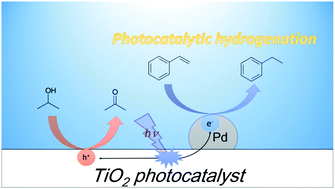
Styrene was successfully hydrogenated (reduced) to ethylbenzene in alcoholic suspensions of a palladium-loaded titanium(IV) oxide (TiO2) photocatalyst, although the reduction potential of styrene is believed to be much higher than the potential of the conduction band of TiO2.

When titanium(IV) oxide (TiO2) is irradiated by UV light, electrons in an electron-filled valence band (VB) are excited to a vacant conduction band (CB), leaving a positive hole in the VB. Thus-formed electrons and positive holes cause reduction and oxidation, respectively, of compounds adsorbed on the surface of a photocatalyst. Application of photocatalysis of TiO2 particles to organic synthesis is attractive for the following reasons. Since both oxidation and reduction occur on the surface of TiO2 particles, photocatalytic reactions can be applied for electrolytic organic synthesis without the use of an electrolyte and electrical wiring, both of which are requisites in conventional electrolytic conversion. Photocatalytic redox reactions by electrons and positive holes leave no by-product that originated in the reductant and oxidant, whereas conventional redox reagents such as permanganate or lithium aluminum hydride leave manganese ion or aluminum hydroxide after oxidation and reduction, respectively. Since photocatalytic reactions proceed at room temperature under atmospheric pressure and since light is indispensable, the reactions can be operated safely and can be easily controlled by the light intensity. In addition, TiO2 has been used for a long time as a common inorganic material such as a pigment and UV absorber because it is inexpensive and not toxic for humans and the environment. Since the above-mentioned characteristics of photocatalysis satisfy almost all of the 12 proposed requirements for green chemistry,1 organic synthesis of various compounds using photocatalysis has recently been studied.2

Applications of photocatalytic reduction have been less frequently reported, although total or partial oxidation of organic compounds has been extensively studied. Most of the organic substrates are oxidized or decomposed by positive holes, and the reduction potential of many organic compounds is more negative than the reduction potential of the CB. Therefore, target compounds in photocatalytic reduction (or hydrogenation) are basically limited to those having a carbonyl group3 and a nitro group,4 and other photocatalytic reductions of organic compounds have scarcely been reported. Very recently, we reported photocatalytic reduction (hydrogenation) of a cyano group (benzonitrile) to an amino group (benzylamine) using palladium-loaded TiO2 (Pd–TiO2) even though the reduction potential of benzonitrile is higher than the potential of the CB of TiO2,5 indicating that the applicability of photocatalytic reduction is not limited by the CB position of semiconductor photocatalysts. Therefore, a new photocatalytic reduction can be developed if metal co-catalysts are introduced on photocatalysts.

Hydrogenation is one of important processes in petroleum chemistry, industrial chemistry, food chemistry and fine chemistry.6 However, these (thermo)catalytic systems require a high temperature and reducing reagents such as hydrogen (H2) gas. Hydrogenation of alkenes to alkanes would be more attractive if the reaction occurs without the use of H2 at room temperature. In this study, we explored a new photocatalytic reduction system other than reduction of nitrobenzenes, carbonyl compounds and nitriles, and we found that photocatalytic hydrogenation of a C[double bond, length as m-dash]C double bond to a C–C bond occurred in alcoholic suspensions of TiO2 with metal co-catalysts at room temperature without the use of H2. Here we briefly report (1) the effect of metal co-catalysts on hydrogenation of styrene to ethylbenzene as a model reaction of hydrogenation of a C[double bond, length as m-dash]C double bond to a C–C bond, (2) stoichiometry and characteristics of the reaction and (3) applicability of the photocatalytic hydrogenation of alkenes to alkanes.

Fig. 1 shows effects of metal co-catalysts on production of ethylbenzene in photocatalytic hydrogenation of styrene in methanol solutions after 30 min photoirradiation. When bare TiO2 was used as the photocatalyst, no reaction of styrene occurred and the color of TiO2 became blue, indicating that Ti4+ in TiO2 was reduced to Ti3+ by photogenerated electrons. This result means that positive holes oxidized methanol, while photogenerated electrons in the CB of TiO2 did not reduce styrene. Almost the same results were obtained when Au, Ag, Cu and Ru were loaded on TiO2 as co-catalysts. These results (no hydrogenation of styrene) can be explained by the reduction potential of styrene being more negative than that of the CB of TiO2. Since the half-wave reduction potential of the system was reported to be −2.4 V versus SHE,6 a high voltage is required for electrochemical reduction (hydrogenation) of styrene. In contrast to these metal-loaded TiO2 samples, when Pd-, Pt- and Rh-loaded TiO2 photocatalysts (Pd–TiO2, Pt–TiO2 and Rh–TiO2) were used, styrene was hydrogenated and ethylbenzene was obtained without the use of H2. Pd–TiO2 showed a much higher ethylbenzene yield than those of the other photocatalysts, and styrene was hydrogenated to ethylbenzene almost stoichiometrically after 30 min. Since supported Pd nanoparticles are often used for catalytic hydrogenation of a C[double bond, length as m-dash]C double bond with H2 as a hydrogen source, it could be considered that ethylbenzene was formed thermocatalytically. However, two blank reactions at 298 K without light irradiation and without Pd–TiO2 produced no ethylbenzene (Table S1, ESI), indicating that ethylbenzene was formed photocatalytically. As far as we know, this is the first report on hydrogenation of a C[double bond, length as m-dash]C double bond by using a TiO2 photocatalyst.


image file: c4ra02275k-f1.tif
Fig. 1 Effects of metals (0.1 wt%) loaded on the TiO2 surface on photocatalytic reduction of styrene (45 μmol) to ethylbenzene in methanolic suspensions (5 cm3) under deaerated conditions for 30 min photoirradiation at 298 K.

Fig. 2(a) shows time courses of styrene remaining, ethylbenzene formed and acetone formed in 2-propanol suspensions of 0.1 wt% Pd–TiO2 without the use of H2. Just after photoirradiation, styrene monotonously decreased, while ethylbenzene and acetone were formed as the reduction (hydrogenation) product of styrene and the oxidation product of 2-propanol, respectively. After 25 min photoirradiation, styrene was almost completely consumed and ethylbenzene was obtained in a high yield (98%). It should be noted that H2 was formed only after consumption of styrene. Formation of H2 means that protons (H+) in the reaction system were reduced. Therefore, reduction (hydrogenation) of styrene occurred selectively under the present conditions. Material balance (MB) calculated by using eqn (1) is shown in Fig. 2(b).

 
image file: c4ra02275k-t1.tif(1)
where n(styrene) and n(ethylbenzene) are the amounts of styrene and ethylbenzene after photoirradiation, respectively, and n0(styrene) is the initial amount of styrene. The high yield of ethylbenzene and the value of MB close to unity indicate that only hydrogenation of styrene to ethylbenzene occurred, i.e., neither polymerization of styrene, cracking of ethylbenzene nor hydrogenation of the aromatic ring occurred. To evaluate the redox property and competitive reduction of styrene and H+ by photogenerated electrons, new indicators, i.e., redox balance (RB) and selectivity for ethylbenzene production (ethylbenzene/acetone, E/A), were calculated from eqn (2) and (3), respectively and are shown in Fig. 2(b).
 
image file: c4ra02275k-t2.tif(2)
 
image file: c4ra02275k-t3.tif(3)
The value of RB close to unity was preserved in all of the reaction, indicating that electrons were used only for reduction of styrene (to ethylbenzene) and H+ (to H2) and that holes were consumed only for oxidation of 2-propanol (to acetone). Therefore, only a desired main reaction (Scheme 1) and a side reaction (Scheme 2) occurred in the present photocatalytic reaction system. Therefore, we can conclude that photocatalytic hydrogenation of styrene to ethylbenzene along with 2-propanol oxidation to acetone occurred over Pd–TiO2 without the use of H2. However, the value of E/A slightly higher than unity suggests that a small amount of acetone was consumed by a photocatalytic reaction.


image file: c4ra02275k-f2.tif
Fig. 2 Time courses of (a) amounts of styrene remaining (red circles), ethylbenzene formed (blue squares), acetone formed (green open diamonds) and H2 (orange triangles) (b) MB (left axis, blue squares), RB (left axis, red circles) and E/A (right axis, green triangles) in 2-propanolic suspensions of 0.1 wt% Pd–TiO2 (50 mg) under deaerated condition at 298 K.

image file: c4ra02275k-s1.tif
Scheme 1

image file: c4ra02275k-s2.tif
Scheme 2

Effects of the amounts of Pd loaded on the TiO2 surface on yield of ethylbenzene were examined, and the yield of ethylbenzene reached maximum at 0.5 wt% (Fig. S1, ESI). In the 0.5 wt%-sample, fine Pd particles with an average diameter of 4.8 nm were observed by a transmission electron microscope (Fig. S2, ESI). To evaluate the durability of the Pd–TiO2 photocatalyst in this reaction system, the reaction was repeated. As shown in Fig. S3 (ESI), Pd–TiO2 photocatalysts were reusable at least three times without loss of activity. Totally, 141 μmol of ethylbenzene was formed by three-time reuse of Pd–TiO2 and, based on eqn (4), the turnover number (TON) of Pd for styrene hydrogenation was calculated to be 300, indicating that Pd worked as a co-catalyst.

 
image file: c4ra02275k-t4.tif(4)

The value of apparent quantum efficiency (AQE) at 366 nm was calculated from the ratio of the amount of ethylbenzene and amount of photons provided from a UV LED (λmax = 366 nm) using eqn (5). It should be noted that the value of AQE reached 38% even under irradiation of intense UV light (10.5 mW cm−2), indicating that this reaction occurred with very high efficiency.

 
image file: c4ra02275k-t5.tif(5)

Applicability of the photocatalytic hydrogenation of alkenes to alkanes was investigated using various aromatic or aliphalic alkenes, and Table 1 shows results of the photocatalytic hydrogenation in methanolic suspensions of Pd–TiO2 particles under deaerated conditions. Hydrogenation reaction proceeded in all cases, and high yield was obtained.

Table 1 Photocatalytic hydrogenation of various alkenes to alkanes in methanolic suspensions of 0.1 wt% Pd–TiO2 for 30 min photoirradiation
Entries Substances Products Yield
a 2-Propanol was used as solvent.
1 image file: c4ra02275k-u1.tif image file: c4ra02275k-u2.tif >99
2a image file: c4ra02275k-u3.tif image file: c4ra02275k-u4.tif 98
3 image file: c4ra02275k-u5.tif image file: c4ra02275k-u6.tif 98
4 image file: c4ra02275k-u7.tif image file: c4ra02275k-u8.tif 92
5 image file: c4ra02275k-u9.tif image file: c4ra02275k-u10.tif >99
6 image file: c4ra02275k-u11.tif image file: c4ra02275k-u12.tif 93
7 image file: c4ra02275k-u13.tif image file: c4ra02275k-u14.tif 98


In thermocatalytic process, H2 is dissociatively adsorbed on Pd surface and thus formed H species (as H–Pd) are incorporated into a C[double bond, length as m-dash]C double bond. Based on the mechanism of thermocatalytic hydrogenation over Pd catalyst, mechanism of photocatalytic hydrogenation without the use of H2 can be considered as follows: (1) protons (H+) are reduced by photogenerated electrons on Pd surface to give active H species (probably as H–Pd) and (2) this active H species on Pd are inserted into a C[double bond, length as m-dash]C double bond, resulting in ethylbenzene formation. The active species formed in thermocatalytic and photocatalytic reactions would be essentially same because H2 was evolved after consumption of styrene (Fig. 2(a)). It is apparent that H species photocatalytically formed on Pd are very active for hydrogenation of alkenes.

Conclusions

As a new application of TiO2-photocatalyzed reduction to organic synthesis, we examined reduction (hydrogenation) of alkenes to alkanes without the use of H2 and found that Pd showed a remarkable co-catalyst effect. Photogenerated electrons were used only for alkene hydrogenation and not for H2 evolution. This paper provides a new strategy for designing a photocatalytic reduction system, i.e., utilization of photocatalytically formed H species having a strong reduction power.

Notes and references

  1. P. T. Anastas and J. C. Warner, Green Chemistry: Theory and Practice, Oxford University Press, 1998 Search PubMed.
  2. (a) M. A. Fox and M. T. Dulay, Chem. Rev., 1993, 93, 341–357 CrossRef CAS; (b) G. Palmisano, V. Augugliaro, M. Pagliaro and L. Palmisano, Chem. Commun., 2007, 3425–3437 RSC; (c) G. Palmisano, E. García-López, G. Marcí, V. Loddo, S. Yurdakal, V. Augugliaro and L. Palmisano, Chem. Commun., 2010, 46, 7074–7089 RSC; (d) B. Ohtani, B. Pal and S. Ikeda, Catal. Surv. Asia, 2003, 7, 165–176 CrossRef CAS; (e) B. Ohtani, Trends Photochem. Photobiol., 1994, 3, 531–539 CAS; (f) H. Kisch, J. Prakt. Chem., 1994, 336, 635–648 CrossRef CAS; (g) H. Kisch and W. Lindner, Chem. Unserer Zeit, 2001, 35, 250–257 CrossRef CAS; (h) B. Ohtani and T. Ohno, Photocatalytic organic syntheses by using semiconductor particles, in Photocatalysis Science and Technology, ed. M. Kaneko and I. Okura, Kodansha-Springer, Tokyo, 2002, p. 186 Search PubMed.
  3. (a) C. Joyce-Pruden, J. K. Pross and Y. Li, J. Org. Chem., 1992, 57, 5087–5091 CrossRef CAS; (b) J. W. Park, M. J. Hong and K. K. Park, Bull. Korean Chem. Soc., 2001, 22, 1213–1216 CAS; (c) Y. Matsushita, S. Kumada, K. Wakabayashi, K. Sakeda and T. Ichimura, Chem. Lett., 2006, 35, 410–411 CrossRef CAS; (d) S. Kohtani, E. Yoshioka, K. Saito, A. Kudo and H. Miyabe, Catal. Commun., 2010, 11, 1049–1053 CrossRef CAS PubMed.
  4. (a) F. Mahdavi, T. C. Bruton and Y. Li, J. Org. Chem., 1993, 58, 744–746 CrossRef CAS; (b) J. L. Ferry and W. H. Glaze, Langmuir, 1998, 14, 3551–3555 CrossRef CAS; (c) O. V. Makarova, T. Rajh, M. C. Thurnauer, A. Martin, P. A. Kemme and D. Cropek, Environ. Sci. Technol., 2000, 34, 4797–4803 CrossRef CAS; (d) V. Brezová, P. Tarábek, D. Dvoranová, A. Staško and S. Biskupič, J. Photochem. Photobiol., A, 2003, 155, 179–198 CrossRef; (e) H. Tada, T. Ishida, A. Takao and S. Ito, Langmuir, 2004, 20, 7898–7900 CrossRef CAS PubMed; (f) T. Zhang, L. You and Y. Zhang, Dyes Pigm., 2006, 68, 95–100 CrossRef CAS PubMed; (g) S. O. Flores, O. R. Bernij, M. A. Valenzuela, I. Córdova, R. Gómez and R. Gutiérrez, Top. Catal., 2007, 44, 507–511 CrossRef CAS PubMed; (h) H. Kominami, S. Iwasaki, T. Maeda, K. Imamura, K. Hashimoto, Y. Kera and B. Ohtani, Chem. Lett., 2009, 15, 410–411 CrossRef; (i) K. Imamura, S. Iwasaki, T. Maeda, K. Hashimoto, B. Ohtani and H. Kominami, Phys. Chem. Chem. Phys., 2011, 13, 5114–5119 RSC; (j) S. Chen, H. Zhang, X. Yu and W. Liu, Chin. J. Chem., 2010, 28, 21–26 CrossRef CAS; (k) K. Imamura, K. Hashimoto and H. Kominami, Chem. Commun., 2012, 48, 4356–4358 RSC; (l) K. Imamura, T. Yoshikawa, K. Hashimoto and H. Kominami, Appl. Catal., B, 2013, 134–135, 193–197 CrossRef CAS PubMed.
  5. K. Imamura, T. Yoshikawa, K. Nakanishi, K. Hashimoto and H. Kominami, Chem. Commun., 2013, 49, 10911–10913 RSC.
  6. (a) F. Corvaisier, Y. Schuurman, A. Fecant, C. Thomazeau, P. Raybaud, H. Toulhoat and D. Farrusseng, J. Catal., 2013, 307, 352–361 CrossRef CAS PubMed; (b) A. Dahlén, Å. Nilsson and G. Hilmersson, J. Org. Chem., 2006, 71, 1576–1580 CrossRef PubMed.

Footnote

Electronic supplementary information (ESI) available: Experimental procedure, Fig. S1–S3, Table S1. See DOI: 10.1039/c4ra02275k

This journal is © The Royal Society of Chemistry 2014
Click here to see how this site uses Cookies. View our privacy policy here.