Effect of ion doping on the electrochemical performances of LiFePO4–Li3V2(PO4)3 composite cathode materials

Chao Jin , Xudong Zhang *, Wen He*, Yan Wang, Haiming Li, Zhuo Wang and Zhiying Bi
Institute of Materials Science and Engineering, Qilu University of Technology, Jinan 250353, China. E-mail: zxd1080@126.com; Fax: +86 531 89631080; Tel: +86 531 89631518

Received 18th December 2013 , Accepted 5th February 2014

First published on 5th February 2014


Abstract

Due to its low intrinsic electronic and ionic conductivities, olivine-structured LiFePO4 has been the focus of research into ionic modifications of LiFePO4/C cathode materials. Various ionic doping processes have been developed for enhancing the electrochemical performances of lithium-ion batteries, including cation and anion doping of LiFePO4. In particular, significant progress has recently been made in understanding and controlling the syntheses, nanostructures and electrochemical performances of LiFePO4–Li3V2(PO4)3 composite materials. However, there are still many challenges in achieving good charge transfer kinetics and charge–discharge performances of LiFePO4–Li3V2(PO4)3 composite cathodes. In this review, we summarize some of the recent progress in several typical cation modification methods.
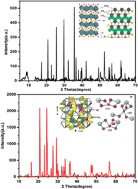

image file: c3ra47734g-p1.tif

Chao Jin

Chao Jin was born in 1989 in Shandong province, China. He graduated from Qilu University of Technology in 2012. Then, in the same year, he moved to the Institute of Materials Science and Engineering, Qilu University of Technology as a postgraduate student, and majored in materials chemistry. His scientific interests focus on nanomaterials for lithium batteries.

image file: c3ra47734g-p2.tif

Xudong Zhang

Xudong Zhang is currently a full professor in the Department of Materials Science and Engineering at Qilu University of Technology. He received his PhD degree from Shandong University in 2004, in the State Key Lab of Crystal Materials. His research interests focus on materials chemistry, technology for the synthesis of nanometer materials, lithium batteries and electrode materials.

Introduction

Due to the rapid depletion of non-renewable resources and the effects of global warming, people's attention has been attracted to electric vehicles (EVs), hybrid electric vehicles (HEVs) and energy storage devices. The cathode material is the most important component for obtaining a lithium-ion battery with high energy density, high rate capability and long cycle life. Choosing cathode materials for large-scale lithium-ion batteries should be a major issue. Among the cathode materials, olivine-structured LiFePO4 (LFP) and monoclinic Li3V2(PO4)3 (LVP) attract the most attention, due to their intrinsic structural and chemical stabilities that lead to safe, low cost batteries with long cycle life. LFP and LVP have been considered as the most competitive cathode candidates for next-generation large-scale lithium-ion batteries for use in HEVs or EVs. However, one of the main obstacles to the practical application of LFP and LVP is their poor rate capability, which can be attributed to slow lithium-ion diffusion kinetics and poor electronic conductivity.1–3

Pure LFP is an electronically conductive material consisting mainly of an N-type semiconductor. It has a theoretical capacity of 170 mA h g−1 at a voltage of 3.45 Volts versus lithium, a lithium-ion diffusion coefficient of 10−14 to 10−16 cm2 s−1 and an electron conductivity of 10−9 to 10−10 S cm−1.4,5 Prosini et al. measured the lithium ion migration parameter value as approximately −3.8 (when the lithium ion migration is 0, the interaction parameter g is −4).6 Pure LVP has a low electronic conductivity of about 2.3 × 10⁻⁸ S cm−1 at 27 °C,7 which presents a major drawback to practical implementation of the material.

In order to improve the properties of existing LiFePO4-based electrode materials, electrochemical researchers have made extensive efforts, which include particle size control and manipulation, surface modification of particles by coating with electronically conductive agents, and atomic-level doping with supervalent ions.8–10 One early report that spawned much activity suggested that the poor electronic conductivity could be increased by 8 orders of magnitude by supervalent-cation doping, which was proposed to stabilize the minority of Fe3+ hole carriers in the lattice.11 The dramatic increase in conductivity was later implied to be a result of carbon and metallic iron phosphides/carbophosphides on the LiFePO4 surface arising from solid-state reactivity at the elevated temperatures used in processing.12 In 2002, Chung et al.11 investigated different cation dopants to determine the effects of aliovalent doping on the electronic conductivity of LiFePO4. In 2012, Park et al.13 demonstrated that the undercoordinated Fe2+/Fe3+ redox couple at the surface causes a high barrier for charge transfer, but it can be stabilized by surface modification with nitrogen or sulfur anions. Surface modification greatly improves the charge transfer kinetics and the charge–discharge performance of an LiFePO4 cathode. Reports indicated, via structural and electrochemical analyses, that ion doping could decrease the lithium miscibility gap, favor phase transformation kinetics in cycling, expand diffusion channels, and introduce controlled atomic disorder into the ordered olivine structure.14 Since the pioneering work of Jiajun Wang and coworkers,3 much work has been carried out to investigate the synthesis, structure and electrochemical properties of LiFePO4. The present work focuses on the impact of cation modification on the electrochemical performances of LiFePO4–Li3V2(PO4)3 composite cathodes. The effects of single and dual dopants on the cathode materials are compared. An insight into future research and development of LiFePO4–Li3V2(PO4)3 composites is also discussed.

Structure and properties

The structural framework of olivine-type LiFePO4 consists of FeO6 octahedra and PO4 tetrahedra; its space group is Pnma, and Li ions are located in the 1D channels along the [010] direction with relatively low migration energies.15–17 One FeO6 octahedron has common edges with two LiO6 octahedra. The PO4 groups share one edge with an FeO6 octahedron and two edges with LiO6 octahedra. This will greatly limit the transmission speed of the lithium-ions. Monoclinic Li3V2(PO4)3 possesses a NASICON-type structure consisting of slightly distorted VO6 octahedra and PO4 tetrahedra.18–20 Li3V2(PO4)3 contains three independent lithium sites. The large polyanions replace the smaller O2− ions in this open framework so as to stabilize the structure and allow fast ion migration. As the VO6 octahedra are separated by PO4 tetrahedra, the VO6 octahedra cannot directly connect to each other, which limits the electronic conductivity.21–26 XRD profiles and the structures of olivine-type LiFePO4 and monoclinic Li3V2(PO4)3 are shown in Fig. 1. The other basic properties are shown in Table 1.28
image file: c3ra47734g-f1.tif
Fig. 1 The crystal structure of olivine LiFePO4 projected along [001]27 and its XRD profile (a); the crystal structure of monoclinic Li3V2(PO4)3 (ref. 18) and its XRD profile (b).
Table 1 Basic properties of olivine LiFePO4 and monoclinic Li3V2(PO4)3 (ref. 28)a
  Olivine LiFePO4 (LFP) Monoclinic Li3V2(PO4)3 (LVP)
a Note: WP: working potential; C: capacity at low C rates (<0.1 C); Ed: energy density; Ec: electrical conductivity.
WP (V vs. Li/Li+) 3.45 3.62, 3.68, 4.08 and 4.55
C (mA h g−1) 170 (theoretical), 150 (practical) 197 (theoretical), 160–170 (practical)
Ed 590 (W h kg−1) (theoretical), 520 (W h kg−1) (practical) 2330 mW h cm−3 after carbon coating
Ec (S cm−1) 10−9 to 10−8 2.3 × 10⁻⁸
Cost ($ kg−1) 20–25; possibly low, but limited by patent issues and process cost Higher than LFP


Enhancing the electrochemical performance of LiFePO4–Li3V2(PO4)3

LFP is cheap and environmentally friendly, and can be cycled thousands of times over years without decay, while monoclinic LVP offers the optimal combination of high operating voltage, high lithium capacity, good ion mobility, excellent thermal stability and the highest theoretical capacity of all the phosphates. They are potential cathode materials. However, both LFP and LVP have low electronic conductivities, which present a major drawback for their practical implementation in EVs or HEVs.

Many efforts have been made to improve the electrochemical performances of LFP and LVP, including nanosizing (so as to shorten the Li ion diffusion length in the solid state as well as decrease the anti-site defects to increase the Li ion conductivity29),30–36 conductive coating,37,38 and doping modification.9,11,39–42 Another method is preparing LiFePO4-based compounds with the fast ion conductor additive Li3V2(PO4)3.43–47

Conductive coating

Coating of LiFePO4 and Li3V2(PO4)3 particles with electron and Li+ ion conductive materials is common, and carbon coating is an effective way to improve the electronic conductivity. Fig. 2 shows a schematic representation of conductive coating of LiFePO4. Organic matter pyrolizes into carbon at high temperature, and the carbon increases the surface conductivity. Nanometer sized particles can be produced, expanding the conductive area which contributes to diffusion of lithium ions. The introduction of carbon can prevent the formation of Fe3+, and provides electron tunneling in the phosphate material to prevent grain growth, increasing the surface area and improving the electrochemical performance of the product. Barker et al.49 first introduced a carbothermal reduction method to synthesize Li3V2(PO4)3/C using carbon black as the carbon source, and the electronic conductivity of the materials was greatly improved by the residual carbon. Pioneering work was carried out by Ravet et al.,50,51 who showed that LiFePO4 with a carbon coating can almost achieve its theoretical capacity.
image file: c3ra47734g-f2.tif
Fig. 2 Schematic representation of LiFePO4 nanoparticles fully coated using (a) an ionic conductivity layer and (b) a carbon layer.48

Single doping

Regarding lithium iron phosphate and lithium vanadium phosphate modification, doping is necessary to enhance their electrochemical properties, and previous work has demonstrated that this improves the electrochemical performance. It is necessary to take into account the structure of the materials before doping. Experiments have shown that the conductivity of Li1−xMz+xFePO4 is 108 times that of the undoped sample. The XRD results show that the doping in the structure allows charge compensation by means of point defects.14,52 Research on LiFePO4 defect chemistry has provided some acceptable defect compensation mechanisms, as shown in Table 2.53 Ions tend to be substituted by isovalent ions. A variety of dopants with charges of +1 to +6, including V5+,54,55 Ti4+,56–58 Cr3+,59 Al3+,60–62 Nb5+,63,64 Zn2+,9 Mg2+,65–67 Mo6+,68 and La3+,69 have been employed for both Li+ and M2+ substitution in the nano-sized LiFePO4 or Li3V2(PO4)3 systems. Low favorable energies were only obtained for Na+ substitution in the Li+ sites and isovalent dopants (e.g., Mg2+) in the M2+ sites. In contrast, aliovalent doping appears to be unfavorable in both the Li+ and M2+ sites in all four phases.70 The SEM images of LiFe0.95V0.05PO4 with their elemental mappings (Fig. 3a1–a4) and the XRD patterns of M-doped LiFePO4 samples (M = Ni, V, Mg, Al) (Fig. 3b) verify that the doping element is incorporated in the lithium iron phosphate crystals.71
Table 2 Defect compensation mechanisms for LiFePO4 (ref. 53)
Ideal crystal composition Defect compensation mechanism Defect compensation Kroger–Vink notation
Li1−nyMyn+FePO4 Li-substitution & Li-vacancy compensation image file: c3ra47734g-t1.tif
Li1−(n−2)yMyn+Fe1−yPO4 Fe-substitution & Li-vacancy compensation image file: c3ra47734g-t2.tif
Li1−yMyn+Fe1−(n−1)y/2PO4 Li-substitution & Fe-vacancy compensation image file: c3ra47734g-t3.tif
LiMyn+Fe1−ny/2PO4 Fe-substitution & Fe-vacancy compensation image file: c3ra47734g-t4.tif
LiFePO4 + MxOy Stoichiometric & impurity Undetermined


image file: c3ra47734g-f3.tif
Fig. 3 Elemental mapping and SEM image for an LiFe0.95V0.05PO4 sample. (a1) SEM image of an LiFe0.95V0.05PO4 sample, (a2) elemental mapping for Fe, (a3) elemental mapping for P, (a4) elemental mapping for V; (b) XRD patterns of M-doped LiFePO4 samples (M = Ni, V, Mg, Al).71

After modification, the high rate performances or cycling performances of the two materials were improved. Na-doped Li3−xNaxV2(PO4)3/C (x = 0.00, 0.01, 0.03, and 0.05) compounds were synthesized using a sol–gel method. Li2.97Na0.03V2(PO4)3/C showed the highest initial capacity of 118.9 mA h g−1, and the capacity retention rate was 88% after 80 cycles at 2.0C (Fig. 4a1 and a2).72 Li3V2−xSnx(PO4)3/C cathode materials were synthesized quickly by a microwave solid-state synthesis method. At a discharge rate of 0.5C in the potential range of 2.5–4.5 V at room temperature, the initial discharge capacity of Li3V1.95Sn0.05(PO4)3/C was 136 mA h g−1 (Fig. 4b1 and b2).73 Addition of Cu and Ag to an LiFePO4 electrode did not affect the structure of the LiFePO4 electrode material, but it contributed to the growth of small particles and reduced the resistance between the particles, improving the kinetics in terms of capacity delivery and cycle life.32 LFP particles were synthesized by a solid state reaction method and ball milled with polyethylene glycol (PEG) based ZnO nanopowders to form ZnO/C co-coated LFP particles. An LFP/PEG/ZnO (2 wt%) composite electrode showed maximum discharge capacities of 158.9 mA h g−1 at 0.1C, 145.7 mA h g−1 at 5C and 109.3 mA h g−1 at 10C. The discharge capacity of the LFP/PEG/ZnO (2 wt%) composite electrode remained stable for 50 cycles at a 0.1C rate (Fig. 5a1 and a2).74 Ti4+-doped LiFePO4 was prepared by an ambient-reduction and post-sintering method. The electrochemical properties of lithium iron phosphate were significantly improved with Ti4+-doping. The Ti4+-doped sample sintered at 600 °C delivered initial discharge capacities of 150, 130 and 125 mA h g−1 at 0.1C, 1C and 2C rates, respectively, and there was a negligible drop in the capacity after 40 cycles (Fig. 5b1 and b2).75 Mg-doped LiFePO4 and pure LiFePO4 were prepared by a low-temperature sol–gel method using succinic acid as a chelating agent. LiMg0.05Fe0.95PO4 showed initial charge and discharge capacities at a 0.2C rate of 159 and 141 mA h g−1 respectively, compared to 121 and 107 mA h g−1 obtained for pure LiFePO4. After 60 cycles, the capacity retention rate of LiMg0.05Fe0.95PO4 was still more than 89%.67 An olivine-type lanthanum and magnesium-doped Li0.99La0.01Fe0.9Mg0.1PO4/carbon aerogel composite was synthesized via a simple solution impregnation process using carbon aerogel (CA) as a template. At room temperature (20 °C), the capacity reached 160.2 mA h g−1, 154.3 mA h g−1, 142.7 mA h g−1, 135.7 mA h g−1, 124.3 mA h g−1 and 101.8 mA h g−1 at discharge rates of 0.2C, 1C, 5C, 10C, 20C and 50C, respectively (Fig. 5c1 and c2).76 Dy-doping and carbon coating were used to synthesize an LiFePO4 cathode material in a simple solution. The LiDy0.02Fe0.98PO4/C composite cathode showed an initial discharge capacity of 153 mA h g−1 at 0.1C. The electronic conductivity of Dy-doped LiFePO4/C was enhanced to 1.9 × 10⁻² S cm−1.77


image file: c3ra47734g-f4.tif
Fig. 4 Charge–discharge and cycling performances of samples of doped Li3V2(PO4)3 compounds (initial charge–discharge curves of Li3−xNaxV2(PO4)3/C (x = 0.00, 0.01, 0.03, and 0.05) (a1), and rate capabilities at 0.2C, 0.5C, 1.0C and 2.0C (a2); initial charge–discharge curves of Li3V2−xSnx(PO4)3/C (x = 0, 0.01, 0.02, 0.05, and 0.10) at a 0.5C rate in a voltage range between 2.5 and 4.5 V (b1), and cycling performance comparisons (b2)).72,73

image file: c3ra47734g-f5.tif
Fig. 5 Charge–discharge curves and cycling performances for doped LiFePO4 (discharge capacity of LFP/PEG/ZnO (2 wt%) at different C-rates (0.1–10C) (a1), cycling performance comparison of LFP, LFP/PEG and LFP/PEG/ZnO discharge capacities at 0.1C (a2); initial discharge curves (b1) and cycling performances (b2) of LiFePO4 and Ti4+-doped LiFePO4 synthesized at 600 °C; discharge curves (c1) and cycling stability (c2) of doped LFP/CA at room temperature).74–76

Single dopants play a big role in improving the electrochemical properties of both LiFePO4 and Li3V2(PO4)3. The single doping element is uniformly distributed over all the particles; homogeneous doping can effectively inhibit the growth of crystalline grains and reduce the crystal particle diameter. If the dopant has a smaller radius than Fe, V, or Li, the composition powder has smaller lattice constants and unit cell volume than LFP or LVP. On the contrary, if the radius of the dopant is larger, the lattice constants and unit cell volume of the composition powder are larger. In addition, single dopants do not alter the structure of the material and result in electron holes in the structure, which are beneficial to the electrochemical performances of cathode materials.

Dual (mutual) doping and composite material modification

Because the structures and preparation methods of LiFePO4 and Li3V2(PO4)3 are similar, Fe2+ and V3+ mutual doping may be unavoidable during the calcining process for preparing LiFePO4 and Li3V2(PO4)3 composite materials. That is, Fe2+ (and/or Li+) in LiFePO4 may be substituted by V,55,78 and V3+ (and/or Li+) in Li3V2(PO4)3 may be substituted by Fe.21 The XRD pattern (Fig. 6a) and the EDS spectra of regions i (Fig. 6c) and ii (Fig. 6d) in the TEM image of 9LiFePO4·Li3V2(PO4)3/C (Fig. 6b) correspond to V-doped LiFePO4 and Fe-doped Li3V2(PO4)3, indicating that the synthesized compound is a mixture of LiFePO4 and Li3V2(PO4)3.79,80
image file: c3ra47734g-f6.tif
Fig. 6 XRD pattern of LiFePO4–Li3V2(PO4)3 synthesized at 700 °C for 12 h (a); TEM image of 9LiFePO4·Li3V2(PO4)3/C (b); EDS spectra of regions i (c) and ii (d) (regions i and ii are shown in (b)).79,80

LiFe1−xVxPO4/C samples were synthesized using a two-step solid-state reaction route. Experiments showed that V incorporation significantly enhances the electrochemical performance of LiFePO4. Particularly, the LiFePO4/C sample with 5 wt% vanadium-doping showed the best performance with a specific discharge capacity of 129 mA h g−1 at 5C after 50 cycles; the capacity retention rate was over 97.5% at 0.1C, 1C, 2C and 5C (Fig. 7a1 and a2).45 Mg2+, Ni2+, Al3+, or V3+ ions, which have atomic radii similar to or smaller than that of the Fe2+ ion, were doped into the Fe sites to synthesize LiFe0.95M0.05PO4 samples using a solution method. All samples contained a carbon content of about 3 wt% and had similar Brunauer–Emmett–Teller surface areas. The LiFe0.95V0.05PO4 powder had the largest unit cell volume (longest Li–O bond lengths) and exhibited the highest discharge capacities of 152 and 136 mA h g−1 at 0.1C and 1C rates, respectively (Fig. 7b1 and b2).71 Fe-doped Li3V2(PO4)3 cathode materials for Li-ion batteries were synthesized by a conventional solid-state reaction. The initial discharge capacity of Li3Fe0.02V1.98(PO4)3 was 177 mA h g−1, and after the 80th cycle it was 126 mA h g−1. The retention rate of the discharge capacity was about 71%, much higher than that of the undoped system (58%) (Fig. 7c1 and c2).21 9LiFePO4·Li3V2(PO4)3/C was synthesized via a carbon thermal reaction using petroleum coke as a reducing agent and carbon source. Fig. 8a1–a3 show the electrochemical properties. The first discharge capacity of 9LFP·LVP/C in 18650 type cells was 168 mA h g−1 at 1C, and the material showed a high reversible discharge capacity of 125 mA h g−1 at 10C, even after 150 cycles. At −20 °C, the reversible capacity of 9LFP·LVP/C was maintained at 75% of that at room temperature.46 The hybrid materials xLiFePO4·(1−x)Li3V2(PO4)3 were synthesized through a sol–gel method. The sample 0.7LiFePO4·0.3Li3V2(PO4)3 showed the advantages of both LiFePO4 and Li3V2(PO4)3, exhibiting initial discharge capacities of 166 mA h g−1 at a 0.1C rate and 109 mA h g−1 at a 20C rate, with a capacity retention rate of 73.3% and an excellent cycling stability. xLiFePO4·(1−x)Li3V2(PO4)3 with x = 0, 0.3, 0.5, 0.7, and 1 correspond to samples A, B, C, D, and E in Fig. 8b2, respectively. The electrochemical performances of xLiFePO4·(1−x)Li3V2(PO4)3 are shown in Fig. 8b1 and b2.81


image file: c3ra47734g-f7.tif
Fig. 7 Charge–discharge and cycling performances of Fe2+ and V3+ mutually doped samples (charge–discharge profiles of samples at 0.1C (a1), and cycling performances of samples at a 5.0C rate (a2); the discharge curves of LiFe0.95M0.05PO4 samples at 0.1C during the 10th cycle (b1), and the discharge curves of LiFe0.95M0.05PO4 samples at a 1C rate during the 10th cycle (b2); typical charge–discharge curves of Fe-doped (a) and undoped (b) Li3V2(PO4)3 (c1), and discharge capacity as a function of cycle number at 0.2C and 25 °C for various Li3FexV2−x(PO4)3 samples: (a) x = 0.00; (b) x = 0.01, (c) x = 0.02, (d) x = 0.04 and (e) x = 0.06 (c2)).21,45,71

image file: c3ra47734g-f8.tif
Fig. 8 Charge–discharge and cycling performances of xLiFePO4·yLi3V2(PO4)3 composites (the first charge–discharge curves of the xLiFePO4·yLi3V2(PO4)3/C composites (a1) and cycling performances of 9LiFePO4·Li3V2(PO4)3/C at different discharge rates (a2) and at different working temperatures (a3); charge–discharge curves of sample D (b1) and cycling performances of the samples at different discharge rates (b2)).46,81

Compared with single dopants, large numbers of defects can also be produced by dual dopants (especially by Fe and V); this would greatly improve the electrochemical properties of the materials. Li3V2(PO4)3 has an inherently high ionic conductivity, with the large polyanions helping to stabilize the structure as an open 3D framework and allowing fast ion migration. Binding LiFePO4 and Li3V2(PO4)3 together would create more Li+ transport channels, so V-doped LFP and Fe-doped LVP play an important part in the electron transfer activities and the lithium ion diffusivities of the composite materials.

Future directions

Various aspects of the performances of lithium vanadium phosphate and lithium iron phosphate have gradually been explored, however there are plenty of problems that are still unresolved. These problems are classified as follows.

The relationship between the power performance and the electrode–electrolyte interface is still a mystery. The stability of nano-sized LiFePO4 under atmospheric conditions is bad. Poor low temperature performance and low tap density seriously limit the volumetric power density of lithium-ion batteries for use in portable devices.

Further work is needed to ensure that lithium iron phosphate and lithium vanadium phosphate batteries can withstand operation in EVs, HEVs and other equipment.

Conclusion

Various modification strategies have improved the electrochemical properties of LiFePO4 and Li3V2(PO4)3. Modification by doping and composite modification have been mainly explored in this article, and some obstacles to the use of LiFePO4 and Li3V2(PO4)3 remain.

Single and dual dopants (which modify the composites in a different way) are compared in this article. The influence of single dopants on anode materials such as lithium iron phosphate and lithium vanadium phosphate has been explored. Composite materials are formed by dual dopants and exhibit the advantages of both materials. According to our comparison, single dopants paved the way for dual dopant modification.

Acknowledgements

This work was financially supported by the Natural Science Foundation of China (grant no. 51272144, 51172132 and 51042003), and we also thank the Taishan scholarship program in the field of glass and ceramics for the technological support.

References

  1. M. Thackeray, Nat. Mater., 2002, 1, 81 CrossRef CAS PubMed.
  2. X. Y. Du, W. He, X. D. Zhang, Y. Z. Yue, H. Liu, X. G. Zhang, D. D. Min, X. X. Ge and Y. Du, J. Mater. Chem., 2012, 22, 5960 RSC.
  3. J. J. Wang and X. L. Sun, Energy Environ. Sci., 2012, 5, 5163 CAS.
  4. M. Takahashi, S. Tobishima, K. Takei and Y. Sakurai, J. Power Sources, 2001, 97–98, 508 CrossRef CAS.
  5. M. Takahashi, S. Tobishima, K. Takei and Y. Sakurai, Solid State Ionics, 2002, 148, 283 CrossRef CAS.
  6. P. P. Prosini, M. Lisi, D. Zane and M. Pasquali, Solid State Ionics, 2002, 148, 45 CrossRef CAS.
  7. S. C. Yin, P. S. Strobel, H. Grondey and L. F. Nazar, Chem. Mater., 2004, 16, 1456 CrossRef CAS.
  8. P. S. Herle, B. Ellis, N. Coombs and L. F. Nazar, Nat. Mater., 2004, 3, 147 CrossRef CAS PubMed.
  9. H. Liu, Q. Cao, L. J. Fu, C. Li, Y. P. Wu and H. Q. Wu, Electrochem. Commun., 2006, 8, 1553 CrossRef CAS.
  10. C. A. J. Fisher and M. S. Islam, J. Mater. Chem., 2008, 18, 1209 RSC.
  11. S.-Y. Chung, J. T. Bloking and Y.-M. Chiang, Nat. Mater., 2002, 1, 123 CrossRef CAS PubMed.
  12. M. Wagemaker, B. L. Ellis, D. Lützenkirchen-Hecht, F. M. Mulder and L. F. Nazar, Chem. Mater., 2008, 20(20), 6313 CrossRef CAS.
  13. K.-S. Park, P. Xiao, S.-Y. Kim, A. Dylla, Y.-M. Choi, G. Henkelman, K. J. Stevenson and J. B. Goodenough, Chem. Mater., 2012, 24, 3212 CrossRef CAS.
  14. N. Meethong, Y.-H. Kao, S. A. Speakman and Y.-M. Chiang, Adv. Funct. Mater., 2009, 19, 1060 CrossRef CAS.
  15. M. S. Islam, D. J. Driscoll, C. A. J. Fisher and P. R. Slater, Chem. Mater., 2005, 17, 5085 CrossRef CAS.
  16. S.-I. Nishimura, Y. Kobayashi, K. Ohoyama, R. Kanno, M. Yashima and A. Yamada, Nat. Mater., 2008, 7, 707 CrossRef CAS PubMed.
  17. D. Morgan, A. Van der Van and G. Ceder, Electrochem. Solid-State Lett., 2004, 7, A30 CrossRef CAS.
  18. S. C. Yin, H. Grondey, P. Strobel, H. Huang and L. F. Nazar, J. Am. Chem. Soc., 2003, 125, 326 CrossRef CAS PubMed.
  19. M. Y. Saidi, J. Barker, H. Huang, J. L. Swoyer and G. Adamson, J. Power Sources, 2003, 266, 119 Search PubMed.
  20. X. H. Rui, N. Ding, J. Liu, C. Li and C. H. Chen, Electrochim. Acta, 2010, 55, 2384 CrossRef CAS.
  21. M. M. Ren, Z. Zhou, Y. Z. Li, X. P. Gao and J. Yan, J. Power Sources, 2006, 162, 1357 CrossRef CAS.
  22. M. Sato, H. Ohkawa, K. Yoshida, M. Saito, K. Uematsu and K. Toda, Solid State Ionics, 2000, 135, 137 CrossRef CAS.
  23. L. Zhang, X. L. Wang, J. Y. Xiang, Y. Zhou, S. J. Shi and J. P. Tu, J. Power Sources, 2010, 195, 5057 CrossRef CAS.
  24. L. S. Cahill, R. P. Chapman, J. F. Britten and G. R. Goward, J. Phys. Chem. B, 2006, 110, 7171 CrossRef CAS PubMed.
  25. M. Y. Saidi, J. Barker, H. Huang, J. L. Swoyer and G. Adamson, Electrochem. Solid-State Lett., 2002, 5, A149 CrossRef CAS.
  26. M. Y. Saidi, J. Barker, H. Huang, J. L. Swoyer and G. Adamson, J. Power Sources, 2003, 119–121, 266 CrossRef CAS.
  27. J. M. Tarascon and M. Armand, Nature, 2001, 414, 359 CrossRef CAS PubMed.
  28. O. K. Park, Y. Cho, S. Lee, H. C. Yoo, H. K. Song and J. Cho, Energy Environ. Sci., 2011, 4, 1621 CAS.
  29. B. Xu, D. N. Qian, Z. Y. Wang and Y. S. Meng, Mater. Sci. Eng., R, 2012, 73, 51 CrossRef CAS.
  30. A. Yamada, S. C. Chung and K. Hinokuma, J. Electrochem. Soc., 2001, 148, A224 CrossRef CAS.
  31. C. Delacourt, P. Poizot, S. Levasseur and C. Masquelier, Electrochem. Solid-State Lett., 2006, 9, A352 CrossRef CAS.
  32. F. Croce, A. D. Epifanio, J. Hassoun, A. Deptul, T. Olczac and B. Scrosati, Electrochem. Solid-State Lett., 2002, 5, A47 CrossRef CAS.
  33. Y. Q. Hu, M. M. Doeff, R. Kostecki and R. Finones, J. Electrochem. Soc., 2004, 151, A1279 CrossRef CAS.
  34. K. S. Park, J. T. Son, H. T. Chung, S. J. Kim, C. H. Lee and H. G. Kim, Electrochem. Commun., 2003, 5, 839 CrossRef CAS.
  35. G. Meligrana, C. Gerbaldi, A. Tuel, S. Bodoardo and N. Penazzi, J. Power Sources, 2006, 160, 516 CrossRef CAS.
  36. S. F. Yang, P. Y. Zavalij and M. S. Whittingham, Electrochem. Commun., 2001, 3, 505 CrossRef CAS.
  37. P. P. Prosini, D. Zane and M. Pasquali, Electrochim. Acta, 2001, 46, 3517 CrossRef CAS.
  38. Z. Chen and J. R. Dahn, J. Electrochem. Soc., 2002, 149, A1184 CrossRef CAS.
  39. D. Y. Wang, H. Li, S. Q. Shi, X. J. Huang and L. Q. Chen, Electrochim. Acta, 2005, 50, 2955 CrossRef CAS.
  40. J. Barker, M. Y. Saidi and J. L. Swoyer, Electrochem. Solid-State Lett., 2003, 6, A53 CrossRef CAS.
  41. N. Hua, C. Y. Wang, X. Y. Kang, T. Wumair and Y. Han, J. Alloys Compd., 2010, 503, 204 CrossRef CAS.
  42. X. Q. Ou, G. C. Liang, J. S. Liang, S. Z. Xu and X. Zhao, Chin. Chem. Lett., 2008, 19, 345 CrossRef CAS.
  43. J. C. Zheng, X. H. Li, Z. X. Wang, J. H. Li, L. J. Li, L. Wu and H. J. Guo, Ionics, 2009, 15, 753 CrossRef CAS.
  44. M. R. Yang, W. H. Ke and S. H. Wu, J. Power Sources, 2007, 165, 646 CrossRef CAS.
  45. L. L. Zhang and G. Liang, J. Phys. Chem. C, 2011, 115, 13520–13527 CAS.
  46. J. Y. Xiang, J. P. Tu, L. Zhang, X. L. Wang, Y. Zhou, Y. Q. Qiao and Y. Lu, J. Power Sources, 2010, 195, 8331 CrossRef CAS.
  47. L. Wang, Z. Li, H. Xu and K. Zhang, J. Phys. Chem. C, 2008, 112, 308 CAS.
  48. Y. G. Wang, P. He and H. S. Zhou, Energy Environ. Sci., 2011, 4, 805 CAS.
  49. J. Barker, M. Y. Saidi and J. L. Swoyer, J. Electrochem. Soc., 2003, 150, A684 CrossRef CAS.
  50. N. Ravet, J. B. Goodenough, S. Besner, M. Simoneau, P. Hovington and M. Armand, J. Electrochem. Soc., 1999, 99(2), 172 Search PubMed.
  51. N. Ravet, Y. Chouinard, J. F. Magnan, S. Besner, M. Gauthier and M. Armand, J. Power Sources, 2001, 503, 97 Search PubMed.
  52. A. Goni, L. Lezama and A. Pujana, Int. J. Inorg. Mater., 2001, 3, 937 CrossRef CAS.
  53. A. Goni, L. Lezama and M. I. Arriortua, J. Mater. Chem., 2000, 10, 423 RSC.
  54. C. S. Sun, Z. Zhou, Z. G. Xu, D. G. Wang, J. P. Wei, X. K. Bian and J. Yan, J. Power Sources, 2009, 193, 841 CrossRef CAS.
  55. J. Hong, C. S. Wang, X. Chen, S. Upreti and M. S. Whittingham, Electrochem. Solid-State Lett., 2009, 12, A33 CrossRef CAS.
  56. G. Wang, Y. Cheng, M. Yan and Z. Jiang, J. Solid State Electrochem., 2007, 11, 457 CrossRef CAS.
  57. S. Wu, M. Chen, C. Chien and Y. Fu, J. Power Sources, 2009, 189, 440 CrossRef CAS.
  58. L. Li, X. Li, Z. Wang, L. Wu, J. Zheng and H. Guo, J. Phys. Chem. Solids, 2009, 70, 238 CrossRef CAS.
  59. H. C. Shin, S. B. Park, H. Jang, K. Y. Chung, W. I. Cho, C. S. Kim and B. W. Cho, Electrochim. Acta, 2008, 53, 7946 CrossRef CAS.
  60. K. Hsu, S. Tsay and B. Hwang, J. Power Sources, 2005, 146, 529 CrossRef CAS.
  61. H. Xie and Z. Zhou, Electrochim. Acta, 2006, 51, 2063 CrossRef CAS.
  62. R. Amin, C. Lin and J. Maier, Phys. Chem. Chem. Phys., 2008, 10, 3519 RSC.
  63. Z. D. Gao, Z. X. Bing, X. Jian, T. Jian, Z. T. Jun and C. G. Shao, Acta Phys.-Chim. Sin., 2006, 22, 840 CrossRef.
  64. Z. Li, Z. M. Shou, W. D. Dan, S. Ou, D. Rui-Ping and M. Jian, Chin. J. Inorg. Chem., 2009, 25, 1724 Search PubMed.
  65. X. Ou, G. Liang, L. Wang, S. Xu and X. Zhao, J. Power Sources, 2008, 184, 543 CrossRef CAS.
  66. S. Yang, Y. Liu, Y. Yin, H. Wang and C. Cui, J. Inorg. Mater., 2007, 22, 627 CAS.
  67. D. Arumugam, G. P. Kalaignan and P. Manisankar, J. Solid State Electrochem., 2009, 13, 301 CrossRef CAS.
  68. C. Yu, W. Z. Li, Y. C. Yang, X. D. Guo and W. Z. Yu, Acta Phys.-Chim. Sin., 2008, 24, 1498 Search PubMed.
  69. Y. Cho, G. T. Fey and H. Kao, J. Solid State Electrochem., 2008, 12, 815 CrossRef CAS.
  70. C. A. J. Fisher, V. M. H. Prieto and M. S. Islam, Chem. Mater., 2008, 20, 5907 CrossRef CAS.
  71. M. R. Yang and W. H. Ke, J. Electrochem. Soc., 2008, 155, A729 CrossRef CAS.
  72. Q. Kuang, Y. M. Zhao and Z. Y. Liang, J. Power Sources, 2011, 196, 10169 CrossRef CAS.
  73. H. Liu, S. F. Bi, G. W. Wen, X. G. Teng, P. Gao, Z. J. Ni, Y. M. Zhu and F. Zhang, J. Alloys Compd., 2012, 543, 99 CrossRef CAS.
  74. J. Lee, P. Kumar, J. Lee, B. M. Moudgil and R. K. Singh, J. Alloys Compd., 2013, 550, 536 CrossRef CAS.
  75. L. Wu, Z. X. Wang, X. H. Li, L. J. Li, H. J. Guo, J. C. Zheng and X. J. Wang, Trans. Nonferrous Met. Soc. China, 2010, 20, 814 CrossRef CAS.
  76. H. Zhang, Y. L. Xu, C. J. Zhao, X. Yang and Q. Jiang, Electrochim. Acta, 2012, 83, 341 CrossRef CAS.
  77. H. Göktepe, J. Chin. Chem. Soc., 2013, 60, 218–222 CrossRef.
  78. J. Ma, B. Li, H. Du, C. Xu and F. Kang, J. Electrochem. Soc., 2011, 158, A26 CrossRef CAS.
  79. J. C. Zheng, X. H. Li, Z. X. Wang, S. S. Niu, D. R. Liu, L. Wu, L. J. Li, J. H. Li and H. J. Guo, J. Power Sources, 2010, 195, 2935 CrossRef CAS.
  80. S. K. Zhong, L. Wu and J. Q. Liu, Electrochim. Acta, 2012, 74, 8 CrossRef CAS.
  81. H. Tang, X. D. Guo and B. H. Zhong, J. Solid State Electrochem., 2012, 16, 1537 CrossRef CAS.

This journal is © The Royal Society of Chemistry 2014
Click here to see how this site uses Cookies. View our privacy policy here.