


 PLATFORM UPDATE:


Sustainable mitigation of chromium bioavailability in soil and rice grains using nZVI–biochar: an integrated approach for remediation and enhanced nutrition
 a
and
Pradip
Bhattacharyya
*a
a
and
Pradip
Bhattacharyya
*a
Abstract
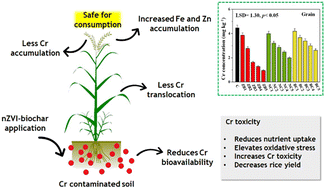
Chromium (Cr) contamination in soils of rice-growing regions poses a significant risk to both human health and the environment. Elevated Cr levels in soil reduce photosynthetic activity, induce oxidative stress, and limit rice plant growth. This work investigated the remediation of Cr-contaminated soil using bare nZVI (NC), biochar (BC), and biochar-supported nZVI (ZB) and examined their impacts on plant development, Cr uptake, and micronutrient (Zn and Fe) accumulation in rice grains. The result indicates that nZVI–biochar significantly reduced bioavailable Cr in soil [water-soluble (F1) = 71%, exchangeable (F2) = 73%, and oxide-bound (F4) = 64%], which is primarily transformed into unavailable forms. Therefore, the application of nZVI–biochar composites effectively inhibits Cr mobility in the soil. Also, Cr accumulation in rice grains was considerably reduced in the ZB addition (79%), as compared to the untreated soil. Although BC and NC alone improved plant performance in contaminated soil, their combination was more effective. The use of ZB, NC, and BC at 5000 mg kg−1 increased grain Fe content by 91%, 81%, and 51%, respectively. Additionally, biochar in ZB increased grain Zn by 34%, likely due to its low Zn sorption affinity, facilitating Zn transportation and accumulation. Overall, application of ZB at 5000 mg kg−1 enhanced rice growth, biomass, photosynthetic pigments, and antioxidant enzyme activity by decreasing Cr bioavailability in soil, which in turn reduced Cr uptake and translocation to rice grains. Hence, amending soil with a ZB composite may offer a promising approach for the safe utilization of Cr-contaminated sites in the future.
 Please wait while we load your content...


