


 PLATFORM UPDATE:


Electrocoagulation pretreatment for total phosphorus and boron removal in waste lubricating oil regeneration wastewater: efficiency and mechanism
 *a
*a
Abstract
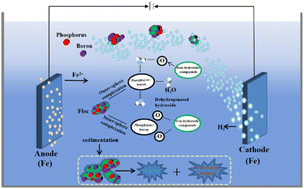
Waste lubricating oil regeneration wastewater (WLORW) contains a complex array of pollutants, such as organic oils, ketones, ethers, total phosphorus (TP), and boron (B), whose direct discharge poses significant environmental risks. While previous research has extensively addressed the removal of organic pollutants, oils, and chemical oxygen demand (COD), the treatment of TP and B—similarly harmful yet less studied—has received comparatively limited attention. This gap is particularly pressing in light of China's stringent discharge standards for TP in industrial wastewater. Consequently, this study investigated the efficiency of electrocoagulation as a pretreatment for simultaneously removing TP and B from WLORW on a laboratory scale, employing a two-stage methodology: operational parameters were first optimized using synthetic wastewater via an orthogonal experimental design, and then validated with actual wastewater. Under the identified optimal conditions (current density = 15 mA cm−2, initial pH = 7, electrode spacing = 2 cm, treatment time = 30 min), the process achieved removal efficiencies of 79.0% for TP and 13.5% for B from actual WLORW. The primary removal mechanism was identified as flocculant adsorption through both inner-sphere and outer-sphere complexation. Notably, the formation of vivianite within the flocs was observed, indicating a promising avenue for phosphorus resource recovery. Moreover, the hydrogen co-generated at the cathode presents an additional stream of reclaimable energy. In summary, this research provides valuable theoretical insight and practical guidance for scaling up WLORW pretreatment, thereby enhancing the recycling of used lubricating oils and contributing to environmental conservation.
 Please wait while we load your content...


