


 PLATFORM UPDATE:


A theoretical investigation on the photochemical performance of hybrid dye-sensitized solar cells based on Keggin-type polyoxometalates
 *a
and
*a
and
Abstract
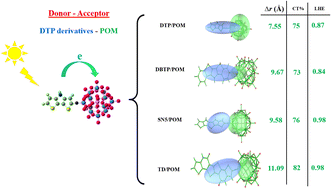
Polyoxometalates (POMs) are versatile inorganic compounds that can be integrated into hybrid materials due to their unique properties, which allow them to interact effectively with organic components. In this study, we designed a series of donor–acceptor (D–A) type hybrids in which dithieno[3,2-b:2′,3′-d] pyrrole (DTP)-derived building blocks served as donors and the Keggin-type POM acted as the acceptor moiety. The electronic structures, UV-visible absorption spectra, and photovoltaic properties of these hybrid compounds, along with their potential applications in n-type dye-sensitized solar cells, were investigated using density functional theory (DFT) and time-dependent DFT methods. Key parameters such as excitation energies (Ever), maximum absorption wavelengths (λmax), oscillator strengths (f), charge-transfer percentages, local excitation percentages, and Δr values for the principal molecular orbitals were systematically computed. To better understand intramolecular charge-transfer processes, natural transition orbitals and the charge density differences between the excited state and the ground state were analyzed. Research shows that among the 12 designed hybrid compounds, TD/POM, SN5/POM, DTP/POM, and DBTP/POM exhibited the highest Δr and CT charge values, making them the most effective sensitizers for dye-sensitized solar cells due to their superior LHE and high VOC.
 Please wait while we load your content...


