


 PLATFORM UPDATE:


Elimination mechanism of vanillin from non-phenolic β-O-4-type terminals formed in guaiacyl lignin: a combined kinetic and theoretical study

Abstract
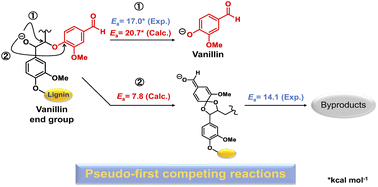
The alkaline aerobic oxidation of lignin to vanillin (4-hydroxy-3-methoxybenzaldehyde) has been employed as an industrial method for producing bio-based low-molecular-weight aromatic compounds. To deepen the molecular-level understanding of this reaction, we have been investigating the vanillin formation mechanism from native softwood lignin. One of the major reaction pathways involves oxidative degradation of β-O-4-type internal units, followed by alkaline-induced elimination of vanillin from the resulting vanillin end group. This study examined the reaction mechanism of a model compound, 4-[2-(3-ethoxy-4-methoxyphenyl)-2-hydroxy-1-(hydroxymethyl)ethoxy]-3-methoxybenzaldehyde, VEβ, which mimics the vanillin end group, in 4.0 mol L−1 aqueous NaOH, with particular focus on the formation pathways of vanillin and byproducts. VEβ rapidly formed an equilibrium mixture comprising various rearranged compounds, in which the vanillin residue had migrated to the α- and γ-positions of the side-chain via an acetal-type intermediate. Kinetic analysis based on a pseudo-first-order competitive reaction model revealed that this equilibrium mixture was consumed through two distinct pathways: vanillin elimination and side reaction accompanied by polymerization. The activation energy (Ea) for vanillin elimination was determined to be 17.0 kcal mol−1, which agreed moderately with the Ea value of 20.7 kcal mol−1 calculated by DFT(M06-2X) for the α-oxyanion-assisted elimination process. Although the details of the side reaction pathway remain unclear, the overall reaction followed pseudo-first-order kinetics despite the involvement of bimolecular steps, suggesting that the rate-determining step of the side reaction proceeds via a unimolecular process.
 Please wait while we load your content...


