


 PLATFORM UPDATE:


Recycling spent dry cells into rGO/MnO2 nanocomposites for advanced supercapacitor electrodes
 a
and
Sabina
Yasmin
*a
a
and
Sabina
Yasmin
*a
Abstract
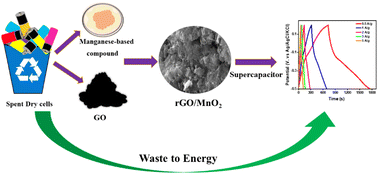
Electronic waste (e-waste) poses a pressing environmental challenge, with improper disposal leading to pollution, resource depletion, and ecosystem damage. In this study, we demonstrate a sustainable strategy to repurpose e-waste into high-performance supercapacitor materials. A reduced graphene oxide/manganese dioxide (rGO/MnO2) nanocomposite was synthesized entirely from spent dry cells through a cost-effective process. Structural and morphological analyses confirmed a porous nanostructure with a large accessible surface area, enabling efficient charge storage, rapid ion transport, and favorable electrochemical reversibility. Electrochemical testing in 1 M KOH revealed excellent performance, with a specific capacitance of 532 F g−1 at 1 A g−1, an energy density of 36.22 Wh kg−1 at a power density of 350 W kg−1, and 80% capacitance retention after 1500 cycles. Kinetic analysis indicated a hybrid charge storage mechanism involving both capacitive and diffusion-controlled contributions, with capacitive behavior becoming more dominant at higher scan rates. Impedance measurements further confirmed low charge-transfer resistance and rapid ion diffusion. This sustainable approach for converting e-waste into advanced supercapacitor electrodes demonstrates the potential of hybrid charge storage mechanisms in delivering fast, reversible, and durable energy storage.
 Please wait while we load your content...


