


 PLATFORM UPDATE:

Alkaline soil disintegration and organic nanocolloidal-dissolved U release under IPCC-based elevated CO2 conditions with global environmental risk implication
 *ac
*ac
Abstract
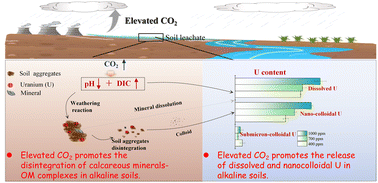
Alkaline soils sustain billions of people worldwide. These soils serve as vast uranium (U) reservoirs containing ppm levels of U. Elevated global CO2 (eCO2) levels may lead to the massive release of U from alkaline soils, posing a great environmental risk. However, the mechanistic responses of U release in alkaline soils to eCO2 are largely unknown. In this study, we investigated structural stability, U mobility, and phase partitioning in two alkaline soils under IPCC scenario-based eCO2 conditions using single-particle inductively coupled plasma mass spectrometry (SP-ICP-MS) and scanning electron microscopy with energy-dispersive X-ray spectroscopy (SEM-EDS) elemental mapping, in conjunction with U speciation analysis. Exposure to eCO2 resulted in substantial U release from both soils, dominantly in the dissolved phase (51.07–78.10%) and nanocolloidal phase (10.24–45.85%). Within nanocolloids, U was predominantly enriched in organic phases derived from disaggregated calcareous mineral–organic complexes. pH drop and DIC rise induced by eCO2 are crucial for U release. Reduced pH caused dissolution of cementing calcareous minerals and breakdown of mineral–OM complexes and, thus, the release of colloids, DOM and their associated U. Enhanced DIC under eCO2 resulted in an increase in UO2(CO3)34− but a decrease in UO2(CO3)22−, which promoted the release of dissolved U. These novel findings are helpful for gaining deep insights into U behavior and risk in soils in the context of future climate change and imply that future global climate change may drastically weaken soil health and amplify environmental risks of U, which is a global environmental and health concern that needs enough attention.
 Please wait while we load your content...


