


 PLATFORM UPDATE:

“Green” carbon dots from coffee waste for adsorption of xenobiotic and trace heavy metals in both aquatic and physiological media
 acd
Natalia
Pozdnyakova,
a
Artem
Pastukhov,
a
Liliia
Kalynovska,
a
Marina
Dudarenko,
a
Valeriy
Skryshevsky,
*bc
Vladimir
Lysenko
d
and
Tatiana
Borisova
ace
acd
Natalia
Pozdnyakova,
a
Artem
Pastukhov,
a
Liliia
Kalynovska,
a
Marina
Dudarenko,
a
Valeriy
Skryshevsky,
*bc
Vladimir
Lysenko
d
and
Tatiana
Borisova
ace
Abstract
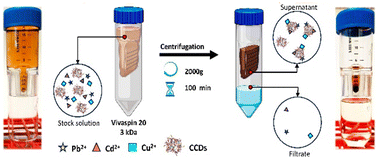
Xenobiotic and trace heavy metals such as Pb2+, Cd2+ and Cu2+, which abundantly pollute the environment, are hazardous neurotoxicants. Herein, the ability of “green” carbon dots from coffee waste (CCDs) to adsorb Pb2+, Cd2+ and Cu2+ in aquatic media and in biological systems, such as presynaptic rat cortex nerve terminals, was assessed. Using ICP-MS and DLS, it was demonstrated that CCDs were able to adsorb Pb2+, Cd2+ and Cu2+ in water, forming complexes with these metals. In animal experiments, CCDs, even at a high concentration of 2 mg ml−1, did not change the extracellular levels of the excitatory neurotransmitter L-[14C]glutamate and inhibitory one [3H]GABA in nerve terminal preparations, and so, CCDs are highly biocompatible. Combined application of CCDs with Pb2+, Cd2+ and Cu2+ resulted in a significant mitigation of the acute Pb2+/Cd2+/Cu2+-induced increase in the extracellular levels of L-[14C]glutamate and [3H]GABA in nerve terminal preparations. Therefore, CCDs did not possess neurotoxic effects and, due to their original synthesis methodology, were able to adsorb Pb2+, Cd2+ and Cu2+ in aquatic media and in biological systems, mitigating acute Pb2+/Cd2+/Cu2+-induced neurotoxicity in nerve terminals. CCDs have prophylactic and therapeutic potential to combat heavy metal poisoning. This study fits several key priorities in environmental science as a heavy metal adsorbent obtained from biowaste using an eco-friendly synthesis protocol has the potential to combat heavy metal poisoning in organisms and wastewater.
 Please wait while we load your content...


