


 PLATFORM UPDATE:


Interaction mechanism of BSA, Hb, and dsDNA with graphene oxide after visible light exposures: in vitro physicochemical properties and multi spectroscopic insights
 a
and
Man
Singh
*a
a
and
Man
Singh
*a
Abstract
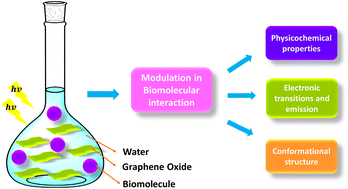
Graphene oxide (GO), a photoactive nanomaterial, is a versatile candidate that has gained attention for biomolecular interactions with promising applications in the biomedical field. However, the impact of light exposure in modulating the interactions between biomolecules and GO remains unexplored. Herein, we have investigated the change in interacting behaviour, electronic transitions, and conformational dynamics of bovine serum albumin (BSA), hemoglobin (Hb), and double-stranded DNA (dsDNA) with GO in aqueous medium after controlled visible light exposure (LE) for 0, 15, and 30 min. The synthesized GO was characterized with XRD, FTIR, Raman, TGA, SEM, HR-TEM, XPS, and AFM analysis. The aqueous solutions of 0.2–2.0 mg/100 mL@0.6 BSA, Hb, and dsDNA and with 2.5, 5.0, and 10.0 mg/100 mL GO were precisely studied for their interactive dynamics before and after LE. In vitro physicochemical properties (PCPs) like ρ, η, γ, σ, V2, ϕ, Rh, and ksϕ for the aforementioned systems at the physiological temperature of 310.15 K were determined to investigate the interacting profile of the biomolecules w.r.t. hydration sphere stability after LE. Meanwhile, UV-Vis, fluorescence, and circular dichroism (CD) spectroscopies have been employed to understand the modulations in electronic transitions and conformational structure, respectively. The observed trends and magnitudes of all the studied methodologies confirm that both LE and concentration of GO are key parameters affecting the interacting dynamics of biomolecules. Thereby, the integrated in vitro PCPs and multi spectroscopic approach advance the understanding of the visible light-triggered GO interaction with biomolecules, offering potential implications in photo-modulated biomedical applications.
 Please wait while we load your content...


