


 PLATFORM UPDATE:


Coexistence of isoenergetic Rashba and Dirac fermions on the surface of centrosymmetric topological insulator decorated with transition metals
 *de
*de
Abstract
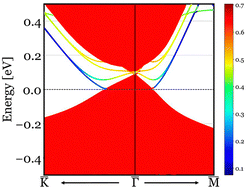
The Dirac cone originates from the bulk topology, yet its primary contribution comes from the surface since spatially, the Dirac state emerges at the boundary between the trivial and topological phases. At the same time, the Rashba states emerge in regions where inversion symmetry is broken. On the surface of the centrosymmetric topological insulators, both Rashba and Dirac bands are present and their hybridization produces the giant Rashba effect, modifying both Rashba's and Dirac's bands. Therefore, pure Rashba and Dirac fermions are inherently incompatible on the surface of centrosymmetric topological insulators if the material is homogeneous. Inspired by recent experiments, we focused on the (111) polar surface of PbSe, which becomes a topological crystalline insulator under compressive strain, and we established the conditions under which a topological system can simultaneously host pure Rashba and Dirac surface states close to the Fermi level. The coexistence of pure Dirac and Rashba dispersions at the same energy is only possible in a non-homogeneous centrosymmetric topological insulator, where the spatial origins of the two bands are effectively separated. In the experimentally observed case of PbSe, we demonstrate that a metallic overlayer induces a strong electrostatic potential gradient in the subsurface region, which in turn generates the electric field responsible for Rashba splitting in the subsurface layers. Consequently, in PbSe(111), the Rashba states arise from subsurface layers, while the Dirac states live mainly on the surface layers. Finally, we compare the properties of the Rashba in the trivial and topological phases; the calculated Rashba coefficient agrees qualitatively with the experimental results.
 Please wait while we load your content...


