



Transient interactions and local heterogeneity drive rotational–translational decoupling of nanorods in semidilute mucin solutions

Abstract
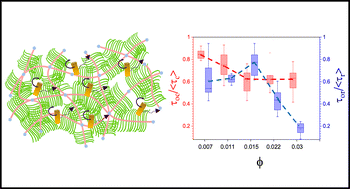
We investigated the rotational and translational dynamics of gold nanorods in semidilute solutions of bovine submaxillary mucin (BSM), a biologically relevant bottlebrush polymer rich in MUC5B. Using fluctuation correlation spectroscopy (FCS), we observe that both translational and rotational motions exhibit anomalous subdiffusion, with the corresponding exponents decreasing systematically with mucin concentration. Mean-square displacement (MSD) analysis reveals a clear crossover from short-time subdiffusion to long-time normal diffusion at low mucin levels, while persistent subdiffusion dominates at higher concentrations. Translational diffusion coefficients show only weak dependence on polymer volume fraction, whereas rotational mobility is markedly constrained, particularly at elevated mucin volume fractions. These results cannot be fully explained by conventional hydrodynamic or obstruction-based theories. Instead, we attribute the observed decoupling between translation and rotation to transient interactions between nanorods and mucin chains, combined with spatial heterogeneity in local polymer density and segmental dynamics. Our findings demonstrate how anisotropic probes can sensitively capture multiscale viscoelastic and structural features of complex biological polymer solutions.
- This article is part of the themed collection: Soft Matter Open Access Spotlight 2025
 Please wait while we load your content...


