


 PLATFORM UPDATE:


Wettability-gradient-driven capillary filling dynamics in architected tapered microchannels
 †a
Vinod B.
Vanarse
†*a
and
†a
Vinod B.
Vanarse
†*a
and
Abstract
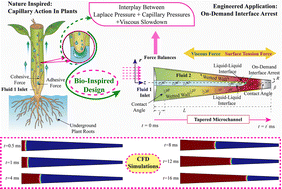
Capillary-driven transport is central to soft and biological matter, from plant-xylem water ascent to autonomous flows in microfluidic networks. Here, we systematically investigate autonomous capillary filling dynamics in microchannels combining geometric tapering and spatially variable wettability. Using high-resolution computational fluid dynamics (Navier–Stokes equations and the level-set method), we quantify the impact of stepwise, linear, and quadratic contact-angle profiles on the Laplace pressure, interface morphology, and flow velocity. For uniform channels and contact angles, the simulations reproduce the classical Lucas–Washburn regime, characterized by a viscous slowdown. In contrast, geometric tapering amplifies the capillary pressure gradient, sustaining or accelerating interface advancement. Tailored wettability gradients enable further control: decreasing the contact angle maintains flow, while increasing the angle toward 90° robustly halts motion, enabling on-demand interface arrest. These results reveal how geometric and interfacial patterning can be coupled for precision fluid manipulation, offering broadly applicable design principles for advanced passive microfluidic systems and programmable soft-matter transport.
 Please wait while we load your content...


