


A study on the spectroscopy of cis- and trans-formic acid upon ionisation
 *a
*a
Abstract
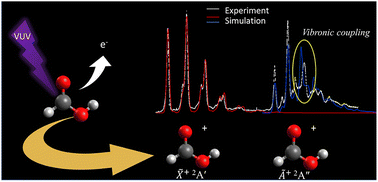
Using post-Hartree–Fock methods and, where appropriate, the time-dependent DFT approach, we investigated the electronic states of both the cis- and trans-HCOOH+ cations and the electronic ground state of the neutral HCOOH species. Then, we determined their equilibrium structures and vibrational frequencies. We also mapped the potential energy surfaces of the doublet cationic species along various internal coordinates. These potentials revealed the complex electronic structure of these cations due to vibronic couplings, resulting in the mixing of their electronic wave functions. Accordingly, only multiconfigurational approaches were valid for investigating them. Subsequently, the computational results were used to reassign the He I photoelectron and threshold photoelectron spectra of trans-HCOOH. We demonstrated that couplings between ionic doublet states induce complex vibronic features and predissociations. Furthermore, we predicted the photoelectron spectrum of cis-HCOOH and the electronic spectra of cis- and trans-HCOOH+. Our data could encourage new experiments to probe the vibronic couplings that we have identified, to improve our understanding of the state-to-state dynamics of cis- and trans-HCOOH+, and to help us to identify these cations in laboratory, astrophysical media, and planetary atmospheres.
- This article is part of the themed collection: Structure and dynamics of chemical systems: Honouring N. Sathyamurthy’s 75th birthday
 Please wait while we load your content...


