


 PLATFORM UPDATE:


Understanding CO2 adsorption on the surfaces of SrO and its hydroxylated variants Sr(OH)2·nH2O (n = 0, 1, 8)

Abstract
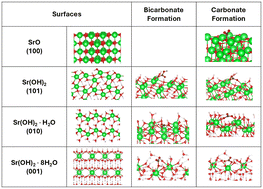
Strontium oxide (SrO) is a promising material for CO2 capture through a reversible cycle of carbonation and calcination, where SrO reacts with CO2 to form SrCO3 and can be regenerated by calcination. In the presence of moisture, SrO forms strontium hydroxide and its hydrates (Sr(OH)2·nH2O). This study, which employs density functional theory, investigates the CO2 adsorption mechanism of these processes on various crystal surfaces, including SrO, Sr(OH)2, Sr(OH)2·1H2O, and Sr(OH)2·8H2O. A significant finding is that the interaction of CO2 with these surfaces leads to carbonate/bicarbonate formation via electron transfer, with notable differences in CO2 orientation and bond characteristics between SrO surfaces and its hydroxylated surfaces. To explore the effects of moisture on CO2 adsorption, H2O adsorption on these stable surfaces was investigated. The results showed that H2O reacts with the SrO (100) surface to form hydroxyl (OH) groups while it bonds with the surfaces of Sr(OH)2·nH2O (n = 0, 1, 8) with hydrogen bonding. A small amount of H2O can enhance CO2 adsorption while a large amount of H2O could decrease the capability of CO2 adsorption.
 Please wait while we load your content...


