


Sigma-hole-supported interactions in complexes of group 5 oxyhalides (MOX3) with insights for their extended solids

Abstract
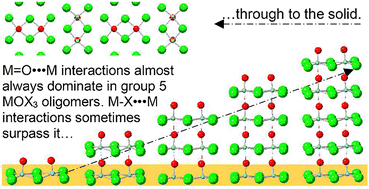
The existence and nature of sigma hole type interactions in inorganic extended solids remain largely unexamined, even though the influence of such interactions for heteroorganic compounds is well known. The series of group 5 MOX3 oxyhalides are intriguing in this regard since several of the known crystal structures are molecular solids with highly polarized M centers. We examine computationally the bonding in the isolated MOX3 molecules and their smallest clusters (MOX3)n where M = V, Nb, and Ta, and X = H, F, Cl, Br, and I. That investigation provides us with substantial evidence, based on patterns and quantitative trends exhibited in the bonding and energetics of the oxyhalide clusters, that several of the extended solids are stabilized by sigma-hole-supported M⋯O and more rarely M⋯X bonding interactions between the MOX3 molecules or dimers. In particular, one-dimensional stacks of doubly bridged, X2OMX2MOX2, dimer units in several of the oxyhalide crystal structures are shown to be propagations of sigma-hole-supported bonding interactions with weak charge transfer contributions that are already established at the level of the tetramer. Our results are in harmony with a more recent crystal structure for NbOCl3 over a much older proposal.
- This article is part of the themed collection: Celebration of the 70th birthday of Prof. Giuseppe Resnati
 Please wait while we load your content...


