
Arif Ali
Mandal†
a,
Saurav
Kumar†
b,
Srijan
Singh
a,
Apurba
Mandal
a,
Samya
Banerjee
*a and
Prodyut
Dhar
*b
aDepartment of Chemistry, Indian Institute of Technology (BHU), Varanasi, Uttar Pradesh 221005, India. E-mail: samya.chy@iitbhu.ac.in
bSchool of Biochemical Engineering, Indian Institute of Technology (BHU), Varanasi, Uttar Pradesh 221005, India. E-mail: prodyut.bce@iitbhu.ac.in
First published on 8th December 2025
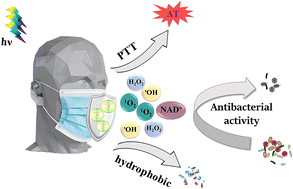
Four novel Ru(II)-photoantibiotics (Ru1–Ru4) were developed to produce infection-resistant self-cleaning mask coatings. These photoantibiotics eliminate bacterial infections by generating oxidative stress and photothermal effects upon exposure to visible light (400–700 nm) with tuneable surface hydrophobicity.
:
99, v/v) medium under light conditions (10 J cm−2, 400–700 nm) showed good photo stability up to 7.0 h (Fig. S16, SI). Ru1–Ru4 did not show any notable absorption change in a GSH (1 mM) solution under light, indicating their robustness to GSH (Fig. S17, SI). The photochemical/physical properties of Ru1–Ru4 were investigated using computational methods. The optimized structures of Ru1–Ru4 were in good agreement with the crystal structure of Ru4 (Fig. S18 and Tables S3–S6, SI). For Ru1–Ru4, the HOMO was partially on the Ru(II) centre, and the LUMO was concentrated mainly on the terpyridine moieties around the Ru(II) centre. TD-DFT calculation for Ru1–Ru4 predicted the electronic transitions within the complexes. Key findings obtained from these calculations are presented in Table S7, SI. TD-DFT calculations indicated the 1O2 generation ability of Ru1–Ru4. A minimum energy gap (ΔES–T) of 0.98 eV is required between the lowest singlet state (S0) and the lowest triplet state (T1) to generate 1O2.12 The ΔES–T values of Ru1–Ru4 were 2.20 eV, 1.95 eV, 2.17 eV, and 2.21 eV, respectively, which are much higher than 0.98 eV, validating the 1O2 generation ability of Ru1–Ru4 (Fig. S19, SI). This fact inspired us to investigate the 1O2 generation ability of Ru1–Ru4 using DPBF as a 1O2 probe8–10 in PBS–DMSO (99
:
1 v/v, pH = 7.0) solution (Fig. 2a, and Fig. S20, SI). Upon light irradiation, Ru1–Ru4 (2 µM) showed a decrease in DPBF (30 µM)-based absorbance. The 1O2 quantum yields (ΦΔ) of Ru1–Ru4 ranged from 0.09 to 0.15, using [Ru(bpy)3]Cl2 as a standard (ΦΔ = 0.22). Furthermore, the introduction of sodium azide (NaN3), a known 1O2 scavenger,13 inhibited the decrement of the DPBF-based peak, confirming the 1O2 generation ability of Ru1–Ru4 in the presence of light (Fig. S21, SI). 1O2 is known to damage bacterial cellular components like DNA, proteins, and cell membranes, ultimately leading to bacterial death.8–10 Upon light irradiation, Ru1–Ru4 (2 µM) showed a gradual decrease in the characteristic absorbance of MB (10 µM) (∼700 nm) (ca., 41%–58% within 50 s) in PBS–DMSO (99
:
1 v/v, pH = 7.0) solution, revealing the ˙OH production ability of Ru1–Ru4 (Fig. S22, SI). The ˙OH generation ability of Ru1–Ru4 was validated using MB degradation in the presence of tert-butanol, a ˙OH scavenger.14 In the presence of tert-butanol, Ru1–Ru4 + light showed no change in absorbance of MB, confirming that the MB degradation in Ru1–Ru4 + light is specifically due to ˙OH generation (Fig. S23, SI). NADH plays a crucial role as an electron donor in cellular redox processes in bacteria, producing ATP for survival.15 Its oxidation to NAD+ disturbs the bacterial redox equilibrium and metabolic activity, impairing energy generation.15 Therefore, the NADH oxidation ability of Ru2 in the presence of light was investigated using UV-Vis. spectroscopy by monitoring characteristic bands of NADH and NAD+ in a PBS-DMSO (99
:
1, v/v) solution.9Ru2 (2 µM) did not change the absorption spectra of NADH (180 µM) in the dark (Fig. S24, SI). However, under light, Ru2 gave a turnover frequency (TOF) of 40.5 ± 4.8 h−1 for NADH photo-oxidation (Fig. 2b). This photo-oxidation of NADH by Ru2 might contribute to its aPDT activity via in-cell NADH oxidation.2 Furthermore, upon light irradiation, Ru2 generated H2O2 in the presence of NADH (Fig. 2b), promoting ROS generation via the type I pathway. This observation matches well with previous reports.2,13 Thus, this series of Ru(II) complexes may have prospects in aPDT, through the dual mode of ROS generation, i.e., type I and type II pathways.
Ru1–Ru4 demonstrated significant antibacterial activity against both Gram-positive (S. aureus) and Gram-negative (E. coli) bacteria under dark and light conditions (Figs. S25, S26; Table S8, SI). The ZOI increased with concentration, confirming dose-dependent activity. Under white light, Ru3 (0.5 µg mL−1) showed the highest ZOI against S. aureus (0.92 cm), while Ru2 (0.5 µg mL−1) was most effective against E. coli (0.60 cm). Additionally, assays performed under green light irradiation showed lower ZOI (Fig. S27 and Table S9, SI). Furthermore, minimum inhibitory concentrations (MICs) of Ru1–Ru4 were evaluated against both E. coli and S. aureus in the presence of light and dark (Fig. S28, S29, and Table S10, SI). The MIC in light conditions is lower compared to dark conditions, reflecting strong antimicrobial potency even at low doses in the presence of light. The MIC further showed a similar response for Ru1–Ru4, ranging from 0.05 to 0.09 µg mL−1. Ru1 and Ru2 exhibited the lowest MIC of 0.05 µg mL−1 for S. aureus and 0.06 µg mL−1 for E. coli, respectively (Table S10, SI). MIC under green light conditions was higher than the white light irradiation, with the lowest MIC for G(+) being 0.07 µg mL−1 for Ru1 and Ru2, whereas the lowest MIC for G(−) was 0.07 µg mL−1 for Ru2 and Ru4 (Fig. S30 and Table S11, SI). To further confirm the antibacterial activity and its mechanism, a bacterial membrane lysis assay was performed. The membrane lysis and nucleic acid release by the microbes in the presence of Ru1–Ru4 were measured by monitoring the absorbance at 260 nm under white light conditions and green light (Fig. 2c and Fig. S31 and S32, SI). The most prominent effect was observed for Ru2 and Ru3, where the OD reached approximately 1.3 after 120 min at 0.5 µg mL−1, indicating extensive cell lysis. This effect was both dose and time-dependent, indicating that photoactivated Ru1–Ru4 generated ROS, which were capable of compromising membrane integrity, leading to bacterial cell death.8–10Ru1–Ru4 showed slightly higher sensitivity against G(+) (S. aureus) compared to G(−) (E. coli), due to differences in cell wall composition and permeability of the two groups.16 Moreover, the biofilm inhibition assay of Ru2 was studied against S. aureus in both light and dark conditions. This result demonstrated a dose-dependent inhibition of the bacterial biofilm in the presence of light where at 0.25 MIC, inhibition reached ca. 58%, which is only ca. 5% in the dark, and the effect intensified at higher concentration (98–100%) at MIC and 2MIC under light, while samples not treated with light showed inhibition at ca. 42–50% (Fig. 2d). Overall, these results demonstrate that Ru(II)-complexes, particularly Ru2, exhibit strong light-activated antibacterial activity.9,17 Therefore, coating Ru2 on surgical masks could offer localized, on-demand antimicrobial protection using light-triggered ROS generation, providing a promising strategy for next-generation infection control. The Ru2 was sprayed on the mask matrix to form a photoactive coating (Ru2-CM). The antimicrobial properties of the Ru2-CM showed significant reduction of bacterial load for both G(−) and G(+) bacteria under light (Fig. 3a) compared to dark conditions, as evidenced by the reduced CFU/mL of 1.2 × 10⁶ (E. coli) and 4 × 10⁵ (S. aureus) under light illumination, which was 1.6 × 10⁶ for S. aureus and 3.2 × 10⁶ for E.coli under dark conditions at MIC concentration. The reduction of CFU/mL is noticeable at concentrations below and above the MIC (Table S12, SI). This enhanced antibacterial property is attributed to the immobilization of photo-responsive Ru2, as also observed in the SEM images of Ru2-CM. The surface morphology of Ru2-CM, as examined using SEM, showed that it retains the pristine fibrous nature of the mask while exhibiting a uniform deposition of the Ru2 on the fibre, confirming effective interaction (Fig. 3b). The photo-responsive nature of Ru2 is examined by thermal imaging of Ru2-CM under light irradiation, showing a rapid rise in temperature to ∼44.8 °C within 5 min, demonstrating efficient photothermal effect (Fig. 4a, b and Fig. S33, SI), where the Ru(II) complex absorbs incident light energy through metal-to-ligand charge transfer (MLCT) transition and non-radiatively dissipates the absorbed energy as localized heat. The reversible temperature fluctuations across multiple light-on/off cycles indicate dynamic and stable photoactivation behaviour, even at low concentration of coating (0.25 MIC). The minimal loading of Ru2 reduces the risk of toxicity and allows targeted clinical application while maintaining the therapeutic impact. Furthermore, contact angle measurements revealed a light-dependent alteration in surface wettability exhibiting hydrophobic characteristics. Ru2-CM displayed a higher contact angle (131.5 ± 0.1°) under light illumination, whereas the contact angle is lower under dark conditions (∼122.8 ± 0.3°) at the MIC concentration (Fig. 4c). The variation of contact angle with time and light illumination was evaluated for the MIC- and 2MIC-coated Ru2-CM (Fig. S34, SI). The initial contact angle was 123.6 ± 0.2° (MIC) and 131.3 ± 0.3° (2 MIC), which gradually decreased over repeated measurements due to water absorption. After four cycles in the dark, the contact angle decreased 116.2 ± 0.5° (MIC) and 113 ± 0.6° (2 MIC), while under illumination, a higher contact angle of 117.5 ± 0.4° (MIC) and 124.5 ± 0.3° (2 MIC) (Fig. S35, SI) was retained, confirming light-induced modulation of the surface wettability. The hydrophobic coating prevents the penetration and accumulation of pathogen droplets. Additionally, the self-cleaning property allows droplets to roll off the mask surface, removing contaminants and ensuring surface hygiene. The incorporation of Ru2 into Ru2-CM imparts synergistic photothermal and photodynamic properties, enabling light-triggered antimicrobial activity, attributed to the combined effects of localized photothermal heating, dynamic modulation of surface energy, and surface hydrophobicity, which together minimize bacterial adhesion while sustaining efficient photoactive disinfection. The enhanced bactericidal efficacy is further attributed to intracellular NADH photo-oxidation-mediated ROS generation by Ru2.
In summary, a series of novel Ru(II)-polypyridyl-based photo-antibiotics (Ru1–Ru4) were synthesized and characterized, and their antibacterial efficacy was investigated under visible light exposure against both G(+) and G(−) bacteria. The UV-Vis. spectra of Ru1–Ru4 suggested their ability to absorb light in the visible region. Among these, Ru2 showed better activity in the presence of light due to high ROS generation (via type I & type II pathways) and efficient catalytic NADH photo-oxidation. In vitro studies revealed that Ru2 + light showed antibacterial efficacy against E. coli and S. aureus. The Ru2 was further coated onto a surgical mask (Ru2-CM) to create a photo-responsive antibacterial interface capable of self-sterilization under visible light. The Ru2-CM mask exhibited strong antibacterial properties through ROS-mediated membrane disruption and oxidative damage, effectively preventing bacterial adhesion while maintaining the mask's breathability and durability. The antibacterial coating of Ru(II)-based PSs on face masks could be a promising light-assisted antibacterial approach for reducing bacterial infections. Further in-depth studies are still needed to coat these photosensitive agents for health protection applications in the future.
This work was supported by the SERB (now ANRF), India (SRG/2022/000030) and (BT/HRD/35/02/2006) DBT, India. A. A. M. and A. M. thank the GOI for the PMRF. S. K. thank the Ministry of Education, India for its provision of financial support. P. D. thanks DBT, GOI for the Ramalingaswami and IYBA fellowship. P. D. acknowledges the research grant received from DST and Ministry of Textiles, GOI.
CCDC 2499129 contains the supplementary crystallographic data for this paper.18
Footnote |
| † Equal contribution. |
| This journal is © The Royal Society of Chemistry 2026 |