


Effects of substrate orientation and oxygen partial pressure on the growth of Ga2O3 films and the performance of solar-blind ultraviolet photodetectors

Abstract
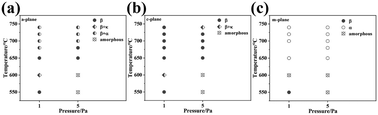
With an ultrawide bandgap, gallium oxide (Ga2O3) emerges as a promising semiconductor for next-generation solar-blind ultraviolet photodetectors (SBPDs) owing to its high DUV absorption coefficient. The epitaxial growth of Ga2O3 films is essential for the performance of SBPDs. Herein, we experimentally demonstrate the impact of the orientation of the sapphire substrate (c-, a-, and m-plane sapphires) and oxygen partial pressure (p(O2)) on the epitaxial growth of Ga2O3 films via pulsed laser deposition (PLD). Systematic measurements are used to characterize the phase composition, surface morphology, oxygen vacancy concentration, and optical properties of Ga2O3 films on various substrates. It is determined that the phase compositions of films grown on various substrate orientations have significant differences. Meanwhile, this work indicates that oxygen partial pressure serves as a critical parameter in the PLD method. The films exhibit higher crystallinity and smoother morphology when the p(O2) is lower. Moreover, the solar-blind UV detectors fabricated based on lower p(O2) samples exhibit a higher photocurrent reaching 10−4 A due to the higher oxygen vacancy concentration. The responsivities of these detectors reach 308.94, 329.52, and 319.17 A W−1, respectively, which are two orders of magnitude greater than those of detectors based on higher p(O2) samples. This study provides valuable guidance for heteroepitaxy of Ga2O3 and the further development of Ga2O3 based SBPDs.
 Please wait while we load your content...


