


 PLATFORM UPDATE:

Structural adaptation in a cadmium–porphyrin MOF through solvent-driven change of interpenetration
 *a
and
Tomasz
Poręba
*b
*a
and
Tomasz
Poręba
*b
Abstract
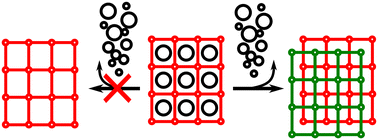
Cadmium–porphyrin metal–organic frameworks combine the structural rigidity of the porphyrin core with the coordination flexibility of closed-shell Cd2+ centres, enabling diverse framework topologies and versatile applications. Here, we report a single-crystal-to-single-crystal transformation in a CdCl2–meso-tetra(4-pyridyl)porphyrin (H2TPyP) MOF induced by mild thermal desolvation (120 °C in air). The solvated MOF (UB-MOF-1) adopts a non-interpenetrated CdSO4-type topology stabilized by 1,1,2,2-tetrachloroethane and 3-chloroaniline guests. Upon solvent removal, the framework undergoes irreversible drastic rearrangement to a two-fold interpenetrated cds-type network (ESRF-MOF-1), accompanied by more than a twofold reduction in accessible pore volume. Periodic DFT calculations show that, while guest inclusion substantially stabilizes the open framework UB-MOF-1, the interpenetrated, solvent-free ESRF-MOF-1 is thermodynamically favoured over the hypothetical empty UB-MOF-1 as interpenetration provides even greater stabilization. The transformation, driven by framework densification, is irreversible due to geometric pore constraints. This study demonstrates how controlled solvent manipulation can trigger topology changes in porphyrin-based MOFs, offering a route to design dense, structurally locked architectures with tailored accessibility.
 Please wait while we load your content...


