


Advanced n-type ionic hydrogel with simultaneously enhanced thermoelectric and mechanical performances via the synergy of hydrophilic and hydrophobic polymers

Abstract
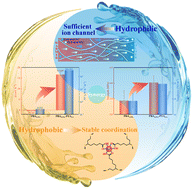
Ionic thermoelectric (i-TE) gels are considered as promising candidates for wearable electronics as they are green and flexible, and directly convert low-grade waste heat into electricity. However, the comprehensive performance of n-type i-TE gels reported so far lags far behind the p-type owing to multiple conflicts among negative thermopower, ionic conductivity, strength, and toughness, hindering large-scale applications. Here, based on the good biocompatibility of polyvinyl alcohol (PVA) and poly(thioctic acid) (PTA), a bio-inspired design of a hydrophilic–hydrophobic dual network structure is developed for the first time to enhance the TE and mechanical properties simultaneously. The PTA undergoes stable coordination interaction with cations, while the PVA provides sufficient paths for anions; also, the dual network structure contributes to the mechanical properties. With the synergy of hydrophilic PVA and hydrophobic PTA, the optimized ionic hydrogel exhibits giant negative thermopower (−16.68 mV K−1), excellent ionic conductivity (1.084 S m−1), low thermal conductivity (0.36 W m−1 K−1), high tensile strength (>4 MPa), huge elongation at break (>1300%), and superb toughness (>31 MJ m−3) in an ambient environment, representing the best research until now on n-type i-TE gels with such excellent TE and mechanical properties, comparable to the state-of-the-art p-type. Besides, the i-TE hydrogel also presents application potentials in temperature sensors and thermoelectric generators. This work creates a new milestone in advanced n-type i-TE gels by the synergy of various polymer–ion interactions.
 Please wait while we load your content...


